Poor sleep affects your mood, your stress response and your thinking, and mental health problems make sleep harder. The link runs both ways, which is why fixing one usually means looking at both. Below is how that connection actually works, the signs worth noticing, and what helps.
This is general information rather than medical advice. If sleep or mood changes are interfering with your daily life, a doctor or mental health professional can assess what is going on in your case, and that conversation is usually faster than people expect.
As of 2026, the guidance on the hours adults need and the sleep-mental health link has stayed remarkably consistent across the NIH, the NHS and major mental health charities, even as the research underneath it has grown.
Table of Contents
- How Sleep Affects Mental Health: A Clear Guide
- Why Sleep Changes Mood, Stress, and Thinking
- How Sleep Affects Mental Health Through the Body
- What Happens When You Do Not Get Enough Sleep?
- Warning Signs That Sleep May Be Affecting Your Mental Health
- Which Sleep Problems Can Affect Mental Health?
- How Much Sleep Do Adults Generally Need?
- What Can You Do to Support Sleep and Mental Health?
- When Should You Seek Help for Sleep or Mental Health Problems?
- Frequently Asked Questions
- Can poor sleep cause depression and anxiety?
- Can mental health problems affect sleep?
- How long does it take to feel better after improving sleep?
- Are sleep trackers accurate enough to diagnose a problem?
- Should I take a sleeping pill or sleep aid for stress-related insomnia?
- When is insomnia serious enough to see a doctor?
- Conclusion: Start With One Small Sleep Change
How Sleep Affects Mental Health: A Clear Guide
Sleep affects mental health through two main routes. It changes the brain’s emotional and stress systems, and it changes how rested you are for everyday coping. Sleep loss does not create a mental health condition on its own, but it reliably worsens mood, sharpens anxiety reactions and weakens the attention and self-control you need to handle a hard day.
The pattern of sleep matters as much as the total. Here is what the research tends to find for the most common problems, drawing on the sleep-mental health literature covered by the Sleep Foundation, Stanford Medicine and the National Heart, Lung, and Blood Institute.
| Sleep pattern | What it tends to do to mood and thinking |
|---|---|
| Not enough sleep, night after night | Irritability, lower mood, reduced emotional control, weaker concentration and motivation |
| Irregular or shifting schedule | Trouble falling asleep, grogginess, circadian rhythm disruption, feeling detached from the day |
| Enough hours but waking often | Unrefreshing sleep, daytime tiredness, poorer attention even though time in bed looks fine |
| Sleeping much more than usual | Can be a symptom of low mood, and it often brings guilt and self-criticism on top |
| Later bedtime than planned, most nights | Bedtime procrastination, reduced sleep opportunity, next-day fatigue |
One night of bad sleep is not a mental health event. The concern builds when short, broken or mistimed sleep is the pattern, because that is the situation the research links to a higher likelihood of depression and anxiety symptoms over time.
Mind, the UK mental health charity, puts it simply: there is a close relationship between sleep and mental health, and living with a mental health problem can affect how well you sleep. That framing is more useful than treating either one as the single cause.
Why Sleep Changes Mood, Stress, and Thinking
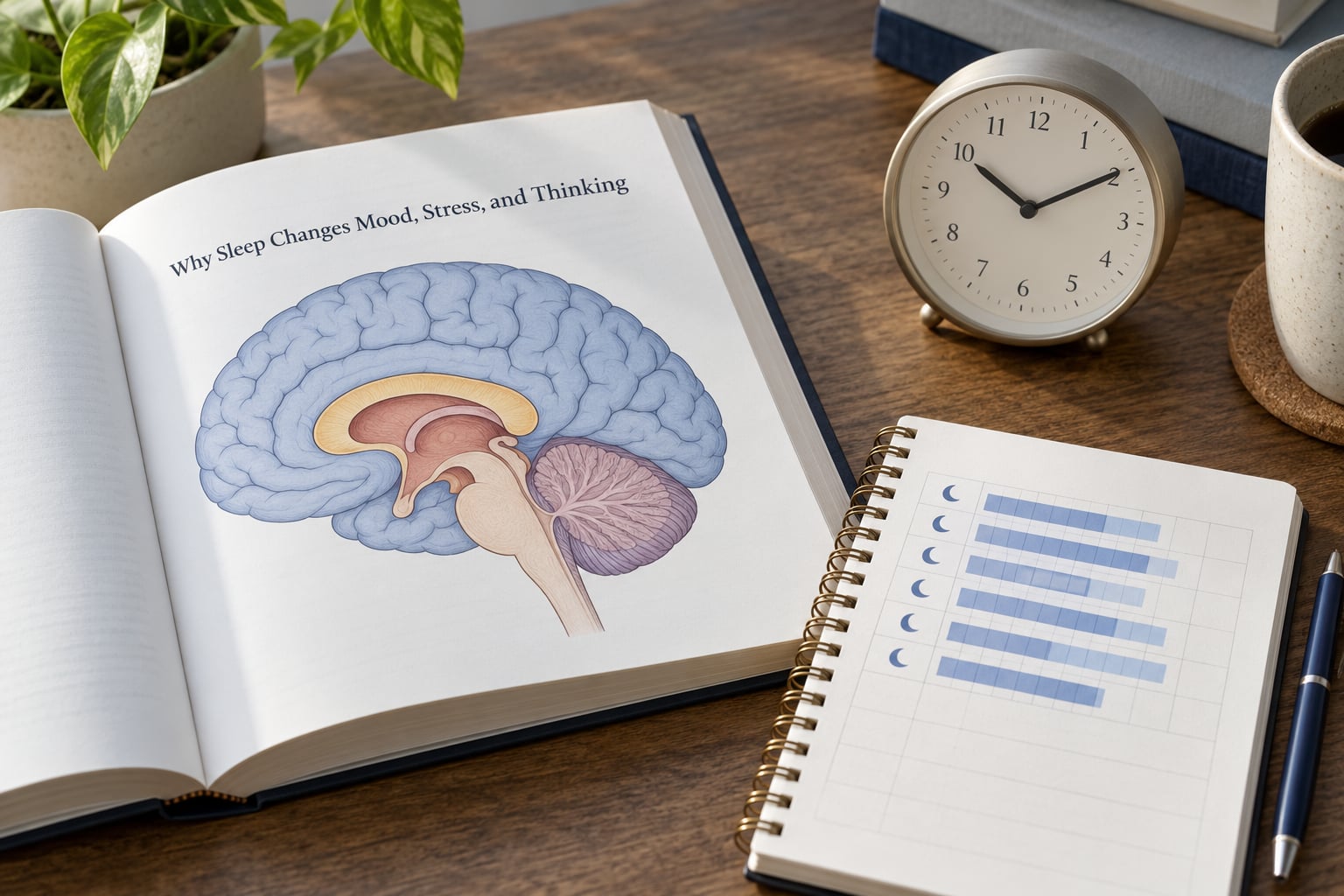
Sleep is not an off switch. It is an active period when the brain sorts out the day, and several named mechanisms explain why skipping it changes how you feel.
- Amygdala reactivity. Deep sleep helps keep the amygdala, the brain’s threat-detection system, calibrated. Sleep-deprived people show stronger and faster responses to emotional faces, which is part of why small annoyances land hard.
- Prefrontal cortex function. The region behind judgement, planning and impulse control is less responsive after short sleep. That shows up as snap decisions and a shorter fuse.
- REM sleep and emotion processing. REM sleep is when the brain replays emotional experiences with the chemical charge dialled down, which appears to help reduce the emotional weight of the day’s events.
- Cortisol and the stress response. The stress hormone follows a rhythm tied to sleep. Disrupted sleep flattens that rhythm, so the body stays closer to a stress-ready state through the day.
- Memory consolidation. Sleep helps move new learning into longer-term storage. When it is cut short, the day feels hazier and mistakes feel more obvious.
- Emotional regulation and hyperarousal. People with insomnia often describe a state of being switched on, where they notice and monitor their own body and alertness instead of drifting off.
Harvard Health notes that clinicians once viewed sleep disorders mainly as a symptom of a psychiatric disorder, and that the evidence has complicated that view. Sleep problems can precede, accompany and follow mental health conditions.
It is worth being honest about the limits here. Most of this evidence comes from observational studies and from experiments that restrict sleep in volunteers, so it shows association and short-term effects clearly. Researchers still debate exactly how much poor sleep causes a condition on its own, and how much reflects other factors.
How Sleep Affects Mental Health Through the Body
The connection is not only psychological. Sleep appears to support immune function, regulate inflammation, help control metabolism and let tissues recover from the day’s wear. When those systems run on short sleep, the physical load shows up as daytime fatigue, cravings, brain fog and a general sense of being stretched thin.
Harvard Health and Stanford Medicine both describe sleep as one of the few drivers of mental health symptoms that people can actually change. That is the hopeful part of this article: sleep is a lever, and pulling on it can help.
What Happens When You Do Not Get Enough Sleep?
One short night is genuinely useful to know about, because it shows how much the system can wobble before anything breaks. Sleep researchers call a single night of restricted sleep deprivation, and it produces predictable effects within about 24 hours.
The next day typically brings a shorter temper, a heavier mood, more emotional reactivity to small things, slower reaction time, and more effort for simple tasks that would normally be automatic. People report wanting more sugar and more stimulation, and finding it harder to stop eating late.
Over weeks and months, the accumulated version matters more. Poor sleep is consistently associated with a higher likelihood of developing and worsening depressive and anxiety symptoms, reduced resilience during a crisis, and lower motivation to keep up routines, exercise and relationships.
I’m afraid lack of sleep is going to ruin my life.
That worry came up again and again in Reddit discussions about sleep, according to the community research behind this article. The fear is common and it is worth naming: short-term irritability is not the same as permanent damage, and the fixes usually start with sleep itself, not with reassurance.
The reverse also holds. People sleeping far more than usual during a depressive episode often describe it as the only way to stop thinking, which is one reason oversleeping deserves attention in its own right rather than being treated as laziness.
Warning Signs That Sleep May Be Affecting Your Mental Health
Sleep problems and mental health symptoms influence each other, so noticing one is not proof of the other. These signs suggest it is worth paying attention, and worth raising with a professional.
- Mood shifts that track your sleep week to week, including a noticeably flatter or more irritable version of yourself after a short night.
- Shorter tolerance for stress, where problems that used to be manageable now feel bigger.
- Difficulty concentrating, brain fog, or mistakes at work or school that feel out of character.
- Loss of motivation, especially for things you normally enjoy.
- A pattern of dreading bedtime, or lying there monitoring whether you are falling asleep. People on Reddit describe this in almost identical words: they notice the moment they are drifting off and the noticing wakes them up again.
- Waking at 3am with a racing heart and a sense of dread that fades once the day starts.
- Using sleep as an escape, whether that is oversleeping or spending far longer in bed than you intend to.
- Pulling away from people, because sleep debt makes socialising feel like too much.
People also ask whether they are depressed or simply exhausted. There is a rough distinction worth naming: exhaustion from short sleep usually clears after a night or two of normal sleep, whereas low mood, loss of interest and hopelessness tend to persist across rested days. That is a clue, not a diagnosis.
One Reddit thread about the anxiety-insomnia loop put it plainly: it is brutal that anxiety causes insomnia, and then lack of sleep makes the anxiety worse. Recognising that loop is often the first step to breaking it.
Which Sleep Problems Can Affect Mental Health?
Different sleep problems tend to land on mental health in different ways, and knowing which pattern you have helps you describe it to a clinician.
- Insomnia. Trouble falling asleep, staying asleep or waking too early, with daytime effects. The most common sleep complaint, and the one most closely tied to depression and anxiety in the research. In people with insomnia, mental health conditions are also more common, which is why clinicians look at both.
- Sleep apnea symptoms. Loud snoring, gasping or choking during sleep, morning headaches and unrefreshing sleep. Repeated oxygen dips fragment sleep, and untreated apnea is associated with mood, concentration and irritability problems.
- Restless legs and periodic limb movements. The uncomfortable urge to move the legs at rest, worse in the evening, which delays sleep onset and causes iron-related problems in some people.
- Circadian rhythm disruption. Night-shift work, irregular hours or a body clock that has drifted. This produces the same core complaints as insomnia but from a different cause, and shift workers often also describe daytime sleepiness that makes depression harder to spot.
- Nightmares and night terrors. Repetitive frightening dreams, or episodes of screaming with no awareness, which fragment sleep and can build a fear of the bedroom itself.
- Early morning waking. Waking hours before your alarm and being unable to return to sleep. People with depression describe this pattern more than any other.
- Hypersomnia. Sleeping much more than needed during a depressive episode, and the guilt that comes with it. One account quoted on Mind described sleeping 18 hours a day at the worst point, because it was the only way to stop thinking.
Diagnosing any of these needs a proper clinical assessment, and sleep apnea in particular usually needs a sleep study. A wearable or an app cannot tell you which of these you have.
How Much Sleep Do Adults Generally Need?
Most adults generally need seven to nine hours a night, and US health bodies including the National Sleep Foundation and the American Academy of Sleep Medicine use that range as their standard guidance. Teenagers generally need eight to ten hours, and school-age children nine to twelve.
| Group | Generally recommended sleep per 24 hours |
|---|---|
| Adults aged 18 and over | 7 to 9 hours |
| Teenagers aged 13 to 17 | 8 to 10 hours |
| School-age children aged 6 to 12 | 9 to 12 hours |
Those are ranges, not targets. Individual needs differ, and being slightly outside them is not a problem in itself.
Catching up at the weekend feels good and does reduce sleep debt a little, but it does not fully undo it, and it can shift your body clock so Sunday night becomes hard. A consistent schedule generally does more for mood than an occasional long lie-in.
Please do not turn time in bed into a score you grade yourself on. People in the community discussions we reviewed were clear that the pressure to perform at sleep was making the anxiety worse, not better.
What Can You Do to Support Sleep and Mental Health?
These steps are low-risk and worth trying for a few weeks before you judge them. None of them replaces treatment for an existing condition, and if insomnia has been going on for months, sleep hygiene alone often is not enough.
- Keep a steady wake-up time. Get up within the same half-hour every day, weekends included. It is the single most reliable anchor for your body clock.
- Get morning light. Outdoor light soon after waking tells your circadian rhythm the day has started and makes falling asleep easier that night.
- Move caffeine earlier. Caffeine stays in the body for hours. Cutting off after midday is easier to judge than trying to cut it out.
- Do not use alcohol as a sleep aid. It shortens time to sleep and fragments the second half of the night, which is where most of the recovery happens.
- Make the bedroom boring. Quiet, dark, cool, and reserved for sleep rather than work or scrolling. If you are awake and frustrated for a while, get up and do something dull in dim light, then return when sleepy.
- Build daytime movement. Regular exercise, particularly earlier in the day, is one of the few things community members consistently reported as helping. It takes the edge off tension and it deepens sleep.
- Keep a two-week sleep diary. Note when you get in bed, when you estimate you fell asleep, when you wake and when you get up. It is genuinely useful at an appointment, and writing it down also loosens the monitoring habit.
- Stop measuring yourself constantly. Sleep trackers estimate movement and heart rate, not sleep quality or mental health. Constant checking feeds the same worry loop you are trying to escape.
Some things tend not to help much, and being straight about that saves weeks. Sleep supplements and over-the-counter aids often do nothing for a mind that cannot switch off. Going to bed earlier when you are not sleepy just adds hours of lying awake, which is where many insomnia loops start.
Mind lists one more pattern worth naming: getting into bed late on purpose because the day is over and it is the only time that belongs to you. That is different from insomnia, and the fix is a better boundary around the evening rather than a sleeping pill.
When Should You Seek Help for Sleep or Mental Health Problems?
Talk to a doctor or a qualified mental health professional when sleep problems last more than a few weeks, when they interfere with work, study or relationships, or when they come with lasting mood changes, panic, or a loss of interest in things you used to enjoy.
Some patterns deserve a faster appointment rather than a wait-and-see approach: sleeping very little for several nights without feeling tired, severe agitation, hearing or seeing things others do not, and any talk of harming yourself or not wanting to be alive.
If any of that last group applies to you right now, contact the 988 Suicide and Crisis Lifeline in the US by calling or texting 988, or go to your nearest emergency department. Outside the US, contact your local emergency number or a crisis line in your country. Do not wait for a sleep appointment before getting support for this.
What happens after you book? A doctor will ask about your sleep pattern, mood, medications and any other conditions, and may complete a screening questionnaire. Depending on what they find, they may refer you to CBT-I, the recommended first-line treatment for chronic insomnia, or to a sleep clinic for assessment and possible sleep testing. A referral to a mental health professional may be part of that too.
That process is more concrete than most people expect. Community members who had sleep problems confirmed and treated described it as the point where the anxiety loop finally loosened.
Frequently Asked Questions
Can poor sleep cause depression and anxiety?
Poor sleep is consistently linked to a higher likelihood of depression and anxiety symptoms, and it reliably makes existing symptoms worse the next day. It is not a cause on its own in every case, since other factors matter and the research is largely observational. The practical takeaway is that sleep is one of the few drivers of mental health symptoms you can change, so it belongs in any treatment plan alongside professional support.
Can mental health problems affect sleep?
Yes. Anxiety causes hyperarousal and a body that will not power down, while depression commonly brings early morning waking or the opposite problem, sleeping far too much. Trauma, bipolar disorder and psychosis each have their own sleep signatures too. This two-way pattern is why clinicians assess sleep and mental health together rather than treating either one as the sole cause.
How long does it take to feel better after improving sleep?
Mood often shifts within a week or two of getting more consistent sleep, though people frequently notice the change as calmer rather than happy. Restoring sleep does not treat a mental health condition on its own, so improvements can plateau or feel uneven. Anyone whose low mood, hopelessness or panic continues for more than a couple of weeks should speak with a doctor or mental health professional rather than waiting for sleep to fix it.
Are sleep trackers accurate enough to diagnose a problem?
Consumer wearables estimate sleep stages from movement and heart rate, so they are useful for spotting patterns over weeks but they cannot diagnose insomnia, sleep apnea or a circadian rhythm disorder. Diagnosis needs a clinical assessment, questionnaires and, for apnea, a sleep study. Constant checking can also feed the anxiety loop, so a rough weekly trend is usually more helpful than a nightly score.
Should I take a sleeping pill or sleep aid for stress-related insomnia?
Speak to a doctor or pharmacist before taking anything for sleep, including over-the-counter aids and melatonin, especially if you take other medication or have a health condition. For chronic insomnia, CBT-I is the recommended first-line treatment and works better over time than sleep medication. Nothing you take by yourself will switch off a mind stuck in hyperarousal, which is the core of most stress-related insomnia.
When is insomnia serious enough to see a doctor?
See a doctor if insomnia lasts more than a few weeks, affects your work, study or relationships, or comes with low mood, panic or losing interest in things you enjoy. Go sooner if you sleep very little for several nights without feeling tired, or if you are hearing or seeing things others do not. Seek urgent help through 988 or local emergency services if you have thoughts of harming yourself.
Conclusion: Start With One Small Sleep Change
Sleep and mental health move together in both directions. Short, broken or mistimed sleep changes mood, stress response and thinking, and anxiety, depression and trauma change how you sleep, and each one feeds the other.
Pick one thing this week rather than all of them. A fixed wake-up time, morning daylight or an earlier caffeine cut-off are the three that tend to hold up best, because they are easy to keep when motivation is low.
If sleep or mood has been a struggle for more than a few weeks, book an appointment rather than waiting it out. You do not have to work out which is causing which first, and that conversation is where a plan usually starts.