Memorizing a poem means committing its exact lines to long-term memory so you can say them out loud on demand, with nothing in front of you. If you have searched for how to memorize a poem and why it helps, the short answer is this: understand the poem, cut it into small meaningful pieces, then practice recalling it rather than rereading it, spread across days instead of crammed into one night.
The benefits are real but modest, and worth stating plainly. Memorizing poetry builds vocabulary in context, trains sustained attention, and gives you something exact to say at the moment you need words. It is not a treatment for anything and it will not make you a genius, but people who learn poems by heart tend to stay in touch with the words for decades.
Timelines are more forgiving than most people assume. A short lyric takes a few days. A Shakespearean sonnet takes a couple of weeks of short sessions. A page of Whitman is a month-long project, and a month is a perfectly good length of time.
This guide works whether you are preparing a school recitation, reading at a wedding, finding words for a funeral, learning verse in a second language, or simply want to keep a few hundred lines of beauty for life.
Table of Contents
What You Need
You need very little. Five things, and most households already have four of them.
- A fixed text. Choose one edition of the poem and memorize that one. Punctuation, capitalization and spelling vary between editions, and learning a version you do not hold is wasted effort.
- A notebook or a memory app. Paper suits people who think in handwriting; an app suits people who would rather test themselves than write. Either beats memorizing straight from a screen with no record of where you stopped.
- A timer. Twenty-minute sessions beat one exhausted hour, and you need to know when to stop before frustration takes over.
- A quiet fifteen-minute window. Waiting, walking and showering all work, because the poem needs to be spoken out loud, not read silently.
- A marking system. A pencil for the text, index cards for line cues, sticky notes for stanzas. Whatever you use, it should be cheap enough that you will not hesitate to scribble on the page.
Teachers often frame this work as three R’s: reread, recite, retain. It is a teaching shorthand rather than a formal doctrine, but it is a useful way to spot where your practice has stalled. If you are rereading and never getting to the recite, you are studying, not memorizing.
Two terms worth knowing before you start. Retrieval practice is recalling something from memory, as opposed to looking at it again, and it is the single change that does most of the work in this guide. Spaced repetition means reviewing at growing intervals, such as the same day, then a day later, then a week later, so each review lands on a memory that is still fragile.
How to Memorize a Poem and Why It Helps: Step-by-Step
The method below runs in six steps and works for free verse, formal verse, and translations. The two things it does well: it makes you retrieve the poem rather than reread it, and it gives you a schedule, so you are never deciding what to do at the top of the session.
The why sits underneath all of it. Building an exact text in your head forces sustained attention, because a line you half-know is obviously wrong in a way a half-read book is not. It stores vocabulary with its context attached, so words arrive with the company they keep. It trains interpretation, because you cannot hold an argument you have not understood. And it builds the particular kind of confidence that comes from having said something difficult out loud and having it hold.
How to Memorize a Poem and Why It Helps: Read for Meaning First
Read the poem aloud once or twice before you do anything else, then stop and say what it is about in plain words. If you cannot, you are not ready to memorize it, and no amount of repetition will change that.
Find four things: who is speaking, to whom, in what situation, and where the poem turns. That turn matters more than people expect. Almost every poem has a moment where the meaning shifts, and if you can name it, you have built yourself a natural joint to pause at while you recite.
Then do the test that changes everything: paraphrase one passage. Take Dickinson’s opening stanza —
Because I could not stop for Death –
He kindly stopped for me –
The Carriage held but just Ourselves –
And Immortality.
— and put it in your own words. Something like: a speaker who cannot stop for death, so death stops for them, and the two of them ride off alone. You are not memorizing the paraphrase. You are memorizing the original, which now has a shape, a joke in the middle of it, and a reason for the odd word kindly.
Unfamiliar words get a gloss at this stage, not a definition buried in a dictionary later. One look now saves you five failed recalls later.
Break the Poem Into Meaningful Units
Divide the poem into units you can hold in one breath of attention: stanzas for formal verse, scenes for long narrative poems, sentences for prose poems, or natural phrase groups where lines break mid-thought. Then give each unit a one-word cue and write it in the margin.
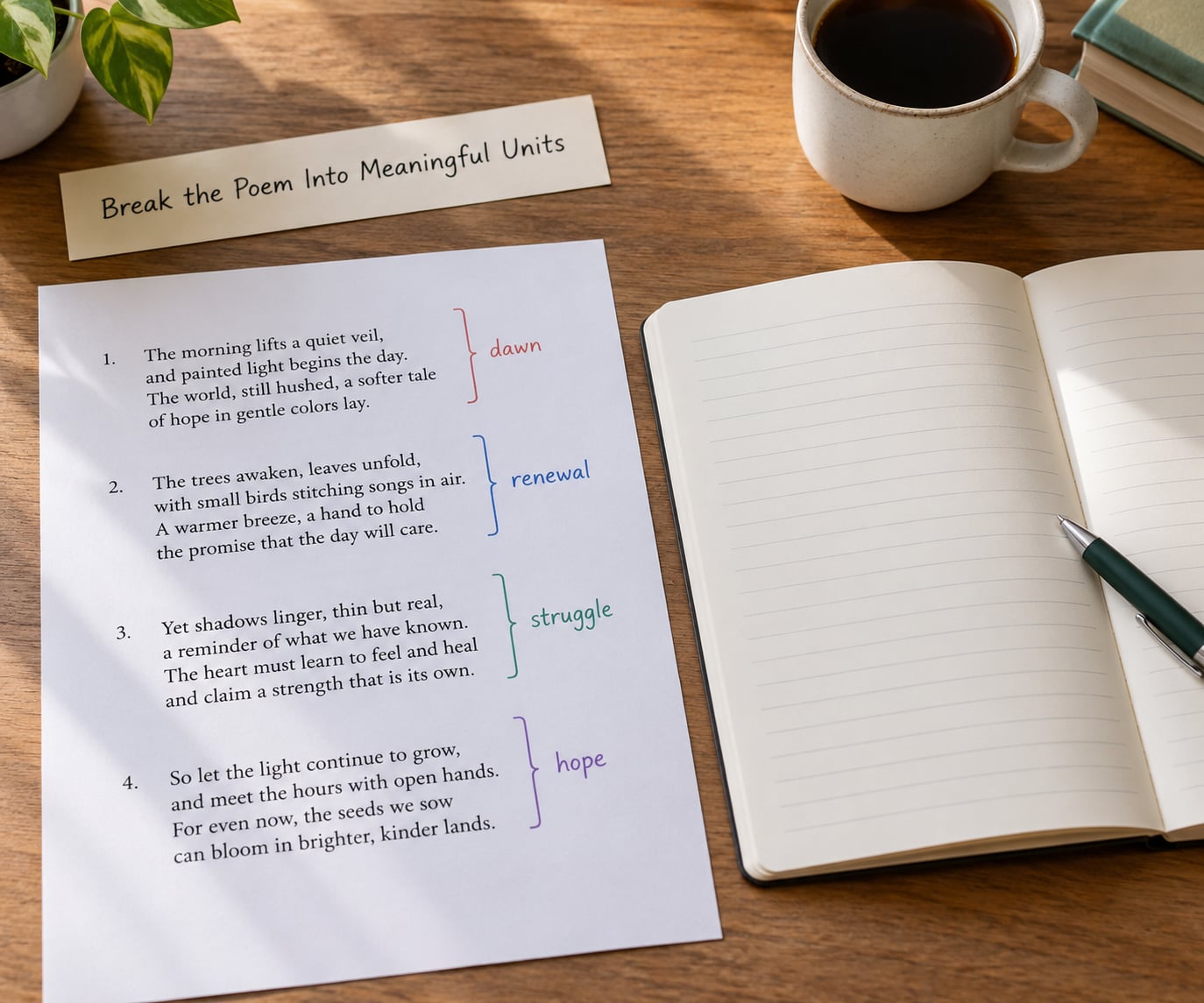
Chunking works because recall has a capacity limit, and stanza-sized blocks fit inside it while a full page does not. It also exposes the poem’s shape, which surprises people: once the units are on separate cards, you can see which ones do the real work and which are transition.
Avoid chunks defined by line count alone. A unit that begins and ends in the middle of an image is harder to recall than one that begins and ends where the poet’s thought does, even if it is longer.
If the poem is short enough to memorize whole, keep it whole. The chunking habit is for material too long to hold in one pass, not a rule to impose on a four-line lyric.
Use the First Successful Recall
The moment you switch from reading to recalling is where memorization actually begins, and it is the step most people skip. Cover the poem. Say or write the next unit from memory. Check the original. Correct yourself out loud. Then move on.
Success looks different at different stages, and knowing the difference keeps you from getting stuck. On day one, success is getting through a stanza with one or two wrong words that you catch and fix. By day three, success is reaching the end of the poem with only one hesitation. Before a performance, success is a clean run with your own phrasing, not a word-for-word freeze.
Two honest rules here. Correcting out loud matters more than correcting in your head, because your mouth is the instrument you will actually use. And going back to reread the whole poem every time you slip is exactly the habit that keeps you stuck at beginner level. Reread the specific line, then push forward.
Layer the Memory Techniques
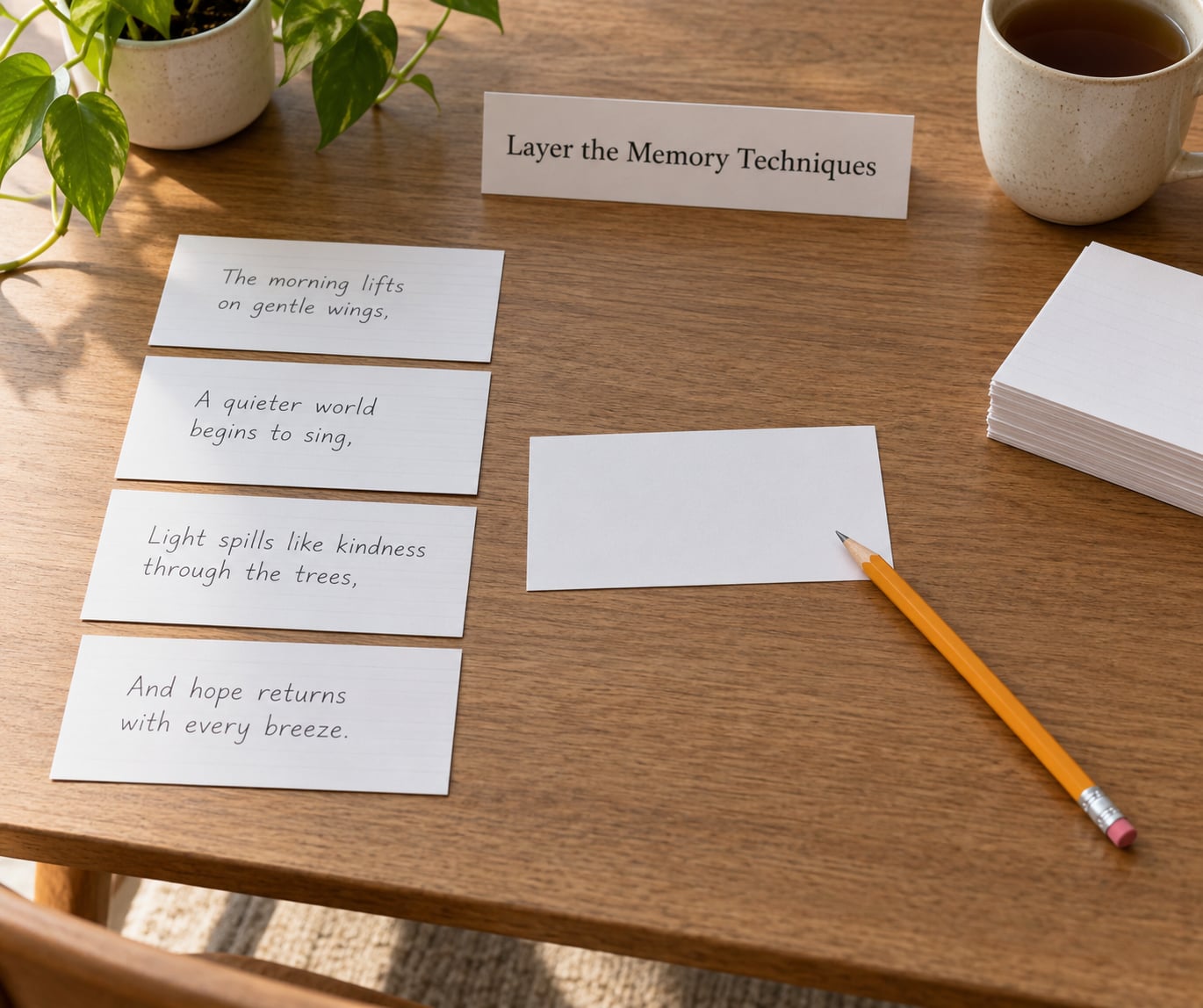
No single trick is strongest for every poem, so use two or three together. Pick by what the poem gives you.
Cue images work best for visual free verse. Reduce each unit to one concrete image, then link the images into a short story.
Line-initial letters suit short formal pieces. Take the first word of each line, write the initials on a card, and let the card prompt you. It works on sonnets and short lyrics; it collapses on a long poem with hundreds of lines.
Rhyme, meter and alliteration are already built into formal verse, which is one reason rhyme and rhythm are worth learning. Use them as handrails: if you know the sound the stanza ends on, the last word arrives before the memory of it does.
Body movement suits poems with physical action in them. Teachers have used standing, clapping patterns and call-and-response recitation for years, and the University of Arizona Poetry Center describes teaching third and fourth graders that way, with the spoken poem coming before the printed one.
Substitution lists are the advanced option. On the Art of Memory forum, regulars describe building a personal code for common function words — I as eye, the as tea, to as toe — and pairing each with a fixed image. It is a genuine system, and it is also a lot of setup. Reserve it for very long poems or for a language where function words dominate.
Reciting to music works because melody holds the sequence while you search for the words. It is a useful scaffold, not a permanent home. If the tune outlasts the poem, you have memorized the song.
Whichever techniques you use, keep interpretation underneath them. A poem memorized as a string of images with no sense of who is speaking comes apart the first time someone asks you what it means.
Practice for Performance
Memorized and performed are different skills. Recitation needs pace, emphasis and breath, none of which come free with the words, and a poem you know perfectly can still be ruined by a dead-flat delivery.
Record yourself on your phone and listen back. You will hear the hesitations immediately, and they are rarely where you expect. Mark the spots in your text, then work only on those. A ten-minute run where you speak aloud, once at half speed for accuracy and once at full pace for rhythm, does more than an hour of silent reading.
Emphasis should follow meaning, not volume. Where the poem turns, slow down. Where the poet is being ironic, flatten your tone slightly and let the words do the work. Speakers at funerals and weddings who nail this say the whole poem arrives with its meaning intact.
For a short daily schedule: fifteen minutes, always starting with the one unit you got wrong last time, then adding a new unit, then a full run-through with no notes. For a deadline, run three sessions a day for four days rather than one eight-hour session, and stop the night before to let the poem settle.
On a genuinely short timebox, this works: choose your stanza, read it aloud twice, write out the cue words, then recite with the text covered. You will not achieve fluency in five minutes. You will achieve a rough map of the poem, which is what makes the next session efficient.
Review, Sleep, and Retrieve
What you can recite tonight is not what you can recite next month. The transfer from fragile short-term recall to durable long-term recall is the slow part, and it is where most people give up, not because the method was wrong but because they stopped reviewing once the poem finally felt easy.
A schedule that works: full recitation on day 1, again on day 2, then day 7, day 14, day 30, and day 60. After day 30 the poem mostly maintains itself, provided you still say it aloud occasionally. Families who use a poem-every-six-weeks cycle, as described on the Charlotte Mason homeschool forum, are effectively running a longer version of this without calling it that.
Low-stakes daily repetition works too. Reciting while showering, walking or driving shows up over and over in reader accounts because repetitive motion plus speech is a reliable pairing, and it costs nothing.
Sleep matters here, and it is the one claim worth making plainly: review placed shortly before you sleep tends to hold up better than review crammed into a distracted afternoon. That is about as far as the evidence lets a general reader go, so treat any promise of overnight mastery with suspicion.
Common Mistakes
Almost every failed memorization attempt I have seen comes down to one of six problems, and each has a specific fix.
Memorizing line by line with no sense of the whole. You end up able to recite stanza two perfectly while having no idea what it is for. Fix: before any line work, say the whole poem’s argument in two sentences.
Rereading instead of retrieving. Rereading feels productive because the page does the work and recognition feels like recall. Fix: cover the text before every single practice attempt, and only uncover it to check.
Cramming. One long session produces a thin layer that fades within days. Fix: three or four short sessions beat one marathon, every time, and the sessions should be on different days.
Practicing silently. You are training a different skill than the one you need. Fix: recite out loud, ideally standing, ideally at a volume slightly above your normal speaking voice.
Ignoring the poem’s form. Applying sonnet methods to a long free-verse poem wastes hours. Fix: anchor formal verse on rhyme and meter, free verse on imagery and line breaks, and translations on meaning plus cadence.
Stopping the moment it works once. The classic curve is a smooth run, followed a week later by a surprising blank. Fix: keep reviewing on the schedule above for at least two months.
Two quick situations. If you are completely stuck, shrink the material: memorize a single stanza until it is effortless, then add the next. If you have only a day, pick the shortest poem that will genuinely serve your purpose, and a shorter poem learned properly beats a long one abandoned halfway.
One more thing, since it comes up constantly in reader questions: you do not need to memorize every word to use a poem well. Learn the shape, the exact opening lines and the final stanza, and improvise the middle in your own words for a reading. Plenty of public speakers do exactly this, and nobody in the room can tell.
Frequently Asked Questions
How long does it take to memorize a poem?
It depends on length and how often you practise. A short lyric of four to eight lines can be solid in two or three days of fifteen-minute sessions. A Shakespearean sonnet usually takes a week or two. A page of free verse or a full narrative poem is realistically a month. People who succeed are the ones who practise daily in small blocks, not the ones who cram hardest at the start.
What is the most effective memorization technique for a poem?
Retrieval practice beats every alternative: cover the poem, recall a unit from memory, then check and correct. Techniques like cue images, first-letter cards and rhyme handrails help, but only on top of actually testing yourself. Rereading feels effective because the text does the work for you, and that is precisely why it produces weak recall. Add spaced review on days 2, 7, 14 and 30 to move the poem into long-term memory.
How do I memorize a poem in 5 minutes?
You cannot fully memorize most poems in five minutes, but you can build a usable map. Read your chosen stanza aloud twice. Write the first word of each line as a cue list. Cover the text and say the stanza from memory, pausing wherever you hesitate. Mark the gaps. That leaves you with a rough version, the places that need work, and a session tomorrow that takes ten minutes instead of forty.
What is the easiest poem to memorize for a beginner?
Start with a short poem that repeats a pattern. Emily Dickinson’s Because I could not stop for Death is four lines, four stanzas, with a repeated rhyme scheme and a clear turn in the middle. Shakespearean sonnets work well too, because the fixed form does the sequencing for you. Avoid anything long and free-verse as a first attempt. John Hollander’s Committed to Memory and Roger Housden’s Ten Poems to Last a Lifetime both arrange poems roughly shortest first.
Is memorizing poetry good for the brain?
The honest answer is that it is demanding mental exercise with real but ordinary payoffs. Learning a poem trains sustained attention, stores vocabulary with its context intact, and strengthens the link between reading and speaking, which is why the Poetry Center compares it to language immersion. Many people also report it makes their own writing rhythm better. None of that makes it a treatment for any condition, and benefits come from the effort rather than the subject matter.
What do I do if I blank on a line while reciting?
Do not restart. Say the nearest line you are certain of and keep going; the thread usually reappears within a stanza. If it does not, describe the image in your own words and move on, because a paraphrase beats silence. Blanking is the most common complaint among people learning poems, and it happens to almost everyone. Returning to the next session with that one spot marked and practised separately fixes it faster than any whole-poem rehearsal.
Conclusion
Start smaller than feels impressive. Pick one short passage, read it aloud until you can say what it means, cut it into two or three units with a cue word each, then put the text away and say it back. That single cycle, repeated tomorrow, is the whole method.
Everything after that is maintenance: a few minutes of spaced review on days 2, 7, 14 and 30, and eventually a poem you carry without effort. What you get in return is a working vocabulary in context, a sharper sense of what a poem is doing, and a few hundred lines you can produce out loud on a stage, at a graveside, or in the middle of an ordinary Tuesday when you feel like saying something worth hearing.