Poetry feels confusing because it compresses meaning: it drops the explanation, trusts you with a gap, and asks you to build the meaning back up from images, sound, and form. Knowing how to read poetry when it feels confusing is less about decoding and more about working in passes. You read it aloud, list what you literally see, name who is speaking, notice how it is shaped, and only then decide what it means.
Give it about twenty minutes for a first pass, forty if the poem is long. It feels slower than prose, and it is not because you are slow.
Table of Contents
- What You Need
- How to Read Poetry When It Feels Confusing: Step by Step
- Common Mistakes
- Frequently Asked Questions
- What should I focus on first when reading a confusing poem?
- Why does the first line of a poem feel so important?
- How do I understand a poem without knowing its historical context?
- Is it okay if I cannot find one definitive meaning?
- Should I look up every unfamiliar word while reading poetry?
- When should I ask a teacher or librarian for help with a poem?
- Conclusion: Start With What You Notice
What You Need
Very little. You need the poem itself, somewhere quiet, and a notebook or a blank document for notes. A dictionary within reach is more useful than any study guide, and that is not a joke.
Three habits before you start help more than any theory:
- Read aloud. Your ear catches rhythm, repetition, and emphasis faster than your eye does, and enjambment — a sentence that runs past the end of a line without punctuation — is nearly invisible on the page and obvious when spoken.
- Look up words, not meanings. If a word stops you, define it in a dictionary. Do not go looking for what the poem “means”; you will find someone else’s answer before you have formed your own question.
- Allow multiple passes. One reading is a contact with the poem. Meaning arrives on the third or fourth, and some poems never fully resolve, which is a different kind of outcome, not a failure.
You do not need to know anything about literary periods, meters, or criticism to start. Everything technical used in this guide is defined the first time it appears.
How to Read Poetry When It Feels Confusing: Step by Step
Six steps, in order, each one small enough to finish before moving on. The order matters more than speed: doing step five before step two is the reason most readers stall.
1. Read the Poem Once Without Trying to Solve It
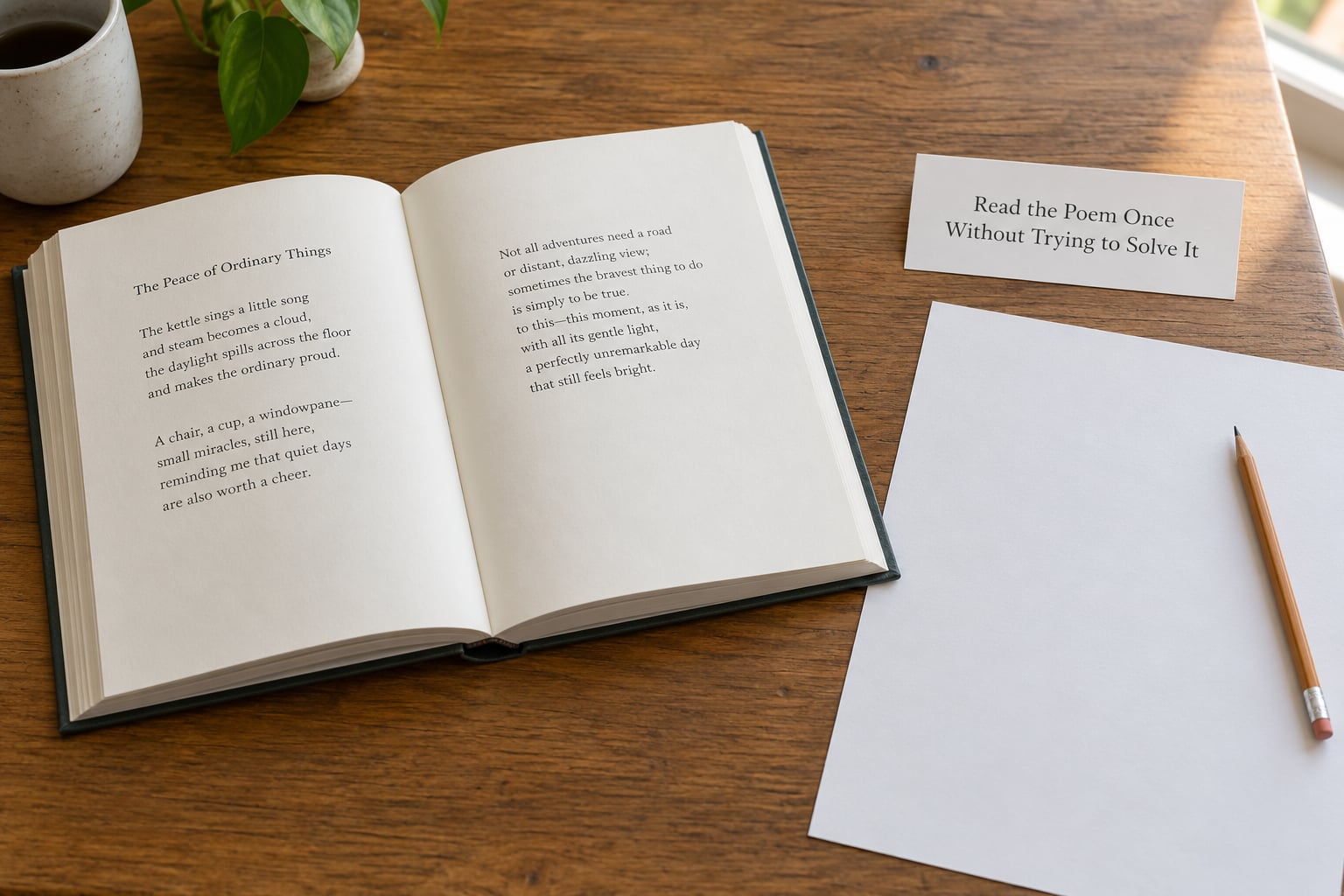
First pass, silent, at reading speed. Do not annotate. Do not look up a single word. You are only finding out where the poem gets its hands on you, and that information is worth more than you expect.
Then read it aloud twice. The first time at normal pace, the second time slowly, and if a line trips you, a third time to see whether the stumbling is in your mouth or in the poem. Almost always it is in the mouth. Readers trained on prose expect a sentence to close neatly at the line’s end, and when it does not, the whole thing stops making sense in a way that has nothing to do with meaning.
After the three passes, write down two things: where you felt something, and where you got lost. That is your map. Confusion you can point at is workable; confusion that floats around the whole poem is not.
Beginners often try to explain every line on the first encounter. Resist it. Understanding is built on top of noticing, not the other way round.
2. Separate What You See from What You Think
Now make a list of what is literally on the page: objects, actions, places, people, times of day, weather, verbs. Only things you could photograph. This is your evidence list, and it is the part of the poem any interpretation has to answer to.
Take a well-known line. From Emily Dickinson’s “Because I could not stop for Death”:
He kindly stopped for me
The Carriage held but just Ourselves
And Immortality.
What you see: a driver who stops politely, a carriage with room for two, a third passenger named Immortality. What you might think: the speaker is describing death and does not yet understand what is happening. Both are true, and they are different kinds of true. The first is text you can point at; the second is a claim about the poem, and it needs the first before it is worth anything.
Next, paraphrase in one plain sentence, no literary vocabulary allowed. “A speaker gets picked up by someone polite who is taking them somewhere they do not understand.” If you cannot do this, you are not lost yet — you just have not finished the literal pass. Confusing poems almost always become simpler once you can state what happens in ordinary words.
3. Mark Repeated Words and Important Images
Go back through and circle anything that appears twice, and underline any word you would not have chosen yourself. Repetition marks what the poem wants you to notice; odd word choice marks where the pressure is.
Then take one image at a time and name what kind it is:
- A simile compares two unlike things using like or as. A simile tells you the poet is reaching for a comparison.
- A metaphor says one thing is another, with no comparison word at all. A metaphor asserts rather than suggests.
- Personification gives human qualities to something non-human.
- Sensory imagery is language aimed at sight, sound, taste, touch, or smell. When a poem is thick with it, the feeling is often the meaning’s near relative, and you can note the feeling before you can explain the idea.
Write the effect, not just the label. Not “simile,” but “comparing grief to a slow drive makes the loss feel unhurried and inevitable.” Naming a device and moving on teaches you nothing; naming what it does is the whole job. And keep one image open for more than one meaning. Ambiguity is usually deliberate, and pinning an image to a single definition is how readers talk themselves out of the poem.
Take one device per sitting if you have to. A poem with four figures of speech in it is not a problem to solve in a single pass.
4. Notice How the Poem Is Built
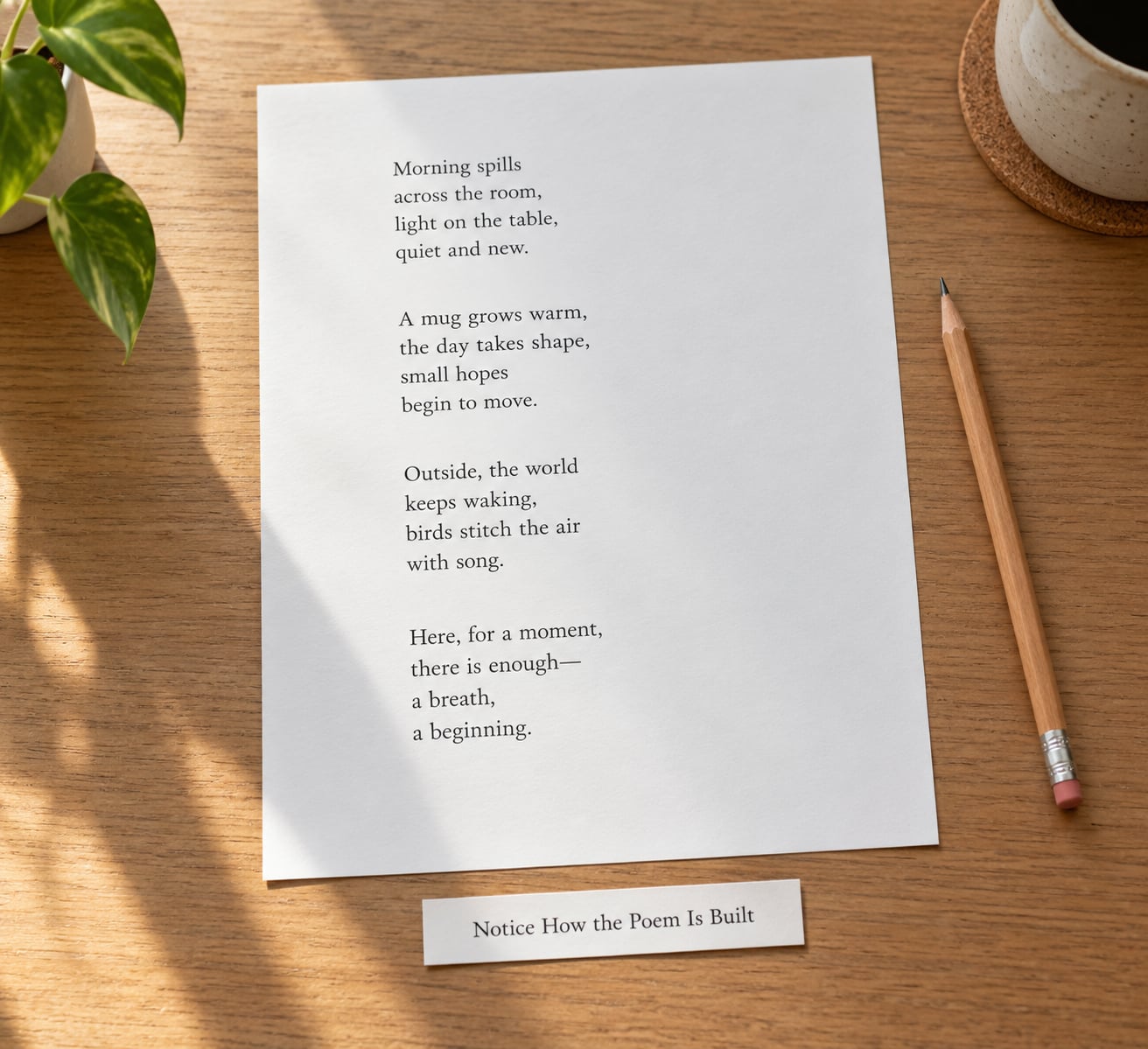
Form is not decoration on the meaning. It is meaning, working underneath the words, and beginners skip it because it does not look like content.
- Stanza — a grouped block of lines, usually marked by a blank line. A new stanza is almost always a shift of place, time, speaker, or pressure.
- Line break and enjambment — a line ending mid-thought. Enjambment makes the reader’s eye fall into the next line before the sense has caught up, which produces suspense or lightness depending on speed.
- Rhyme — including slant rhyme, where words nearly match. Rhyme ties one line to another and often signals where the poem wants your attention to land.
- Meter — a regular pattern of stressed and unstressed syllables. The commonest is iambic pentameter: five pairs per line, each pair weak then strong, as in “Shall I compare thee to a summer’s day.” You do not need to scan anything to enjoy it, but knowing it exists explains a lot of a poem’s forward motion.
- Cadence — the rhythm of natural speech rather than of metrical feet. It is what makes a line feel like a sentence a person would actually say, and it matters in free verse, where there is no meter to fall back on.
- Caesura — a pause inside a line, usually marked by punctuation. A caesura in the middle of a line cuts the thought in half.
- Free verse — poetry with no regular rhyme scheme or meter. It is not formless, it just uses line breaks, sentence shape, and sound as its structure instead.
Read the shape on the page before you read the words. A poem printed in very short broken lines moves like a stutter. A poem in long unbroken lines moves like a held breath. That impression is data, and it costs you nothing.
5. Track Changes in Speaker, Tone, and Meaning
Identify the speaker. The speaker is the voice inside the poem, and it is not the poet. A poem about a departing lover may be written by someone happily married; a poem in a dead woman’s voice may be a man borrowing a mask to say something he could not say directly. The moment you collapse the speaker into the author, you lose the poem’s main layer of distance and start guessing at biography instead of reading.
Also name the addressee, if there is one. A great deal of what sounds mysterious is a one-sided conversation where only one side is present, and that changes the meaning more than you would expect.
Then track the tone stanza by stanza. A poem usually has a central tension — a withdrawal, a lament, a memory, a refusal — that develops rather than repeats. The place where it changes direction is called the volta, or turn, and it is often the single most useful thing to find in a poem that feels like it is going nowhere.
You can track it simply: write one word for the tone of each stanza, then look at the sequence. Grief, anger, calm, grief again tells you a story. Grief, grief, grief, grief tells you the poem is holding still, and that is a design too.
6. Build an Interpretation from the Evidence
Put three things together in one sentence: a main observation, the specific words that support it, and what it means. For example: the poem keeps returning to the word “still,” which appears in every stanza; that stillness makes the loss feel permanent rather than temporary, so the speaker is trying to hold a moment in place so it cannot finish happening.
That is a defensible reading. It names evidence, it explains the effect, and it leaves room for someone to argue with it — which is the correct condition for a reading, not a defect in it.
If the poem stays ambiguous, say so plainly. “The ending does not tell me whether the speaker forgives or merely stops being angry” is a real, accurate observation, and hiding it behind a confident summary makes your reading worse, not better.
Set a limit too. After three full passes, stop. You have what you came for, and the poem will say more next month than it does today. That is how this works.
Common Mistakes
Decoding every line in the first pass. You are reading a compressed text line by line and asking each one to be self-explanatory. Fix: paraphrase the poem in ordinary words first, and let the imagery stay unexplained for a while.
Reading the poet instead of the speaker. Researching a life can feel productive and produce nothing, because the poem’s voice is a construction, not a diary entry. Fix: research the poem’s date, place, and situation; treat the biography as optional colour.
Treating a first impression as a final one. The reaction you have on pass one is data, not a conclusion. Fix: keep noticing on a separate page from meaning, and do not let an early feeling close the question.
Skipping form. If you only read the words, you miss the enjambment, the caesura, and the volta doing their work. Fix: read the shape and the sound before you interpret anything.
Looking up someone’s interpretation first. This is the most common and most damaging mistake, and readers describe it as feeling graded on a test they never studied for. An online gloss hands you a finished argument built on a poem you have not read yet, and then your own reactions feel irrelevant. Fix: form a question and mark the lines that produced it, then read other people’s notes and use them to sharpen yours, never to replace them.
A few habits worth keeping: read the title first and again at the end, since it often shifts; keep a dictionary open; read one poem at a time rather than straight through a collection; and let a poem you do not understand sit unread for a while. Coming back in a month with new context is a legitimate stage of close reading, and it happens to almost everyone who reads seriously.
Frequently Asked Questions
What should I focus on first when reading a confusing poem?
Focus first on what is literally there: objects, actions, places, people, and images, listed without interpretation. Paraphrase the whole poem in one plain sentence before you decide what it means. Confusion usually comes from one of four places, unfamiliar words, unfamiliar structure, unfamiliar references, or an unfamiliar speaker, and a literal pass tells you which one you are dealing with.
Why does the first line of a poem feel so important?
The first line sets the poem’s terms, including the speaker, the situation, and the voice you will be listening to. It also carries the strongest instruction about pace and sound, so a hard opening is often a deliberate demand rather than an obstacle. Read it aloud, then reread it after finishing the poem. Its meaning usually changes.
How do I understand a poem without knowing its historical context?
You can get most of the way without it. Notice imagery, form, tone, and speaker, and write a reading supported by those. Then add context only where your reading hits a wall, such as an unexplained place, event, or custom. Too much background before reading pulls you toward other people’s conclusions and away from your own response to the text.
Is it okay if I cannot find one definitive meaning?
Yes, and it is more than okay. Many poems are deliberately open, and skilled readers disagree about poems published centuries ago. What matters is that your reading names specific words, explains their effect, and can be argued with. A clear claim supported by two lines of evidence is worth far more than a vague sense of hidden significance.
Should I look up every unfamiliar word while reading poetry?
Look up every unfamiliar word. Diction is where a poet’s choices show, and an unfamiliar word is often the one doing the most work. Define the word rather than searching for the poem’s meaning, since a summary will give you an answer before you have asked a question. Some words will still be ambiguous after three passes, and that is fine.
When should I ask a teacher or librarian for help with a poem?
Ask when the poem is an assignment, when a reference or allusion blocks your reading entirely, or when you have done three careful passes and still cannot find your footing. Frame the question as what you have noticed rather than what the poem means. A librarian can usually suggest an anthology matched to what you already enjoy, which solves more stuck poems than a gloss does.
Conclusion: Start With What You Notice
Being stuck in a poem is not a sign that you are bad at reading poetry. It is the point where reading actually begins, and the way through it is to slow down and get specific.
So do one thing now: reread the poem that confused you aloud, pick the one image that stayed with you, and trace where it appears across the poem. Notice how it changes. That is how to read poetry when it feels confusing, and it is how most people describe the moment a poem finally opened.