To run a meeting where everyone speaks, build participation into the design instead of waiting for volunteers. State the outcome up front, offer written and paired ways to contribute, agree ground rules, then give every person a low-stakes first turn. It takes about ten minutes of preparation beyond a normal agenda.
One honest correction before we start. Getting every person in the room to talk out loud is not the goal, and chasing it can make a meeting worse. The goal is that no relevant voice is missing from the record before a decision is made.
Some people think better in writing, some are mid-shift when they dial in, some are the most junior person present and have no realistic way to interrupt a director. Forcing speech out of them produces one-word answers and resentment. A well-run meeting finds a fair way in for each of those people, and says so out loud.
The quiet cost of getting this wrong is well documented. Gallup’s State of the Global Workplace 2026 reports a widening engagement gap, with manager engagement down sharply in recent years and most of the rest of the workforce disengaged enough to affect output. Meetings are where that shows up: cameras off, nodding that is not listening, silence after a question. Meanwhile executives commonly spend around 23 hours a week in meetings, against roughly 10 hours back in the 1960s. We have never had less meeting time, or less of it well spent.
Here is the method, step by step.
Table of Contents
- What You Need
- Step-by-Step: How to Run a Meeting Where Everyone Speaks
- 1. Define the decision and outcome
- 2. Choose inclusive ways to participate
- 3. Set participation agreements
- 4. Assign and brief the facilitator
- 5. Start with structured round-robin input
- 6. Guide the discussion and invite quieter voices
- 7. Synthesize decisions and follow up
- Common Mistakes
- Frequently Asked Questions
- How do you get quiet people to speak in a meeting?
- Should every participant answer during a round-robin?
- How can a facilitator stop one person from dominating?
- Is it okay to let participants type or write their answers instead of speaking?
- How do you know whether everyone had a fair chance to participate?
- Conclusion: Start With the Ground Rules
What You Need
Preparation is what separates a meeting where everyone speaks from one where three people do. None of this takes long, and all of it should exist before the invite goes out.
- The outcome in one sentence. What is decided, recommended or simply understood by the end?
- An agenda with the question on it. Not topic labels. The actual question, phrased so people can prepare an answer.
- A participant list. Who needs to be heard for a sound decision, and who is optional?
- Ground rules text. Four or five lines, pasted into the invite. You will cover them in the first two minutes.
- A shared notes document. Visible to everyone, editable by the facilitator, so nobody has to scribe in order to contribute.
- A timer. For round-robin turns and for the pause after a question.
- Blank cards or a private notebook per person. For silent writing rounds and pairing.
- An anonymous channel. A chat thread, a form, a shared drop. Optional but useful when the topic is sensitive.
- An access check. Captions on, materials circulated ahead, dial-in details that work, a way for someone to join by phone without penalty.
If you are running a hybrid or virtual meeting, the access check is not optional. Shared notes, live captions and a chat channel that is treated as a real voice, not a second-class one, do more for participation than any icebreaker.
Step-by-Step: How to Run a Meeting Where Everyone Speaks
Seven steps, in order. The order matters because each one buys the next: people cannot contribute if they do not know what is being decided, and they will not contribute if they do not know how.
1. Define the decision and outcome
Most meetings fail before anyone speaks because the people in the room do not know what kind of speaking is useful. Start with four sentences in the invite: what this meeting is for, the exact question we are discussing, which decisions are genuinely open to influence today, and what happens to the output afterwards.
Wording you can paste:
We’re meeting to decide whether to move the pilot launch into two additional regions. The question on the table: is the pilot ready, and what would need to change? The budget cap of $X is fixed and the launch date is not up for debate today. Notes and decisions will be in the shared doc within two hours of the call.
You will know this step worked when people arrive already thinking about the question, and when someone asks a clarifying question in the first few minutes instead of the last five. If nobody challenges your framing, your framing was probably too vague.
2. Choose inclusive ways to participate
Pick at least three channels and announce them. Speaking first is one option, not the only option. Someone thinking in writing for ninety seconds may produce a better contribution than the same person forced to speak on cue.
Match the method to the group and the stakes:
- Spoken, open floor. Works for small groups, familiar teams, low-stakes topics.
- Round-robin go-around. Works for check-ins, retrospectives, decisions where you need a record of every view, groups up to about twelve.
- Silent writing, then sharing. People write alone for two to three minutes, then share what is on the card. Good for sensitive topics and for senior rooms where junior staff will not speak freely.
- Think-pair-share. Everyone thinks, then talks to one neighbour, then reports. Lowest risk entry point I know, and it works on a video call as well as in a room.
- Anonymous or written input. Chat, a form, a drop. Best when power differences are steep or when the topic touches identity, money or performance.
- Breakout rooms. Three to four people per room, two or three minutes, then a report back. Scales past twelve people.
Announce the mix in the invite: “We’ll open with a written round, pair up for five minutes, then discuss together.” People can prepare for the method instead of being ambushed by it.
3. Set participation agreements
Ground rules work when they are short, said by a person with authority in the room, and applied to everyone including the chair. Long rule sets read as corporate theatre and get ignored.
Four or five lines is plenty:
One conversation at a time, no interrupting.
We listen to understand, not to reply.
Everyone gets airtime; passing is fine and needs no explanation.
Speak from your own experience and say when something is a generalisation.
Say the impact plainly when a decision lands badly for your group.
That last line does more work than the others. Naming an impact out loud, in the room, is what stops a quiet objection from hardening into quiet non-compliance after the meeting.
4. Assign and brief the facilitator
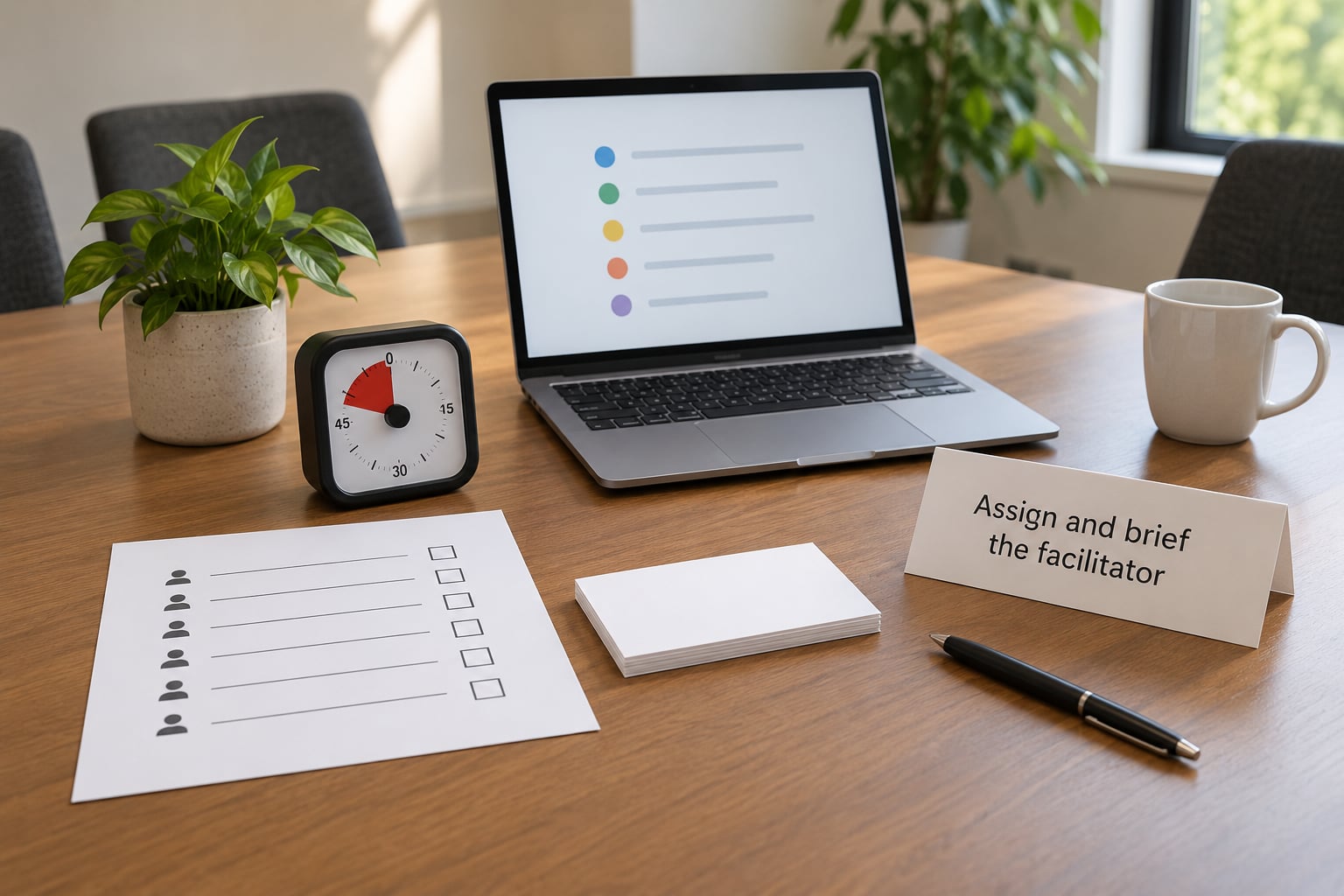
The facilitator is not the person with the most to say. It is a role, and it can be someone else. The facilitator watches the room instead of performing in it.
Four jobs, and you can hand three of them to other people:
- Facilitator. Watches who has and has not spoken, makes the invitations, keeps the format running, summarizes points back so nothing gets lost in translation.
- Chair or decision-maker. Owns the agenda and closes the decision. Answers direct questions. Does not need to hold the floor.
- Timekeeper. Calls the round, watches the clock, gives the two-minute warning. Small job, saves the facilitator from being the villain.
- Participation champion. A rotating role, one person per meeting, whose only job is to notice who has not been heard and to say so out loud. Rotate it monthly so it is not the same junior person forever.
Brief the facilitator the night before with three lines: “we have heard from two people so far”, “there are three cards in the chat nobody has read”, “Priya needs ninety seconds to compose an answer, give her the time”. That last one is the whole job.
5. Start with structured round-robin input
This is where most facilitators lose people. The first turn sets the norm for the whole meeting: if the loudest voice opens, everyone else calibrates to that and never recovers.
So open with everyone. Give the frame, then go around: “One sentence each, what matters most to you here. One sentence is the right length. Pass is completely fine and I’ll move on.” Set a visible sixty to ninety seconds per turn, and hold the time.
Three rules keep it humane. Normalize brevity by doing a short turn yourself first. State the pass clearly so nobody has to invent an excuse. And never use the round to force disclosure, feedback on a colleague, or anything a person would reasonably want to keep private.
Round-robin has a deserved bad reputation, earned mostly by rigid pass-the-mic formats with no framing. Framed as a first pass rather than the whole discussion, it is hard to beat for a check-in. The record of who said what, in order, is also useful later.
6. Guide the discussion and invite quieter voices
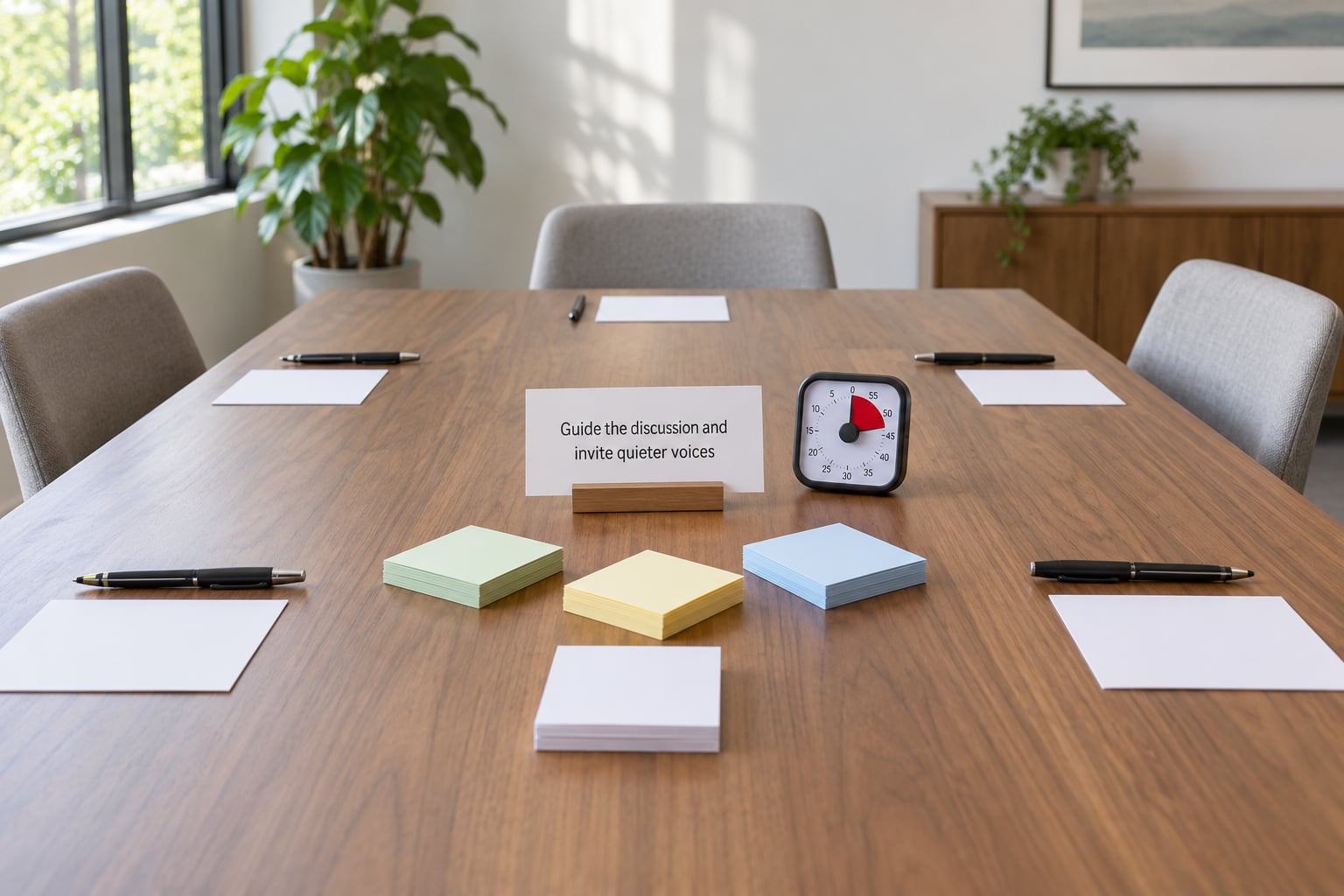
Most facilitators ask an open question, get silence, panic, and start talking. The pause was doing its job. Give it five to seven seconds. Then give it more.
The larger mistake is naming people. “Leslie, what do you think?” lands as an ambush, and the room hears it as one. Inviting by role or perspective is slower to read and much more effective:
- “We’ve heard from finance and from the two engineers. We haven’t heard from operations yet.”
- “Who is closest to the customer in this decision?”
- “People who joined this call by phone, we haven’t turned to you.”
- “Before we move on, one thing from anyone who hasn’t spoken. A sentence or a card, either way.”
When someone does speak after being invited, close the loop with acknowledgment so the behaviour repeats: “That’s useful, thank you, writing that down.” People take the risk once and then stop if nothing visibly happens.
Four other moves that work:
- Read the written channel. “Three more came in on the card, here they are.” Otherwise quiet input is invisible input, and people learn quickly not to bother.
- Pair first, room second. Every person has rehearsed something once, so the open floor costs far less.
- Interrupt the pattern, not the person. “Hold that thought, we’re going to come back to it, I want to hear from two more people first.”
- Ask for a decision and a condition. “If you were wrong about this, what would have to be true?” gets answers from people who have not volunteered.
On a hybrid call, do the hard parts in the chat and the tool, not the camera. Remote participants are slower to unmute, easier to talk over, and often physically invisible in the room. Ask every question twice, once aloud and once in the chat, and read questions aloud by name.
When not everyone shares a first language, slow everything down: share the agenda and the materials a day ahead so people can prepare in writing, put the key question in writing during the meeting, use pairs before the full room, and check understanding by asking people to rephrase rather than by asking “does that make sense?”
7. Synthesize decisions and follow up
Decisions made on incomplete airtime are the failure this whole method exists to prevent. Close by being explicit.
Say what you heard: “Here’s what we’ve agreed, here’s what we’re still split on, and here’s what we’re not deciding today.” Then test it rather than assuming: “Has anyone heard a serious objection that isn’t on this list?” Silence at that point is not agreement, so treat it as unresolved and note it as such.
Then close the loop in writing, the same day if you can. Decisions, open questions, one named owner per action, and a date. Send it to everyone, including the people who never spoke; they need the record as much as anyone, and a good record is one of the quietest ways you can reduce the cost of speaking second.
Common Mistakes
Six failure modes, each with the fix.
Cold-calling by name. It produces honest answers about what is safe. Invite by role or perspective instead, and if you must name someone, name them with the reason and the runway: “Ana, you ran the pilot, so you’ll see the constraint I can’t, take a minute.”
Overstructuring. Rounds for everything make a discussion feel like a form. Structure the input, leave the discussion loose. If a meeting feels like a survey with faces, you have gone too far.
Rewarding only the fastest speakers. You say “great question” to the first hand up, and the room learns that speed is the currency. Thank the second, third and fourth contributions too, and thank written ones by name when you read them out.
Ignoring the written channel. Reading chat is not a favour to the meeting, it is the job. Put a named person on triage and set a two-minute check so nothing sits unread.
Vague action items. “Circulate the doc” is not an action. Name a person and a date, in the shared notes, visible to the room.
Treating silence as agreement. This is the expensive one. Unspoken consent gets logged as a decision, and the people who were affected but quiet find out afterwards. Mark unresolved items as unresolved.
Four tips that fit anywhere: keep the round to under ten minutes or move it to a separate check-in; invite by perspective rather than name; make the pass a normal act so nobody has to justify skipping; and keep a parking lot visible, because the number one reason good input dries up mid-meeting is the sense that there is no room for it.
Frequently Asked Questions
How do you get quiet people to speak in a meeting?
Give them a route in that is not the open floor. Silent writing first, then pairs, then the room. Invite by perspective rather than by name, since naming reads as an ambush. Close the loop when they do speak, by thanking them and writing their point down visibly. And say out loud that passing is normal, so nobody has to weigh the risk of speaking against looking prepared.
Should every participant answer during a round-robin?
Offer the round to everyone and make passing genuinely acceptable, but do not require a substantive answer. Someone may have nothing to add on a topic, and forcing filler undercuts the whole method. Keep turns to about sixty seconds, do a short turn yourself first to model brevity, and avoid using rounds for anything a person would reasonably want to keep private, such as feedback on a colleague.
How can a facilitator stop one person from dominating?
Interrupt the pattern rather than the person. Say, hold that thought, we are going to come back to it, I want to hear from two more people first. Then keep a running list of who has not spoken and work down it, because structure beats confrontation. If it continues, move the conversation to written input for a stretch, where volume carries no advantage. Private feedback after the meeting handles the person directly.
Is it okay to let participants type or write their answers instead of speaking?
Yes, and on a written-only discussion most people say the written channel gave them their best contribution of the meeting. Two conditions make it work. Read written input out during the meeting and credit it by name, or people stop writing. And treat chat as a first-class voice, not overflow, by asking every question aloud and in the channel. Otherwise quiet input quietly disappears.
How do you know whether everyone had a fair chance to participate?
Check it while it is happening rather than afterwards. Keep a simple tally of who has contributed in each channel, spoken and written, and notice whether anyone is absent from both. Ask at the close whether anyone held back, which is more useful than it sounds. Then look at the notes: if the record of decisions shows one or two names as the source of nearly every point, participation did not happen.
Conclusion: Start With the Ground Rules
One action for your next meeting: before it goes out, write the ground rules into the invite and add a line saying how people can contribute other than by speaking. That single change does more than any technique you will apply live, because people who know the rules are not waiting to find out whether it is safe.
Participation works best when nobody has to be pushed. Give people a written route, a paired route and a spoken route, keep the pass normal, and credit every contribution you receive. The people you are least likely to hear from are usually the ones carrying the information the decision depends on.
That is the whole of how to run a meeting where everyone speaks. Not a performance, and not a rule that everybody talks. Just a meeting where every voice has a way in, and no one leaves wondering whether it was said.