
Describing your culture to someone who never asked comes down to one specific detail instead of a list of facts. You name a meal, a holiday, a phrase in another language or something a relative always did, and then you say what it meant to you. Two or three sentences does the job. You are opening a window, not giving a lecture.
Most people find this harder than it should be, and the reason is usually that we rehearse an answer that sounds official. A genuine answer sounds a bit uneven, with an admission in it: that you practice some of it, that your grandmother did it your way, that you are still figuring it out. That unevenness is what makes people trust it.
Here is a version you can use today, before you need one.
- Where your family is from, and where you actually grew up.
- One thing that happens at a table, on a specific day, that nobody outside your family would recognise.
- One phrase, food, or habit that carries the meaning.
- One honest note about what you practice, what you only know about, or what changed.
That is a complete description. Most people need one more sentence than that, and not much more.
Table of Contents
- What You Need
- Step-by-Step: How to Describe Your Culture Without Over-Explaining
- 1. Identify What You Mean by Culture
- 2. Choose the Level of Detail
- 3. Start With a Concrete Moment
- 4. Explain the Meaning, Not Just the Fact
- 5. Invite Questions Without Making Them Do All the Work
- Common Mistakes
- Frequently Asked Questions
- How much should I share about my culture with someone who is curious?
- What if someone makes a mistake about my culture?
- How do I explain a culture that is mixed, changing, or hard to label?
- What questions about my culture are too personal to answer?
- How can I explain a tradition without making it seem strange or exotic?
- What if the person asks why I participate in a cultural practice?
- Conclusion
What You Need
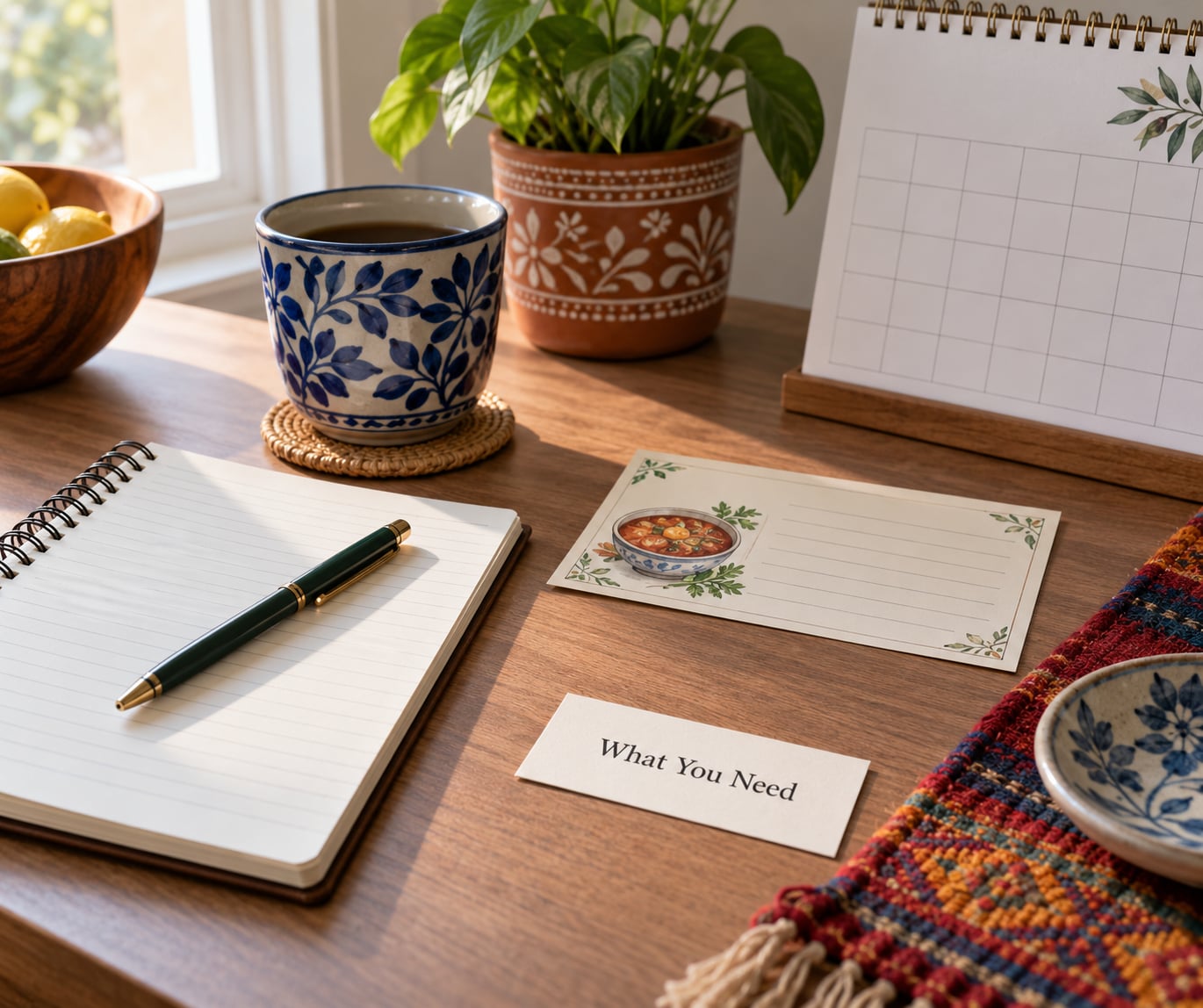
You need three things before you open your mouth, and none of them require research.
The first is one concrete example. A dish with a specific name, a holiday that happens on a date other people would not guess, a greeting that takes longer than a handshake, a grandmother’s rule about the phone at dinner. The example has to be one you remember, not one you read about.
The second is a sense of your own boundaries. Some parts of a family life are private, some are political, and some belong to other people. Deciding in advance which parts you are willing to discuss means you are not making that decision while someone waits for an answer.
The third is permission to be incomplete. A description is not a claim to represent anyone. You are describing what your household did, and that is a smaller and much more defensible claim than what a whole culture does.
A useful way to prepare is to write the description once, badly, then cut it in half. Most people land on two sentences that say more than the paragraph they started with.
Step-by-Step: How to Describe Your Culture Without Over-Explaining
1. Identify What You Mean by Culture
Start by noticing that culture, heritage, background and identity are not the same word, and that people use them interchangeably when they ask. Your nationality is a document. Your heritage is what came down to you. Your background is the set of conditions you grew up in. Culture is the part that shows up in what you do on an ordinary Tuesday.
That last one is the useful part, because it is the only one you can actually describe. Someone who has never asked is usually responding to something specific they noticed, a way you greeted them, a food you mentioned, a phrase you switched into. Whatever prompted the question is a good place to start.
2. Choose the Level of Detail
Match the answer to the setting, not to your own enthusiasm. At a party, a stranger, or the first ten minutes of a new job, two sentences is generous. A friend who has asked twice, a classroom, a written bio, or someone who is clearly asking because they care, can handle a few minutes.
Watch the other person rather than your own script. Follow-up questions mean go one layer deeper. Flat questions and a change of subject mean you have said enough, and pushing further turns a description into a performance.
There is a version of this that writers on culture get exactly right: readers respond well to being asked rather than told. The best move when someone is unsure is to hand the question back, as in “I’d rather hear how you see it. What have you noticed?”
3. Start With a Concrete Moment
Specific nouns are what make a description stick. “We are Muslim” is abstract. “My dad calls my grandmother every Friday after her morning prayer” is not. You can use a holiday, a dish, a language, a room in a house or a time of day, and the listener has somewhere to stand.
Pick the example you would happily talk about for ten minutes. Not the most impressive one, and not the most painful one. The one that still surprises you.
A worked example, from a moment to a finished answer: someone asks a woman what her background is. She starts with a memory, the Friday call. She adds that the call is in a language her cousins use and she understands but no longer answer in. She ends by saying the language is the part she is sorry about, which is the part she would like to have kept. That is a description. It has a fact, a meaning, and an honest limit, and it took about fifteen seconds.
4. Explain the Meaning, Not Just the Fact
Facts about customs are the beginning of the sentence, not the end. What makes a description worth hearing is the why: who it connects you to, what it protects, what it argues for.
“We take our shoes off at the door” is a fact. “Guests keep their shoes on, which my dad thinks is unhygienic and my mother thinks is unnecessary, and they argue about it every time” is a description with a person in it.
Watch the sentence that starts with “everyone in my culture.” It is the one that loses trust fastest, because it turns a handful of people in your household into a population. Say “in my family” or “at my house” and you stay on solid ground.
Say too when a practice is not universal. “This is how we do it, though my cousins would do it completely differently” costs you three seconds and buys you back your credibility.
5. Invite Questions Without Making Them Do All the Work
End with an open door rather than a summary. A simple “happy to go into any of that” tells the listener which parts of your answer had something behind them, and lets them choose instead of guessing.
It also lets you control the depth. If someone asks about your religion, your parents, your accent or your partner, you decide whether it is a real question. Curiosity is not consent. The line most people find hardest to say is: “That one is a bit private, but the food side is fair game.”
If a question comes from a bad assumption rather than genuine curiosity, correct it once, plainly, and without a lecture. “I am not from there, I just cook a lot of it” is a complete answer. A short correction repeated is enough; a long defence gives the assumption more air.
Common Mistakes
Sounding like a brochure. Rehearsed language reads as dishonest because it has no specific nouns in it. Fix: swap every abstraction for one detail you would recognise in a photograph.
Claiming to speak for a group. “In my culture we…” hands the listener a whole population to generalise from. Fix: name the household, the region or the generation you are actually describing.
Explaining a practice without saying what it does. A list of customs leaves the listener with trivia. Fix: add one sentence about who it connects you to or what it protects.
Over-answering out of guilt. Repeating the same background to the same person in a slightly longer way is the most common way this goes wrong. Fix: give the two-sentence version, then stop. Repeating yourself does not build understanding, it just rehearses the same distance.
Treating “I don’t have one” as a failure. Plenty of people come from a family with no visible traditions, no second language and no ritual calendar. That is a real answer, not a missing one. Describe the family you do have, the region you grew up in, the habits you picked up, and stop apologising for it.
Claiming a culture that was never handed to you. This is the sharpest line in the whole conversation. A heavily mixed reader on r/mixedrace put it plainly: their family dropped those cultures long before they were born, so how are they supposed to carry on cultures that never carried them. If a practice was not part of your life, you can describe it, cook it, or learn it, and you can say clearly that you are not claiming it as inherited.
Frequently Asked Questions
How much should I share about my culture with someone who is curious?
Share one example, its meaning, and one honest limit. That is enough for a first answer with anyone you have just met. Look for follow-up questions as the signal to go a layer deeper, and a change of subject as the signal to stop. People remember the shape of an answer, so a two-sentence description that lands beats five minutes of detail that overstays.
What if someone makes a mistake about my culture?
Correct it once, plainly, and without emotion. Say what is true and what is yours, then move on: I was not raised there, but I cook it often. A short correction repeated once is enough. A long defence gives the assumption more attention than a flat sentence would. If the person keeps repeating it after a clear correction, that tells you something useful about them.
How do I explain a culture that is mixed, changing, or hard to label?
Describe the parts instead of searching for a single label. Say which sides came through, which ones were not passed down, and which practices you actually grew up with. Mixed and bicultural readers often find that a precise account of what was and was not inherited lands better than any single word, because it is the truth of most families in a mixed neighbourhood.
What questions about my culture are too personal to answer?
Anything about your body, your faith, your politics, your family members who are not in the room, or your income. So are questions that ask why you participate in something, if the real reason is curiosity about whether you are allowed to. You can say that a topic is private without apologising, and you can offer another part of your answer instead.
How can I explain a tradition without making it seem strange or exotic?
Explain it in the voice of an ordinary person rather than an expert. Say when it happens, who does it, and what it means, and avoid the words unusual, exotic and fascinating, which put distance between the listener and the practice. The test is simple: if your explanation would be strange to your own relative hearing it, it is framed from the outside.
What if the person asks why I participate in a cultural practice?
Answer for yourself and stop there. My grandmother’s side did it this way and I like the food. Some people will keep pushing toward the deeper reason, and they are usually looking for a verdict on whether you are allowed to take part. You are not applying for a licence. Giving a short honest answer once is fair; defending it at length is not.
Conclusion
Pick one cultural detail today and write it as a single sentence in your own voice. A meal, a holiday, a phrase, a rule somebody in your house follows. Then add one sentence about what it means to you, and one honest line about what you do not practice or were not handed.
That is your answer when someone asks. Keep it ready, keep it short, and let the other person decide whether they want the rest.