Raising a child who speaks up for others is a different job from raising a child who stands up for themselves. This guide to how to raise children who speak up for others covers the harder version: a child who will use their voice for a peer who is being teased, excluded, or treated badly, and who keeps doing it after the first time it costs them something socially. The honest answer takes months of small practice, not one good conversation.
Most parents assume the problem is courage. It usually is not. Children go quiet because speaking has a price and they cannot see that the price gets refunded later. So the order matters more than the words: remove the cost first, give them language second, and only then ask them to use it.
What follows is a six-step progression, the age ranges where each step becomes realistic, and the scripts that make the difference between a child who means it and a child who freezes. It also covers the part most advice skips, which is what you do after your child speaks up and it goes badly.
Table of Contents
- What You Need
- Step-by-Step: Building Children Who Speak Up for Others
- Step 1: Help Your Child Notice Injustice and Exclusion
- Step 2: Build Empathy Through Perspective-Taking
- Step 3: Teach Children to Choose the Right Moment
- Step 4: Practice Brave Words With Role-Play
- Step 5: Make Speaking Up Safe and Accountable
- Step 6: Reinforce Action Without Seeking Credit
- Common Mistakes
- Frequently Asked Questions
- How do I raise children who speak up for others without pressuring them to confront people?
- What age should children start learning to speak up for others?
- How can I help a shy child become more confident without forcing them to be outspoken?
- What should a parent do when a child reports racism, bullying, or discrimination at school?
- How can children speak up safely online?
- How do I teach my child to stand up for others without becoming a target themselves?
- Start With One Small Conversation
What You Need
No supplies, no curriculum, no special program. Everything this approach requires is a decision and about twenty minutes a week, which is the part that makes it hard to start.
The first thing to prepare is a calm baseline. Your child has to know, in advance and not as a hope, that telling you something uncomfortable will not produce a lecture, a raised voice, or a phone call to another parent. In the parenting forum threads I read while researching this, parents described children regretting that they had told, because the telling brought a fight instead of help.
Second, you need age-appropriate language, not grown-up words. A six-year-old does not need the phrase “relational aggression”. A six-year-old needs “that wasn’t kind, and I don’t like it.”
Third, you need real examples from your child’s actual world, because abstract fairness is invisible. A child recognises exclusion faster when you name the specific things you have seen: the game nobody asked them to join, the table where everyone shifted over, the joke that landed on one kid three times in a row.
Fourth, you need a practice plan. Pick two low-stakes situations a week to rehearse. Not real conflicts, imaginary ones. The playground incident that happened last month is fine to revisit; the argument happening in front of you right now is not the moment to run a lesson.
Fifth, and most parents skip this, you need a clear line about which situations are the child’s job and which are yours. A child can invite a classmate to sit with them. A child should not be managing an adult who is hurting a child. Write that line down in your own head, because you will need it at 8am on a school morning.
You also need to know your school’s reporting route before you need it. Most schools have a named safeguarding contact or a specific form, and finding it in an emergency wastes the window you are trying to protect.
Step-by-Step: Building Children Who Speak Up for Others
The process is a gradual climb. Each step assumes the one before it is in place, and skipping ahead is what produces a child who agrees enthusiastically and does nothing.
Step 1: Help Your Child Notice Injustice and Exclusion
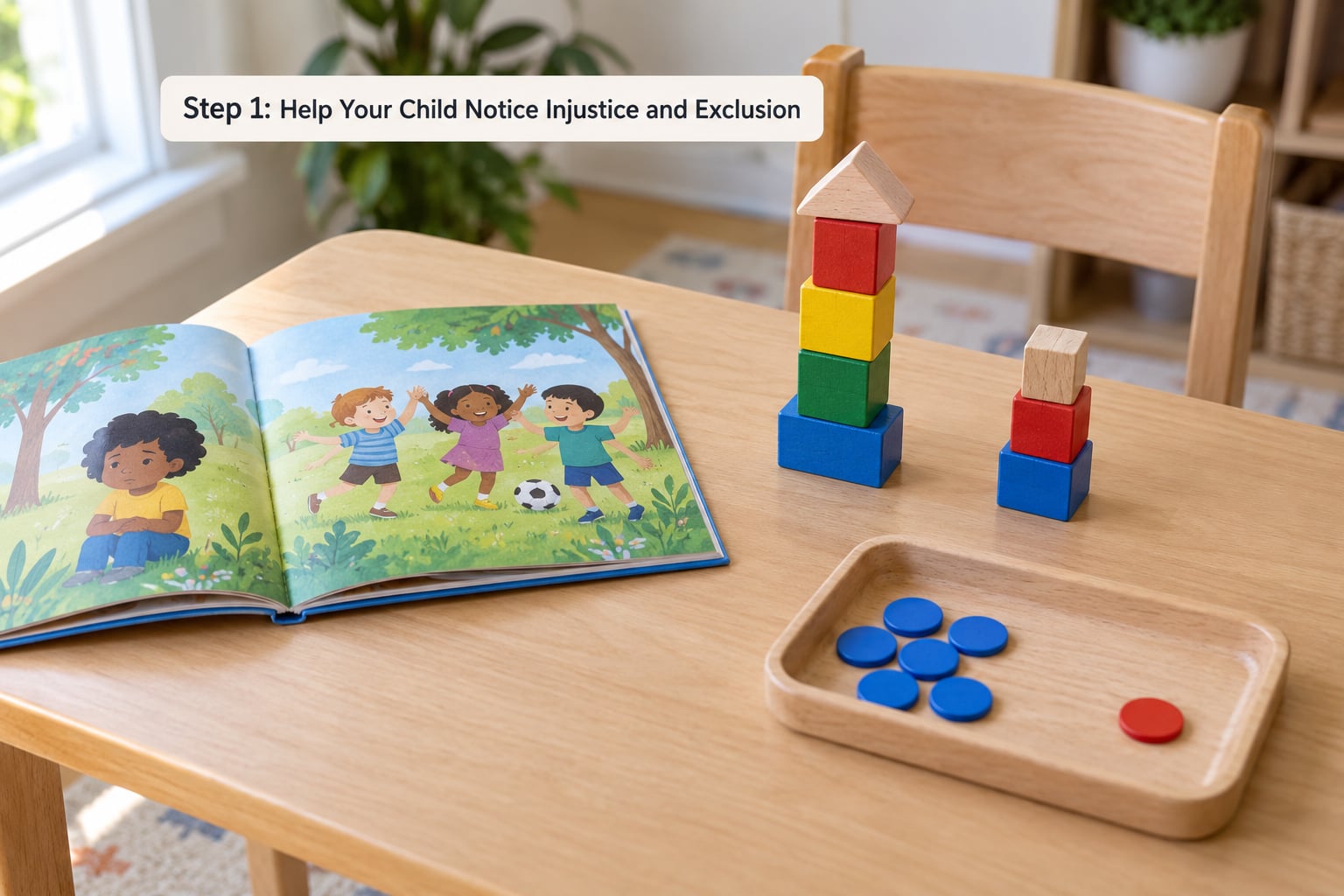
Before a child can speak up, they have to notice. Most can see a punch and miss everything softer, which is where most hurt between peers actually happens.
Teach observation without turning every social moment into an investigation. You are not looking for someone to blame. You are building the habit of noticing who got picked, who got skipped, and who stopped talking.
Say it plainly: “Who was not in that game?” or “You noticed Ben was on his own. That is a sharp eye.” Then stop. Let your child sit with it.
How do you know it worked? A few weeks in, your child starts narrating the world out loud without being asked. “Mom, nobody asked her to the party.” That unsolicited commentary is the tell. It means noticing has become automatic rather than prompted.
What children can realistically do at each age:
- 3 to 4 years old: notice that someone is sad or alone, and stay near a grown-up. The action is proximity, not words.
- 5 to 6 years old: invite one excluded child into a game, share a snack, or ask an adult to come over. Concrete actions with adult support nearby.
- 7 to 9 years old: say a short sentence to the person doing the excluding, and tell an adult afterwards. Reporting still happens the same day.
- 10 to 12 years old: name the pattern out loud in front of peers, and use a school’s reporting channel without a parent in the room.
- 13 and up: organise, not just react. Join a group, start a club, change a rule that was quietly unfair.
Asking for a 13-year-old to do the work of a 6-year-old is how you get a child who decides the whole thing is pointless.
Step 2: Build Empathy Through Perspective-Taking
Noticing is mechanical. Understanding why someone else is in the situation is what makes the noticing mean something, and it is the piece most homes skip because it takes patience.
Use open questions and accept long, uncertain answers. “How do you think she felt when nobody said anything?” “What might be hard about being the new kid on that table?” “What would you have wanted someone to do?”
Perspective-taking also works backwards. Put your child in the excluded seat. Ask what they would think about themselves if they were the only one not invited, and watch how quickly the answer changes.
For a school or community example: when a child is unkind to a classmate at the table, do not run straight to labelling. Ask what happened just before, and what the other child might be experiencing that nobody can see, such as a new sibling, a move, or a learning difficulty.
You will get the answer “they are just joking” more than once. Respond without a lecture: “Maybe. What do you think it sounds like from over there?” Let the silence do the work.
Step 3: Teach Children to Choose the Right Moment
Advocacy is timing, and so is safety. A child who interrupts a serious fight or confronts a much older child has not been brave, they have been exposed.
Give them a simple sort. Some situations are private and small, like a friend being left out of a chat, where a quiet word works. Some are public and ongoing, like repeated teasing, where a witness needs to break the pattern rather than comfort afterwards. Some are urgent, like someone being hurt or threatened, where an adult is needed immediately and the child should not wait for a good opening. And some are ongoing but not dangerous, where the child reports to a trusted adult and lets the adult carry it.
The rule to give a child is short enough to remember: if it is about feelings, use words; if it is about safety, use an adult.
Also teach the reverse, which protects them from becoming the aggressor. Walking away and getting help is a legitimate response. Being the person who keeps circling back to make a point is not, and it is the fastest way to turn an advocate into a participant.
Step 4: Practice Brave Words With Role-Play
Children do not perform courage on demand. They perform what they have already said out loud in a safe room, which is why rehearsed language beats inspiring principle every time.
Keep the scripts short. A long speech is a speech a frightened child cannot finish.
Phrases a child can borrow:
- “Are you okay?”
- “That doesn’t seem fair.”
- “Come sit with us.”
- “Do you want me to get a teacher?”
- “I’m going to tell someone, and that’s okay.”
- “I don’t think that’s funny.”
Rehearse by playing the other part. You be the child who is being excluded, and let your child practise the sentence until it comes out without a script. Then swap. The discomfort in the rehearsal is the point; a child who has felt how awkward it is to say the sentence out loud to a caring adult will find it far easier to say it to a peer.
Run the rehearsal twice a week for three minutes. Not a lesson, a game, and stop before either of you wants to.
Role-play also lets you correct the edges. A child rehearsing “that’s not funny” often needs a softer landing afterwards: “I’m not trying to start a fight, I just don’t like it when that happens.” Practise the exit as well as the opening.
Step 5: Make Speaking Up Safe and Accountable

This is the step that decides whether anything else worked. A child who speaks up once and gets a bad reaction will not speak up again for years.
When your child tells you something happened, do four things in order. Listen fully before you respond. Thank them specifically, using words about the risk they took: “I know that was hard, and I’m glad you told me.” Ask open questions rather than interrogating ones. Then tell them what you are going to do, and actually do it.
The follow-up is where most parents drop the ball. If nothing visibly happens, a child learns that telling is pointless, which is exactly the conclusion parents report their children reaching about school.
Say what you will do by when. “I will email her teacher before lunch tomorrow.” Then report back, even if the answer is that nothing happened. Hearing that the adult checked and could not change it teaches something different from silence.
Check whether they feel supported without asking them to reassure you. Try: “Was it hard to tell me that?” or “Anything you want to say about how it went?”
And keep the burden proportionate. A child who raised a concern has done their part. Do not hand them the follow-up, do not make them write the apology request, and do not tell them they should have handled it better.
Step 6: Reinforce Action Without Seeking Credit
Once speaking up feels normal, the goal shifts from courage to follow-through. Does something change because they said something?
Encourage concrete action: sitting with the excluded child at lunch, asking a teacher to check on a situation, joining a group or club that makes the school more inclusive, and reporting an online comment that was cruel. Small acts, repeated, are what actually shift a peer culture.
Be careful with the praise. Praising a child for being noticed turns advocacy into a performance, and a child who is not going to be liked will quietly stop. Praise the specific act instead: “You went and asked if she was okay. That took noticing.”
The value you are teaching is fairness, not applause. Say that out loud at some point, in plain words. Children understand a standard once it has a name, and this one is worth naming: what you do for someone else matters even when nobody thanks you and even when it does not work the first time.
Common Mistakes
Most families I hear about are not missing effort. They are making one of these six moves, and each has a straightforward correction.
- Demanding courage on demand. “You should have said something” hands a child a failure for a skill they were never taught. Correct it with the script: “Next time, try asking if she is okay, and I will help you tell the teacher.”
- Over-reacting to the first disclosure. A raised voice, an immediate call to the other parent, or a family argument teaches your child that information is dangerous. Correct it by staying flat and boring. The most reassuring thing you can do is sound unbothered while you take it seriously.
- Turning advocacy into a lecture. A child who gets a five-minute speech about tolerance leaves remembering the lecture. Correct it with one sentence and a follow-up action.
- Coaching confrontation. Children sent to “tell that kid what they deserve” learn to start fights. Correct it by pointing them at the version that works: get a witness, get an adult, and say one short sentence.
- Praising only the brave moments. Praise for being visible rewards the child for a performance, not a principle. Correct it by praising the noticing and the reporting, including the times the child was scared and did it anyway, especially those.
- Promising outcomes you do not control. “They will be punished” sets your child up to learn that speaking up is useless when it does not produce that. Correct it by being honest about what you can actually do: report it, ask questions, follow up, and be there.
One more to watch for: telling a child to “just ignore it” or “not be a tattler”. That advice is the reason many children grow into adults who do nothing when they witness harm. If you want to raise children who speak up for others, that sentence has to leave the house.
Progress here is uneven and slow, and some weeks will look like nothing happened. Consistency matters more than intensity. Ten minutes a week for six months beats one long conversation you both forget by Friday.
Frequently Asked Questions
How do I raise children who speak up for others without pressuring them to confront people?
Separate the two skills. Speaking up for others means noticing, asking one short question, and getting an adult involved. Confrontation is a different, riskier move that children should not be pushed into. Practise the low-risk version at home with role-play, praise reporting over fighting, and tell your child plainly that bringing an adult in is the strongest option available, not a lesser one. A child who knows the safe route will take it.
What age should children start learning to speak up for others?
Start naming it at 3 or 4, when the realistic action is simply noticing an alone child and staying nearby. At 5 or 6, add a concrete act such as inviting someone into a game. From 7, a short spoken sentence to the person doing the excluding becomes realistic, with an adult involved the same day. By 10, children can report to a school contact on their own. Expecting the full behaviour from a young child is how you teach them that it is not for them.
How can I help a shy child become more confident without forcing them to be outspoken?
Do not build confidence around public speaking. Build it around loyalty. Shy children usually act reliably in one-to-one settings, so practise there first: asking a friend if they are okay, sitting with someone new. Rehearse the sentence until it is automatic, then let them choose when to use it. Praise quiet acts of notice heavily and ignore nothing, but do not praise loudness. Many shy children become the person others go to first, and that is the outcome you want.
What should a parent do when a child reports racism, bullying, or discrimination at school?
Write down what your child said, including the exact words used, before you respond. Tell them you believe them and that you will act. Then use the school’s written reporting route rather than phoning the teacher in the moment, and ask for the outcome in writing. If the school says nobody witnessed it, ask what evidence they need and follow up in writing. Document every step. If the response is weak or dismissive, that is information about the school, not about your child’s report.
How can children speak up safely online?
Teach three rules for group chats and comment threads. Do not reply in the heat of it, because screenshots travel. Save what matters with a screenshot and a timestamp. Then report through the platform and tell an adult at home, the same day. Practise the wording in advance so it is not improvised under pressure, and set a clear line about what kinds of posts a child should bring to you without asking permission first.
How do I teach my child to stand up for others without becoming a target themselves?
Do not send your child alone into a situation with someone bigger or more powerful than them. The safer patterns are: go with a friend, bring an adult, write it down, or check on the person afterwards. Role-play the risk, not just the courage, and show your child what a group of peers does when someone is targeted alone. Tell them that standing up is a team action, and that their job is to help make it a team action rather than to be the lone voice.
Start With One Small Conversation
Pick one thing that happened in the last week. Not the worst thing, just a real one.
Ask your child what they noticed, then ask who might have needed something. No lecturing, no corrections, just the questions. Then model it yourself, out loud, later that day: tell them exactly what you said to the other parent, the teacher, or the relative.
Praise the noticing, not the bravery. That is the whole method in miniature, and it is repeatable on a Tuesday evening without a plan.