
How hiring bias shows up in resumes is easier to spot than most people expect: reviewers read identity signals at the same time as skills. A name, a graduation year, a zip code, an email format or a photo tells a recruiter something about who you might be before a single bullet point gets read. Two candidates with identical qualifications can receive very different callbacks because of those markers.
This matters because the early-career gap tends to stick. In an audit study covering roughly 80,000 applications across 97 large US companies, employers responded to resumes with presumed-white names about 9.5 percent more often than identical resumes with presumed-Black names. Nothing about the qualifications changed. Only the signal did.
If you’re job hunting, or you review resumes and want to do it better, here’s what to look for and what you can actually change.
Table of Contents
- How Hiring Bias Shows Up in Resumes
- What Kinds of Bias Can Appear in Resume Review?
- How Name Bias Affects Screening Decisions
- How Hiring Bias Shows Up in Employment Gaps and Career Changes
- How Skill Requirements Create Resume Bias
- How to Review Resumes More Fairly
- What Can Job Seekers Do About Resume Bias?
- Frequently Asked Questions
- What is an example of bias in hiring?
- Are Black-sounding names less likely to be hired?
- What is a red flag on a resume?
- What is the 7 second rule in resume?
- What is the 70/30 rule in hiring?
- Can an applicant tracking system reject my resume because of my name?
- Conclusion
How Hiring Bias Shows Up in Resumes
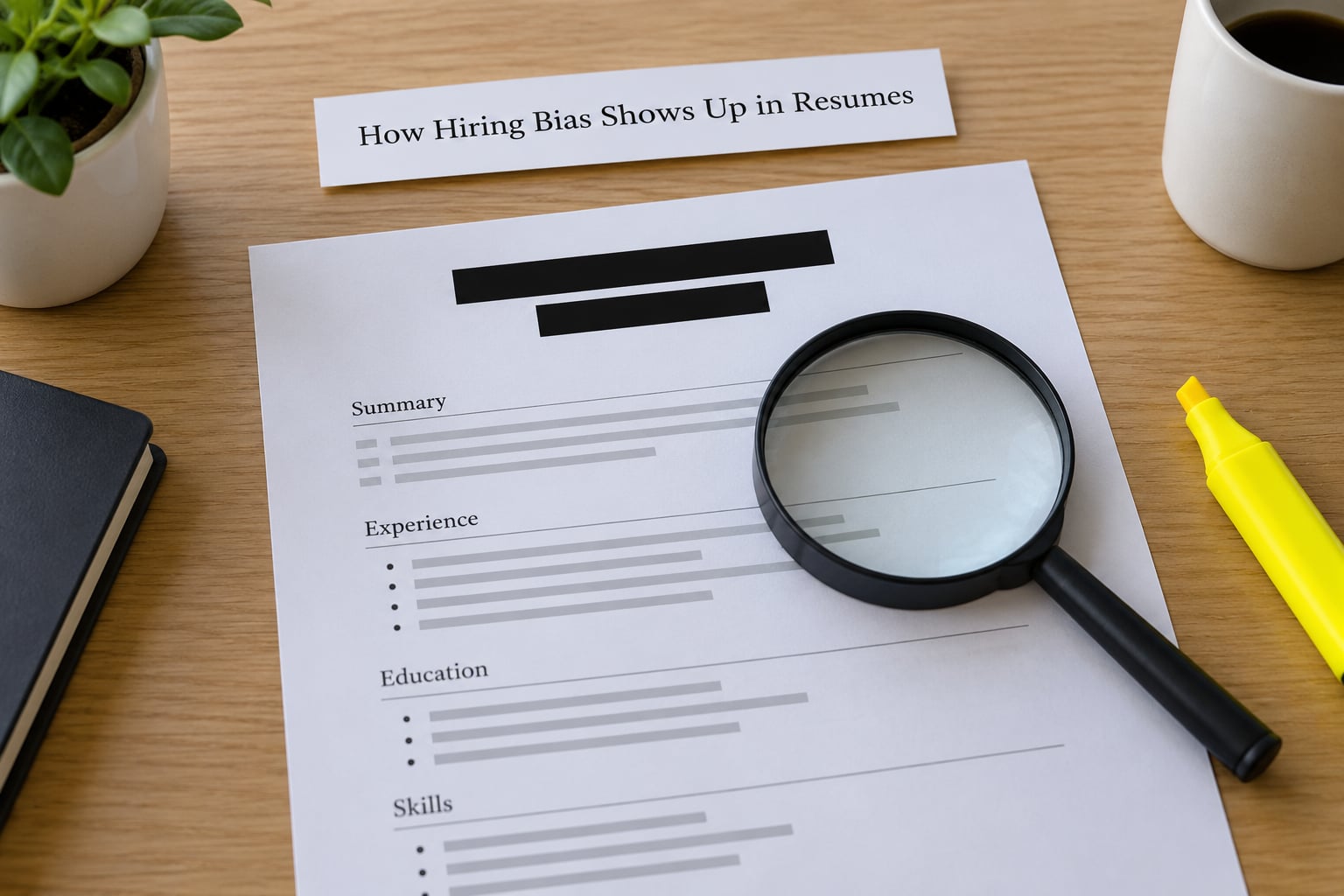
Hiring bias in resumes is the unfair pull of protected characteristics and first impressions on how a resume gets judged. It shows up in eight places more often than the rest, and they tend to stack rather than appear alone.
- Names. Names associated with race, ethnicity, gender or nationality read as identity markers before anything else.
- Graduation dates. Graduation years on every line let a reviewer calculate age before reading a single job description.
- Employment gaps. Unlabeled gaps get filled in with the reviewer’s own assumptions about commitment.
- Degree requirements. A posted degree screen removes qualified people who learned the work another way.
- Email and address formats. A handle tied to a nickname, a faith tradition or a home city is data, even when it looks like nothing.
- Photos and video. Appearance-based judgments appear the moment a face is visible, even on an interview call.
- University names. Institutional prestige substitutes for evidence of skill in many first-pass screens.
- Communication style. Phrases that read as assertive in one culture can read as abrasive in another reviewer’s ear.
None of these are mistakes the candidate made on purpose. They are features of the format that most resumes use, and they are read as data.
What Kinds of Bias Can Appear in Resume Review?
Bias in resume review falls into a few recognizable patterns. Some come from who the reviewer imagines the candidate is. Others come from rigid filters applied before a human opens the file. The table below pairs common resume elements with what reviewers read into them and what tends to read more clearly.
| Resume element | What reviewers may read into it | What usually reads better |
|---|---|---|
| Full legal name | Race, ethnicity, gender, nationality | Nothing can remove it, so add a portfolio or work sample link that carries the evidence |
| Graduation years | Age, then a ceiling on perceived runway | Degree name without year, or a single date range for education |
| Unlabeled gap | Unemployment, instability, low commitment | A one-line label with what you actually did during it |
| Degree requirement | A proxy for trainability and cost | Skills and a work sample that prove the same thing |
| Full street address | Distance from the office, neighborhood income | City and state only, or nothing at all |
| Personal email handle | Nickname, religion, culture, generation | A plain professional address that matches your name |
| University name | Prestige and presumed network | Relevant coursework, projects, teaching, or published work |
| Photo or video intro | Age, weight, gender presentation, accent | No photo, and a written or on-demand work sample |
| Job titles | Prestige of the previous employer | Actual responsibilities and scope in the bullet points |
| Long “responsible for” bullets | Passivity, weak ownership | Specific action, measurable result, named tool |
How Name Bias Affects Screening Decisions
A name is the one identity marker no candidate can remove, which is exactly why it carries so much weight. Research on name discrimination has repeatedly found that otherwise identical resumes with White-sounding names receive far more callbacks than the same resumes with African-American-sounding names, with several studies landing near a 50 percent gap.
The mechanism is rarely a deliberate decision. It is a quick read plus a quiet inference about fit, followed by a stack of similar-looking files. Some of that reading happens inside applicant tracking systems, which match name-adjacent text and formatting cues rather than understanding what you did. The rest happens in the ten seconds a human spends on a first screen.
On Lipstick Alley, women describe using a different-sounding name on applications and getting the shocked reaction in person when the interviewer finally puts a face to the resume. Other users there say they have told friends with Black-sounding names to use a middle name instead, because the callback numbers improved. Those accounts describe a real workaround that many people rely on, and also describe how exhausting the workaround feels.
The point is not to sort candidates by what their name implies. The point is to strip the name out of the scoring, which is what structured review and blind screening are built to do.
How Hiring Bias Shows Up in Employment Gaps and Career Changes
Caregiving, illness, disability, unemployment, a freelance stretch or a switch into a new field all show up as the same thing in a resume: empty space. Reviewers fill that space themselves, and the story they usually write is about reliability.
A nine-month gap labeled “caring for a parent” reads as a reason. The same nine months unlabeled reads as a question the reviewer may not ask, because asking feels slow when forty files are waiting. Freelance or contract years read as intermittent commitment when they were actually five years of continuous client work. A career change into an adjacent field reads as a mistake when the transferable skills are sitting in plain sight but named in industry shorthand nobody outside the field recognizes.
On r/biotech, a user described defeating locality bias by listing a different address on the resume. Same idea, different signal: you can shape which inferences a reviewer makes before you ever get to explain yourself.
How Skill Requirements Create Resume Bias
Some of the strongest resume screening bias comes from requirements that were never really about the work. A four-year degree filter, a ten-year tenure rule, a mandatory list of ten tools, a required industry keyword in the summary line: each one looks like rigor, and each one removes people who can do the job.
Disability shows up here more often than people expect. Applicants using screen readers often apply through portals that time out on complex tables or images, and candidates with limited work history get filtered by rules written for a different kind of candidate pool. Format requirements also punish people whose experience is real but documented in a different structure, such as care work, military service or informal sector experience.
Skills-based hiring is the fix: test the actual capability with a short work sample, score it against a rubric written before anyone reads a resume, and drop the proxies. A reviewer’s familiarity with your industry jargon stops mattering when everyone answers the same short task.
Automated screening adds its own layer, and in 2026 it is getting stranger. Research testing seven large language models against 2,245 generated resumes found the models preferred their own writing style in roughly 82 percent of comparisons. When AI writes and AI screens, the loop closes on polished presentation rather than capability, and the candidates who lose are the ones whose experience doesn’t come pre-formatted.
How to Review Resumes More Fairly
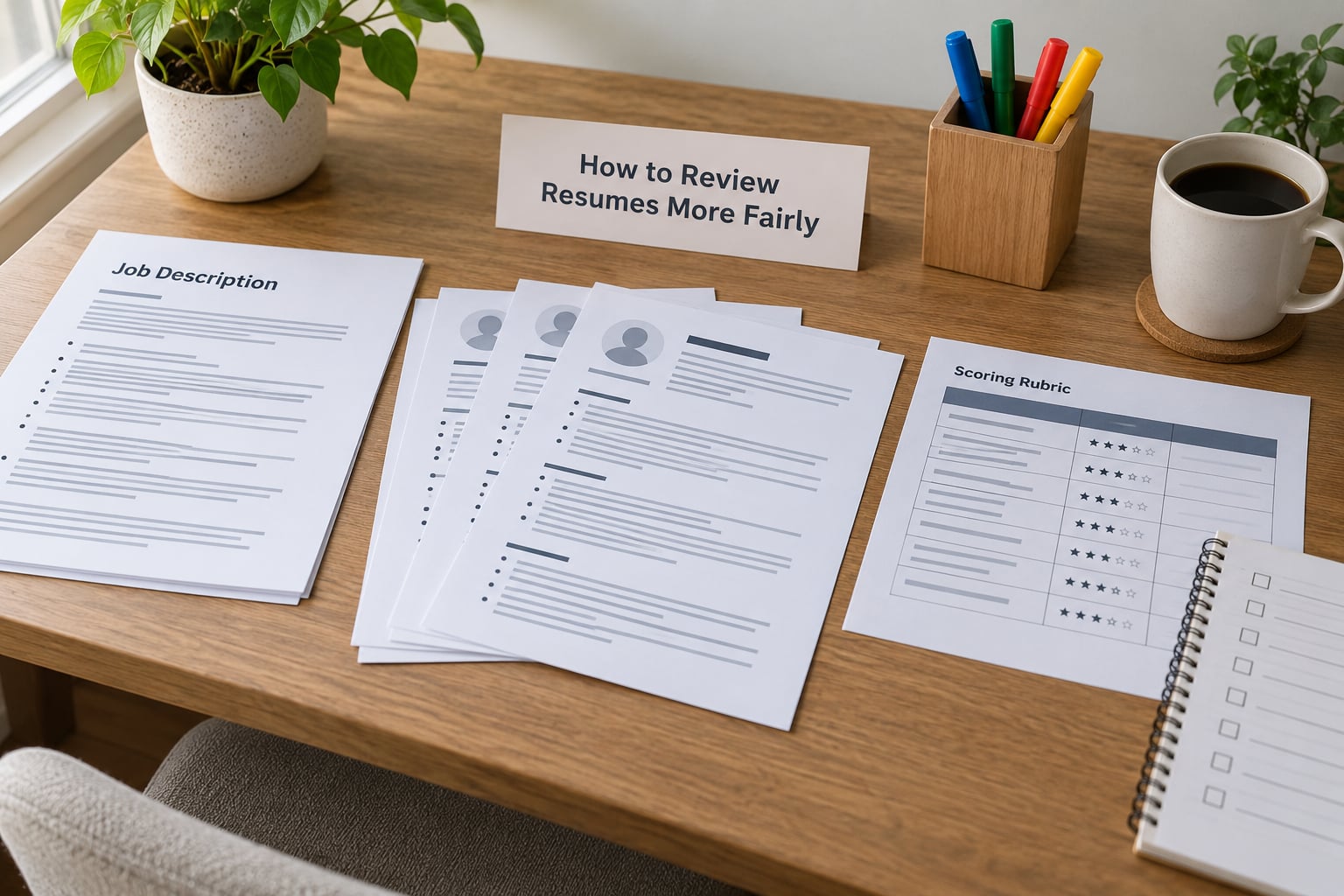
Fair resume review is mostly a design problem. You remove the decision from the moment of impression and put it back on a written standard.
- Write criteria first. Build a rubric with 4 to 6 job-related criteria and a clear score for each before any file is opened.
- Strip identity markers. Remove names, addresses, graduation years, photos and school names from the first-pass copy.
- Ask the same questions. Every candidate gets the same short work sample or exercise, scored against the rubric.
- Score independently. Reviewers submit scores before any group discussion, so the first opinion doesn’t anchor the room.
- Separate must-haves from nice-to-haves. List the genuinely essential requirements, then put everything else in the preferred column.
- Watch for drift. When a rubric isn’t followed, the reason is usually time pressure. Add time to the calendar, not more candidates.
- Collect candidate feedback. Ask applicants how the process went, including people you did not hire. It’s the fastest bias signal you’ll get.
Then audit the funnel, not the room. Track where each group enters, passes screening, reaches interview and receives an offer, then compare those rates. The four-fifths rule gives you a workable threshold: if the pass rate for any group is less than four-fifths of the highest group’s rate, that’s a disparity worth investigating, not a rounding error to explain away.
One pattern keeps showing up in how organizations compare their own results: mandatory bias training on its own tracks with little change in outcomes, while centralized hiring operations, skills-based assessments and diverse recruiter pools track with less bias. Forum discussions about this reach the same conclusion from the candidate side, and it’s the least abstract explanation available. Training changes what one person thinks for an hour. Standardized systems change what happens to every file.
What Can Job Seekers Do About Resume Bias?
You can’t change how a reviewer reads, but you can change what they read. A few things consistently help.
Move the evidence forward. Put the two or three most relevant accomplishments at the top with numbers in them. A reviewer who stops after seven seconds should see capability, not a header block.
Label every gap. One line, plain, no apology. Dates, then what you actually did: caregiving, part-time warehouse work, a certificate, a freelance client. A labeled line removes an inference you would rather not leave to a stranger.
Cut the identity markers you can remove. City and state instead of a street address, a plain professional email, no photo, graduation year omitted or shown once. On the application portal, a portfolio or work-sample link gives you something substantive that sits outside the traditional signal set.
Translate nontraditional experience. Care work, military service, volunteer coordination, informal business and career changes all map to job requirements if you name them in the employer’s language instead of the sector’s.
Ask for process feedback. When a rejection is silent, a short polite request for feedback sometimes returns something useful and sometimes returns nothing. Either way, it documents your interest, and it gives you information for the next application.
Assume it’s not always about you. When two identical resumes get different results, one candidate is getting a signal that has nothing to do with the work. Forum posters describe absorbing that rejection as a skills problem for years before anyone named the pattern for them.
Frequently Asked Questions
What is an example of bias in hiring?
A common example is name-based screening: two resumes with identical skills and experience, one with a White-sounding name and one with an African-American-sounding name, sent to the same employer. Audit research shows the presumed-white resume is far more likely to receive a callback. Age bias works the same way, through graduation dates and total years of experience.
Are Black-sounding names less likely to be hired?
Yes, based on audit studies that submit matched resumes with different names to the same postings. Employers respond noticeably more often to White-sounding names, and the gap holds across industries and job levels. That is why structured review and blind screening exist: remove the name from the scoring and the gap closes, without deciding anything about a candidate’s identity.
What is a red flag on a resume?
From an employer’s side, red flags are things like unexplained gaps, a mismatch between listed skills and the actual role, or inconsistent dates. From a candidate’s side, the warning signs are different: graduation dates that expose your age, an email handle that signals more than you meant it to, and a resume so long that the relevant work never makes it into the first third of the page.
What is the 7 second rule in resume?
The 7 second rule says a recruiter spends about seven seconds on a first pass over a resume before deciding whether to read more. It is widely repeated and not well studied, so treat it as a description of reviewer attention rather than a measured fact. The practical takeaway holds up regardless: your most relevant evidence belongs at the top, where a fast read will land.
What is the 70/30 rule in hiring?
The 70/30 rule describes how much of a hiring decision should come from job-related criteria such as a work sample and structured answers, with the remaining share left to judgment factors like motivation and team fit. It is a framing device rather than a legal standard. Its point is that most hiring decisions currently run closer to the reverse.
Can an applicant tracking system reject my resume because of my name?
Most systems are keyword and parsing tools, not decision makers, so a name alone rarely filters a file. The risk is indirect. Automated rankings favor documents that resemble the resumes used to train them, which tends to mean conventional formatting, standard job titles and dense keyword matching. That disadvantages career changers, candidates using assistive technology and anyone whose experience is documented unusually.
Conclusion
Start where you sit. If you review resumes, write the rubric before you open the first file this week and strip identity markers from the first pass. If you’re applying, move your strongest evidence to the top and label every gap today. If you run the process, pull your funnel numbers by group and run the four-fifths comparison before the next hiring cycle starts.