
To respond when someone says something racist, check that the situation is safe, pick one realistic goal, name the specific behavior in a short sentence, and state what you need to happen next. Speaking briefly and calmly stops the comment far more often than a long speech does.
The hard part is not the words. It is the two or three seconds after the comment lands, when your brain either goes blank or rushes to a comeback you will regret. People describe exactly that freeze, and then ask whether ignoring it was the right call. It is the most common report on this, and the most common reason a response that should have happened never does.
So this guide skips the perfect script, because there isn’t one. What follows is a process: a way to decide what you actually want from the moment, a handful of sentences you can practice out loud until they come out on autopilot, and a clear account of when leaving is the strong choice rather than the weak one. Updated for 2026.
Table of Contents
- What You Need Before Responding
- How to Respond When Someone Says Something Racist: Step by Step
- 1. Check Whether the Situation Is Safe
- 2. Decide What You Want From the Moment
- 3. Name the Problem Without Arguing About Intent
- 4. Set a Clear Boundary and State the Consequence
- 5. Choose Whether to Explain, Redirect, or Leave
- 6. Move Toward Repair or Accountability
- 7. Follow Up and Check Your Own Well-Being
- Common Mistakes and How to Fix Them
- Mistake 1: Trying to Prove Exactly What the Speaker Meant
- Mistake 2: Returning Insults or Escalating the Argument
- Mistake 3: Demanding an Immediate Apology
- Mistake 4: Making the Target Person Defend Their Experience
- Quick Tips for High-Stakes Moments
- Frequently Asked Questions
- What if I freeze or feel shocked when someone says something racist?
- How do I respond when the racist comment comes from a boss, teacher, or family member?
- Should I explain why a comment is racist, or is that the speaker’s responsibility?
- What if the person apologizes but then repeats the joke?
- How can I support a friend who was targeted without speaking for them?
- Conclusion: Start With Safety, Then Set a Firm Boundary
What You Need Before Responding
You do not need a speech, a citation, or the vocabulary of antiracism theory. You need three things, and none of them is a line.
A single goal. People freeze because they are trying to accomplish four things at once: end the comment, teach the speaker, protect the person targeted, and win the room. Pick one. Ending the comment is a legitimate goal on its own, and it is the one that matters most in the moment.
A read on the setting and the power gap. The same sentence lands completely differently depending on who is speaking, who is listening, and what it would cost you to be wrong. A quip at a group dinner with your aunt is not the same situation as a meeting where your manager controls your performance review, and it is not the same as a parking lot at 11pm.
One rehearsed sentence and a real exit. If your only plan is to say the perfect thing, you will say nothing. Pick one line you can produce under stress, and decide now how you would leave the room if it went badly. Knowing you can walk away is what lets you stay calm while you are still there.
What you also want is a rough read on which kind of racism you are looking at. A racial slur, a “just joking” remark, a backhanded compliment, and a coded reference to crime or neighborhoods get very different replies. If someone has said this kind of thing before, that changes things again, because a pattern is a workplace and safety problem rather than a conversation problem.
How to Respond When Someone Says Something Racist: Step by Step
1. Check Whether the Situation Is Safe
Assess the physical and professional risks before you open your mouth. Is the person agitated? Are they drinking heavily? Is a crowd watching in a way that turns a sentence into a spectacle, or a fight? Is anyone nearby who needs help getting out?
Safety comes first, and it means different things in different rooms. In public, a stranger who is already annoyed and now feels publicly corrected can escalate fast. At work, the risk is your reputation and your job, particularly if the speaker outranks you or if speaking up is something you have to do in front of the person who pays you.
How you can tell the situation was handled safely is simpler than it sounds: the volume stayed low, nobody was physically threatened, and you left with the option to keep working or seeing that person tomorrow. If you cannot say yes to all three, the right move is to take the issue somewhere smaller, later, where the cost of a mistake is lower.
2. Decide What You Want From the Moment
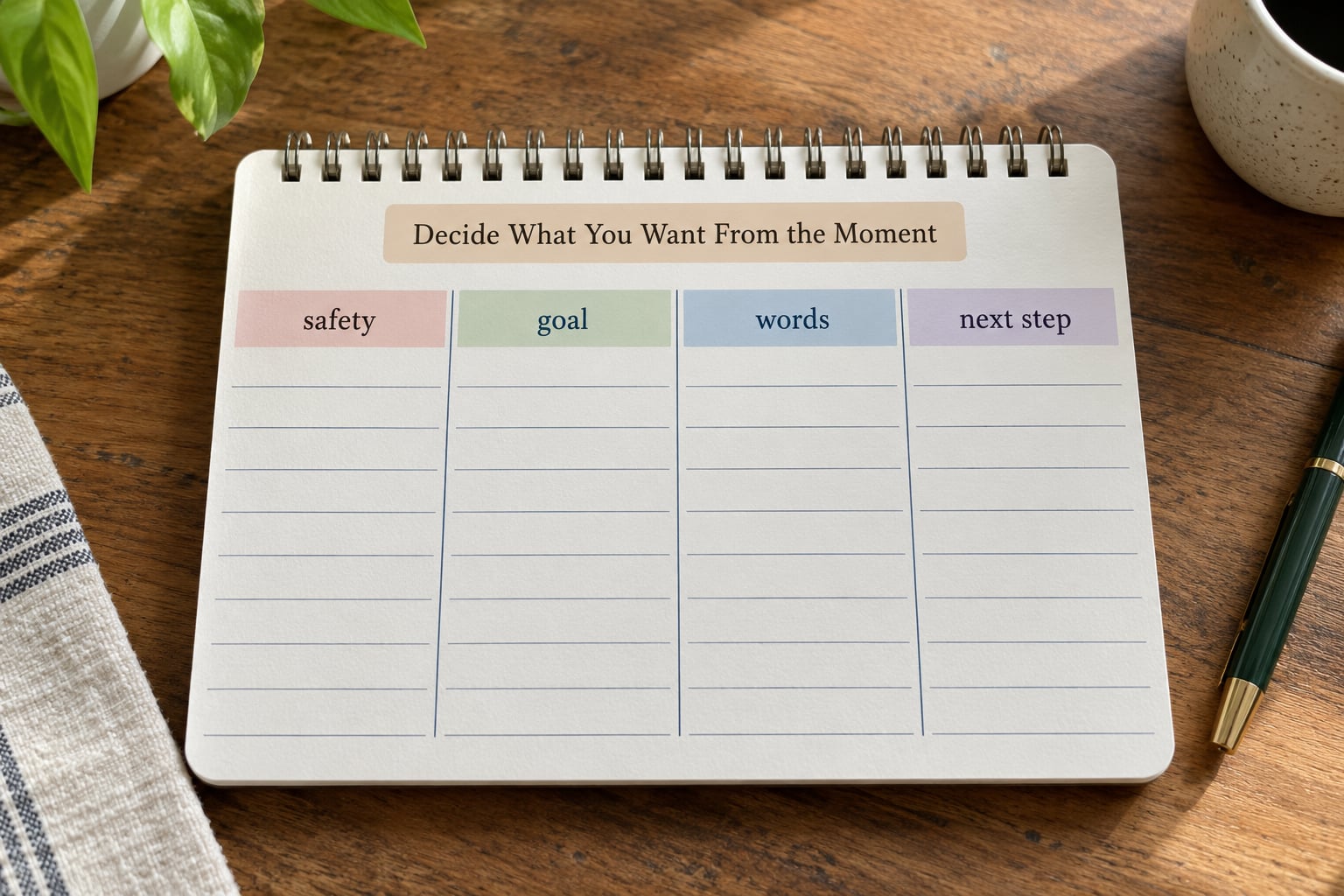
Choose one objective, and choose it before you speak. There are five realistic ones.
- Stop the comment. “That’s not okay here.” The goal is a quiet room, not a changed mind.
- Make the impact clear. “I’m not comfortable with that.” The goal is for the speaker to understand it landed.
- Protect someone else. “She doesn’t find that funny, and neither does the rest of this table.” The goal is to take the heat off a person who cannot take it themselves.
- Open a real conversation. “Can you explain what you mean by that?” The goal is understanding, and it only makes sense with someone who seems willing to be honest.
- Preserve the record. “I’m going to ask you to stop, and if it happens again I’ll raise it with HR.” The goal is what comes after today.
Most of the time you want the first one. Trying to combine stop-the-comment with open-a-conversation is the most common reason responses fail, because the speaker hears a challenge and defends themselves while the original comment sits unchallenged in the air.
3. Name the Problem Without Arguing About Intent
Name the behavior, not the person, and describe it in words the speaker cannot argue with. “That was a racist joke” starts a debate about whether you are too sensitive. “That joke used a slur that people get called in real life” describes something that happened.
Some sentences that do that work:
- “I don’t find that funny, and I’m not laughing.”
- “That comment treated a whole group of people as a punchline.”
- “Say what you actually mean instead of using that as a code.”
- “I don’t understand the reference. Can you explain it?”
- “Please don’t use that word in this space.”
A short version that works well because it makes no accusation: I don’t like using racial slurs. It is a statement about you, not a verdict on them, which takes away the easiest escape route. Another approach some people use is to answer with a completely serious face and ask how exactly it was funny, which forces the joke into daylight where it usually does not survive.
Keep the sentence under about fifteen words and then stop talking. Every extra clause is a new opening for a rebuttal, and a rebuttal is a way of putting the comment back on the table.
4. Set a Clear Boundary and State the Consequence
A boundary has two halves: what you need them to do, and what you will do if they don’t. Say both, in that order, without raising your voice. A quiet voice in a room gets more attention than a loud one, and it takes the drama out of the moment for everyone watching.
Here are the shapes that work in different rooms.
- Quiet, among friends: “I need you to stop that. It’s not a joke and it’s not my thing.”
- Family dinner: “I’m not going to argue about this at dinner. I want to talk about it later, when it’s just us.” Then actually bring it up later, privately, or it becomes a repeated performance at every holiday.
- Work, with a peer: “Please take that out of this meeting. If it comes up again I’m going to mention it to our manager.”
- Work, with your boss: “I’d like to talk about that comment separately, so we’re not having this discussion in front of the team.” Keep the record afterwards, in writing to yourself, with the date and who was there.
- Public, with a stranger: “Don’t talk to me like that.” Then keep walking. You do not owe a stranger an explanation.
- Online, in a group chat: “Take it out. I’m not going to keep reading this thread.” Mute and leave is a complete response, and in a comment section it is often the strongest one.
You will know the boundary landed if one of three things happens: the comment stops, the speaker apologizes or goes quiet, or they push back and reveal that this is a pattern you now have information about. All three count as a clear response. A silent room is not a failed intervention; it is the outcome you were aiming for.
5. Choose Whether to Explain, Redirect, or Leave
There are four real options, and mixing them is what turns a response into a fight.
Explain, briefly. One or two sentences of why the remark lands where it does, aimed at a speaker who seems to be asking rather than attacking. If they are arguing in bad faith, stop explaining after the first attempt.
Redirect. Change the subject so the comment has nowhere to go. This works well with a group that is comfortable with you and will follow your lead, and it works badly when your redirect makes the speaker look interesting to the audience.
Document. When the cost of speaking is high, keep a record: date, time, who was present, what was said, in your own notes, sent to yourself by email. Documentation does nothing on its own, but a pattern documented over three months is a completely different conversation from a complaint filed on a bad afternoon.
Leave. Say one line, or say nothing, and go. Leaving is the correct response when the person is escalating, when the setting rewards volume, when you are outnumbered, when you are physically alone, or when the cost of staying is your job, your visa status, or your safety. People who have actually faced this tend to agree on one point: being told plainly that stepping away is legitimate, not cowardly, is what separates useful advice from moral grandstanding.
Extra discussion creates risk in one specific case. If the speaker is enjoying the exchange, or has an audience waiting for a performance, further explanation is a reward rather than a correction. Say the line, then leave the stage.
6. Move Toward Repair or Accountability
The next step is usually smaller than people expect. A useful outcome is one of four things: an apology that comes with changed behavior, a short written correction where the damage was public, removal from a space where they are not welcome, or a formal process through HR, a school, a landlord, a platform, or in some cases police.
Watch what an apology contains. A real one has three parts: naming the specific thing, taking responsibility without excuses, and saying what will be different. “I’m sorry, I made a joke about accents and that was stupid, I won’t do it again” clears all three. “Sorry if you were offended” clears none, because it locates the problem in your reaction and hands the speaker a way to have tried without consequence.
Then support the person who was targeted, carefully. Do not debrief them, do not ask them to describe how they felt in front of the room, and do not treat their response as a decision you get to override. Offering “I’m here if you want to talk about it” respects that some people would rather never touch it again.
7. Follow Up and Check Your Own Well-Being
Give the interaction a clear endpoint. When it is over, tell one trusted person what happened. Not for advice, mostly. Holding a racial comment alone for weeks is heavier than most people expect, and saying it out loud to a friend tends to be what releases the pressure.
Notice the lingering effects honestly. Anger that lasts a week, replaying the comment every time you are in that building, dread before a family dinner, or the specific exhaustion of having to be the person who raises it every time, are all reasons to talk to someone you trust, a counselor, or your doctor. That is ordinary care-seeking, not an overreaction, and it is not a medical claim about you.
Also decide whether the pattern continues. One comment is a conversation. The same comment three times, or once and escalating, is a reason to put it in writing to a manager, a school administrator, a platform, or whoever controls the space you are both in.
Common Mistakes and How to Fix Them
Mistake 1: Trying to Prove Exactly What the Speaker Meant
Debating intent is the most common way responses get derailed. Was it a joke? Do they even know what they said? The argument can run for twenty minutes and end with no acknowledgment of the remark itself.
The fix: go back to what was observable. “You said that, here’s how it lands, here’s what I need.” You never have to establish that anyone meant harm in order to decide you don’t want to hear it again. And this is why the response can stay about the comment instead of the character: saying something offensive does not automatically make someone an irredeemable person, it just gives you information about what to do next.
Mistake 2: Returning Insults or Escalating the Argument
Plenty of people search for savage replies to racist comments, and the demand is obvious. It is also the trap. Insults put you in the same category as the person you are correcting, expose you to whatever retaliation is coming, and give the speaker a story about you that crowds out the remark they made.
The fix: aim at the behavior and keep the volume down. Lowering your voice while the room is loud is itself a demonstration of control, and it makes the comment look worse by contrast, not better.
Mistake 3: Demanding an Immediate Apology
“Say you’re sorry” in front of an audience puts a public performance on the bill. It produces silence, defensiveness, or a formulaic apology said for the crowd, and none of those tell you whether anything will be different on Tuesday.
The fix: drop the demand and keep the standard. State the boundary, then watch the next three interactions. Behavior over time is the only reliable signal, and it costs you nothing to wait for it.
Mistake 4: Making the Target Person Defend Their Experience
Asking someone targeted by racism to explain, contextualize, or prove a comment was offensive before you will act hands them your work. A very common version of this looks like an “inadvertent” comment followed by the person it landed on wondering whether they are even allowed to be bothered by something said so casually.
The fix: believe them on the first telling and act on that. If you are unsure, say “I believe you, and I want to check whether this happens here too,” then go verify. The burden of proof sits with the standard, not with the person who was insulted.
Quick Tips for High-Stakes Moments
- Use the pause. Three seconds of silence before you answer reads as confidence, not hesitation. Everyone else in the room is waiting for you to speak first.
- Lower your volume. Nothing requires raising your voice, and doing so hands the room back to the person who shouted.
- Repeat the boundary once. Say it, then say the same thing again. Repetition ends most exchanges that a first attempt did not.
- Name the behavior, not the person. “That joke is racist” beats “you’re a racist,” because the first leaves a door open and the second only invites a debate about the label.
- Name the concrete next step. “I’m going to ask you to stop. If it happens again I’ll tell my manager.” A specific next step is easier to follow than an appeal to respect.
- Move your body. Turning toward the person who was targeted, or toward the door, is a complete sentence on its own.
Frequently Asked Questions
What if I freeze or feel shocked when someone says something racist?
The freeze is a normal stress response, not a character flaw, and it happens to the people who care most. The fix is rehearsal, not willpower. Pick two short sentences and say them out loud five times until they stop feeling like lines. In the moment, buy time with a question: can you clarify what you mean by that? Then use the silence while they answer to find your words. Doing something small counts too, such as asking someone near you if they are okay.
How do I respond when the racist comment comes from a boss, teacher, or family member?
With anyone who controls your money, your grades, or your family access, match your method to your leverage. Skip public confrontation. Ask for a private conversation, state the impact in one sentence, name a concrete standard, and then keep a private written record with dates. For family, the same approach works but the deadline is longer: bring it up later when it is just the two of you, and only keep showing up if the behavior actually changes.
Should I explain why a comment is racist, or is that the speaker’s responsibility?
Briefly, once, and only to someone who seems to be asking. Two sentences of explanation can help a person who is genuinely unaware. It cannot repair a person arguing in bad faith, because an argument is not an information gap. If your first explanation gets you a dismissal, a laugh, or a pivot, stop explaining and restate the boundary. The standard belongs to the space, not to your willingness to lecture.
What if the person apologizes but then repeats the joke?
Treat the repeat as new information rather than a setback. The apology was not sincere, or the person never understood the boundary, and either way talking is not what is needed. Say one sentence: I mentioned that this stops here, so I am going to leave. Then leave, and start documenting. When the same thing happens three times, a dated record in your own notes or an email to yourself is what turns a private annoyance into something a manager, school, or platform will act on.
How can I support a friend who was targeted without speaking for them?
Believe them the first time, and ask what kind of support they want instead of offering it. Some people want someone to report it; others want their dinner invitation to feel normal again. Offer the practical things you can control: your time, a ride, a copy of what was said, a second person who was there. Do not retell the story to other people, and do not treat their response as a decision for you to overrule.
Conclusion: Start With Safety, Then Set a Firm Boundary
Start with safety, then set a firm boundary. Check who you are talking to and what it would cost you to be wrong, pick one goal, name the behavior in a sentence you rehearsed beforehand, say what you need next, and stop talking.
And remember the part most advice leaves out. Silence and confrontation are not the only two options on the table. Questioning, redirecting, documenting, and leaving are all real responses, and choosing one of them is choosing to respond, not choosing to do nothing. What is not a response is deciding later, alone, in your car, that you should have said something.