
Equality means giving everyone the same treatment, resources, or opportunity. Equity means giving people different amounts or kinds of support based on what they actually need, so that a fair shot becomes real rather than theoretical. In short: equality is sameness, equity is fairness.
The two words are easy to mix up because they grew out of the same Latin root, aequus, meaning even, plain, or just. But in practice they point at two different questions. Equality asks, “Are we treating everyone the same?” Equity asks, “Is that treatment actually fair here?”
Below is a plain-language breakdown, with worked examples from schools, workplaces, clinics, and public buildings, plus a short look at the criticism that surrounds the word.
Table of Contents
- What Does Equity Mean Compared to Equality? at a Glance
- What Is Equality?
- What Is Equity?
- What Does Equity Mean Compared to Equality?
- Equity Compared With Equality: What Changes in Practice
- Equity Compared With Equality: A Workplace Example
- Where Equality and Equity Work Together
- Does Equity Mean Everyone Gets a Different Outcome?
- Does Equity Replace Equality?
- How to Apply Equity in Everyday Decisions
- What Does Equity Mean Compared to Equality in Education and Health?
- Which Approach Should You Choose?
- Frequently Asked Questions
- Is equity the same as giving everyone something different?
- What is an example of equity in a school?
- Why can equality still be unfair?
- Does equity mean lower expectations for some people?
- How can an organization measure equity?
- Conclusion
What Does Equity Mean Compared to Equality? at a Glance
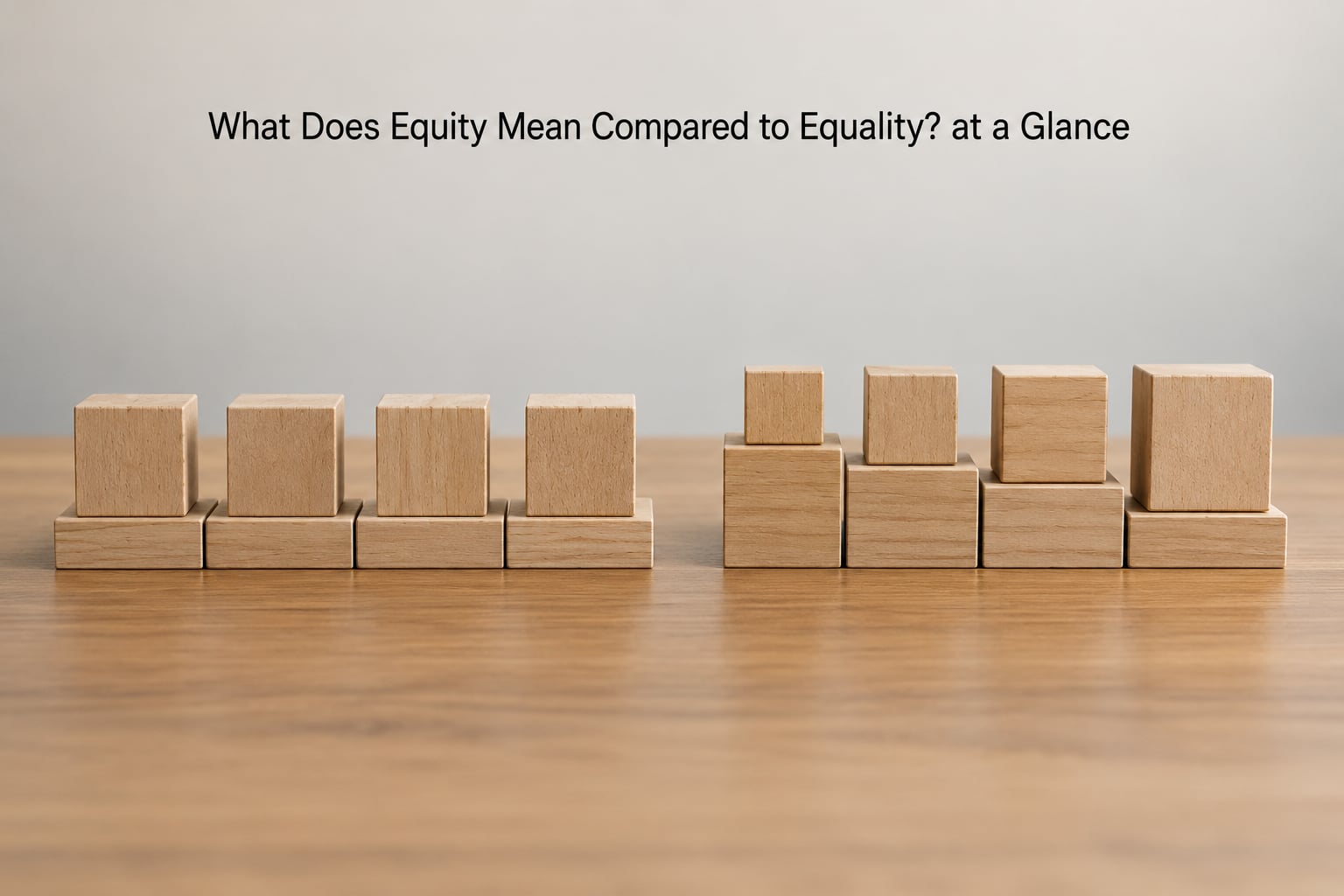
| Dimension | Equality | Equity |
|---|---|---|
| Core definition | The state of being equal; the same treatment or opportunity offered to everyone | Fair distribution, adjusted for differing needs and circumstances |
| Purpose | To prevent favoritism and ensure nobody is singled out | To remove barriers that sameness alone leaves in place |
| Approach | One rule applied uniformly | Rules plus targeted adjustments for documented circumstances |
| Fair result | Equal opportunity offered, outcomes still vary | Comparable opportunity to take part and succeed |
| Typical example | Every student gets the same device and the same packet of materials | Every student gets the device, plus captions, extra time, or a tutor when reading is the barrier |
| Strength | Simple, transparent, hard to argue with | Actually reaches the people the same rule was holding back |
| Common criticism | Can leave people behind while looking fair on paper | Depends on whose judgment defines “need,” so it needs evidence and review |
What Is Equality?
Equality is the state of being equal: the same rule, the same amount, or the same opportunity extended to every person without regard to who they are. In law and in organizations, equality is usually treated as the baseline, the floor that says nobody gets less simply because of who they are.
Equality works on one assumption: that people begin from roughly the same place. Hand everyone the same thing and, the theory goes, the results should be broadly fair. That assumption is where the trouble starts, because people do not begin from the same place.
The classic illustration is three people and a set of boxes. The first person’s box is small, the second’s is medium, the third’s is large, and a stack of blocks sits on the ground nearby. Everyone gets the same 100 blocks and the same instruction to build as high as they can. The tall stack stays tall, the small one stays low. Nothing about the rule was unfair, and the gap is still there.
Equal is not the same as equitable. That single distinction explains most of the confusion people bring to this topic.
What Is Equity?
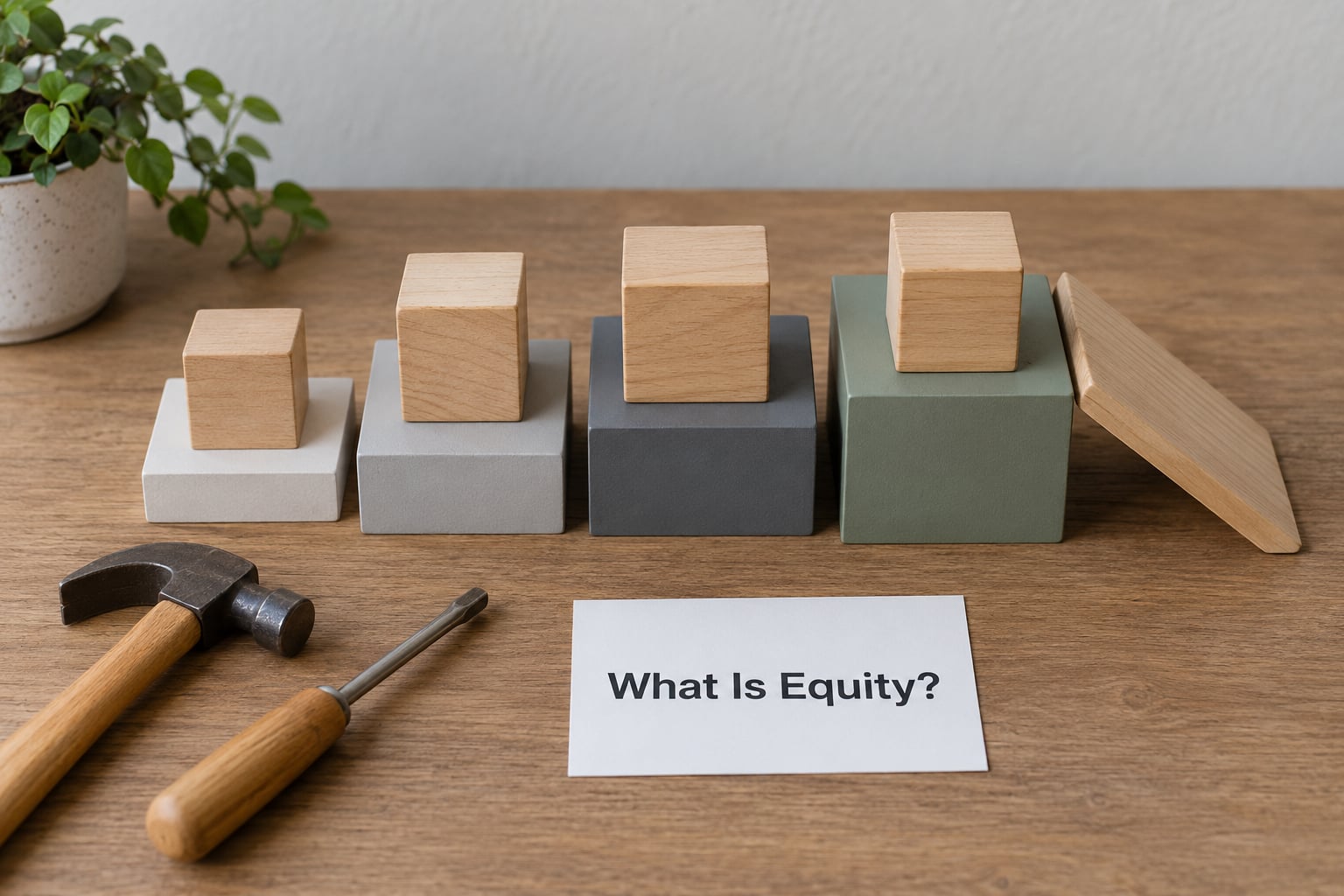
Equity is the quality of being fair and impartial, and fairness in practice means giving people different support so that they have a comparable chance to take part. Instead of one fixed input, you vary the input. The person with the small box gets extra blocks or a platform. The person using a wheelchair gets a ramp or an elevator because the stairs-only entrance is a barrier, not a preference.
Equity is not the same as being generous with everyone’s money. It is a narrower claim: that when a rule operates on people who start from different positions, some adjustment is owed. That adjustment can be money, time, accessible formats, a different testing window, or simply a schedule that fits a person who cannot attend at six on a Wednesday.
Be honest about the weak spot here. Equity depends on a judgment about what someone needs, and that judgment can be argued with. Two administrators can look at the same case and disagree. That is why serious equity work leans on evidence, clear criteria, and a review date rather than on anyone’s instinct alone.
What Does Equity Mean Compared to Equality?
The honest one-line answer: equity differs from equality because equity varies the inputs to match the circumstances, while equality keeps the inputs the same and accepts whatever outcomes follow. Same rules versus fair results in the attempt. That is the whole argument, and everything below is a consequence of it.
Two clarifications keep this from sliding into vagueness. First, equity is not identical treatment reversed. It is not a rule that favors one group on principle. It is a response to a specific, documented obstacle. Second, equity does not promise identical outcomes, because outcomes also depend on choices, effort, and luck that no allocation scheme controls.
Equity Compared With Equality: What Changes in Practice
Five things shift when you move from an equal approach to an equitable one.
Purpose. Equality aims at impartiality: no exceptions, no favorites. Equity aims at fair participation: the people most affected by a barrier get attention first.
Decision-making. Equality asks whether the rule was applied consistently to everyone. Equity asks who the rule was written for, and who it quietly does not reach.
Resource distribution. Equality spreads resources evenly. Equity spreads resources in proportion to need, which usually means uneven spending by design.
Measurement. Equal programs are checked by confirming everyone received the same thing. Equitable programs are checked by asking whether the people who were previously excluded are now participating.
Desired result. Equality wants equal opportunity on the table. Equity wants equal opportunity in practice, which is a higher bar and a messier one to hit.
Equity Compared With Equality: A Workplace Example
Say two new hires start the same week on the same team. Equality gives them the identical two-day orientation on a Monday and Tuesday, recorded once, watched later by anyone who missed it.
One of them has dyslexia and takes three times as long to process a written brief. The equitable version of that same orientation is the same content, delivered in a way they can actually use: slides read aloud, a transcript in advance, and permission to ask for the brief a day early so there is time to absorb it.
Notice what equity does not mean here. Nobody promised the promotion. Nobody promised equal output by Friday. The adjustment is narrower than that: the material reaches the person who otherwise could not use it.
Where Equality and Equity Work Together
They are not rivals, and treating them as rivals wastes the useful part of each. Equality supplies the floor. Equity closes the specific gaps the floor does not cover.
You need the equality part: a published standard everyone is held to, the same rights, the same protections. Skip that and equity becomes a series of private favors with no standard at all, which is a genuinely worse outcome and a common criticism worth taking seriously.
You need the equity part too. A rule can be applied flawlessly to everyone and still exclude the person it was written around. Adjusting for that is not a violation of the rule. It is the rule doing its job.
A useful test: does the equal approach deliver the intended result to everyone it reaches? If yes, stop. If it reliably misses a documented group, adjust and write down why.
Does Equity Mean Everyone Gets a Different Outcome?
No, and this is where a lot of the arguing starts. Equity of opportunity means removing barriers so people can compete on fair terms. Equity of outcome means trying to make the results themselves equal, whatever it takes. Most of what institutions call equity is the first kind, not the second.
Users of these words often repeat a shortcut that sounds right and is technically wrong: equality is equal opportunity, equity is equal outcome. Swap in the more accurate version. Equity means making the opportunity genuinely comparable, not engineering the finish line.
If equity meant guaranteed equal results, it would be favoritism, and no institution could defend it. That is not what the word means.
Does Equity Replace Equality?
It does not have to, and mature organizations stop choosing between them. One of the more common framings in the public debate is that equity may be the temporary method used while a system is rebuilt, with equality still the stated destination. Equity as scaffolding, equality as the structure.
The same idea circulates in shorter form: equality is the goal, equity is how you get there. It is a clean way to frame the choice, and it is also the reason equity programs tend to have review dates attached. If nothing changes, the adjustments were not addressing a real barrier and should not continue.
The criticism you will hear most often is that equity hides redistribution behind a friendly word. Sometimes that is fair. What settles it is whether the adjustment is tied to evidence about a barrier and applied under a rule anyone could read.
How to Apply Equity in Everyday Decisions
You do not need a committee to run this. Five questions work in a staff meeting, a classroom, or a budget review.
1. Who is affected? Name the actual people, not “users” in the abstract. Usually someone in the room has a direct example.
2. What barriers exist? Money, time, transport, language, disability, hours that clash with shift work, a form only readable on a phone.
3. What does equal treatment miss? Hand out the identical option and walk through who cannot use it. The list writes itself.
4. What support is needed? Pick the smallest adjustment that removes the specific barrier. A caption track, a different time slot, a bus pass, a tutor for a term.
5. How will you know it worked? Set a measure and a date. If participation in the group that was excluded does not move, the adjustment was aimed wrong.
Write the answers down. The point is not the document, it is forcing yourself past the comfortable part where everyone gets the same thing.
What Does Equity Mean Compared to Equality in Education and Health?
In schools. Equality is the same device and the same worksheet issued to every student. Equity adds whatever is missing for a student to use them: captions on the video, the text in an accessible format, extra reading time, or a tutor for the term when reading speed is the obstacle. Same funding formula, different support, different outcome for the student.
In clinics. Equality means everyone receives the same clinical service and the same appointment process. Equity means adding interpretation, transport help, phone follow-up for people who cannot easily come back in person, or scheduling that does not assume a nine-to-five workday. The medical service does not change. The path to receiving it does.
Both cases follow the same shape. The service itself is equal; the access to it is what equity adjusts. That is why equity conversations get heated whenever somebody assumes the support itself is unequal treatment.
Which Approach Should You Choose?
Choose equality when the rule is genuinely neutral, the people it serves start from similar positions, and you have no evidence of a gap. Equal treatment is simpler, cheaper, and easier to defend.
Choose equity when you can point at a specific barrier affecting a specific group and the equal rule demonstrably does not clear it. Adjust the input, keep the standard, document the reason, and set a date to check the result.
Combine them, which is what most defensible practice looks like: publish the equal standard so everyone knows the baseline, then fund the adjustments that let people reach it. That combination is what the comparison is really asking for. Neither word wins on its own.
Frequently Asked Questions
Is equity the same as giving everyone something different?
Not quite. Giving everyone something different can be arbitrary, and arbitrary help is not equity. Equity means the difference is tied to a documented barrier or need, decided by a rule you could write down and apply again to the next person in the same situation. The test is whether the reasoning would survive being repeated for someone else.
What is an example of equity in a school?
Every student receives the same laptop under an equality approach. Under an equity approach, each student also gets what lets them actually use it: captions on lecture videos, materials in an accessible format, extra time on reading-heavy work, or a tutor when reading speed is the barrier. The device is identical; the support varies with need.
Why can equality still be unfair?
Because equality assumes people start from the same position, which is usually false. A single building entrance with only stairs treats everyone identically on paper while making the entrance unusable for a wheelchair user. Nothing about the rule changed and no one was singled out, yet the same treatment produced a plainly unequal result.
Does equity mean lower expectations for some people?
No. Equity changes the support, not the bar. A student who gets extra reading time is still expected to master the same material, and an employee who gets materials in advance is still accountable for the same output. Where equity lowers a standard, that is a failure of design, and it is worth naming as one.
How can an organization measure equity?
Start by comparing groups on the thing that matters: who enrolls, who gets promoted, who finishes the program, who uses the service. Look at access barriers directly through surveys and request patterns. Track the same measure over time, keep the criteria for adjustments written down, and review on a schedule so support that stopped helping gets removed.
Conclusion
Equality keeps the inputs the same; equity varies the inputs so the opportunity is real. Start by taking one rule you currently apply to everyone and asking who it quietly does not reach. That question is where the work begins, updated for October 2026.