
Restorative justice in schools is an approach to student discipline that swaps out exclusionary punishment for structured conversations, circles, and conferences designed to repair harm, rebuild relationships, and reintegrate students into the school community. Instead of a student serving consequence alone, the people affected come together with a trained facilitator to work out what happened and what would make things right.
That 45-second answer is the easy part. The harder part is that schools calling this “restorative justice” mean very different things, and some of them get it badly wrong. This guide covers what the approach actually involves, where the evidence is strong, and where the honest criticisms are.
We have updated this for 2026, and the picture has not changed much: adoption has grown faster than the training and coaching behind it. That gap is the single biggest reason schools report disappointing results.
Table of Contents
- What Is Restorative Justice in Schools?
- How Does Restorative Justice Work in Schools?
- What Is Restorative Justice in Schools in Practice?
- Core Practices for a Restorative School
- Benefits, Limits, and Risks
- How Can Schools Implement Restorative Justice Responsibly?
- Is Restorative Justice Right for Every Situation?
- Frequently Asked Questions
- What are the 5 R’s of restorative practices in schools?
- What are some examples of restorative practice in schools?
- What are some criticisms of restorative practice in schools?
- How effective is restorative justice in schools?
- Are restorative practices evidence-based?
- What is the difference between restorative justice and restorative practices?
- Conclusion
What Is Restorative Justice in Schools?
Restorative justice asks one question in place of “what rule did you break?” It asks what happened, who was affected, and what needs to change so the harm does not repeat. Accountability still exists, but it takes the form of an agreement the people helped write rather than a consequence handed down from above.
Three terms get tangled constantly, and sorting them out helps. Restorative justice is the response to a specific incident. Restorative practices is the wider set of relational habits a school builds every day. Social-emotional learning teaches students to recognize and manage their own emotions; it is compatible, but it is not the same thing.
| Approach | Core question | Typical response | Main limit |
|---|---|---|---|
| Restorative justice | What harm occurred and how do we repair it? | Circle, conference, mediation, reparative agreement | Needs a trained facilitator and real time |
| Restorative practices | How do we build relationships that prevent harm? | Morning meetings, circles of support, check-ins | Slow to take hold, often starts as a slogan |
| Social-emotional learning | How do students understand their own emotions? | Lessons, regulation tools, advisory time | Say little about repairing specific harm |
| Traditional discipline | What consequence fits the offense? | Detention, suspension, loss of privileges | Teaches little and predicts little |
| Zero tolerance | How do we remove anyone who breaks a rule? | Automatic removal, sometimes for days | Disproportionate impact on Black, disabled and LGBTQ+ students |
The shift away from zero tolerance matters because the old model did not even work on its own terms. An American Institutes for Research study of New York City schools found that suspending students did not reduce their future misbehavior.
How Does Restorative Justice Work in Schools?
Most processes follow a similar arc, whether the harm is a damaged textbook or a fight in a hallway. The order matters more than the format.
Preparation. A trained facilitator gathers the people involved, checks for safety issues and legal requirements first, and sets a clear purpose. Preparation is where most rushed implementations fail.
Recognizing the harm. Participants describe what happened and its impact. The person who caused harm is generally asked to do this before anyone else, because naming the harm honestly is the beginning of accountability.
Dialogue. Everyone affected gets to speak, including staff and family. The facilitator holds the ground rules: no interrupting, no insults, no spectators.
Agreement. The group works out what will repair the harm. That might mean replacing the materials, a written apology, a changed seating plan, or a plan to stay away from a specific person.
Repair and follow-up. Someone checks that the agreement happened, usually two to four weeks later. Agendas that skip this step tend to gather dust after the first month.
What Is Restorative Justice in Schools in Practice?
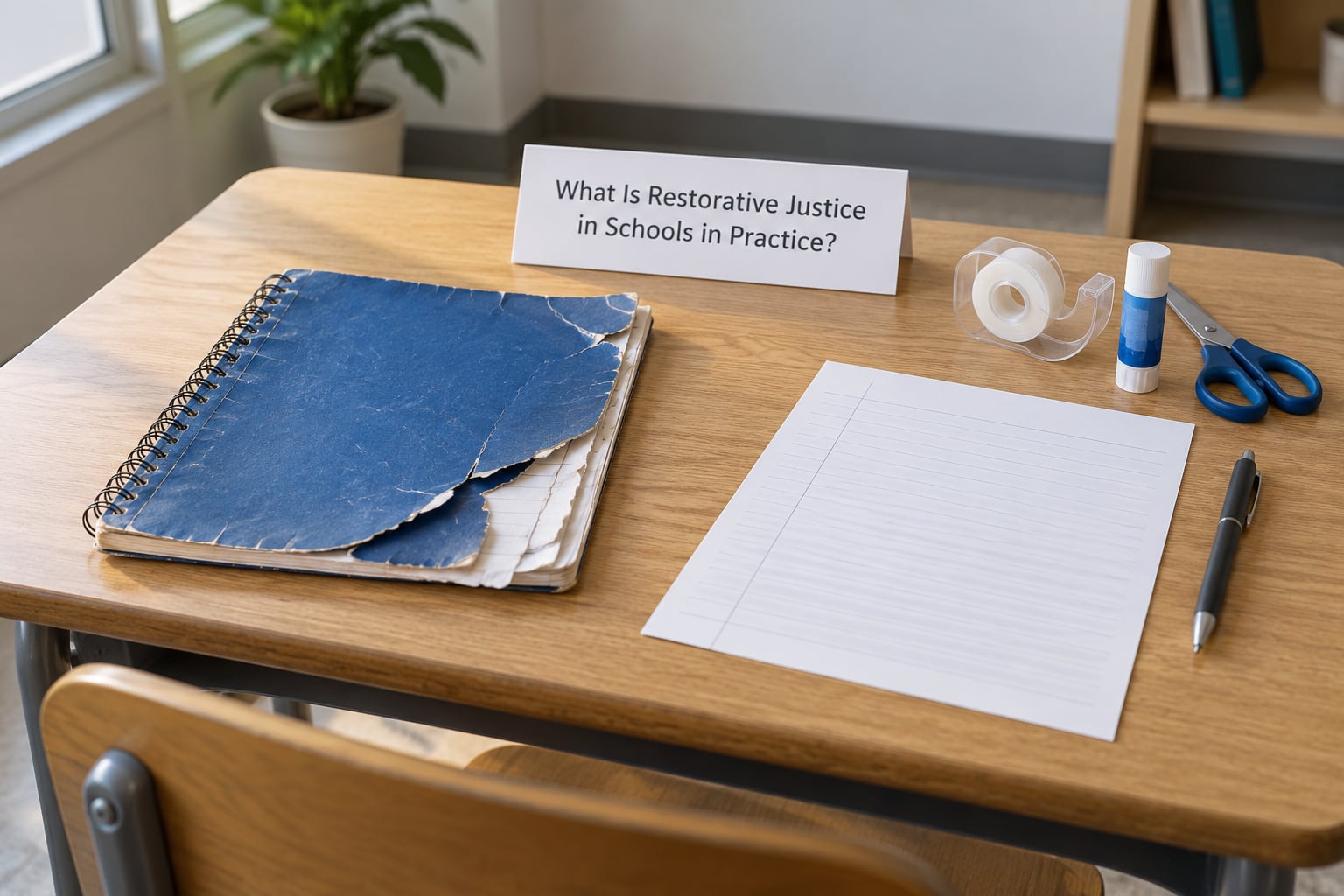
Consider a common scenario: a student leaves a group project in pieces, another student has been excluded from the group since September, and a week later the first student’s laptop is scratched in what may or may not be retaliation.
A restorative approach would not treat those as two unrelated incidents. A facilitator would meet with the students separately, hear both accounts, and check on the student who has been sitting out of the group all semester. Only then would everyone come together, with a chaperone present, and with clear ground rules.
Two protections matter here. First, participation in the dialogue portion should be something the harmed student can decline without losing access to any remedy, because being made to forgive someone is its own harm. Second, an adult must stay in the room whenever there is any history of intimidation, harassment, or a power gap between the participants.
Facilitators who run these regularly use a short set of questions to keep the conversation from sliding into argument. They ask what the impact was on people, what needs repairing, and what the student is agreeing to do differently. Then they keep asking the two simplest questions in the room: what do you need, and what could you offer?
Core Practices for a Restorative School
Schools that do this well usually describe their work with the same five verbs. Ask around a district and you will hear them more than you hear the word “justice.”
- Relate – build the relationships that make conversation possible in the first place.
- Regulate – teach and practice the emotional skills people need to stay in the room.
- Reason – support students in thinking through cause, effect, and other people’s experience.
- Repair – address the specific harm that was done and what would make it right.
- Reintegrate – bring the person back into the community after the response is complete.
The named practices fall into three tiers, which is how most districts structure staffing and time.
| Tier | Purpose | Who is involved | Example practices |
|---|---|---|---|
| Tier 1: Prevention | Build belonging and skills before harm happens | Whole class or school, plus staff | Morning meetings, circles of support, advisory, classroom respect agreements |
| Tier 2: Intervention | Respond to a specific conflict or harm | Those involved, a trained facilitator, sometimes family | Restorative circle, mediation, restorative conference, reparative actions |
| Tier 3: Reintegration | Support a student returning after exclusion or absence | Returning student, support staff, key teachers | Reentry conference, wraparound support, academic catch-up, peer mentor |
Alongside those tiers, schools need infrastructure, not just enthusiasm. That means facilitators who have actually been trained, a written referral path so anyone can get a case reviewed, agreements that get documented, and follow-up that someone is accountable for. A glossary of the core practices helps keep the vocabulary straight: a restorative circle is a structured group dialogue, a restorative conference is a formal meeting about a serious incident, peer mediation is a trained-student process for smaller conflicts, and reparative action is the repair work a student agrees to do, like replacing what was damaged.
Benefits, Limits, and Risks
The evidence is worth taking seriously, with caveats attached. A University of Chicago Education Lab study of Chicago Public Schools, covering school years from 2013-14 through 2018-19, found a 35 percent drop in in-school arrests, a 15 percent drop in out-of-school arrests, and an 18 percent drop in out-of-school suspensions associated with the school’s restorative practices work. Oakland Unified ran a pilot that reported an 87 percent reduction in suspensions. A systematic review by Lodi and colleagues looked at the wider body of school-based restorative research.
Here is where I would push back on the usual presentation of those numbers. Effect sizes like these come from specific schools with specific staff, and schools that implement well are also usually schools that already have coaching, staffing time, and leadership attention. The co-author of the Chicago study, Anjali Adukia, has been explicit that implementation quality drives the results. Treat the numbers as evidence that this can work well, not as a promise any school can import.
The criticisms are real and educators raise them constantly.
- It takes time. Teachers say restorative justice cannot be rushed and does not survive a twenty-minute slot followed by a bell. That is an accurate description of most implementation failures.
- Participation can be coerced. When a student who caused harm “participates” because the alternative is a longer suspension, the agreement carries little weight.
- The burden can shift. Circles can quietly pressure the student who was harmed to forgive, move on, and drop the complaint.
- Non-participation stalls repair. Educators describe students who refuse to speak or who treat the process as theater, and without an alternative pathway the harm stays unrepaired.
- Fidelity is uneven. Districts announce programs, allocate money, and sometimes leave the funds unspent while teachers get no training at all.
- Culture takes about three years. Practitioners consistently describe roughly three years of steady practice before relational habits actually change.
None of these are reasons to skip it. They are reasons to fund it properly. Teacher frustration with “too soft” discipline is usually a complaint about a program that promised repair but never delivered accountability.
Equity deserves separate attention. Black students, students with disabilities, and LGBTQ+ students have long received harsher discipline in US schools, and a circle run by untrained staff can reproduce that skew just as easily. There is no restorative justice in schools without racial justice, because a process that only reaches the kids least likely to be suspended is just another version of the old system.
How Can Schools Implement Restorative Justice Responsibly?
A pilot is the only approach I would recommend. Here is a sequence that works.
- Audit your discipline data first. Look at who gets suspended, by race, disability status, and gender. If the gaps are large, say so out loud before you start.
- Review your policies and handbooks. Define clearly what moves to a restorative process and what never does.
- Pick two or three staff for training. Not the whole school. Start with people who have credibility with students and time in their day.
- Train to competency, not exposure. Facilitation practice, active listening, and how to handle a session that turns into an argument. A single half-day workshop is not training.
- Start low-stakes. Run morning meetings and classroom agreements first. Hold off on rewriting suspension policy until the relational habits exist.
- Build a written referral path. Any staff member should know exactly who to contact and what happens next.
- Screen for safety and legal duty first. Mandatory reporting obligations and civil-rights procedures come before any conversation.
- Fund the follow-up. Budget for coaching and stipends. This is the line item that gets cut first and the one the research keeps pointing to.
- Measure repair, not just referrals. Track how many agreements were completed and how students describe belonging, alongside suspension numbers.
- Communicate with families before you need them. Explain what the process is, what it is not, and what happens if a child does not want to take part.
One practitioner suggestion worth repeating: run the pilot as opt-in, keep the early elements low-stakes, and save the hot-button policy changes for year two or three. That sequence keeps staff resistance manageable while the culture forms.
Is Restorative Justice Right for Every Situation?
No, and a program that says yes to everything is a program that will fail. Some things come before any conversation: an immediate threat to safety, an act of violence severe enough to require a formal response, mandated reporting duties, suspected abuse, or anything covered by civil-rights complaint procedures or a student’s disability accommodations.
Legal obligations do not pause for a circle. A restorative process can follow the formal process, not replace it, and no facilitator should be deciding on their own whether a reporting threshold has been crossed.
Even inside the restorative frame, the harmed student has the right to an alternative remedy that does not depend on talking to the person who harmed them. Repair is offered, never required as the price of a fair outcome.
Frequently Asked Questions
What are the 5 R’s of restorative practices in schools?
The 5 R’s are Relate, Regulate, Reason, Repair, and Reintegrate. Relate means building the relationships that make honest conversation possible. Regulate means teaching and practicing the emotional skills students need to stay in a hard conversation. Reason means supporting cause-and-effect thinking about who was affected. Repair means addressing the specific harm and what would make it right. Reintegrate means bringing the student back into the school community after the response is finished.
What are some examples of restorative practice in schools?
Common examples include classroom morning meetings and circles of sharing, respect agreements built with students, restorative circles after a conflict, peer mediation for smaller disputes, restorative conferences after a serious incident, reparative actions such as replacing damaged property, and reentry conferences for students returning from suspension or extended absence. A circle of support gathers several adults and peers around one struggling or returning student to plan practical help.
What are some criticisms of restorative practice in schools?
Educators raise several recurring objections. Circles consume instructional time and cannot be rushed. Participation can feel coerced when a student chooses a restorative process over a longer suspension. Circles can pressure the student who was harmed to forgive and drop a complaint. Students sometimes refuse to engage, leaving harm unrepaired. Districts also announce programs without funding training or coaching, and fidelity varies wildly between schools.
How effective is restorative justice in schools?
Evidence from individual districts is encouraging. A University of Chicago Education Lab study of Chicago Public Schools found 35 percent fewer in-school arrests and 18 percent fewer out-of-school suspensions, and Oakland Unified reported an 87 percent suspension reduction in its pilot. Results depend heavily on implementation quality, staffing, coaching, and time, so outcomes vary widely between schools running the same program.
Are restorative practices evidence-based?
There is a real research base, including a systematic review by Lodi and colleagues, and several large district studies with specific effect sizes. The evidence is not uniform, though. Studies differ in how they define restorative practices, and schools with strong outcomes usually have strong coaching and leadership support too, which makes it hard to isolate the model from the conditions around it.
What is the difference between restorative justice and restorative practices?
Restorative justice is a response to a specific incident, involving a structured conversation about harm and repair. Restorative practices is the broader set of everyday relational habits a school uses to prevent harm, such as morning meetings and circles of support. You can run a conference without building a restorative culture, though most practitioners say the daily practices are what make the response work when it is needed.
Conclusion
Restorative justice in schools replaces isolation with repair. The people affected by an incident come together, name the harm, and agree on what would make things right, with accountability attached to the agreement instead of to a consequence handed down in isolation.
If you are starting, do four things first. Build relationships in ordinary classrooms before you need them. Write down exactly what your process is and what it is not. Train a few people properly and budget for coaching. Then run one small pilot and measure whether repair actually happened, not just how many conferences you held.
And if you have been through a version of this that felt hollow, the odds are good it was missing one of those four things.