Fact-checking a viral social media post means slowing down, writing down the exact claim, finding where it came from, and testing it against independent evidence before you share it. Seven steps do most of the work: capture the claim, trace it to an original source, reverse search the media, check metadata, look for internal inconsistencies, cross-reference reputable outlets, and only then decide.
A post can be completely accurate and still be built to make you forward it in a hurry. That urgency is the whole trick, and it works on almost everyone. The fix is boring but effective: a repeatable routine you can run on a phone in about ten minutes.
This guide is written for people who are not journalists. No accounts, no subscriptions, no special software. Everything here works with a phone, a laptop, and tools that are free to use.
- Capture before you judge. Screenshot the whole post, including the account name and date, before you scroll away.
- Newest is not truest. Most recycled hoaxes are old clips wearing a new caption. Find the earliest version.
- Search sideways, not downwards. Leave the post and look for independent coverage rather than reading replies under it.
- Sharing is the decision that counts. You can always stop reading. You cannot un-send a forward into a group chat.
One more honest note before we start: some checks end ambiguously, and that is normal. Knowing when you do not know is a better outcome than a confident guess you pass on.
Table of Contents
- What You Need Before You Start
- The checklist
- Step-by-Step: How to Fact Check a Viral Social Media Post
- 1. Slow down and write down the exact claim
- 2. Trace the post back to its original source
- 3. Check the image, the video, or the quotation
- 4. Look for independent evidence
- 5. Judge the source and its evidence
- 6. Check the date, the place, and the missing context
- 7. Decide whether to share, correct, or walk away
- Common Mistakes That Make a Check Fail
- Frequently Asked Questions
- How do I fact check a post?
- How can you tell what is real and what is fake on social media?
- How do I check whether a story is true?
- How do I check for fake news on Google?
- Is FactCheck.org reliable?
- Is Reddit a reliable source of factual information?
- Conclusion: Slow Down First
What You Need Before You Start
You need about ten quiet minutes, the original post rather than a screenshot of a screenshot, and two search tools. That is the whole list. Everything else is optional.
The checklist
- The full post. Open it on the platform, not in a repost. You need the account name, the date, the caption, and the original media.
- A phone and, ideally, a laptop. Every step below works on a phone. A laptop just makes side-by-side comparison easier.
- Google Lens. Built into Google app or Chrome. Right-click, upload, or point the camera. It finds visually similar images across the web.
- TinEye. The specialist image search. It tracks where an image has appeared and how often it has been reused.
- InVID or Forensically. Browser extensions for video. They pull keyframes and run the frame back through reverse image search to find earlier uploads.
- A notebook or a notes app. Write down the claim in one sentence and the source in one line. Your memory will blur the two together within an hour.
- A short list of sources you trust. Two or three outlets you would call to confirm a story, plus one government or agency site for the topic. Writing them down now saves you deciding while you are worked up.
Pick the moment deliberately. The worst time to verify is in the middle of an argument or the first five minutes after you see something outrageous.
Step-by-Step: How to Fact Check a Viral Social Media Post
Run these seven steps in order. The order matters because each one either narrows the search or protects you from a mistake in the one before it. Roughly ten minutes, most of it spent waiting for search results.
1. Slow down and write down the exact claim
Most checks fail because people verify a post they have paraphrased in their head. Write the claim as a single testable sentence first: what exactly is being asserted, and by whom?
Screenshot the whole post, including the account name, the handle, the date, and the caption text. Then ask what kind of claim this is, because each type needs a different check.
- A statistic. Find where the number came from and check the population it measured.
- An event claim. Something happened, to someone, at a time and place. Find independent coverage.
- A quotation. Someone said these words. Search the exact sentence in quotes.
- A question or an opinion. There may be nothing to verify. Not every post contains a fact.
If you cannot write the claim in one sentence, you do not yet understand what you are being asked to believe. Go back and read the caption properly.
2. Trace the post back to its original source
Trace the post back to whoever made the claim first, not to whoever posted it last. Most false viral posts are a real thing plus a caption invented later.
Work backwards from what you have. Open the post, check the account’s history, and ask a few plain questions. Is the account new, or does it post nothing but this one dramatic claim? Does the same wording appear on several accounts at the same minute, which usually means a coordinated push? Does the account ever link to a source?
Then search the distinctive words from the caption in quotes. If the sentence appeared on a page months earlier with a different meaning, you have found the original, and you already know how the post got distorted.
For video, scroll back through the account’s older uploads. Hoaxers reuse footage constantly, and an account with one post and no followers is not a news source.
3. Check the image, the video, or the quotation
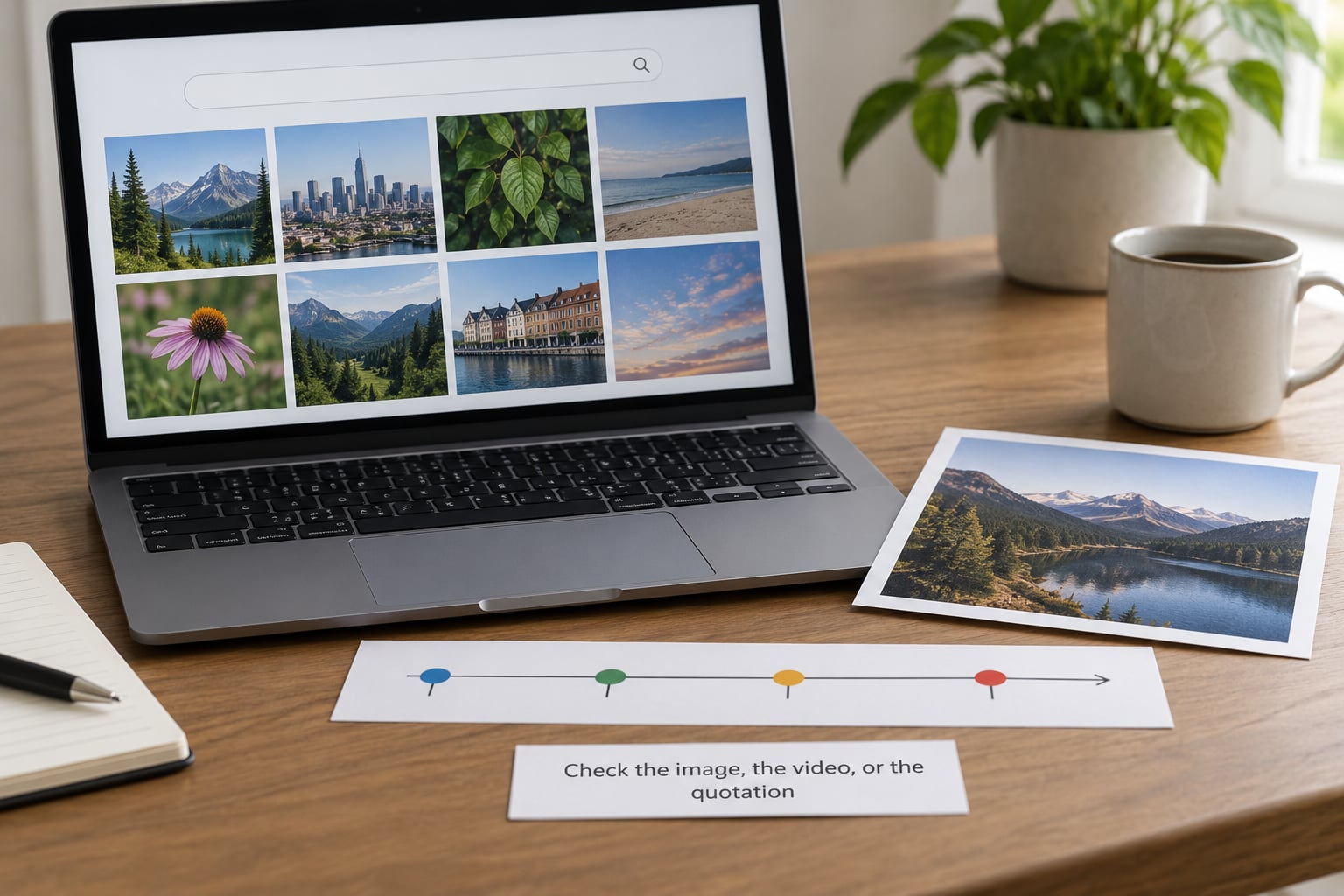
Run the media through a reverse image search and compare it with older versions. For a photo, save it and upload it to Google Lens and TinEye. For a video, use the InVID or Forensically extension to pull keyframes and search those instead.
Four failures account for most altered media, and all four are visible once you look for them.
- Recycled footage shown as current. An earlier upload with a different caption, location, or date. Reverse search the keyframes, not just the newest version.
- A staged scene presented as candid. Unusually tidy framing, everyone looking at the camera, or a moment that looks suspiciously composed.
- A cropped or altered image. Odd edges, mismatched lighting between a subject and its background, or a shadow pointing a different way from the sun.
- A miscaptioned screenshot. Text that doesn’t match the sender’s usual writing, or a conversation with no other party visible.
On AI-generated images and video, look at hands, teeth, reflections in mirrors or sunglasses, text on signs, and the way an object is gripped. Watch the video at quarter speed and look for a frame where a detail shifts. Then be honest about the limits: automatic AI detectors are unreliable on both sides of the call, and a photo carrying C2PA Content Credentials has a verifiable provenance record, while a photo without them may simply come from a camera app that never signed anything.
For a voice clip, there is no good free check for ordinary people. Treat any audio of a person saying something alarming or intimate as unverified until an outlet you trust has reported it independently.
4. Look for independent evidence
Find evidence that does not come from the post, its account, or its comment section. Search government agencies, official statements, court records, academic databases, and reputable newsrooms for the same claim.
The trick here is lateral reading. Instead of reading a claim and judging it on its face, open a new tab and check what other sources say about it. Researchers studying this found that students who read sideways in this way scored much better at spotting false claims than students who read straight down, which means background knowledge you already have is not the protection you think it is.
You can also search the claim directly on Google and look for a fact-check. Fact-checkers such as Snopes, PolitiFact, FactCheck.org, and Reuters and AP fact-check desks have usually been there first. Google also exposes a Fact Check Explorer for looking up what has already been rated.
Two independent sources agreeing is much stronger than ten accounts agreeing, because ten accounts may all be copying the same one.
5. Judge the source and its evidence
Judge the source by whether it shows its work, not by a blue check. A verification badge means money changed hands and a real person is on the account. It says nothing about whether the account’s claims are true this morning.
Ask five questions of any source, including ones you like.
- Is this person or organisation actually an expert in this specific subject, or are they adjacent to it?
- When was this published or recorded, and has anything changed since?
- Where does the funding or the incentive come from?
- Is the methodology described, or are you asked to trust the conclusion?
- Does the evidence actually support the exact claim being made, or a weaker nearby claim?
That last one catches more people than any other. A study showing a small, real effect is very different from a post claiming the effect is dramatic and universal.
Platform labels help, within limits. Meta labels, X Community Notes, and TikTok notices tell you that other people flagged the post, and Community Notes in particular attach themselves to a specific claim rather than a whole post. They are leads, not verdicts. Notes can be slow, can be attached to something true, and never apply to the reworded version your cousin forwarded.
6. Check the date, the place, and the missing context
Check whether the claim is true but misdated, wrong about where it happened, or technically accurate and built to imply something false.
Go through the specific gaps that create most of the harm.
- Out of context. A true statement from a real event, attached to a different event, date, or place.
- Translation drift. A statement in another language trimmed until the meaning flips.
- Selective statistics. A national average presented as what happens in your town, or a raw count presented as a rate.
- Old news recycled. A genuine story from five years ago resurfaces with today’s date on the thumbnail.
- Different rules by place. A law, product, or health guideline that varies by state or country.
If you want to test any of this quickly, search the specific place, date, and numbers separately rather than the whole sentence. Researchers who run those checks on viral images report that context checks find the manipulation more reliably than visual forensics alone.
Health and nutrition claims deserve one extra step. Start at the source type rather than the claim: the World Health Organization, the CDC, and the National Institutes of Health for general guidance, Cochrane Reviews and PubMed for what the research actually shows, and your own pharmacist or doctor for anything about your own body. If a post asks you to distrust all of that, that is itself the finding.
7. Decide whether to share, correct, or walk away
Decide with a simple rule: share only what you can support with evidence you found yourself, in the group of people who actually need it.
You have four honest options. Verified true and relevant means share it. Verified true but old or overhyped means share it with the date and the correction attached. Not verified either way means say nothing, or ask a question rather than an accusation. Verified false means correct it, carefully.
How you correct matters as much as being right. Quoting a false claim in your own post hands the algorithm a second reason to spread it, so keep the claim short and put the correction first: this is not true, here is what actually happened, here is the source. In a family group chat, that framing is kinder too. Most people who forwarded something did it because they thought it mattered to you, and being corrected in front of their relatives is the part that stings.
A workable reply is: I checked this because it sounded like something you’d want to know. The picture is from 2019 and it’s in Lisbon, not the city in the caption. The original post is here.
When every check comes back ambiguous, the correct answer is to leave it alone. You are not obliged to reach a verdict on a stranger’s video to be a reasonable person.
Common Mistakes That Make a Check Fail
These are the errors I see most often, including ones I have made myself. Each one has a fix.
- Treating engagement as proof. Ten thousand reposts is a measure of how fast a platform delivers content, not of whether it is true. Fix: never treat a share count as evidence, in either direction.
- Checking only one source. A single outlet can be wrong, early, or repeating a press release. Fix: require two genuinely independent sources before you call something verified.
- Reading the replies. The comment thread under a false post is mostly other people guessing. Fix: check for coverage away from the platform.
- Confusing a fact-check with an opinion. Disagreeing with a claim is not evidence that it is false. Fix: ask whether the claim is testable before arguing about whether you like it.
- Believing a badge, a blue tick, or a polished account. Fix: check the account’s actual history, not its branding.
- Trusting an AI detector as a verdict. Research on automated fact-checking has found results are uneven, with different accuracy across political groups and languages. Fix: use detectors as one weak signal among several.
- Assuming the metadata will save you. Metadata is usually stripped the moment media hits a big platform, so a missing EXIF date means nothing. Fix: treat metadata as a bonus confirmation, never a required step.
- Amplifying a hoax to debunk it. Repeating the claim, the video, or the outrage hands it a second wave of reach. Fix: correct with a short description and a source, and skip the original media.
- Only running one reverse image search. Practitioners note that a flipped or tightly cropped image can defeat a single search. Fix: try two engines, and search a cropped section if the full image returns nothing.
- Giving up on everything. The idea that everything is fake now feels safer and checks nothing. Fix: you do not need to verify every post. You need to verify the ones you are about to forward.
Frequently Asked Questions
How do I fact check a post?
Write the claim in one sentence, then trace it to its original source, reverse search the image or video, and look for coverage from outlets that are independent of the account posting it. If two unrelated sources confirm the same specific event, date, and place, you have a solid answer. If they only repeat each other, you have one source wearing five costumes.
How can you tell what is real and what is fake on social media?
Look for signals rather than trying to feel your way to an answer: a new account with no history, no link to any source, urgency and fear in the wording, media that fails a reverse search, and a claim that is true but stripped of the date or place that makes it misleading. None of these proves anything alone. Together, and next to independent coverage, they tell you whether a post deserves your attention.
How do I check whether a story is true?
Search the specific claim, not the headline, and add the date and location. Look for the original report rather than the version circulating now, since hoaxes are usually a real event with a rewritten caption. For videos, pull keyframes with the InVID or Forensically extension and search those, because a reposted clip will match an older upload long before it matches anything about today.
How do I check for fake news on Google?
Paste the distinctive sentence from the claim into the search bar in quotation marks and add a date. Google also has a Fact Check Explorer that shows what professional fact-checkers have already rated, which is the fastest way to find out whether this is old news. Read what is dated before what is popular, since recency and engagement both reward content that rewards emotion.
Is FactCheck.org reliable?
It is a professional fact-checker that publishes its sources and methodology, applies the same standards to every political side, and has committed to the International Fact-Checking Network’s code of principles. No outlet is infallible and you can argue with any rating. But it is a far better signal than an unfamiliar account reacting to the same post, which is where most people are getting their fact checks.
Is Reddit a reliable source of factual information?
It is a useful place to find what people are saying and to surface leads nobody else has noticed, but a thread is not evidence. Vote totals measure agreement, not accuracy, and upvotes are easy to buy. Treat a Reddit thread the way you would treat a comment section: useful for finding the original source, useless as the source itself.
Conclusion: Slow Down First
If you do one thing differently, do these two. Write down the exact claim in a single sentence, then find the earliest version of the media before you read a single reply underneath it. Those two minutes catch more hoaxes than anything else in this guide, and they are the two most people skip.
After that, follow the rest only as far as the post deserves. A rumor about a neighbourhood is not worth twenty minutes. A claim about what is safe to drink or who won an election is worth every check available to you.
Share what you checked, link what you found, and say plainly when you could not confirm it. People are not looking for someone who never gets fooled. They are looking for someone who tells the truth about how they know.