You know the loop. The idea arrives ten minutes into the meeting, you decide to say it when the current speaker finishes, the speaker keeps going, and by the time there is room you have talked yourself out of it. Then you replay the whole thing on the drive home.
Most people who freeze in meetings are not missing the words. They are missing the window. Here is how to speak up in a meeting when you are nervous: pick one point before you go in, ask for a few seconds when the floor opens, say the point in two sentences, and stop. Ten minutes of prep, about 30 seconds of nerve in the room, and it holds up even on a bad day.
That is the whole method. It is not about becoming someone who is never nervous. A poster in a project-management thread wrote that they had been doing this for 42 years, dozens of meetings at a time, and still got anxious beforehand. Their conclusion was blunt: you do the thing anyway.
Table of Contents
- What You Need
- Step-by-Step
- 1. Decide on One Clear Contribution
- 2. Ask for a Few Seconds to Gather Your Thoughts
- 3. Write a Two-Sentence Opening
- 4. Use a Visible Note as a Cue
- 5. Slow Down and Breathe Before Speaking
- 6. Say the Point, Support It, and Stop
- 7. Ask a Brief Follow-Up Question
- Common Mistakes
- Frequently Asked Questions
- What if I want to speak in a meeting but keep waiting for a perfect opening?
- How do I speak up without interrupting someone in a meeting?
- What can I say if I miss my chance to contribute?
- How do I stop being afraid that people will judge what I say in a meeting?
- How can I get more comfortable speaking up in meetings?
What You Need
Speaking up in meetings is not a talent question. It is a preparation question, and the preparation is small enough to do on your phone in the lift.
- One relevant point. Not a list of talking points. A single sentence you would be glad to hear somebody else say.
- A brief supporting example. One number, one customer story, one date. That is what turns an opinion into something the room can act on.
- A simple request or question. Most contributions land more easily as a question than as a claim.
- Optional advance notice. A message to the chair saying you will raise one item on the third agenda point removes the hardest part, which is starting cold.
- Thirty seconds of rehearsal. Say your sentence out loud once, badly is fine. A sentence you have spoken aloud is far cheaper to retrieve than one you have only thought.
If you have the first three, you can contribute in any meeting. The last two just make it easier.
Step-by-Step
1. Decide on One Clear Contribution
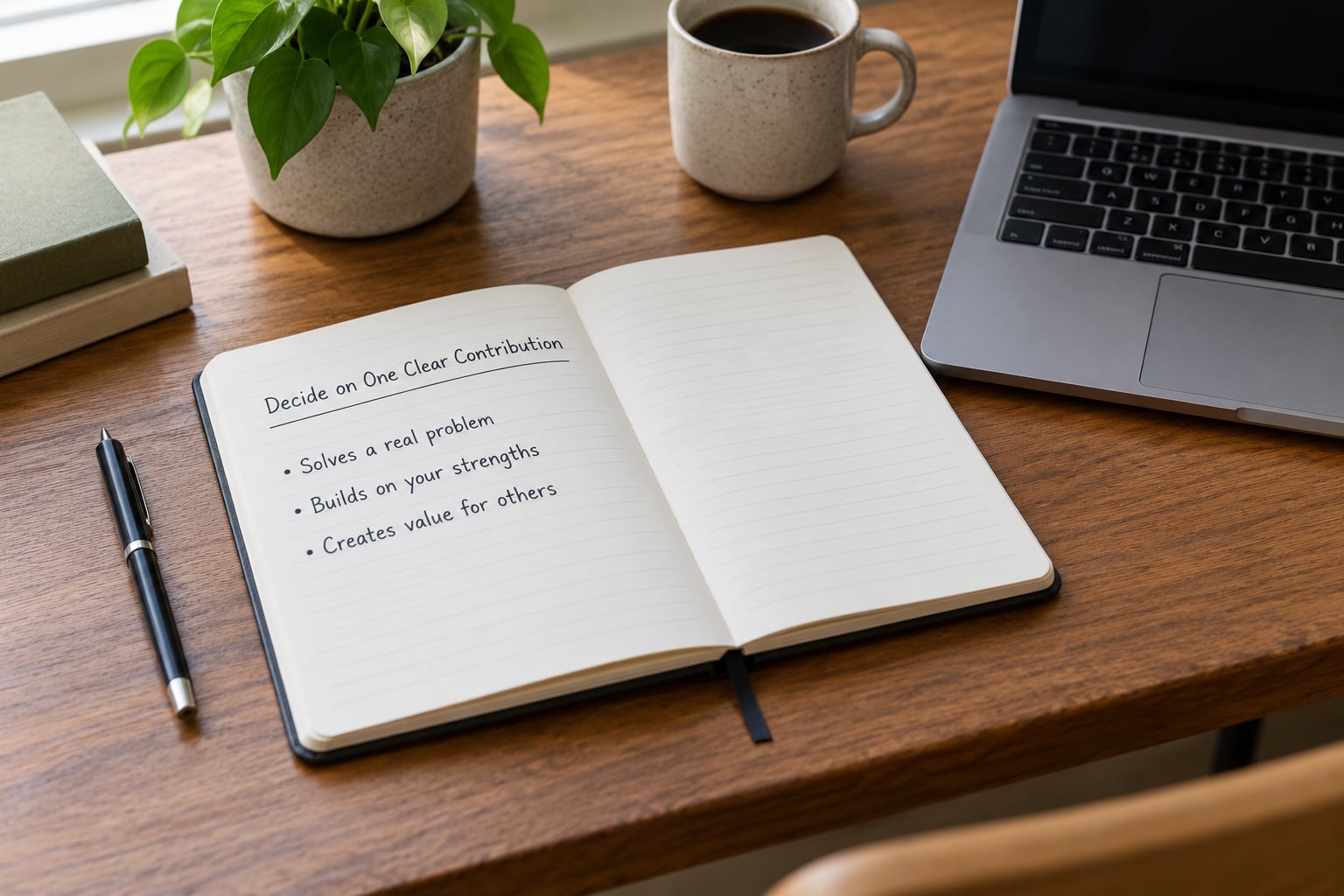
Nerves multiply when a concern has three parts. By the time you have organised all of it, the conversation has moved on and your point has expired.
The test for clarity is simple. If you can say it in one sentence and another person could act on it, it is ready. “The migration deadline lands in the same week we promised the client the new feature” is ready. “This timeline feels a bit tight” is not.
Write it at the top of a page with the agenda item it belongs to beside it, and read it out loud once in the ten minutes before you join. I keep mine at the very top of the page so my eyes land on it the moment the call connects.
2. Ask for a Few Seconds to Gather Your Thoughts
Plenty of people do not speak up because they do not care. They are waiting for a gap that live conversation rarely offers, and by the time one appears they have talked themselves out of it.
Claim the floor rather than waiting for it. “Can I add one thing on that?” works in almost any room. So does “Give me a second to finish this thought” when you are already mid-sentence and someone cuts in.
Skip the long preamble. “Sorry, I know we have covered this, but I was just wondering whether anyone had looked at” costs you more authority than the point itself does. Ask for the space, then use it.
On video calls, unmuting while somebody else is unmuted is a free attempt nobody sees. If you do get interrupted, pause and say, “I would like to finish this point, then I will stop.” Flat and matter-of-fact, it is one of the least confrontational sentences available to you.
3. Write a Two-Sentence Opening
The first ten seconds decide whether people keep listening. Write that sentence before the meeting and the rest of it usually follows.
Four kinds of opening cover nearly everything you will need:
- Asking: “Quick question on the second item, who owns the data cleanup?”
- Disagreeing softly: “I think that assumption breaks in the EU case, because…”
- Asking for clarification: “Can I check I have this right, that we ship without the QA pass?”
- Offering: “We hit something similar last quarter, want me to send the numbers?”
Fill in the blanks tonight so that tomorrow you have a habit rather than a blank page. If English is your second language, shorten these to five words and the thought still lands complete. Short is fine. Long and apologetic is the problem, not the accent or the grammar.
4. Use a Visible Note as a Cue
Recognising your moment is half the difficulty, so give yourself an external signal. Mark the agenda line where your point belongs. Keep the note open in a shared document where you can see it while you listen.
The chat route is underrated. Land the point in writing first, then say, “I have put a note in the chat about the QA sign-off.” Your sentence is already written, so there is nothing to retrieve and no blank mind to panic about. I use this on the calls where unmuting out loud would cost me the most.
5. Slow Down and Breathe Before Speaking
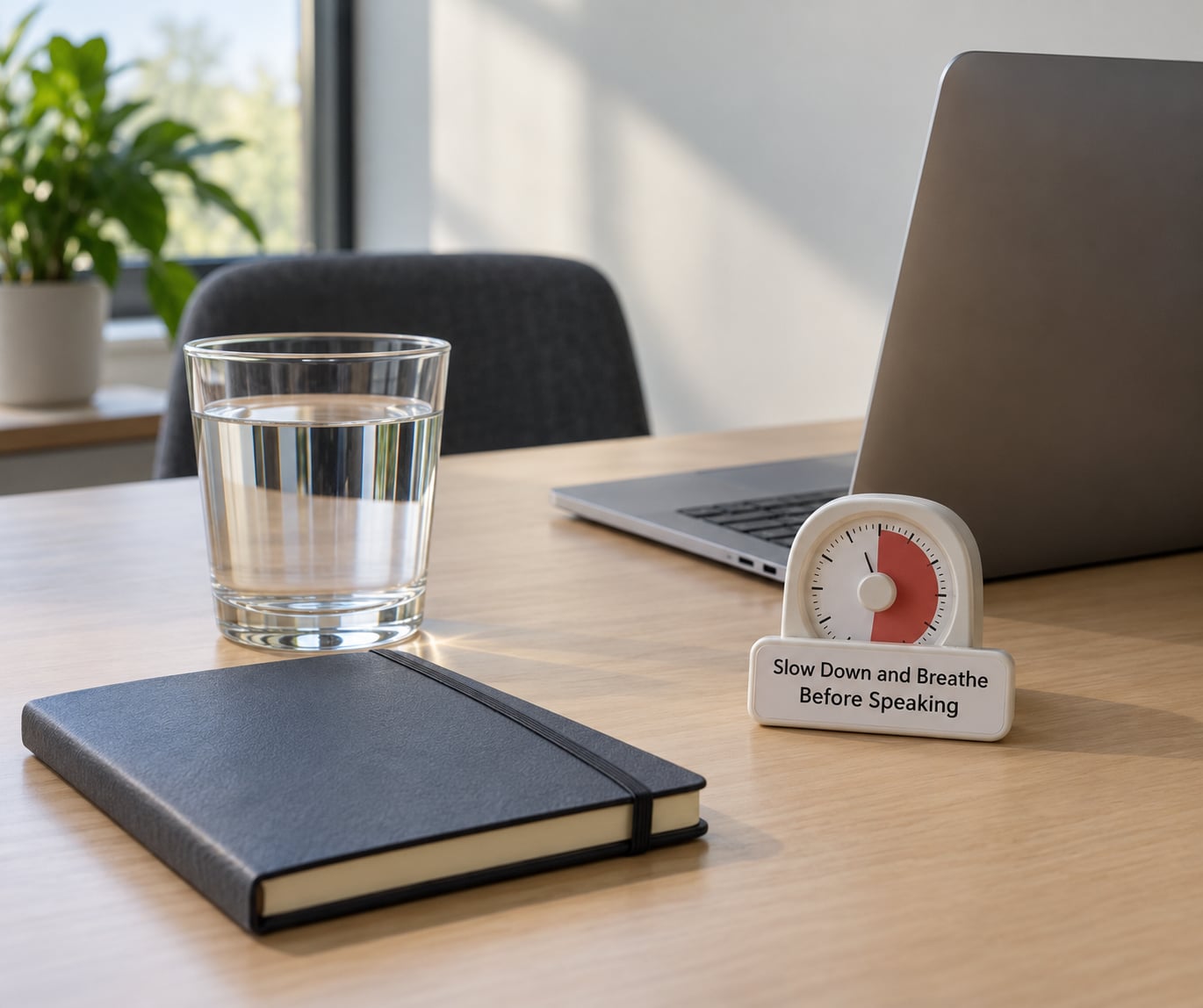
One breath does more than ten minutes of pep talk. The physiological sigh is a sharp inhale through your nose, a second short inhale on top of it, then a long slow exhale. It works because it dumps carbon dioxide and drops you out of the high-alert state faster than an ordinary sigh does.
Do it in the two minutes before you join, and once more while somebody else is talking. Two rounds is usually enough.
The other half is pace. Nerves speed you up and speed reads as panic to everyone except you. Pick a pace slightly slower than feels natural, aim the end of each sentence downward rather than upward, and hold still for half a second after your last word. Nobody registers the pause. Everybody registers the rush.
6. Say the Point, Support It, and Stop
Three parts, in order. Point: the sentence you wrote before the meeting. Support: one reason, number, or example. Stop: silence, held for a beat.
Worked example. Point: “I would move the pilot to the September release.” Support: “Three of the five customers we spoke to in June said they would rather wait than take a partial version.” Stop.
Stopping early feels like dropping a microphone, and it is not. Runners-on sentences lose the room because people lose the thread. You will get a beat of silence after your last word, and that beat is when nods and follow-up questions arrive. If nothing happens, the point still landed. Silence after a clear point is a neutral reaction, not a verdict.
7. Ask a Brief Follow-Up Question
Ending on a question keeps you in the conversation for one more beat and takes the awkwardness out of the silence afterwards. Try “Does anyone see a problem with that?”, “Shall I add that to the notes?”, or “Happy to pick this up after the meeting if that helps.”
In meetings that end abruptly, use the final fifteen seconds: “Can I add one thing before we wrap?” It is the easiest contribution in the whole meeting to make, because nobody is ready to leave yet.
And if you missed your window entirely, a clarifying question still counts. You have stayed in the conversation rather than dropping out of it, and the next point you hear is another chance.
Common Mistakes
Six habits account for most of the contributions that never happen.
- Waiting for a perfect opening. There isn’t one. The gap you are listening for arrives about once per meeting and is usually taken. Fix: claim the floor with a request, “Can I add one thing?” The opening is a sentence, not a gate.
- Over-apologising. “Sorry to jump in, sorry, I just wanted to say…” Every apology hands the point back to the person who already has it. One brief acknowledgement, or none.
- Speaking too fast. It feels like urgency and lands as panic. Fix: pause a beat before your first word and drop your pitch at the end of each sentence.
- Loading on context. Background, history, three related problems. Give one sentence of context and then the point, and let people ask for the rest.
- Debating every line. Not every disagreement deserves a round. Land yours clearly and stop; you can pick it up in the follow-up with more room and better timing.
- Abandoning the thought halfway. The half-sentence is what people remember, and it is the one that replays badly for you afterwards. Finish what you started, even clumsily.
Two habits help more than the rest. Decide your moment before the meeting rather than during it, and commit in advance to speaking once, even if all you do is ask what the deadline is. One contribution is a complete result, and the person who spoke once is a different person from the person who did not.
Frequently Asked Questions
What if I want to speak in a meeting but keep waiting for a perfect opening?
The gap you are listening for rarely arrives, and it is usually taken. Stop treating the opening as a gate you have to be invited through and start treating it as a sentence you say. u0022Can I add one thing on that?u0022 is a complete opening, and it works in rooms where you have no status at all. Pick the moment before the meeting instead of during it, write your sentence, and claim the floor when you are ready rather than when it feels safe.
How do I speak up without interrupting someone in a meeting?
Ask rather than cut in. Saying u0022Can I add one thing on that?u0022 at the end of a speaker’s turn is not an interruption, and most people treat it as normal. If you are genuinely mid-thought and get cut off, wait for the gap and say, u0022I would like to finish this point, then I will stop.u0022 Keep the tone level. On video calls, unmuting while someone else is unmuted is a free attempt, and you can follow your comment with a written one in the chat.
What can I say if I miss my chance to contribute?
Use the last fifteen seconds before the meeting wraps: u0022Can I add one thing before we finish?u0022 If even that has gone, ask a clarifying question about what was just decided. That keeps you inside the conversation, and it often restarts the discussion in a direction you can enter. The window for a point is much wider than it feels during the meeting, and the rumination afterwards is almost always harsher than the moment would have been.
How do I stop being afraid that people will judge what I say in a meeting?
You probably will not, entirely, and that is the useful reframe. Experienced professionals still feel it, decades into the same job, because the fear is a threat response rather than an accurate prediction. What changes is the meaning you attach to it. A blank or a half-sentence after you speak reads to a busy room as one person thinking, not as a verdict on you. Say the point clearly and stop, and let the reaction stay ambiguous rather than predicting it in advance.
How can I get more comfortable speaking up in meetings?
Repeat it in conditions that cost you little, then raise the stakes slowly. Start by asking one clarifying question a week in a meeting you are not leading. Then move to a contribution in a small team huddle, then a cross-functional call, then one with a senior leader in the room. Most people find the discomfort drops the second or third time, not the tenth. Keep a short note of what you said each meeting, because the evidence of your own progress is easier to trust than your memory of it.
Do this in your next meeting, not the one after. Write one sentence, put it where you will see it, and decide before the call that you will say it once. Everything else in this guide is a repair for a moment you skipped, and skipping the moment is the only part that compounds.