To teach kids about fairness and sharing, name the idea out loud, model it yourself, then practise it in small, low-stakes situations until the behaviour runs without you. Fairness is not the same as everyone getting an identical piece. It means each person gets what they need to take part.
That distinction is the whole game. A child who thinks fair means equal will fight over every uneven slice of cake forever, and a child who thinks fair means equal with adults will feel cheated by any difference at all.
Children learn this the same way they learn language: watch an adult do it, hear it named, practise it, then reflect on what happened. Below is a sequence that works for ages roughly two through twelve, with scripts you can say in the moment.
Table of Contents
- What You Need
- Step-by-Step
- 1. Explain fairness in simple words
- 2. Model fair behavior yourself
- 3. Turn sharing into a learnable skill
- 4. Practice with play and everyday routines
- 5. Discuss conflicts without shaming
- Common Mistakes
- Frequently Asked Questions
- What are some effective ways to teach kids about fairness?
- At what age should a child be taught to share?
- Is it okay to force kids to share things?
- How do I teach my child to share without forcing them?
- Can you explain the difference between equity and equality to kids?
- Why does my child say it’s not fair all the time?
- Conclusion
What You Need
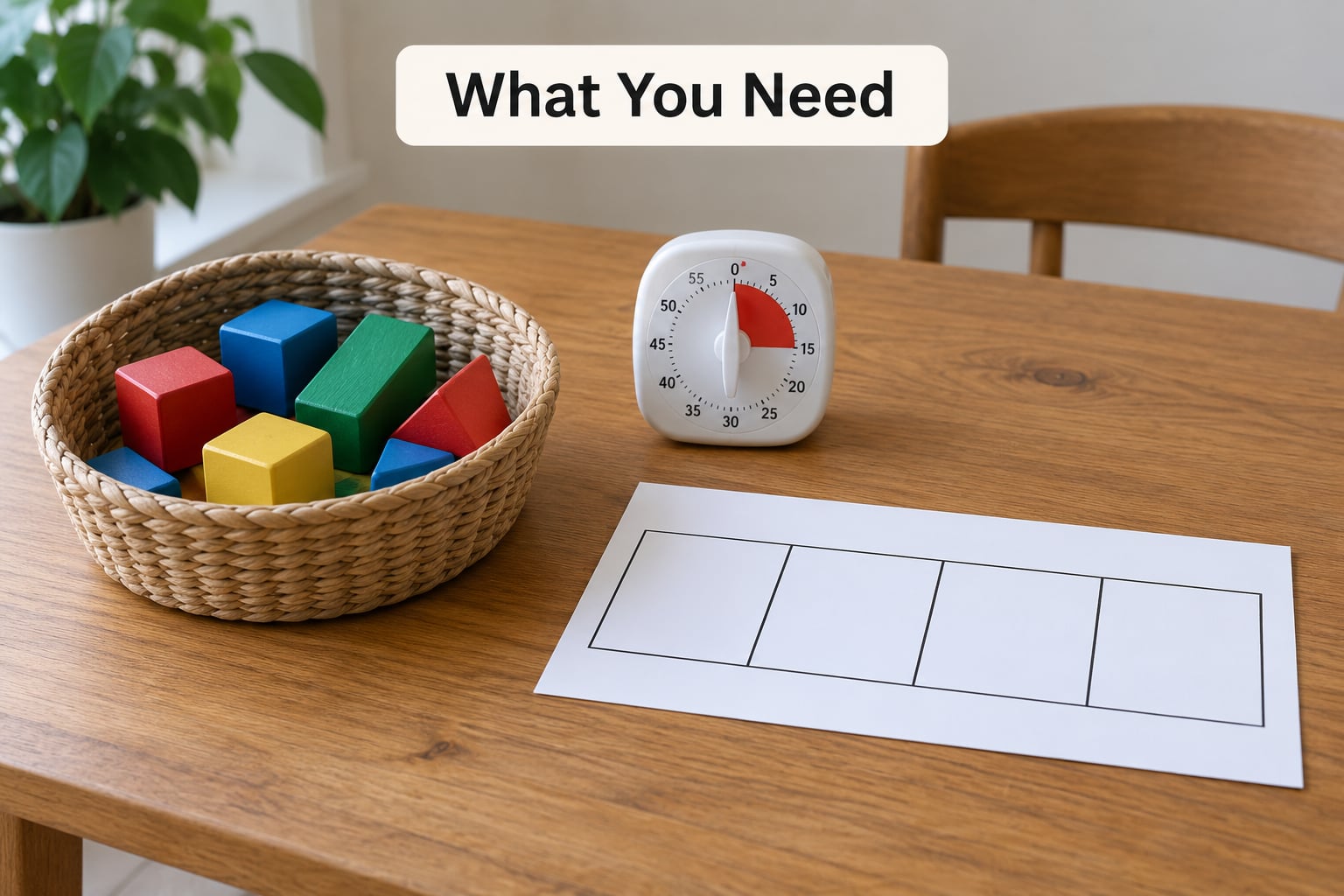
Not much. You need a calm moment and about ten minutes, which is harder to find than it sounds.
Before you start, line up three things:
- A calm neutral moment. Not during a meltdown, not at bedtime, not five minutes before you leave for the school run. Pick a moment when nothing is on fire.
- Words your child can actually use. Two-year-olds need “your turn, then my turn.” Six-year-olds can handle “you’ve had four turns, so it’s time for a swap.” Match the vocabulary to the child, not to the idea.
- A familiar situation. The best teaching moments are boring ones you already have: siblings choosing a show, splitting the last snack, deciding who goes first in the car.
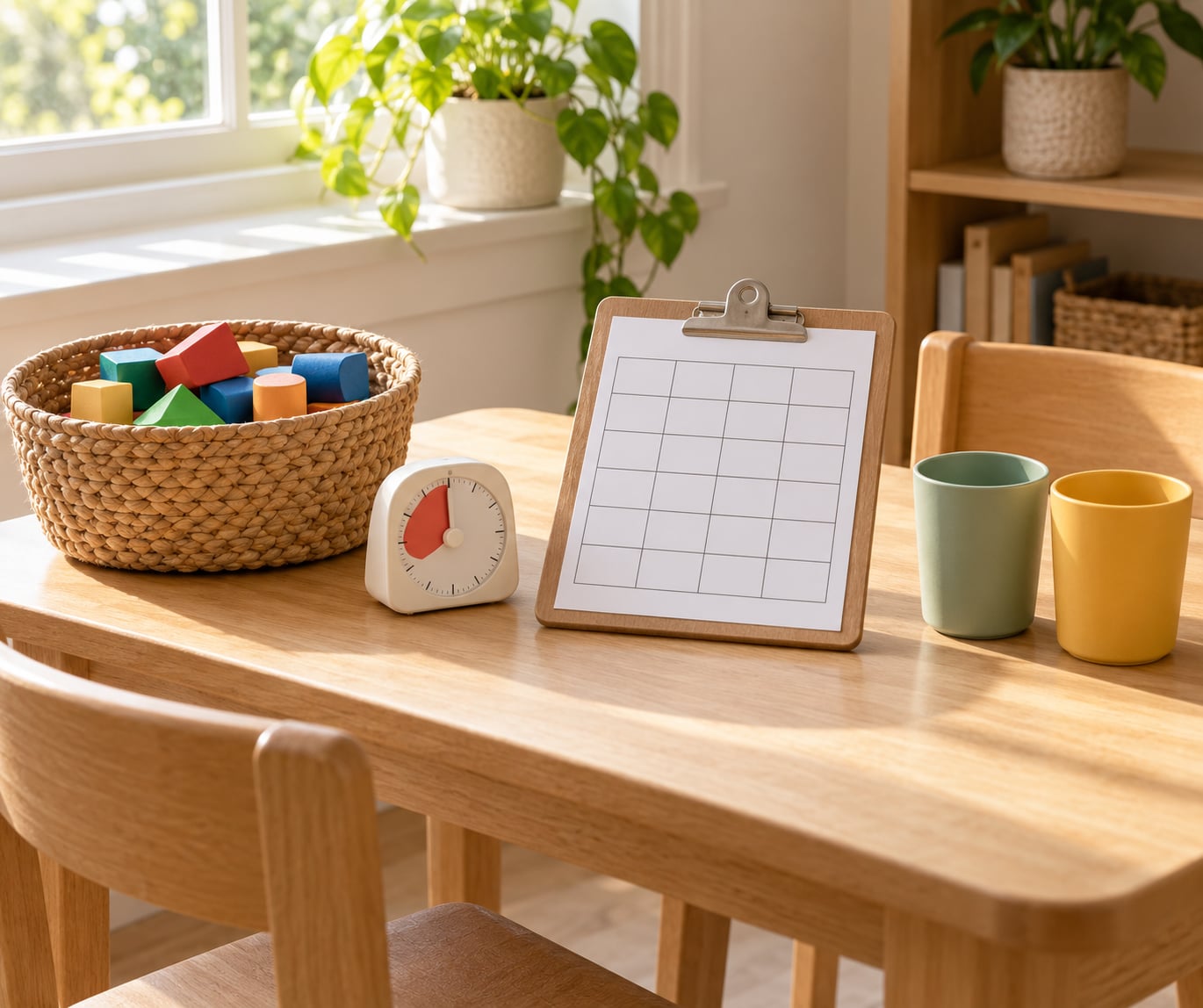
Optional tools earn their keep once you are past the toddler stage: a turn-taking chart on the fridge, a kitchen timer for two-minute swaps, or one clearly communal toy that belongs to everyone so the child is not being asked to give up something precious.
Step-by-Step
1. Explain fairness in simple words
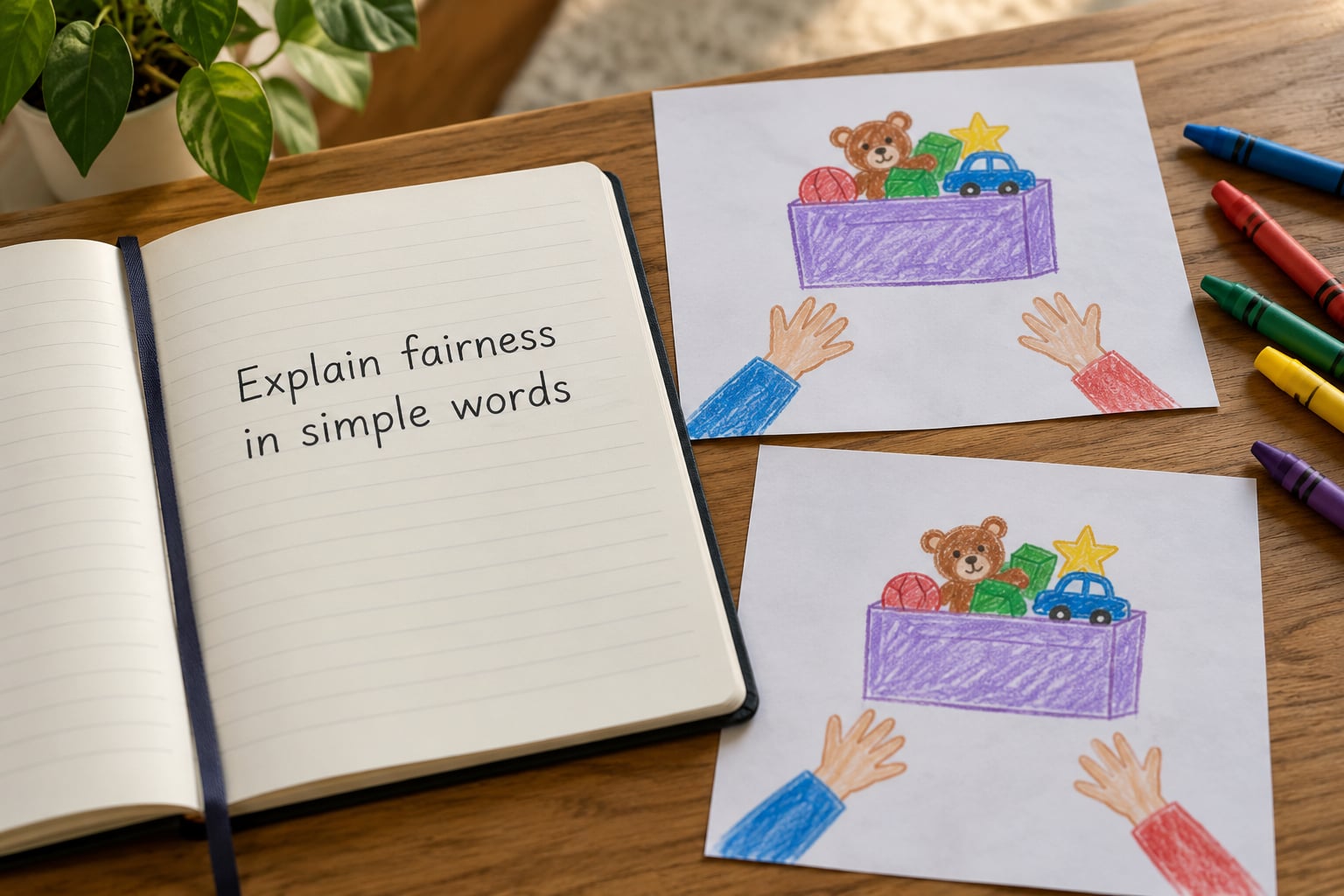
Fairness has four parts, and children can only hold one in their head at a time. Start with whichever one the moment is about.
- Needs. Fair can mean different amounts because people need different things.
- Turns. Fair can mean taking turns so everyone gets a go.
- Rules that apply to everyone. Fair can mean the same limit for everybody.
- Respect. Fair can mean nobody gets to be mean or left out.
Say it in one sentence, then stop talking. “Fair means everyone gets a turn, and everybody gets treated kindly.” That is the version that lands with a four-year-old.
The hardest reframe, and the one that saves you years of arguments, is this one:
| Situation | The equal response | The fair response |
|---|---|---|
| Two kids, one big cookie | Cut it into the smallest possible piece and make them choose | Cut it in half |
| Two kids, ten cookies | Hand out one cookie each and keep the rest | Five each |
| One child struggles to open a jar | Everyone opens their own jar unaided | An adult opens it, or the older child helps |
| Snack time, one child eats slowly | Everyone gets the identical portion | Everyone gets a portion they can actually finish |
| One child is sick and stays home | Nobody gets the special treat | The healthy kids still get their routine |
Equal treats everyone the same. Fair treats each person according to what they need. Once a child can give you an example of a fair split that is not identical, you have moved past sharing entirely and into something more useful.
2. Model fair behavior yourself
Children copy adults far more than they obey them. Narrating your own fairness out loud turns ordinary parenting into a lesson without adding a word of preaching.
“I’m going to answer the phone first, then I’ll read you the rest of that page.” “You can have the blue cup tonight and I’ll have the green one. Different is fine.” “I raised my voice just now. That wasn’t fair of me. I’m sorry.”
That last one does more work than it looks like. Admitting a small unfairness to your own child teaches them that repairing is normal, which matters more than never getting it wrong. Most adults are far better at being right than at being repaired, and kids notice which one you pick.
3. Turn sharing into a learnable skill
Sharing is not a single behaviour, it is a sequence. Teach the steps and you can name the one that is missing in any given meltdown.
- Notice that another person wants something.
- Pause before you grab or run.
- Ask or offer, rather than waiting to be asked.
- Take turns if the answer is no.
- Check in afterwards: did that work for both of us?
Most disputes are a missing step two, not a character flaw. A child who skips straight from noticing to grabbing never had a chance to choose.
What counts as realistic changes completely with age, and this is where most parents are given bad information:
| Age | What sharing looks like | What is realistic |
|---|---|---|
| 2 to 3 | Playing beside another child with toys in reach | Short swaps, often with a grown-up prompting. Treat spontaneous sharing as a bonus. |
| 3 to 4 | Sharing when there are several copies | Happy to share abundance, reluctant when there is only one of something. That is normal, not stinginess. |
| 4 to 6 | Turn-taking with a grown-up nearby | Enforces the rules for others, struggles with losing. Adults can prompt; they often need to. |
| 6 to 8 | Real negotiation, one step at a time | Starting to weigh the other person’s feelings. Still needs help reading a situation. |
| 8 to 12 | Abstract fairness and needs-based thinking | Can explain why equal is not always fair. Capable of genuine compromise without an adult in the room. |
One note on the rules you will hear about online, the 3-3-3 rule and the 7 7 7 rule. Neither is backed by anything you would find in a child development textbook, and both tend to produce kids who measure fairness down to the quarter teaspoon. A child who insists the baking bowls contain precisely identical amounts is not showing good maths. They are showing that the fight is about control, and the fix is a shared goal, not a better scale.
4. Practice with play and everyday routines
Pick activities where the sharing happens for a real reason, not because you set it up.
- Two-minute timer turns. A kitchen timer makes turn-taking concrete for a child who has no concept of “a fair amount of time.” Swap on the beep.
- Cooking together. Washing, stirring, passing the measuring cup. Real shared work teaches cooperation better than any worksheet.
- Board games with no winner. Cooperative games where everybody loses a little and everybody contributes are excellent for kids who hate losing.
- A shared screen. Agree the handover time before you press play, not during the handover.
- Family jobs with real ownership. Someone sets the table, someone feeds the dog, someone sorts the laundry. Contribution is a form of fairness that nobody thinks of.
- Role-play with a doll or stuffed animal. “The bear wants your truck and you’re still playing. What can you do?” Children rehearse out loud far more freely than they perform in the moment.
- Read-alouds where the story has a fairness problem. Stop before the resolution and ask what your child would do. Four or five titles in rotation is plenty.
In a classroom, the same principles translate directly: class jobs posted where everyone can see them, small and large group activities every week, and older children paired as reading buddies. What matters most is that the adult notices and names fairness out loud in the room, because children learn the rules of a place from what the adult attends to.
5. Discuss conflicts without shaming
In the hot minute, keep it to two short sentences. Acknowledge, restate, hand it back.
“You wanted that toy and he is using it. You both want the same thing, and that is hard. You can ask him for a turn.”
Then stop. Lecturing while a child is upset teaches them that fairness is a thing adults say to end an argument, which is exactly the wrong lesson.
For the “it’s not fair” moment specifically, the most useful script I have seen comes from a parent posting in r/ChildPsychology about two children aged five and seven and a half who had turned baking into a series of disputes over who added what. Her sequence worked because it never denied the feeling:
I know it’s hard, but things aren’t always going to be exactly the same. We’re allowed to be upset about it, but we have a choice about whether we let it ruin our baking time. Let’s focus on our common goal.
That last clause is the part most advice leaves out. Redirecting to the shared goal, the thing everyone was making, gives a child somewhere to put their attention that is not winning the argument.
It also helps to know why the fights cluster where they do. Siblings share the same toys, the same treats and the same parent, and there is no exit from the situation. With a friend, a child can simply walk to a different table. With a brother or sister, fairness becomes the only available currency, which is why the stakes feel enormous over nothing.
Two more judgement calls worth thinking through. Should you force a child to hand over a toy they are actively using? Sometimes, yes, when the toy is communal, when there is a genuine turn-taking rule the child agreed to, or when a sibling needs it and cannot ask. Not when the child is mid-task with something breakable or expensive, and not as a punishment for something else entirely. A Montessori school network post with a lot of parent agreement put it well: telling a young child to share something they are still claiming ownership of is not generosity instruction, because the child has not yet got the groundwork for a real choice.
And when a child says no? Sometimes no is correct. Children have the right to keep their own body, their own belongings and their own space, and a child who learns to hand those over on demand has learned something you do not want them to learn. Teach the boundary and the reason together: “That is your special thing, you can say no. This is the shared truck, and that is a yes.”
Common Mistakes
Forcing an immediate hand-over. Compliance is not generosity. A child who gives up the toy under pressure learns to resent sharing, which is worse than never sharing at all.
Making sharing a reward or a punishment. “You shared, so you get a sticker” turns an intrinsic value into a transaction. So does taking away the toy they were hoarding. Neither teaches judgement.
Lecturing during the conflict. Nobody hears a principle while they are flooded. Handle the moment in one or two sentences and talk about the lesson later, when everyone is calm.
Fixing an even split every time. It ends the argument today and teaches the wrong definition of fair. Offer to split it fairly, which sometimes means unevenly.
Comparing siblings. “Your sister shares, why can’t you” puts two children on opposite sides of a rule you invented. Talk to the child, about the child.
Building a reward chart. Charts work for tasks and fall apart for character. Fairness practised for points stops the moment the points stop.
What works instead is boring and slow: choose a teachable moment on purpose, use one short sentence, model it yourself that same day, and let the next situation go a little better than the last. Progress here looks like a child who pauses for two seconds before grabbing. That is the skill forming, and it takes most families a couple of years.
If sharing distress is intense and persistent, involves a child who loses words or has difficulty with turn-taking and sensory input, or if you are worried about development more broadly, raise it with your pediatrician or a qualified child development professional. Ask about how your child plays alongside other children, whether they can describe what others feel, and whether an evaluation would be useful. That is a routine question, not an alarming one.
Frequently Asked Questions
What are some effective ways to teach kids about fairness?
Model it, name it, then practise it. Say the definition in one short sentence. Narrate your own fair choices out loud during ordinary routines. Set up situations where turn-taking is possible, such as a timer or a communal toy. When a conflict happens, acknowledge the feeling, restate the rule, and hand the problem back to the children. Practise during play, when emotions are lower and mistakes cost less.
At what age should a child be taught to share?
Start teaching the idea at around two, but start expecting real sharing at four or five. Between two and three, children share mostly when there are several copies or when a grown-up helps with the swap. Between three and four, they share happily when resources are abundant and resist when there is only one of something. That reluctance is developmentally normal rather than a character flaw.
Is it okay to force kids to share things?
Sometimes, and rarely as a blanket rule. If a toy belongs to everyone, if your child agreed to a turn-taking rule in advance, or if a sibling genuinely needs the item and cannot ask, guiding your child to hand it over is reasonable. Do not do it mid-task, for expensive or breakable things, or as a consequence of another behaviour. Forced hand-overs teach compliance rather than generosity.
How do I teach my child to share without forcing them?
Build the skill in steps: notice that someone else wants something, pause, then ask or offer. Practise when nothing is at stake, such as sharing blocks with a sibling on a good day. Give real choice with two acceptable options, like which turn they want to go first. Follow their no with respect, and praise the specific thing they did well rather than the outcome you wanted.
Can you explain the difference between equity and equality to kids?
Equality means everyone gets the same thing. Equity means everyone gets what they need to take part. Two kids might get the same amount of drink. An adult opening a jar for the child who cannot manage it is equity, not favouritism. With older children you can add that the fair outcome is not always the same outcome, and that the person who needs more support is not being treated unfairly.
Why does my child say it’s not fair all the time?
For many children, fair still means identical, so any difference registers as a wrong. Constant checking is often about control rather than about the specific object. Acknowledge the feeling without arguing the definition, then redirect to what everyone was doing together. If the phrase appears around every decision, notice whether you are reacting to the words, which usually feeds the cycle.
Conclusion
Pick one calm moment this week. The show you argue about, the last biscuit, the turn on the swing. Say the definition in one sentence, do the fair thing yourself out loud while they watch, and let them take one small step with it.
That is the whole method. Repetition over a couple of years does the rest.