
To donate clothes responsibly, repair what can be repaired, clean and dry every item, sort and label it, confirm the recipient actually asked for that category in that season, and document the handoff. Anything that fails those checks goes to recycling or disposal, never into a donation bag.
That takes about an hour for a typical closet. It is the difference between a donation that helps and one that quietly becomes someone else’s unpaid work.
Updated October 2026.
I have watched people carry three bags into a charity shop, get turned away, and drive home with everything still in the car. The staff did not want the donation. They wanted to be rid of the sorting. The people those garments were meant for never saw them.
So this guide is less about the landfill statistics everyone quotes and more about the sorter standing behind a table at nine in the morning, deciding whether your coat belongs on a rack or in a pile. Once you see that person clearly, the steps make themselves.
Table of Contents
- What You Need
- Step-by-Step: How to Donate Clothes Responsibly
- Step 1: Decide What You Want to Donate
- Step 2: Check the Charity’s Needs
- Step 3: Sort Clothes by Condition and Type
- Step 4: Clean, Dry, Fold, and Label Everything
- Step 5: Choose a Reputable Place to Donate Clothes Responsibly
- Step 6: Deliver the Clothes and Confirm Receipt
- Step 7: Follow Up and Avoid Repeated Overdonation
- Common Mistakes
- Frequently Asked Questions
- Do donated clothes need to be washed before giving them away?
- Can I get a receipt when I donate clothes, and can I claim a tax deduction?
- Are clothing donation bins actually charities?
- Can I mail used clothes to a nonprofit?
- Is it bad to donate clothes in poor condition?
- What happens to clothes that charities cannot sell?
- Conclusion
What You Need
None of this is specialised equipment. Gather it once and the whole job goes faster.
- Clean, dry, wearable clothing that you would hand to a friend without apology.
- Sturdy bags or boxes that hold their shape. Overstuffed sacks split and get refused.
- Gloves if you are handling anything from a garage, basement or storage unit.
- The laundry receipt or care labels, so you can sort by fabric and wash temperature.
- A marker or labels for noting item type and size on bags and garments.
- Contact details for the charity you plan to use, so you can confirm needs before packing.
Step-by-Step: How to Donate Clothes Responsibly
Step 1: Decide What You Want to Donate
Start by being honest about the goal. A closet clear-out after a move is a different project from a deliberate donation, and it is worth knowing which one you are doing.
If you want the clothes gone by Friday, you will pick whatever is nearest and accept that some of it will be refused. That is a disposal decision wearing a donation’s clothes.
Pull out anything obviously unusable first: damp items, mildewed textiles, broken zips, cracked heels, holes in the body of a garment, and anything a recipient would be embarrassed to be handed. Outdated styles and mismatched sets usually fall here too.
Step 2: Check the Charity’s Needs
Phone, email or check the posted wish list before you pack a single bag. Most organisations publish a current list, and it is usually shorter and stranger than you would guess. Shoes in a specific size. Boys’ trousers. Work trousers. Nothing for a category they are already overstocked on.
People in zero-waste communities keep recommending one move more than any other: ring your local shelter or call 211 and ask directly. Nobody advertises this, which is why so few donors do it.
Step 3: Sort Clothes by Condition and Type
Build four piles on the floor, not four piles in your head. Sorting by condition is what makes the rest of the process possible.
- Wearable clean and intact, no holes, missing buttons or stubborn odours.
- Repair-needed worth mending: a missing button, a torn seam, a loose hem.
- Textiles for recycling or repurposing sheets, towels, scrap denim, unmatched linens.
- Disposal anything mildewed, contaminated or genuinely beyond use.
Check for stains, odours, holes and missing buttons while the item is in your hands, not after it has been in a bag for a week.
Sort into type as well. Adult sizes a shelter cannot use are still perfectly good clothes for a child or a resale rail. Pair your shoes, your socks and your underwear, or mark the pair clearly. A lone glove is waste, and it is work for somebody else.
Step 4: Clean, Dry, Fold, and Label Everything
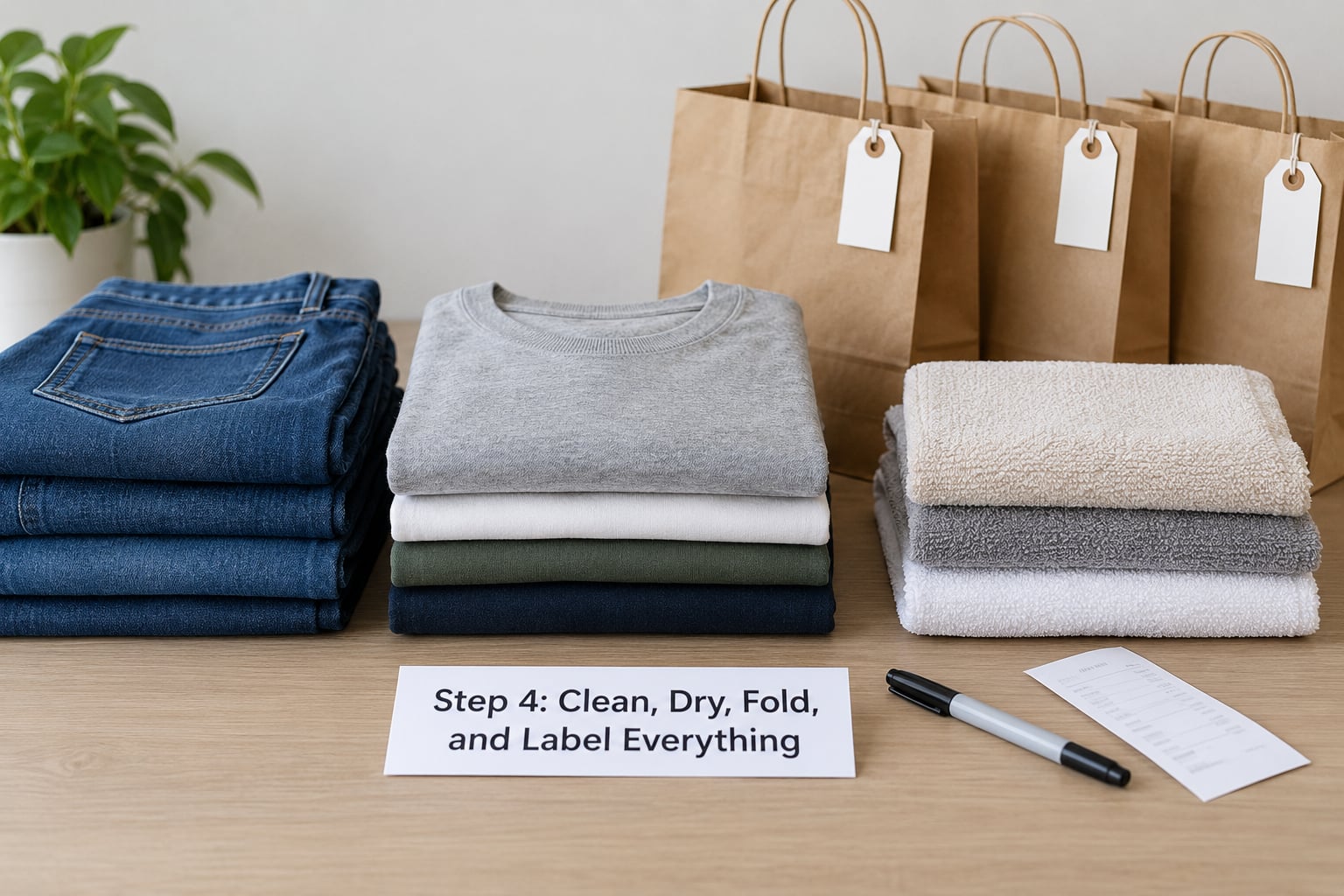
Donated clothes should arrive clean, dry, folded and easy to inspect. A sorter should not have to open a damp bag in a warehouse to find out what is inside.
You do not need to wash everything. Most wearable items are fine without laundering as long as they are free of stains and smells. Underwear, socks, swimwear and anything that goes straight onto skin should be washed, because a recipient may wear it immediately.
Tie shoes together with string through the laces. Follow the care label on anything structured, coats and knitwear included. Then label the bags with the item type and size range.
Step 5: Choose a Reputable Place to Donate Clothes Responsibly
Here is the part most guides skip: matching the destination to the item, and checking who is actually behind the operation.
Direct donation to a shelter or mutual aid group keeps clothing in the community that asked for it. Call first, confirm the category and the size range, and ask whether they want items bagged or folded.
National resale charities such as Goodwill, The Salvation Army, Habitat for Humanity ReStore and St. Vincent de Paul handle volume well. They sell a minority of what they receive, price it to be affordable, and push the rest into export and downcycling streams. That is a legitimate model, but it is not the same as a coat landing on somebody’s rail.
Specialty charities match one category precisely: Soles4Souls for shoes, Dress for Success and Career Gear for workwear, Free the Girls for girls’ clothing, Brides Across America for bridal wear. These are strong choices when you have exactly that item and nothing else.
Donation bins are the least transparent option and the most convenient. A bin on a roadside may be run by a charity, run by a for-profit company paid per pound, or barely monitored at all. Look for the operator’s name, any charity affiliation, and whether the signage says where the clothing goes.
Give yourself five minutes with any organisation before you commit:
- Does it publish what happens to textiles it cannot sell?
- What does its Charity Navigator rating look like, and what does the Form 990 show for program spending?
- Are sorters volunteers or paid workers?
- Does it disclose exports?
- Does it post current needs, or does it ask you not to donate certain items?
If a website cannot answer those five questions, take your bag somewhere that can.
Step 6: Deliver the Clothes and Confirm Receipt
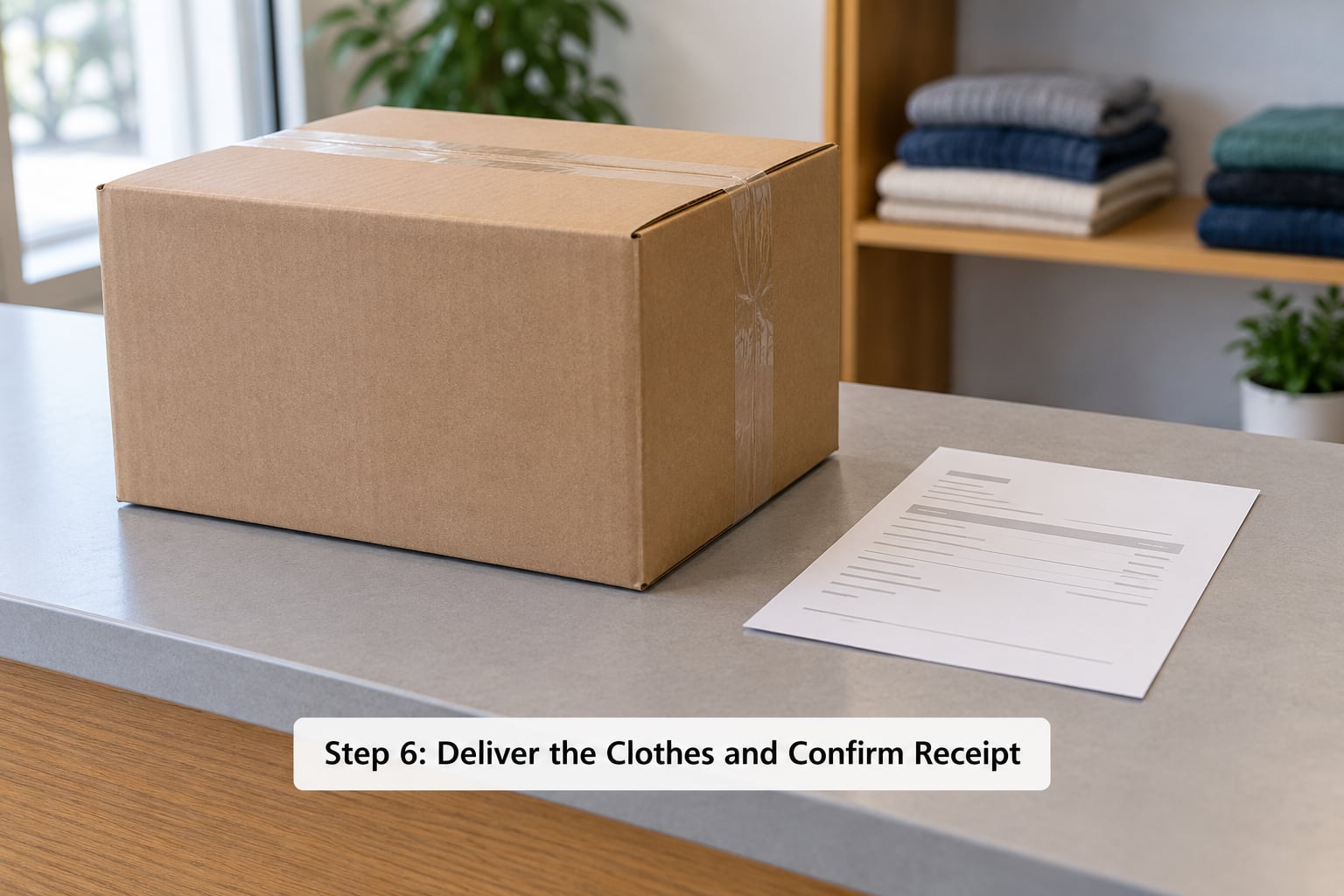
Hand over the donation rather than leaving it somewhere unattended. A donation dropped at a back door or stuffed into an unmonitored bin is not a donation, it is litter with good intentions.
Ask for a receipt and write down the date, the organisation and the estimated value. Photograph the receipt and the packed bags if the handover involves a lot of items, such as an inherited wardrobe.
Then understand what that receipt is. It proves the organisation took custody of the items. It does not prove a tax deduction, and it is not a promise that the clothes were resold.
Step 7: Follow Up and Avoid Repeated Overdonation
Once a donation is accepted, resist the reflex to repeat it every few months. Continuous donations to an organisation that is already full create sorting work, storage costs and, in the worst case, a pile in a corridor.
Set a rhythm instead. Donate winter coats in late autumn rather than in spring. Keep formal wear for the months before proms and weddings. Check back with the organisation before the next bag.
Some textiles should never enter a donation bag at all. Sell or consign the pieces with real resale value through a marketplace platform or a local consignment shop. List them on a Buy Nothing or Freecycle group, describing the condition honestly. Repair them. Repurpose them into rags or crafts. Use a retailer take-back programme or a certified textile recycling stream. Only then consider disposal.
Notice that donation is one option on a list, not the default heading for every unwanted garment.
Common Mistakes
Donating dirty or damaged items. This is the most common and the most expensive mistake for the recipient. Sorters spend paid or volunteer hours on things nobody can use, and the material ends up as waste anyway. Fix: run every item through the four-pile system before it leaves the house.
Ignoring size and seasonal needs. A winter coat arriving in June has nowhere to go. Fix: confirm the current wish list, and note the season and sizes on the bag.
Treating any metal bin as charity. Some are, some are for-profit, some are poorly monitored. Fix: check the signage for an operator name, and prefer an organisation you can name and look up.
Assuming a receipt means a tax deduction. Deductions apply to qualifying donations to qualified organisations, and they are limited to fair market value, with substantiation and a valuation rule above a set threshold. Consignment sales at a thrift store are not charitable deductions. Fix: keep the receipt, then ask a tax professional about your situation.
Overclaiming on the environment. Giving away a bag you bought last month is not the same as extending a garment’s life. Fix: buy secondhand, repair what you own, and use cost per wear as a buying check.
Donating when the real need is money. When you have nothing spare to give, buy from a charity shop instead, or fund a specific item an organisation named. Both keep the recipient’s dignity intact, and both are better than handing over a bag you want rid of.
Two habits cover most of the rest: pick the destination before you pack, and never let a bag get so full and so late that quality is no longer a factor you control.
Frequently Asked Questions
Do donated clothes need to be washed before giving them away?
Not always. Most wearable items are acceptable unwashed as long as they are free of stains, odours and wear. Wash or replace anything that goes directly against skin: underwear, socks, swimwear and sleepwear. A sorter should never have to open a damp bag, and a recipient should never have to launder before putting a garment on.
Can I get a receipt when I donate clothes, and can I claim a tax deduction?
Yes to the receipt: ask for one at drop-off and record the date and organisation. Whether you can deduct it is a separate question. Deductions generally apply only to items given to qualified nonprofit organisations, are limited to fair market value, and usually need substantiation and a qualified appraisal above a certain threshold. Selling on consignment is not a donation. Ask a tax professional about your situation.
Are clothing donation bins actually charities?
Some are, and some are not. A bin may be operated by a registered charity, by a for-profit company paid a set amount per pound, or by a company whose textile sorting and export practices are hard to verify. Check the posted signage for an operator name and any charity affiliation, and prefer a named organisation whose textile policy you can read online.
Can I mail used clothes to a nonprofit?
Only if the organisation offers it. Many mail-in programmes are paid recycling schemes rather than donations, and they cost you a fee or a pre-paid kit in exchange for sorting or shredding. Any organisation that accepts posted items will publish instructions and what it can accept, so confirm that first. Drop-off at a store or a scheduled collection avoids both the postage cost and the guessing.
Is it bad to donate clothes in poor condition?
It depends on what poor condition means. A missing button or a torn hem is often worth mending before giving away. Mildew, damp, heavy staining, cracked footwear and holes in the body of a garment are not, because nobody can use them and the sorting time goes to waste. Put those in a recycling or disposal route instead, and keep the donation bag clean.
What happens to clothes that charities cannot sell?
They follow one of three routes: sorted for resale in local shops, exported to secondhand markets abroad, or processed into rags, wadding and insulation. Sell-through rates at large resale charities are commonly cited in the range of 10 to 20 percent, so the majority of what arrives leaves the resale rack. That is why condition matters so much at drop-off.
Conclusion
Pick one clean, usable category of clothing, confirm that one named organisation has asked for it this season, and hand it over in person with a receipt. That single donation, done properly, is worth more than a year of half-empty bags.
Start today by looking up one reputable local or national organisation, reading what it says about the clothes it cannot sell, and then deciding what in your closet is genuinely good enough to pass that test.