To help a child with math anxiety, you lower the pressure first, then rebuild the habit of trying. Most caregivers spend months arguing about worksheets when what actually helps is a calmer conversation, one small math win a week, and a short routine the child can run alone before a hard problem.
Math anxiety is a real, documented response, not an excuse and not a character flaw. A child who freezes at a word problem may fully understand the idea but lose access to it the moment a timer starts.
What follows takes about fifteen minutes of reading and then roughly ten quiet minutes a day. The eight steps below build on each other, but you can start at step 2 tonight and take the rest over a few weeks.
Table of Contents
- What You Need
- Step-by-Step: How to Help a Child With Math Anxiety in 8 Steps
- 1. Learn What Math Anxiety Looks Like
- 2. Start With a Calm, Specific Conversation
- 3. Replace Pressure With One Small, Doable Goal: How to Help a Child With Math Anxiety One Win at a Time
- 4. Build Math Into Everyday Life
- 5. Praise Process, Effort, and Coping
- 6. Teach a Simple Coping Routine
- 7. Coordinate With the Teacher or Tutor
- 8. Keep Progress Steady Without Forcing Math
- Common Mistakes
- Frequently Asked Questions
- What is math anxiety in children?
- How can I tell if my child is anxious about math?
- Should I help my child with homework when math makes them anxious?
- How can parents help a child who says they are bad at math?
- What should I ask the teacher about math anxiety?
- When should I seek professional help for a child’s math anxiety?
- Conclusion
What You Need
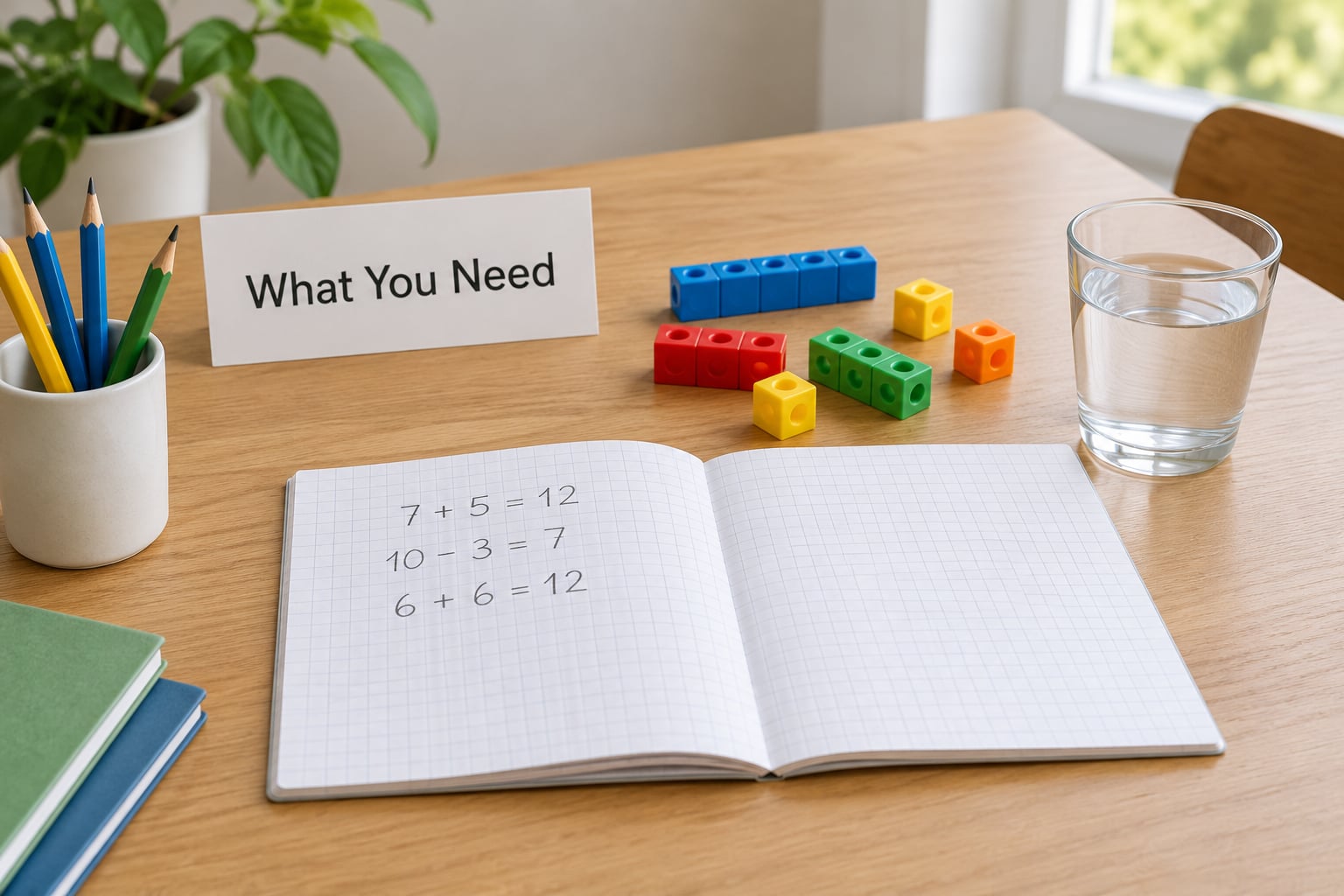
None of this requires money or a specialist. You need a few minutes of calm attention, a notebook the child chooses, and somewhere ordinary in your day to let math show up.
- A quiet ten-minute window when homework is not due tomorrow morning.
- A notebook for the child to keep. Writing the known information down is one of the strongest anti-anxiety moves, because it takes the load off working memory.
- Two or three everyday anchors where math is already happening, such as the kitchen, the car, or the checkout line.
- A copy of the actual homework, so you can find the one step that trips the child up rather than guessing.
- Optional: your child’s teacher or school counselor, contacted with specific observations instead of a general complaint.
A word about your own feelings. A lot of parents who ask how to help a child with math anxiety admit they were anxious about math themselves. That is worth naming out loud, quietly, and it is not a reason to step back.
Step-by-Step: How to Help a Child With Math Anxiety in 8 Steps
1. Learn What Math Anxiety Looks Like
Math anxiety shows up as avoidance first. The child becomes slow to start, finds a reason to leave the table, asks for help before reading the problem, or stalls until the time limit makes it pointless.
Other signs include tears or freezing at a page, physical complaints that conveniently appear before math, perfectionism around neat work, sudden dread about a specific teacher or test, and a flat “I’m bad at math” that lands like a fact. Watch for spillover too, since avoidance can migrate into other subjects or into school itself.
Ordinary frustration is loud and brief. Distress that shows up every single session, that changes sleep or stomachaches, or that survives a week of low pressure is the version worth acting on.
You will know this step worked when you can point to three specific things your child does before or during math, rather than a general feeling that something is off.
2. Start With a Calm, Specific Conversation
Pick a neutral moment, not the middle of a fight. Sit down and describe what you have noticed without labeling it.
Try: “I’ve noticed you go quiet on word problems and then ask me to do the next one. That’s a pattern, and I want to understand it.” Then ask open questions and stay quiet long enough for an answer. “What happens in your head when you see a page of problems?”
Two things to avoid: telling the child the feeling is not real, and assuming the child cannot do the work. Both make it harder to say the honest thing. Try “That page looks hard, and I am not surprised it felt bad” instead of “you are smarter than this.”
It worked if the child tells you one specific moment that felt bad. That single story tells you where to aim the next step.
3. Replace Pressure With One Small, Doable Goal: How to Help a Child With Math Anxiety One Win at a Time
Choose a task the child can finish today with effort, not one they can already do with no effort and not one that will take an hour. Five questions, or one problem solved fully with a written plan, is enough.
Then break big work into visible pieces. A page of twenty problems becomes four small stacks. A multi-step assignment becomes a checklist with the first box as today’s only goal, and the rest unchecked so they do not loom.
Define success in a way you could see from across the room: started within two minutes, wrote the known information down, asked one specific question, finished one problem without a redo. “Feels better” is not observable. “Did the whole routine” is.
Repeat this a few times. The point is not the score, it is building a stack of experiences where starting was followed by finishing.
4. Build Math Into Everyday Life
Math stops feeling threatening when it is attached to something the child actually wants. Halving a pancake recipe, working out whether you have enough change, timing how long the bus takes, reading a weather chart together, comparing which box of cereal is the better buy per ounce.
Keep the stakes at zero. Do not turn the checkout line into a quiz and grade the answers out loud. The tone is chatting, not testing.
Change the label too. A parent who says “let’s do some math” gets resistance. “Do you think two bags of these are enough for the weekend?” gets a yes.
You will see it working when the child starts doing the mental math themselves, unprompted, in a place where nothing is being graded.
5. Praise Process, Effort, and Coping
“Good job” on a correct answer trains a child to hunt for the easiest task. Name the behavior instead, and only when you actually saw it.
Specific lines worth reusing: “You reread it and changed your answer, and that was the right call.” “You asked for help before you were stuck, which took guts.” “You got it wrong and kept going, and that is the part I am proud of.” “You checked your work before handing it in.”
Drop the trait praise. “You’re a math person” and “you’re so smart” put a label on the child that math can then confirm or destroy. Swap in “you haven’t got that yet” and mean it, every time, consistently.
The signal you want is a child who keeps trying something they cannot do yet, because the effort is what earns the good words now.
6. Teach a Simple Coping Routine
Give the child one repeatable sequence they can run without you. Five moves: stop, breathe, reread, write down what you know, then try one thing.
Breathe out longer than you breathe in, four counts in and six out, five times. Grounding works too: name five things you can see, four you can hear, three you can touch. It is a distraction technique, but it also gives a panicking brain a countable task.
Practice it when there is no math involved, so it is a tool rather than an emergency ritual. Once a week at the table, out loud, silly version is fine. Put the steps on an index card in the notebook.
Progress here is simple: the child reaches for the card instead of shutting down.
7. Coordinate With the Teacher or Tutor
Send short, factual notes. Describe the behavior, note when it happens, and ask one or two specific questions.
Try: “For the last three weeks, homework takes about 40 minutes and ends in tears. When he does a short set with a written first step, he finishes. Would it help if he started on a smaller set, and could he check in with you for two minutes at the start of math class? We are also working on a five-step routine at home.”
What to ask: can assignments be broken into smaller parts, is there a way to reduce timed work, is a check-in or a quiet start of lesson possible, what does the school offer for support, and how are public results charts handled in this class.
Ask the school not to label your child. A request for a quiet check-in helps. Being put on a “anxious kids” list in front of the class does the opposite. Track what changed over two weeks, and thank the teacher for the specifics that worked.
8. Keep Progress Steady Without Forcing Math
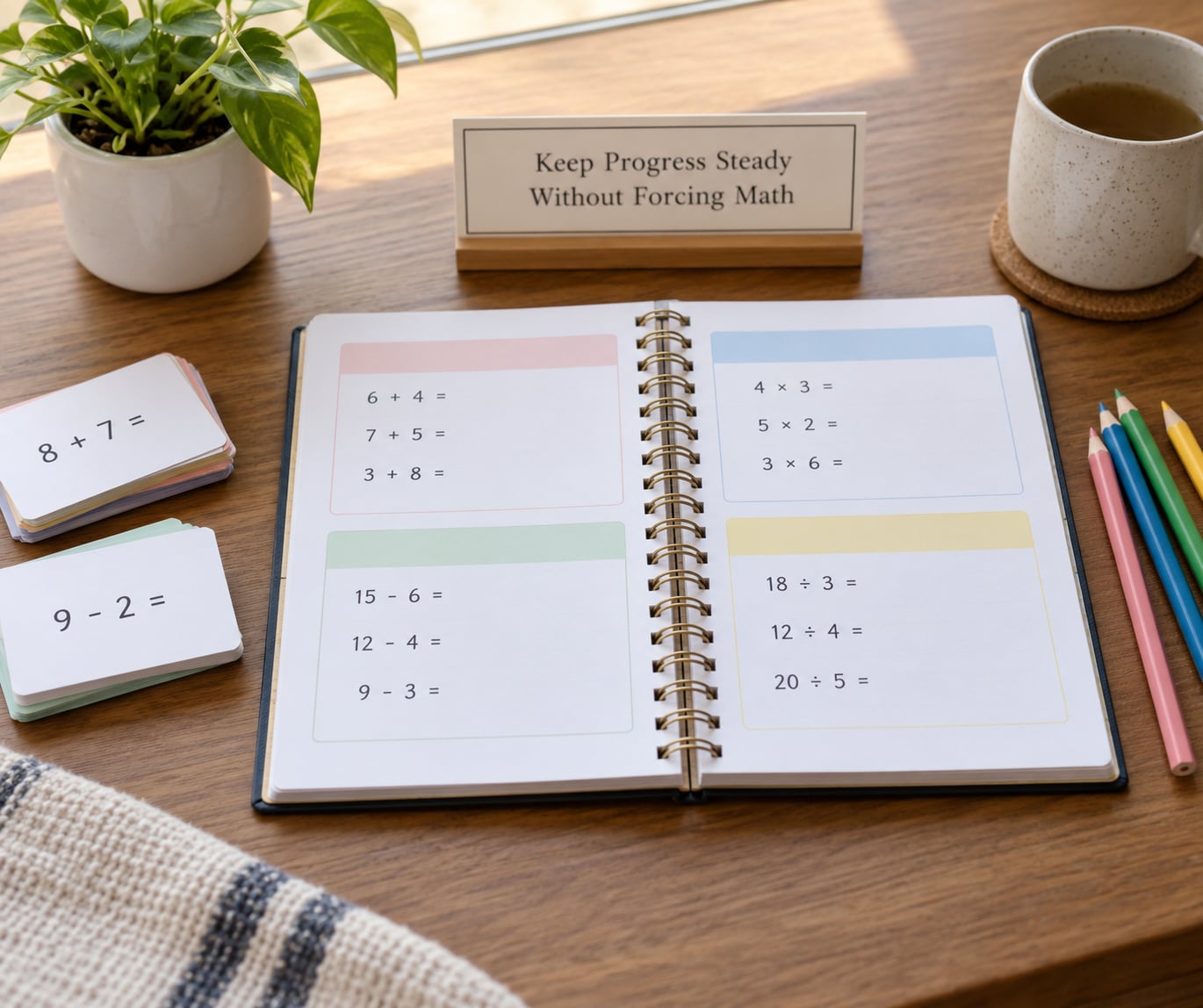
Aim for short sessions on a schedule, not long sessions when a test looms. Ten minutes four times a week beats a punishing hour the night before.
Keep alternative formats available. A child who can explain a problem out loud but freezes on paper is showing you a language barrier, not a thinking one. Let them use a whiteboard, a voice note, tiles, or draw the problem.
Rest matters as much as practice. A week off from worksheets with math still happening in the kitchen is not falling behind.
Bring in professional support when the anxiety is not shrinking after a few weeks of steady low-pressure work, when it is spreading to sleep, eating, friendships, or school attendance, when the child refuses to try at all, or when you hear yourself dreading the homework as much as they do. Start with the pediatrician or the school counselor for a referral, and describe it as anxiety in one specific subject. A therapist who works with young people can help, and a tutor can help, and sometimes a child needs the second one first rather than instead of the first.
Common Mistakes
Arguing about whether the anxiety is real. The debate ends and the child learns that you doubt them. Replace it with one observation: “That looked heavy. Tell me what happened.”
Booking tutoring immediately. More pressure on top of pressure rarely helps, and a fast tutor can teach the child to wait for rescue. Get a few calm weeks in first, then reassess.
Taking over the homework. It buys a finished page and quietly teaches that the work is not the child’s. Sit beside them, stay quiet, and only ask what they already know.
Using threats and bribes for grades. Both tie effort to a payoff the child does not own. Reward the routine instead: did they start, did they use the card, did they finish one problem. That is the behavior you actually want to repeat.
Comparing them with other kids. “Your cousin is fine with math” adds shame to an already full problem. Compare the child to last week’s child.
Treating every mistake as a crisis. Correcting a small slip calmly teaches that errors are ordinary. Save your reaction for a pattern, not for a single crossed-out digit.
Two smaller habits worth adding. Keep a one-line weekly note on what went well, because memory edits itself toward failure. And check your own language out loud, because a parent who says “I was never good at numbers” is handing the child a script.
Frequently Asked Questions
What is math anxiety in children?
Math anxiety is an emotional response to numbers and math tasks: fear, worry, tension, or panic that appears before, during, or after math work. It is well documented in education research and is more common in children than most adults expect. The important detail is that it can block a child who understands the material. Anxiety and math share the same mental processing areas, so worry literally takes up the working memory needed to hold numbers, follow steps, and remember what was asked. That is why a capable child can freeze on a problem they could normally solve.
How can I tell if my child is anxious about math?
Look for a cluster, not one bad evening. Common signs include slow starting, stalling before the first question, asking you to do the next step, tears or blank panic, perfectionism about neat work, stomachaches or headaches that appear before math, avoiding school on test days, and statements like u0022I am not a math person.u0022 Frustration that fades by the end of the week is normal. Distress that shows up every session, travels into other subjects, or affects sleep and appetite is worth acting on.
Should I help my child with homework when math makes them anxious?
Yes, but change your role from solver to scribe. Sit nearby, ask what the child already knows, and have them write the given information down before starting. Silence from you is more useful than hints, since hints quietly teach the child to wait for rescue. If the child is flooded, stop for five minutes and run a breathing or grounding routine, then return to a much smaller piece. The aim is a completed problem they can explain, not a finished page neither of you learned from.
How can parents help a child who says they are bad at math?
Do not argue with the statement or try to talk them out of it. Ask what they think they mean by it, because a child who says this is usually describing one bad afternoon, not a fixed trait. Then separate the two clearly: what happened on that page, and what they are actually able to do. Follow it with a small task they can finish, and name the specific thing they did well. Children rarely argue with evidence they produced themselves.
What should I ask the teacher about math anxiety?
Ask short, specific questions instead of a general complaint. Useful ones: can assignments be split into smaller parts, can timed work be reduced, could the child check in for two minutes at the start of math, what support does the school already offer, and how are public results and charts handled in the classroom. Bring two or three dated observations and one thing that already helped at home. Ask that the child not be singled out or labeled in front of the class, since public identification tends to make avoidance worse.
When should I seek professional help for a child’s math anxiety?
Seek help when anxiety is not easing after several weeks of calm, low-pressure support, when it spreads to sleep, eating, friendships, or school attendance, when the child refuses to attempt math at all, or when the conflict at home is damaging the relationship. Start with the pediatrician or the school counselor, describe it as anxiety around one specific subject, and ask for a referral to someone who works with young people. A tutor can help with the math itself, and both kinds of support sometimes work best side by side rather than one replacing the other.
Conclusion
Start with three things this week: one calm conversation about a specific moment, one small math task the child can finish, and one check-in afterward on how it felt rather than how it went.
Math confidence is not talked into a child. It is built out of repeated, ordinary, low-stakes experiences of starting and finishing, and that is exactly what the eight steps above are for.