You read more books in less time by adding minutes and cutting abandonments, not by pushing your eyes faster across the page. Fifteen focused minutes a day turns into roughly 90 hours a year, which is about 12 to 15 average-length books. Faster reading barely moves that number; finishing what you start moves it a lot.
That is the part most speed-reading advice skips. Eye-movement research going back to Rayner’s work shows that reading well past your natural word-recognition rate trades away comprehension, and a book you skimmed halfway is worth less than one you finished slowly.
So this system has three parts: a short, scheduled routine, a filter for choosing books you will actually finish, and a way of reading that protects attention. It takes about an hour to set up. After that, the maintenance is a weekly look at what moved and what stalled.
If you want the short version, the whole thing runs on a 15-minute minimum session, a weekly target expressed in minutes rather than books, and a hard decision at page 50. Everything below is just the detail on those three pieces.
Table of Contents
- What You Need
- Step-by-Step: How to Read More Books in Less Time
- How to Read More Books in Less Time With a Weekly Reading Plan
- How to Choose Books You Will Finish
- How to Read Faster Without Skipping Important Ideas
- How to Stay Focused and Remember What You Read
- How to Build a Consistent Reading Habit
- Common Mistakes
- Frequently Asked Questions
- How to read multiple books at one time?
- What is the 50 page rule?
- Can you really speed read?
- Do I have to finish every book I start?
- Is listening to an audiobook the same as reading?
- What happens when you read more books?
- Conclusion
What You Need
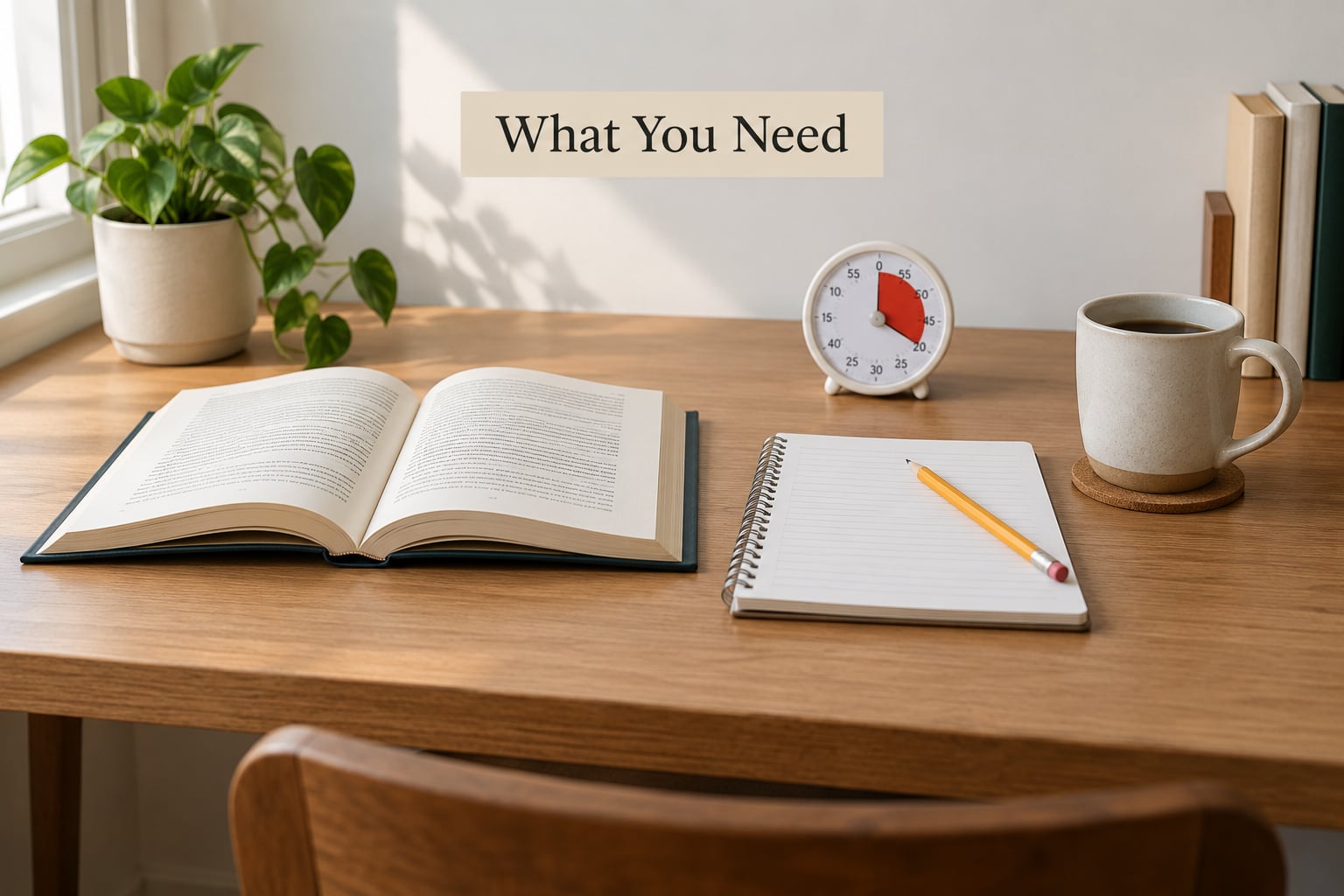
You need four things, and none of them cost money. A current book is the obvious one, but pick something you actually want to finish, not whatever looks impressive on your shelf.
A timer or a tracking habit matters more than most people expect. Untimed reading sessions drift from 15 minutes to 50 and end whenever your attention breaks. Most phones have a built-in timer, and a paper notebook works just as well if a screen-free session is the point.
A reading location that is dull. The chair by the window, the kitchen table before anyone else wakes up, the parked car in the driveway before work. Novelty holds attention for a few days and then stops; a boring spot keeps delivering.
Finally, a schedule that survives a bad week. Fifteen minutes a day is enough to build the habit, and it is small enough that you will still do it on the weeks when everything else falls apart.
Step-by-Step: How to Read More Books in Less Time
Five steps, in order. The order matters, because most people try to solve step two (reading faster) first and never get to the steps that actually change their book count.
How to Read More Books in Less Time With a Weekly Reading Plan
Set a weekly target in minutes, not books. Minutes are what you control on any given day; book counts punish you for a bad Tuesday. Ten pages is a bad unit of measurement, by the way, because page counts vary wildly between a book of essays and a fantasy epic.
Then split the week target into sessions you will actually keep. Fifteen minutes a day is 105 minutes a week. Do that five days and leave two alone, and you have three books’ worth of time in a month instead of one.
| Daily reading time | Minutes per year | Books per year (about 300 pages) |
|---|---|---|
| 10 minutes | 3,650 | 8 to 10 |
| 15 minutes | 5,475 | 12 to 15 |
| 20 minutes | 7,300 | 16 to 20 |
| 30 minutes | 10,950 | 24 to 28 |
| 45 minutes | 16,425 | 35 to 40 |
Those figures assume roughly 250 words per page and a 40-page-an-hour pace, which is ordinary for adult nonfiction. The takeaway is simple: doubling your minutes nearly doubles your books, and a 20% gain in reading speed moves the same row by about two books a year.
You know the plan worked if you hit the weekly minutes five weeks out of six without having to white-knuckle any of them. If you hit them by forcing a 90-minute Saturday session every week, the target is wrong, not your discipline.
How to Choose Books You Will Finish
For a lot of readers, choosing the next book is the real bottleneck. r/books threads keep returning to the same complaint: not that the reading is hard, but that the TBR pile creates so much friction that starting feels like work. Readers on r/productivity say almost the same thing in productivity language.
Run a three-question filter before you buy or borrow anything. Do I want to read this for pleasure, or am I choosing it to look like the person who read it? Do I have the background to get value from it right now? And roughly how many hours is this, honestly?
That last question kills the most books. A 600-page book is a ten-hour commitment. If your weekly plan buys you 105 minutes, that book is a ten-week relationship, and if you picked it up for a specific situation, it may be the wrong one entirely.
Match the book to your energy window, too. Dense nonfiction wants the morning, before your inbox makes you stupid. Fiction goes at night, when you would not have the attention for anything else anyway. Asking a tired brain to parse argument structure at 11pm is how books die.
How to Read Faster Without Skipping Important Ideas
The honest answer is that you can get meaningfully faster, and the lever is word familiarity rather than technique. Rayner’s eye-movement research found that readers resolve most words in the fovea and that the surrounding periphery is too low-resolution to read reliably with, because the cells out there are rods, not the cones that do the fine work. Multi-line and peripheral-vision methods fail for a physical reason, not a motivational one.
RSVP apps, which flash one word at a center of attention, hit the same wall. There is a processing ceiling, and once you pass it you are not reading faster, you are reading less per word. The 50-page rule is a useful companion here: speed matters most on books you are only going to skim anyway.
Subvocalization is the inner voice that pronounces words as you read. Silencing it can lift speed noticeably, and the results people report are mixed, which is exactly what you would expect if the practice helps some readers and just makes others lose the thread.
Two methods survive scrutiny. The first is skimming with a fixed procedure: read the heading, then the first sentence of each paragraph, then stop and ask what the section claimed. The second is simply reading more of the same kind of writing, which is why experienced readers of technical books hit 500 words a minute without trying and beginners cannot.
Test before you trust. Read two pages of a book you have already finished, time yourself, then read two unfamiliar pages and time again. If the fast number holds on new material, you have reading speed. If it collapses, what you have is pattern recognition on familiar text.
How to Stay Focused and Remember What You Read
Put the phone in another room, not face down on the desk. Face down still leaves the vibration and the reflex of checking; another room removes the decision entirely. If that is impossible, airplane mode plus the reading app open on the same device is the fallback.
Write one line per chapter in a notebook as you go. Not notes, not quotes: what that chapter was about, in your own words, in a single sentence. It costs about fifteen seconds and it is the single highest-value thing you can do for retention, because it forces you to convert the chapter rather than absorb it.
At the end of a session, close the book and say the last chapter’s point out loud before you do anything else. Active retrieval beats rereading by a wide margin, and it takes thirty seconds.
Readers on r/readwithme often describe finishing a chapter, closing the book, and losing the thread within a day. That is normal and it is not a memory problem, it is a lack of retrieval cues. The one-line habit and the end-of-session recall handle both.
How to Build a Consistent Reading Habit
Attach reading to something you already do at the same time every day. Coffee brewing, the commute, the ten minutes before the shower. This is habit stacking, and it beats a fixed clock time because it survives a shifted schedule.
Define a minimum session that is too small to skip. Five minutes is the floor. On good days you will read for thirty; on bad days, five still counts and keeps the chain intact. The day you skip because five minutes felt pointless is the day the habit usually ends.
Run two or three books at once. One for the morning nonfiction slot, one for the night fiction slot, and a third you are free to drop. Focus on a single title rarely lasts much past 20 to 30 minutes anyway, so a rotation keeps the reading feeling fresh and stops the daily choice from being a decision.
Layer audiobooks onto time that is already dead. Commutes, walks, cooking. Readers pair them with chores constantly, and the honest limit is that narrative fiction carries over well while technical and dense nonfiction does not. Audio counts as reading for volume, not for the kind of note-taking that studying needs.
When a streak breaks, do not restart from zero with an ambitious target. Just do the five-minute minimum the next day and resume your normal number the day after.
Common Mistakes
Setting a book-count goal. A target of 50 books a year fails on the first bad month and takes the whole system with it. Target minutes instead; books follow as a byproduct.
Buying a speed-reading course and never using it. The deal-breaker is not the cost, it is the belief that your problem is your eyes. For most readers it is scheduling and quitting books too late.
Collecting books without starting them. A visible shelf of unread books creates guilt, and guilt is the fastest way to stop reading entirely. Keep at most three books in play.
Reading on the phone in short gaps all day. Ten-minute fragments of dense material produce the sensation of reading and very little comprehension. Short sessions suit fiction and light nonfiction; serious books need 25 minutes or more.
Finishing books out of obligation. A book that stops working after 60 pages will not improve at page 300. Write the title down, put it in the someday pile, and pick the next one. New r/books threads are full of readers describing exactly this relief.
Comparing your count to someone else’s list. The people posting 80-book years are usually not reading more deeply. Decide whether you are optimizing for breadth or for depth, because the tactics that win one game lose the other.
Frequently Asked Questions
How to read multiple books at one time?
Keep one book per time slot rather than juggling five at random. Most readers hold focus on a single title for 20 to 30 minutes, so a fiction book at night and nonfiction in the morning uses different parts of your day instead of competing. Keep a third book you are free to abandon, and never carry more than three in progress at once.
What is the 50 page rule?
The 50 page rule is a commitment device: give a new book 50 pages, roughly an hour or two of reading, and if it has not earned your attention by then, put it down without finishing it. It exists because a long TBR pile of half-read books is the main reason readers feel stuck rather than prolific.
Can you really speed read?
Somewhat, but not the way speed-reading courses sell it. Eye-movement research shows the eye resolves words sharply only in the fovea, so peripheral and multi-line methods trade comprehension for apparent speed. Word familiarity and cutting subvocalization produce real gains for many readers. Test your speed on unfamiliar pages before trusting any number.
Do I have to finish every book I start?
No, and refusing to finish books is one of the fastest ways to raise your yearly count. Use the 50 page rule as a checkpoint rather than a deadline, and separate books you want from books you only feel obligated to finish. One or two abandoned books a year costs you little; a stalled pile costs you every week you avoid it.
Is listening to an audiobook the same as reading?
Close enough to count toward volume, not close enough to count toward study. Audiobooks suit fiction, memoir and long commutes, and reviewers on r/kindle and r/books regularly pair them with chores and travel. Dense nonfiction, anything you need to look up, and anything you plan to quote are better read on a page where you can go back.
What happens when you read more books?
Expect a wider vocabulary, better follow-up questions, and more arguments you can actually join. Over time you also get faster book selection, because you finish more books per year and learn your own taste faster. The benefit shows up in conversations and writing long before it shows up in any count.
Conclusion
Start with three things: one 20-minute session tonight, one weekly target written in minutes, and one book you genuinely want to read. Give it the 50 page rule and a five-minute minimum for bad days.
Speed is the least useful part of this. Fifteen minutes a day, a boring chair, and fewer half-read books on your shelf will do more for how to read more books in less time than any technique you have not already tried.