
Learning how to write a personal essay for a college application comes down to five moves: read the prompt until you can list out every question it asks, choose one true moment only you can tell, pick a narrative or montage structure, draft it in your own voice using concrete detail instead of summary, then revise through several drafts and take a small amount of outside feedback. The Common Application personal essay holds 650 words, so nothing gets padded.
Students who do well at this treat the essay like a small reporting job rather than a performance. They gather specifics, they cut fast, and they go back and check that every paragraph still answers the prompt in front of them.
Table of Contents
- What You Need
- Step-by-Step
- Choose a Prompt That Shapes Your Story
- Brainstorm Before You Settle on a Topic
- Find the Central Idea
- Outline the Narrative and Reflection
- How to Write a Personal Essay Draft
- Revise for Voice, Focus, and Authenticity
- Proofread and Check the Application Requirements
- Common Mistakes
- Frequently Asked Questions
- How should I start my personal essay for college?
- What are the 5 elements of a personal essay?
- How do I write a college essay if I’m boring?
- What are cliche topics to avoid in a college essay?
- How long should a college personal essay be?
- Can I use AI to write my college application essay?
- Conclusion: Start With One Meaningful Moment
What You Need
You need very little, and none of it costs money. What you do need is a place to work and about four or five separate sessions rather than one long night.
- The prompt itself, printed or copied out. Read the exact wording repeatedly. Some prompts look simple and quietly contain three separate demands.
- An inventory of real material. A page of moments, people, jobs, projects, trips, arguments, habits and losses you actually lived. Write it in a single sitting without editing.
- Notes. Dates, names, places, what the room smelled like, what someone said word for word.
- A document and somewhere to draft. One file for the essay, one for cut lines and half-formed ideas you are not ready to judge.
- Uninterrupted time, several times over. Ninety minutes a session is usually better than a single six-hour block, because the last two hours of a marathon go to fiddling with commas.
- Two or three readers. A counselor, a teacher who likes you, a friend who writes well. Not ten.
One more thing worth sorting out first: three different pieces of writing get called “the essay,” and they are not the same job.
| Essay type | What it is | Main job |
|---|---|---|
| Common Application personal essay | 650 words, one of several prompts you choose from | Show how you think, in your own voice |
| Statement of purpose | School-specific, usually longer and often more formal | Connect your past to that specific program and place |
| Supplemental essays | Short school-specific prompts, often 150 to 300 words | Answer one narrow question fast |
The personal essay is the widest and the least specific of the three. If a supplemental asks about a community you built, that is a different document, and reusing the personal essay word for word there reads as carelessness.
Step-by-Step
Here is the workflow for how to write a personal essay for a college application, in the order that actually works. Seven steps, and most of the value comes from the first two and the last two, which students tend to rush.
Choose a Prompt That Shapes Your Story

Choose the prompt your material actually fits, not the one that sounds most impressive. A useful drill: write the prompt out by hand, then number every question it asks you, including the unstated ones. A prompt that says “describe a moment of uncertainty” really asks what happened, what you did, what it cost, and what you understood afterward.
Now scan your inventory and see which prompt your best material matches. Many students pick the prompt first and then hunt for a story to justify the choice, which is why those drafts feel forced. Two or three prompts will fit the same story differently, and that is useful later when you adapt the story for supplementals.
Juniors reading advice threads on r/ApplyingToCollege usually hear the same thing: do not start stressing over prompts before the list, the activities and the grades are in place. The prompt cycle each year is public long before you are ready to draft.
Brainstorm Before You Settle on a Topic
Generate six candidates, not one. Set a timer for fifteen minutes and write fast: a job, a class, a family thing, a club, a friend, something that went wrong. Then screen each one against three questions. Is it true? Is there a specific scene in it, with a time and a place? Do you have an honest thought about it that is more interesting than the story itself?
Most weak topics fail the second and third test. A cancer diagnosis with no particular scene is just a fact. A summer internship is just a line on a resume. What readers respond to is a person making a choice in a specific moment.
About cliches and trauma: applicants on r/CollegeEssays say constantly that you are not obligated to write about illness, loss or family hardship to be compelling, and that pressure produces the most counterfeit-sounding prose in the pile. The three D’s, death, divorce and disease, are the most overused territory in admissions writing, and a reader who has read four hundred of them will stop before you reach the good part.
If you feel ordinary, that is usually a framing problem rather than a life problem. Take one small moment you dismissed, a shift you worked, a conversation you had after class, and run it through an A-B-C arc: what you believed before, what happened, what you believe now. Small moments with a real change in them are the essays admissions committees quote back to each other.
Find the Central Idea
Write one sentence that says what the essay is actually about. Not the plot, the idea. “My summer job taught me responsibility” is a summary of the plot and it will not guide you. “I learned that being liked and being trusted are two different currencies” is an idea, and every scene should test it.
Fill in the blank: this experience taught me something I did not expect about ______. If you cannot finish that sentence without using a word like perseverance or resilience, keep looking. Those words describe a mood, not a discovery, and they are the first thing a reader tunes out.
Put the sentence at the top of your draft document. Every paragraph that does not serve it is probably decoration, and you will find out during revision.
Outline the Narrative and Reflection
Decide on a structure before you write a sentence. Narrative and montage are the two that work at this length.
| Structure | Best for | Shape | Risk |
|---|---|---|---|
| Narrative arc | One clear turning point | Context, complication, change, reflection | Running over on setup |
| Montage | Several small moments around one theme | Three short scenes, each landing the same idea | Reads like a list without a spine |
For a narrative arc, map five beats: where we are, what happens, what it costs, what you figured out, why that matters now. For a montage, give each scene one job and let the last one do the reflection, because three separate reflections reads like three essays stapled together.
A third option, a single continuous scene with reflection woven in as you go, works when the moment is short and the change is obvious. Reserve it for essays that can live inside one afternoon.
How to Write a Personal Essay Draft
Draft with show, not tell, which means concrete scene instead of summary. Compare these two openings. “My grandmother taught me that hard work matters, and watching her recover from her stroke changed how I think about resilience” tells. “At 2 a.m. my grandmother set a glass of water on my nightstand with two fingers still standing in the bottom, and she did not say she was thirsty” shows.
Three habits carry most of the weight. Write the room: light, sound, temperature, what was in your hands. Use dialogue where the actual words matter, and drop dialogue that only decorates. Balance action and reflection roughly evenly, since 600 words of thinking and 50 words of event is a diary entry in the wrong order.
Write the first draft fast and do not reread it the same day. Aim for 600 to 700 words and keep going past your limit, because trimming is easy and inventing is hard. If you feel yourself performing the admissions voice, the fix is usually more specific detail, not better vocabulary.
Revise for Voice, Focus, and Authenticity
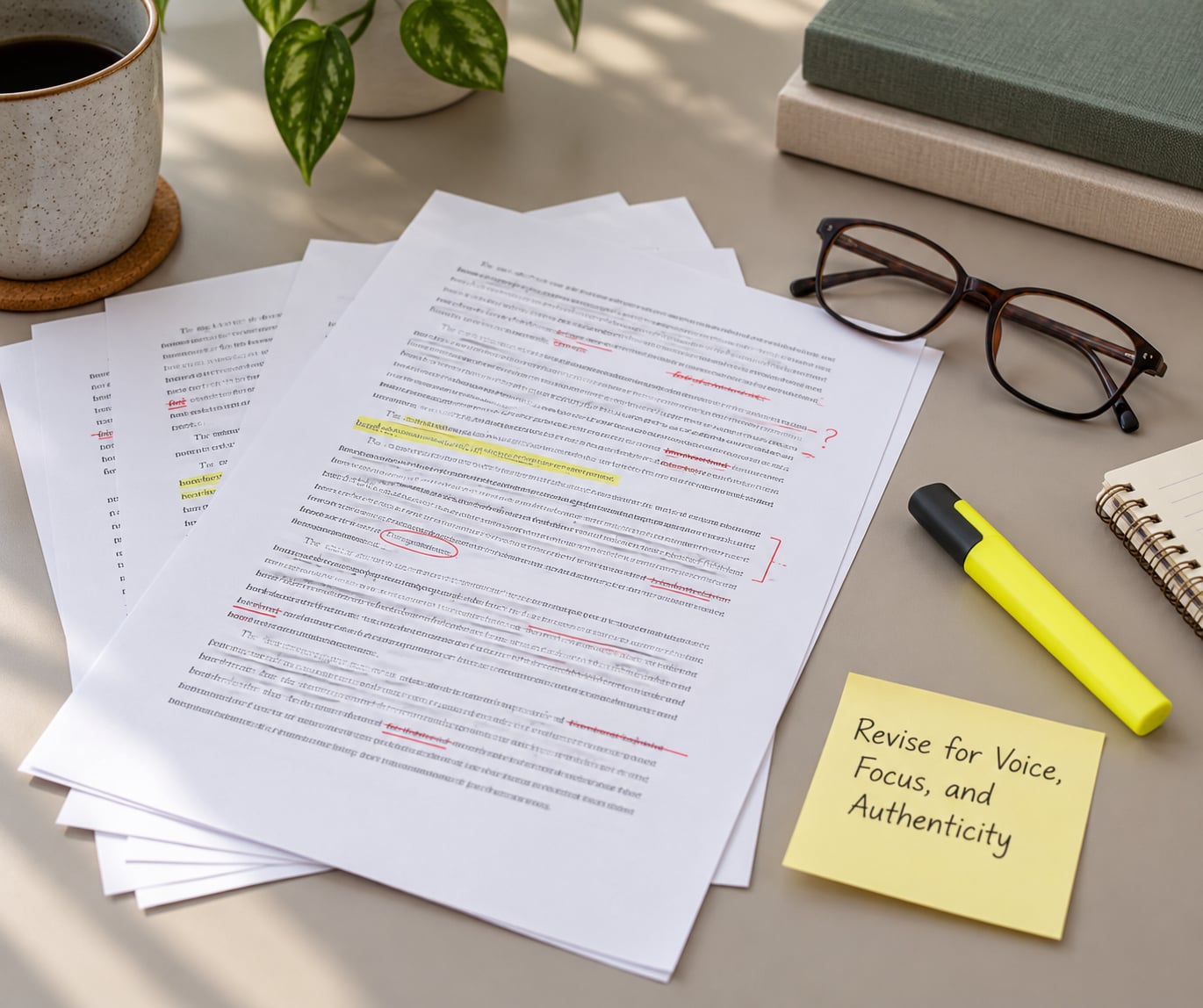
Revision works best as separate passes, one job per pass, spaced by a day. First pass, cut every sentence that does not advance the story or the reflection. Second pass, replace abstractions with specifics, testing every claim like “it was hard” for a concrete instance. Third pass, read it aloud; anything you stumble over is either badly structured or badly worded, and both are fixable.
Test the ending hard. A last line that restates what you have already said tells the reader you ran out of things. A last line that lands the idea in new terms shows you thought about it after the story was over.
Then get feedback from two or three people and ask specific questions: which line stayed with you, where did you get bored, did anyone else become the main character. Students in applicant forums worry about losing their voice after too many edits, and the fix is simple: you own every sentence you keep. Take notes on the feedback, then rewrite in your own words. If a sentence needs to stay but nobody can say why, cut it.
Proofread and Check the Application Requirements
Last pass, slowly and out loud, with the requirements open on your screen. Confirm the word count in whatever tool your application uses, and remember that the box usually excludes the title line and any heading you added.
If you are over, cut in this order: context before the story begins, the second example of anything, sentences that describe your own writing, and adjectives that repeat. Cutting the setup and one example almost always saves 40 words without touching the arc.
Then check the mechanical rules. Plain text or a clean PDF, no tracked changes, no name in the file header unless the instructions ask for one, a sensible file name like Lastname_Firstname_Essay_650.pdf, and the date and time zones your portal uses for the deadline. Read the prompt one final time and point to the part of your essay that answers each numbered question you wrote down in step one. If you cannot point, that question is unanswered.
Common Mistakes
Six errors do most of the damage, and each one has a practical repair.
- Reciting your whole childhood. Nobody has a childhood-shaped insight. Fix: pick one night, one afternoon, one conversation.
- Retelling your resume. The committee already has your activities list. Fix: take one entry and show the moment inside it instead of the achievement.
- Imitating an essay you admired. Applicants warn on r/ApplyingToCollege that reading accepted samples is a trap, because you absorb someone else’s rhythm and then write in it. Fix: read two at most, then close the tab and never look again.
- Preaching. “This experience proves that kindness is the most important value” tells the reader how to feel. Fix: delete the moral, and let the last image carry it.
- Answering a prompt you ignored. A beautiful essay about a completely unrelated experience gets rejected on a technicality. Fix: use the numbered questions from step one as your outline headings.
- Prose that sounds written by software. Smooth, balanced, and lifeless sentences are now recognizable. Fix: read it aloud, and trade two of the three sentences for something lopsided and specific.
One related question comes up constantly: can you use AI to help? Using it to interrogate your own topic, list twenty candidate moments, or check whether your essay answers the prompt is reasonable work. Submitting sentences you did not write is not, and schools increasingly ask about it. Keep the drafting yours.
Frequently Asked Questions
How should I start my personal essay for college?
Start by writing out the prompt and numbering every question it asks you, including the unstated ones. Next, list six or more true moments without judging them, then screen each for a specific scene and an honest insight. Students who stall usually stall because they pick the prompt first and hunt for a story second. Reverse that order and the opening writes itself, because you already know what the essay is about.
What are the 5 elements of a personal essay?
The five elements are a specific scene with time and place, concrete sensory and dialogue detail, a turning point where something changes, reflection that shows what you understood, and a link back to the prompt you were given. Most weak essays have the middle three in reverse order, or skip the turning point entirely. If you can name what changed and why it matters now, you have the core of it.
How do I write a college essay if I’m boring?
Take a small moment you dismissed and run it through an A-B-C arc: what you believed before, what happened, what you believe now. A quiet shift, a conversation after class, or a routine job can carry 650 words when the change in you is real. Admissions readers are not scanning for drama, they are scanning for evidence of thought. What reads as boring is usually a topic with no reflection attached, not a topic with no stakes.
What are cliche topics to avoid in a college essay?
Avoid the three D’s, meaning death, divorce and disease, plus the death-of-a-pet story, the mission trip that changed everything, and the summer internship narrated as a job description. These are not banned, but they arrive pre-loaded with expectations. If you write about one anyway, bring a detail no other applicant could have, and skip the lesson you want the reader to take away.
How long should a college personal essay be?
The Common Application personal essay has a 650-word maximum, and that ceiling is the target rather than a place to stop. Land between 500 and 650 words, with your last ten words used by a line that lands the idea. Supplemental prompts are usually shorter, often 150 to 300 words, and a statement of purpose runs longer. Always check the word box in your own portal, since limits and what gets counted vary by system.
Can I use AI to write my college application essay?
Use it to test topics, list candidate moments, and check whether your draft answers every part of the prompt. Do not use it to write sentences you submit, because that is a misrepresentation on an application you sign. Students who draft with help and then rewrite in their own words end up with a weaker voice, not a stronger one. Every sentence in the final file should be one you would defend in the room.
Conclusion: Start With One Meaningful Moment
The whole process narrows to a single next action: choose one experience and write down what changed, what it revealed and why it matters to you now. Put it on a page without polishing it, then ask whether you could describe the scene with a time, a place and one line of dialogue. If you can, you have an essay. Everything after that, the structure, the trimming, the feedback rounds, is craft on top of something true, and craft is the easy half.