
You can manage a chronic illness while working full time, but the job rarely survives contact with generic advice about morning routines and hustle culture. What actually works is a system: know the protections you already have, pace your energy like a budget, and ask your employer for specific adjustments tied to how your condition really affects you.
This guide walks through that system in six steps, plus the mistakes that burn people out. It is general information about work and health, not medical advice — your clinician decides what your body needs.
Chronic illness already runs on your time. Appointments, refills, symptom tracking and flare recovery quietly become a second unpaid job stacked on the first one. People in long-running illness communities describe exactly this: the exhaustion that survives a full night of sleep, and the fear of spending every sick day you have.
Table of Contents
- What You Need Before Changing Your Routine
- Step-by-Step: How to Manage a Chronic Illness While Working Full Time
- 1. Create a Medical and Workday Snapshot
- 2. Build a Routine Around Your Energy Levels
- 3. Plan for Symptoms, Flares, and Medical Appointments
- 4. Set Workplace Boundaries You Can Maintain
- 5. Use Workplace Supports and Accommodations
- 6. Review Your Plan and Ask for Help When Needed
- Common Mistakes That Burn People Out
- Frequently Asked Questions
- Can I work full time with a chronic illness?
- How can I manage appointments while working full time?
- What should I tell my employer about my chronic illness?
- How do I work on days when my symptoms are worse?
- What if my energy levels change throughout the day?
- When should I stop working and contact a clinician?
- Conclusion: Start With Your Workload Conversation
What You Need Before Changing Your Routine
You cannot build a sustainable plan on memory. Gather five things first, and the rest of the guide becomes much easier.
- Your medical picture in writing. Diagnosis, current symptoms, medications, appointment frequency and any recent changes. Write it out once so you are not reconstructing it under pressure at 8 a.m.
- Your workplace policies. The employee handbook, any flexible work or remote work policy, sick leave terms, and where medical documentation is submitted.
- The name of the right contact. Usually an HR representative, but many employers route accommodation requests through a manager or an occupational health team. Know which one you have.
- A tracking method you will actually keep. A paper notebook, a calendar, or a simple spreadsheet. Whatever it is, it has to survive a bad week.
- Your own limits, stated plainly. How many hours you can realistically give, when your focus is sharpest, and what a flare costs you.
Two more documents are worth having on hand before you need them in a hurry: a flare plan (below) and copies of anything you have already signed with your employer. If you also care for a parent, partner or child with a serious condition, add your own backup list of who can step in, because their appointments land in your calendar too.
Step-by-Step: How to Manage a Chronic Illness While Working Full Time
Six steps, in order. The first two are internal and private; the middle three involve your employer; the last one is the review that keeps the whole thing from quietly falling apart.
1. Create a Medical and Workday Snapshot
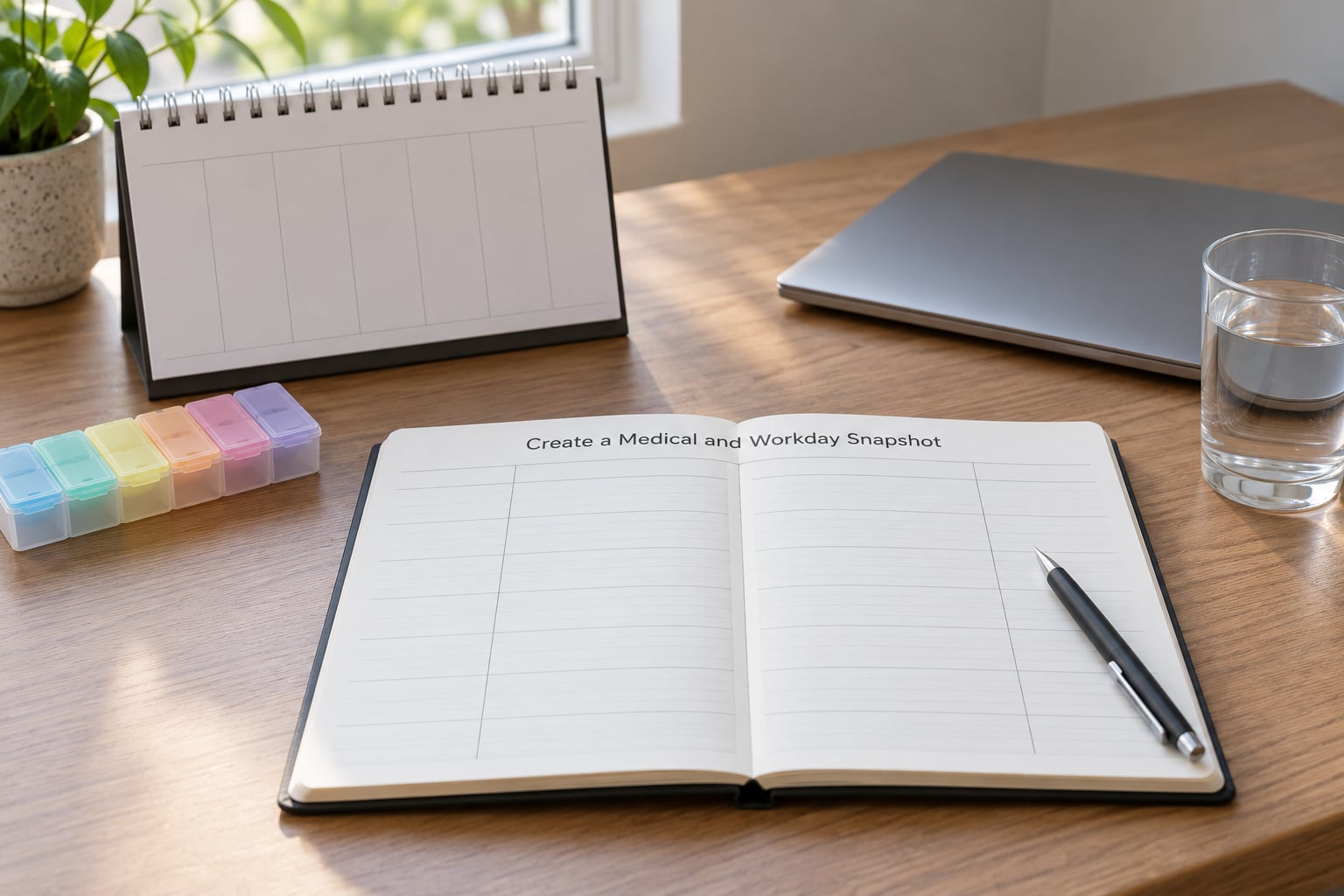
Start by writing two lists side by side: what your body needs, and what your job demands. One page is enough. On the left, list appointments, treatment timing, rest requirements, symptoms that need watching, and the days of the week that reliably hit you hardest. On the right, list your working hours, your meetings, your high-effort tasks, and the things that reliably make symptoms worse.
Bring the medical side to your clinician and ask them to confirm it. They can tell you which items matter clinically, which are urgent warning signs, and how sensitive any of it is. Do not use this snapshot to change treatment on your own — its only job is to make your care and your calendar legible to everyone else.
The payoff shows up fast. Once the two lists sit next to each other, the conflicts become obvious: the 9 a.m. stand-up that lands right after your worst hour, or the recurring 4 p.m. appointment that eats the end of every day.
2. Build a Routine Around Your Energy Levels
Most work advice assumes energy is flat across the day. For many chronic conditions it is not — it dips, spikes after exertion, or disappears entirely on bad days. Match your hardest work to whatever window you actually have.
Then cut the switching. Constantly moving between tasks, tools and conversations costs more than most people expect, and it tends to cost more on days when you are already depleted. Blocking two or three focus windows beats six fragmented ones.
Build breaks in before you need them — a 10-minute pause at a set time rather than a collapse at 3 p.m. Many people with post-exertional malaise find that pushing through one demanding task sets them back for days, so the signal to watch is how you feel 24 hours later, not how you feel while you push.
You also need an honest early warning sign that the routine no longer fits. Mine is simple: two consecutive weeks where I finish the workday and immediately crash instead of recovering. Flare frequency, missed breaks or an increasing pile of deferred tasks all count as data. Write down which signal you are watching so you notice it before it becomes a crisis.
3. Plan for Symptoms, Flares, and Medical Appointments
A flare plan is a short document that answers four questions before you need them: what a flare looks like for you, what usually helps, what you have already tried that does not, and who to contact. Keep it where you can reach it during a bad day — a phone note is better than a folder on your desktop.
Then protect the appointment time itself. Many workers lose their sick leave to appointments because they treat them as an inconvenience to schedule around. Block the time on the shared calendar early, submit the request in writing so a record exists, and ask about recurring appointment patterns once rather than re-explaining them monthly.
Have a contingency for the days when showing up is not reasonable. That can be a simple message template to your manager, a named person who can cover an urgent task, and an honest note about when you will know more. Waiting until you are mid-flare to improvise usually goes worse.
For new or worsening symptoms, contact your clinician or an urgent care service rather than trying to work it out yourself. Go to emergency care for the warning signs your care team has given you, or for chest pain, difficulty breathing, fainting, or sudden severe symptoms that feel unlike your usual pattern.
4. Set Workplace Boundaries You Can Maintain
Boundaries fail when they are dramatic and unrealistic. What tends to work is dull and specific: a defined availability window, a clear answer to “can you take this on?”, and a rule about after-hours expectations.
Practically, that means saying yes to fewer things than you used to, renegotiating instead of absorbing, and keeping work off your actual recovery time. Nobody plans a workday to fail. Decline the extra project or move the deadline, then say the reason plainly: capacity, not enthusiasm.
You are also allowed to keep your condition largely private. Coworkers do not need your diagnosis, and disclosing it widely tends to invite exactly the misinterpretation you are trying to avoid. Share what improves your work — “short breaks help me focus” — and keep the rest with your clinician and the one person who needs it.
Check this step by what changes over the next month. Fewer overcommitments, fewer messages you regret sending, and working hours that stay roughly predictable are the signs a boundary is holding.
5. Use Workplace Supports and Accommodations
Long-term conditions frequently come with legal support in the United States, and most workers never ask for any of it. Two laws do most of the work: the Americans with Disabilities Act (ADA), which requires covered employers (generally 15 or more employees) to provide reasonable accommodations to qualified individuals with a disability, and the Family and Medical Leave Act (FMLA), which gives eligible employees up to 12 weeks of unpaid, job-protected leave, sometimes used intermittently or on a reduced schedule. State disability and sick leave laws can add more.
The process looks the same almost everywhere. You describe a limitation in work terms, you name the adjustment that resolves it, and the employer engages in an interactive process — a conversation, not a formality. Adjustments that come up often include a modified or flexible schedule, remote or hybrid work, rearranged duties, breaks spread across the day, an ergonomic workstation, assistive technology, and leave as an accommodation.
Some terms you will hear and should know. Reasonable accommodation means an adjustment that lets you do the job’s essential functions; essential job functions are the core duties of the role, not peripheral tasks; intermittent leave means FMLA leave taken in blocks rather than one stretch. Employers usually may ask for medical documentation, and they must keep that information confidential and separate from your personnel file — generally only supervisors who need to know the accommodation may see it.
Be realistic about outcomes. Most requests end in a workable arrangement, some get narrowed or denied, and an employer can argue undue hardship where an adjustment is genuinely expensive or disruptive. No one can promise you a particular accommodation, but you can always ask in writing, document the conversation, and use your state’s employment agency or the EEOC if it goes nowhere.
6. Review Your Plan and Ask for Help When Needed
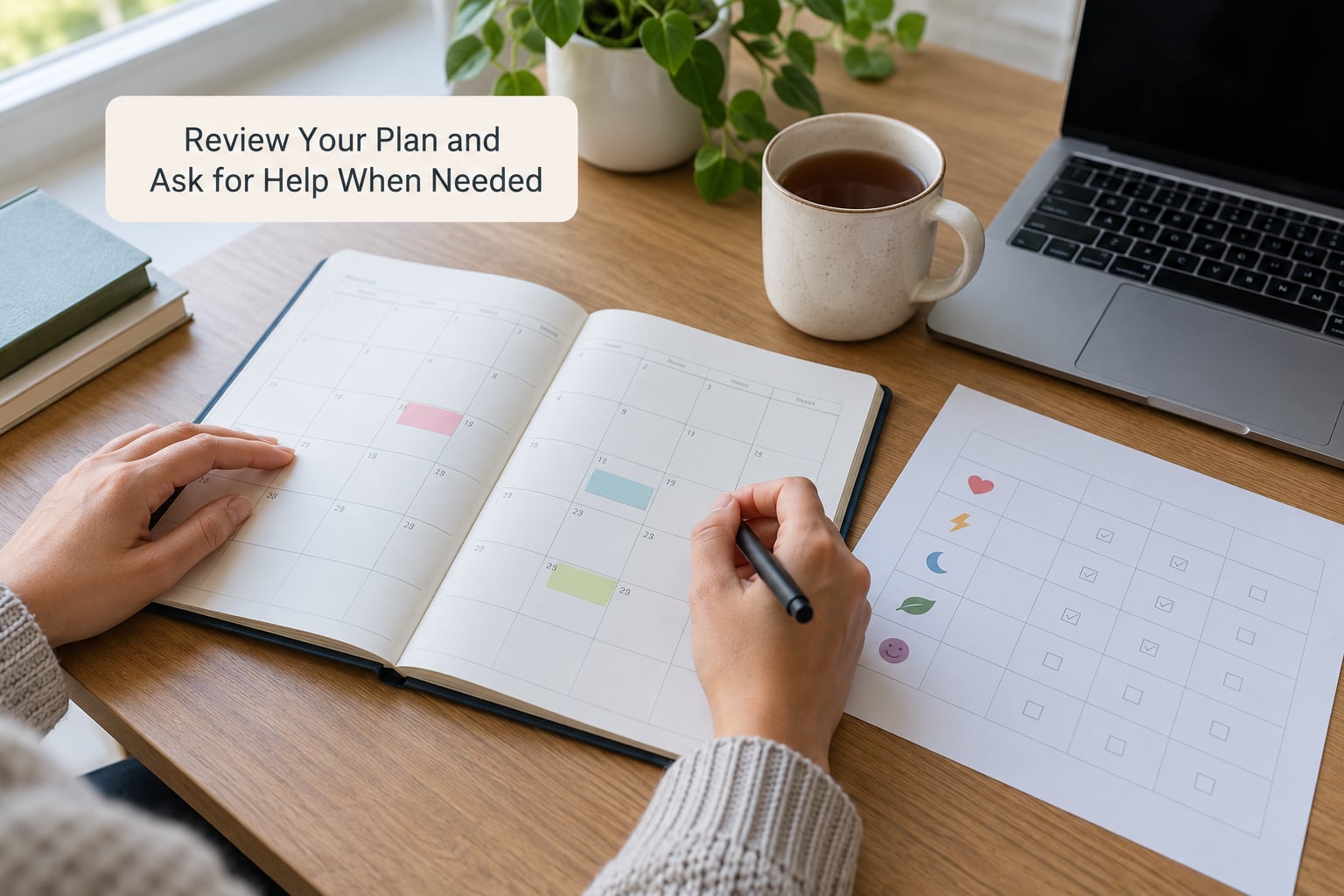
Treat the plan as a living document with a review date, ideally monthly at first. Note how work actually went: tasks finished or deferred, breaks taken or skipped, symptoms that showed up, appointments attended, and any change in your workload or team.
Then decide what stays and what moves. If late meetings reliably trigger your symptoms, request a schedule adjustment. If a recurring appointment keeps colliding with a deadline, ask to shift that project’s milestone. If the numbers are not improving, that is not a discipline problem — it is a design problem.
Bring the pattern to your care team and to your workplace support contact, separately. Clinicians can adjust the medical side; your employer can adjust the work side. Neither can guess what the other is doing, and the gap between them is where people usually get stranded.
Common Mistakes That Burn People Out
Treating severe symptoms as something to push through. A few stubborn hours are normal; a crash that lasts days is a dosing problem, not a willpower one. Back off earlier and ask for help sooner.
Skipping medical care because the appointment is inconvenient. Routine visits are the cheapest place to catch a change. Move the meeting, not the appointment.
Over-disclosing at work. Explaining your condition to everyone invites management, misreads and stigma. Share what you need with the people who need it.
Planning every day identically. A rigid schedule has no room for flare days, which guarantees the day it breaks is the one that matters. Build two or three versions of your workday and rotate between them.
Skipping meals and breaks to finish work. A short break costs minutes. A crash costs days.
Assuming frequent breaks mean you are disengaged. This one comes from other people’s assumptions, and it is worth addressing directly: state what the adjustment does for your output, and give it a trial period.
Waiting until you are desperate before asking for support. Accommodations and leave work far better as a process started early than as an emergency request after a bad month.
Frequently Asked Questions
Can I work full time with a chronic illness?
Many people do, and the honest answer is that the job has to fit your condition rather than the reverse. Full-time work is more achievable when your hours are predictable, your tasks are within your capacity, and you have adjustments for your worst hours. Treat your condition as a scheduling input, not an interruption. If your care team says full time is manageable for you, the work is making it sustainable that determines whether it holds.
How can I manage appointments while working full time?
Block appointments on the shared calendar as soon as they are scheduled, submit the request in writing, and ask early whether recurring visits can follow a predictable slot. Tell your manager the pattern and the expected duration rather than the diagnosis. If a recurring series keeps colliding with deliverables, ask to shift a milestone. Keeping every visit documented helps if you later need intermittent leave.
What should I tell my employer about my chronic illness?
You do not have to name your condition to ask for an adjustment. Describe the limitation and the fix: a schedule change, remote days, lighter duties for a period, or breaks spread through the day. If documentation is required, it usually goes to HR or occupational health rather than your manager. Employers are generally required to keep medical information confidential and out of your personnel file. Share more only when it helps the adjustment work.
How do I work on days when my symptoms are worse?
Switch to your low-energy version of the day: essential tasks only, meetings moved or declined, notifications off, and no task switching. Tell your manager early in the day rather than disappearing mid-afternoon, which reads very differently. Keep your flare plan and backup contacts reachable. If worsening symptoms are new or unfamiliar, contact your clinician instead of trying to work through them.
What if my energy levels change throughout the day?
Match your work to the pattern rather than fighting it. Put deep, high-effort tasks in your sharpest window and move admin, email and routine meetings to the dip. Block focus time instead of letting notifications fragment the morning, and take scheduled breaks before you need them. Track the pattern for two or three weeks, then confirm it with your clinician, since shifts in energy can also reflect a change in the condition itself.
When should I stop working and contact a clinician?
Stop working and contact your clinician when symptoms are new, worsening, or unlike your usual pattern, when your flare plan does not help, or when managing work is making you unsafe to drive, walk or concentrate. Seek urgent or emergency care for chest pain, trouble breathing, fainting, severe bleeding, confusion, or any symptom your care team has flagged as urgent. Do not use this guide, or any article, to decide how to treat those symptoms.
Conclusion: Start With Your Workload Conversation
Do not try to rebuild your entire working life at once. This week, write down what your body needs and what your job demands, then circle the single work pattern most likely to cost you a flare.
Take that one item to your care team or your workplace support contact. A schedule shift, a lighter task list or a documented accommodation is a far smaller conversation than quitting, and it is the difference between managing a chronic illness while working full time and being managed by it.