To read a court docket, start at the bottom of the entry list and work upward, because the newest entries tell you what the case is doing right now. Each numbered line is one event a clerk recorded, such as a filing, a hearing, or an order, and the description on that line is your plain-language translation key.
A docket is the fastest way to answer three questions: what happened, what is scheduled, and what happens next. Most people never need to read the underlying pleadings to get those answers, though a few entries stay unreadable until you open the document behind them.
This guide covers federal and state dockets in the United States. Court systems differ on wording, access rules and abbreviations, so treat every example here as a pattern to recognize rather than a rule that applies everywhere. It is general information, not legal advice.
Table of Contents
- What You Need
- Step-by-Step: How to Read a Court Docket
- 1. Confirm the Court, Case Number, and Jurisdiction
- 2. Understand the Docket’s Main Columns
- 3. Read Entries in Chronological Order
- 4. Decode Common Docket Descriptions
- 5. Open the Underlying Filings When Needed
- 6. Record Dates, Deadlines, and Follow-Up Steps
- How to tell whether a case is still active
- Common Mistakes
- Frequently Asked Questions
- Can I see court filings online for free?
- How do I find my court docket online?
- What does entry of appearance mean on a court docket?
- What does closed mean on a court docket?
- How long before trial is docket call?
- Do I need a lawyer to understand a docket?
- Start With the Latest Docket Entry
What You Need
Before you open anything, gather four things. Having them ready turns a twenty-minute hunt into a two-minute check.
- A case number, if you have one. It is the fastest and most reliable search key, and it is printed on any paper you received from the court.
- Party names if you do not have a case number. You need the full first and last name of at least one party exactly as the court has it recorded.
- The court. A name alone is not enough. You need the court level and location, such as a county superior court, a state court of appeals, a federal district court, or a bankruptcy court.
- The case type. Civil, criminal, family, probate, or immigration each produce a different kind of docket, and searching the wrong type returns either nothing or a confusing partial match.
Have somewhere to take notes, and write down the case number as soon as you see it. Nearly everything else you do with a docket requires that one string of digits.
One expectation to set in advance: not everything is public, and not everything is online. Sealed entries exist, sealed documents often show only a placeholder, and some courts keep older records on paper at the clerk’s office rather than in the electronic system. As of 2026, access rules are still shifting court by court as electronic filing systems expand.
If you are checking your own case and the last entry is more than a few months old, do not assume the case died. Dockets can sit dormant during negotiation, discovery, or an appeal, and a closed case can still be reopened for a limited window. The clerk of court can confirm the status of a specific case; they generally cannot give legal advice about what it means.
Step-by-Step: How to Read a Court Docket
The workflow below works whether you are checking your own case, researching someone else’s, or verifying a public record. It takes about ten minutes once you know where to look.
1. Confirm the Court, Case Number, and Jurisdiction
Every search result that looks similar is still wrong until you confirm five things: the court name, the case number, the case type, the county or district, and the party names. Two cases with similar names in the same state are common, and a party can appear in several cases at once.
Read the case caption at the top of the search result. A caption lists the parties with their roles, so in a civil matter you will see something like a plaintiff suing a defendant, and in a criminal matter the state prosecuting a defendant. If the caption names someone who is not your ex, is not your landlord, or is not the person you expected, stop and re-search.
Next, check the court level. A state trial court docket and a federal district court docket for the same dispute are entirely separate records with separate numbers, and only one of them is yours. Appeals create a third case in a different court, which is why an old case number sometimes stops producing results and a new one appears instead.
If you are searching by name instead of number, expect misses. Courts index names differently, middle initials and suffixes change the spelling, and a party listed as a business entity may be indexed under a registered agent. Searching the exact legal name from a prior document beats guessing.
2. Understand the Docket’s Main Columns
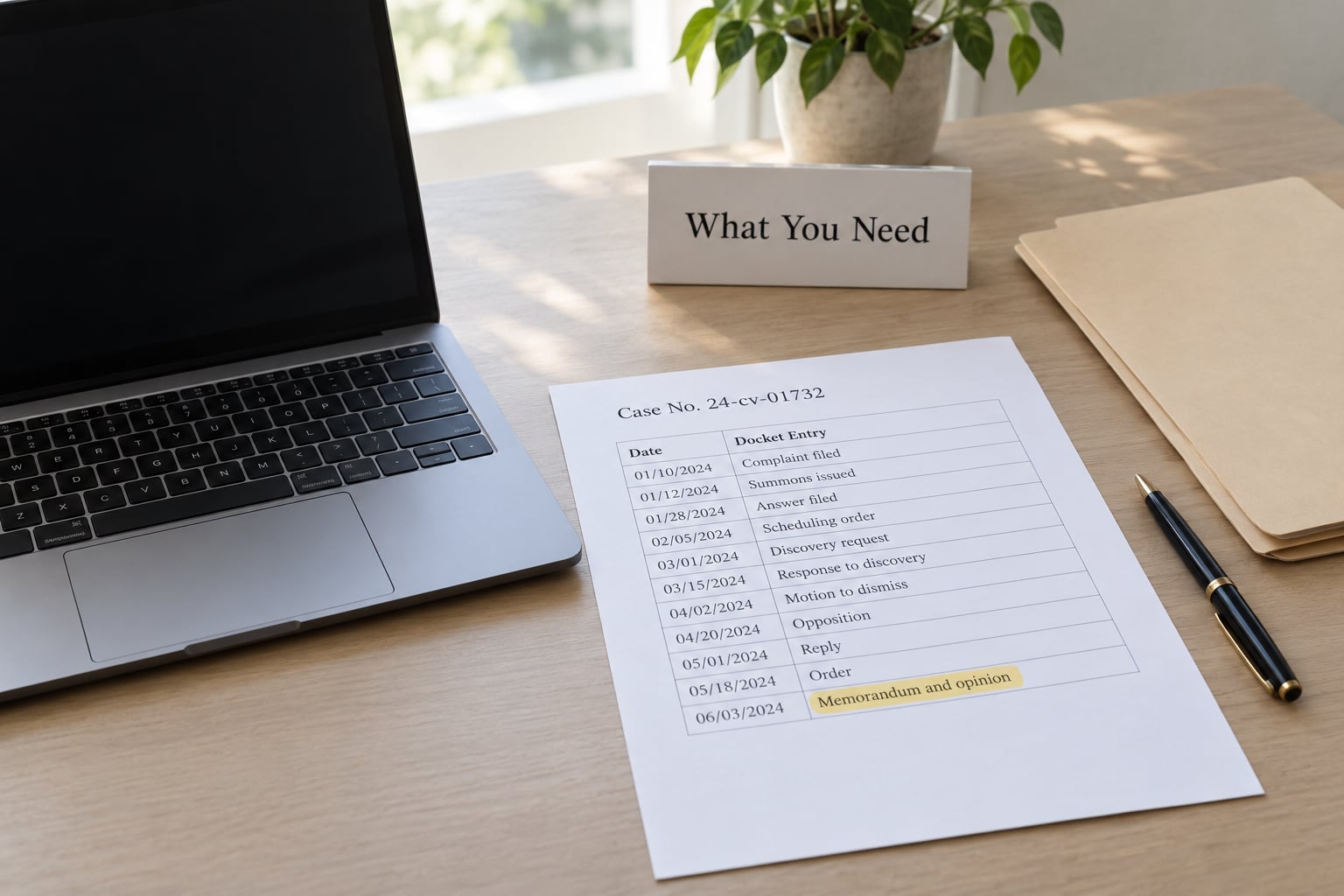
Once you are on the case page, you are looking at a chronological log. Most dockets use the same handful of columns, and reading the header row tells you which system you are in.
| Column | What it means | Example |
|---|---|---|
| Docket number | The sequence number the clerk assigned to this event, unique within the case | 47 |
| Date filed | When the event was recorded by the court, which is often not the same day it was written or signed | March 14 |
| Event or description | The court’s short label for what happened, often abbreviated | MOTION TO COMPEL DISCOVERY |
| Document link | The filed paper itself, its PDF, or a page reference for paper-only records | Document 31 |
| Filed by | Which party or attorney submitted it, shown on many systems as initials or a name | Smith, J. |
| Status or deadline | Any hearing date, response date, or note about a scheduled event | Hearing set |
Now decode the case number itself. Federal civil case numbers follow a consistent pattern: a division code, a two-digit year, a sequence number, and a type code. A division code of 1 means a district court, 2 means a circuit court of appeals, and 5 means bankruptcy. A type code of 1 in a district court means civil, 2 means criminal, 4 means bankruptcy, and 7 means civil matters subject to the alternative dispute resolution rules.
State case numbers look different. A common state pattern is a two-digit county or venue code, a court or division code, a two-digit year code, and a sequential number, such as a four-digit civil filing sequence. Some states add a suffix for the case category. None of these patterns are universal, which is why reading the case number is a useful skill only after you learn your own court’s convention.
Two numbers on the same screen cause constant confusion. The case number identifies the case for its whole life. The docket entry number identifies one event inside it. Entry 47 is not case 47. If a source lists an “index number,” that is usually the older case-tracking identifier, and it is often the number you need for older records.
3. Read Entries in Chronological Order
Here is the part most guides get wrong. Newer entries usually appear first on a court portal, but printed docket sheets and PDF copies often run oldest first. Know which direction your source runs before you decide what you have found.
To work out where the case actually stands, read the final three to five entries from the newest side and ask three questions. Is there a new filing? Is there a hearing or trial date? Is there an order that resolved something? A case with a motion pending and no scheduled event is in a different position from a case with a scheduled trial date and a pending dispositive motion, and the docket is what tells the difference.
Then follow references backward. Entry 62 might read “ORDER granting in part Document 55,” which tells you the ruling came down on entry 55, a motion filed weeks earlier. Clicking back to that entry tells you who filed it and what they asked for. This two-step move, finding the order and then reading the motion it decided, answers most questions people open a docket with.
Look for the entries that describe the case’s spine: the initial filing, the answer or response, the major motions, the orders, and the disposition. Ignore the routine housekeeping in between, which is mostly notices, certificates of service, and clerk-generated entries with no document attached.
4. Decode Common Docket Descriptions
Court shorthand is inconsistent, but the vocabulary repeats. Learning these descriptions turns the entry list from a puzzle into a story you can follow.
- Complaint or petition (COMPL, PET): the document that starts the case and states the claims, or in criminal matters, the formal charges.
- Summons issued (SUMM): the court sends formal notice of the lawsuit to the other side. A criminal summons, sometimes called a bench warrant, serves a different purpose and signals a defendant is wanted.
- Answer or response (ANS, RESP): the opposing side’s reply to the complaint, including any defenses or counterclaims.
- Appearance (APRN): a lawyer or party tells the court they are now involved in the case.
- Motion (MOT): a formal request for the court to do something. A motion to dismiss asks to end the case early; a motion for summary judgment asks to resolve it without a trial; a motion in limine asks to limit what evidence can be presented at trial.
- Order (ORD): a ruling. Orders grant or deny motions and often set the schedule for everything after them.
- Notice (NOT): a communication the court or a party sends, sometimes with a deadline attached.
- Hearing or status conference (HRG, STAT): a scheduled appearance, often used to check in with the judge and see if the case can move forward.
- Trial or jury (TRIAL, JURY): the date the case is tried, which can be set months ahead and then moved.
- Judgment (JDG): the formal ruling that ends a claim or a case. Some judgments are immediately final and some are not, which matters if appeal deadlines are running.
- Dismissal (DIS): the case ends, either by agreement or by court order, with or without prejudice. Dismissal without prejudice generally allows refiling; dismissal with prejudice generally does not.
- Closed (CLSD): the court’s file is marked closed. It reflects the clerk’s file status, not necessarily whether every right has expired.
The same words carry different weight depending on the case type. In a civil docket, an appearance usually means a lawyer has taken over. In a criminal docket, an appearance marks the defendant’s first court date. In an appellate docket, entries are mostly briefs, records on appeal, and opinion filings, and there is usually no trial date at all because the trial already happened.
A status check and a status conference are related but not identical. A status check is often a clerk-generated line confirming the case’s current posture in the system. A status conference is a scheduled meeting with a judge, and if the docket shows one, you are usually expected to be there or to have current contact information on file with the clerk.
Docket call works differently again. In many jurisdictions it is the judge’s routine roll of cases, where the parties report whether the case is ready to proceed. It can happen weeks or months before trial, which answers a common question: a docket call entry near the start of a case does not mean trial is imminent.
Abbreviations vary, so treat any list, including this one, as a starting point. A few entries to expect across systems:
| Abbreviation | Full term | What it means for you |
|---|---|---|
| APRN | Appearance | An attorney or party joined the case |
| COMPL | Complaint | The starting document of the case |
| MOT | Motion | A formal request for a court ruling |
| ORG | Order | The court ruled on something |
| NOT | Notice | A communication, often with a deadline inside |
| HRG | Hearing | A scheduled appearance date |
| MIN | Minutes | The clerk’s record of what happened at a hearing |
| JDG | Judgment | The ruling that resolved a claim or the case |
| DIS | Dismissal | The case ended; check with or without prejudice |
| STIP | Stipulation | The parties agreed to something |
| SURR | Surrender | Common in criminal cases, often tied to a plea |
| CLSD | Closed | The clerk’s file is closed |
| SEALED | Sealed entry | The content is withheld from public view |
| CERT | Certificate of service | Proof that papers were served on the other side |
5. Open the Underlying Filings When Needed
Some entries answer the question on their own. Others are just a label, and the label tells you a motion was filed without telling you what it asked for. When that happens, open the document.
Start with the caption block of the filing. It shows who filed it, against whom, and often the date of the underlying event, which can differ from the date the clerk recorded it. From there, read in a fixed order: the introductory paragraph stating what is being asked, the facts or grounds, the exhibits, and the signature block naming the filer.
For a motion, the requested relief is usually stated as numbered items. “Defendant respectfully requests that the Court enter an order granting the motion in its entirety” tells you the goal. For an order, look at the disposition line, which usually reads granted, denied, granted in part, or denied without prejudice.
Watch for differences between what was filed and what was decided. A motion docketed on one date and ruled on months later is normal, and the ruling controls. Orders often differ from the relief requested, so read the order rather than assuming the motion succeeded.
Some documents will not open, and that is normal. Sealed entries, juvenile records, grand jury matters, and records sealed by court order typically show a placeholder such as “not available” or “case under seal.” Redacted filings exist too, where a document is public but parts are blacked out. A clerk can tell you what exists and what is withheld; what a document means for your situation is a question for a lawyer.
6. Record Dates, Deadlines, and Follow-Up Steps
The most useful thing you can carry away from a docket is a short list of dates. For each one, note what it is, who it belongs to, and whether it is a hearing, a response deadline, or a filing deadline.
Do not assume every entry has a deadline attached. Orders granting a motion to compel in a civil case often set no date at all. Where deadlines do appear, they most often sit inside the document rather than in the entry description, which is one more reason to open the filing.
Three patterns tell you most of what you need to know about timing. A notice that a hearing has been continued means the old date is void, and the new date is authoritative. An order staying discovery pauses a phase of the case without ending it. An order extending time, or a stipulation signed by both sides, usually signals that a deadline moved rather than that the case stalled.
Some dates are court-run, not party-run. The scheduling order, the case management plan, and local rules often govern discovery cutoffs and pretrial dates regardless of what the parties agree privately. In criminal cases, statutory and court-set deadlines around arraignment, plea proceedings, and sentencing follow the same logic.
Watch for the entries that signal risk. A certificate of service filed with nothing else nearby can mean a party has not responded yet, and silence on a docket is not the same as an extension. A “no activity” stretch is often an agreed pause, and it can also mean a party missed something. If you are the party involved, ask the clerk about the case status, and get a lawyer’s view on anything with a real consequence.
How to tell whether a case is still active
Four checks, in order, answer this reliably. Look at the newest entry date and compare it to how long the case type usually takes. Read the last order to see what the judge directed and when. Check whether a hearing is scheduled. Then confirm whether the file shows an open status or a closed one.
If those four point in different directions, the case is probably paused rather than finished, and the answer sits in the order that paused it.
Common Mistakes
Treating a docket entry as the whole record. The docket is an index of events, not the substance of the case. It tells you a motion was filed, not what the motion argued. When a question turns on facts rather than events, open the filing.
Assuming a filing proves the allegations are true. A complaint is an accusation, and a motion is a request. Neither is a finding. Only an order, judgment, or recorded hearing result establishes what the court decided.
Reading the newest entry and stopping. The latest line is often a notice or a clerk-generated entry. The answer usually sits two or three entries further down, or in the document attached to an older one.
Ignoring court-specific definitions. The same abbreviation can mean different things in different systems, and some courts define terms in local rules that override the ordinary reading. When a term carries weight in your situation, check the court’s own glossary or local rules.
Assuming no activity means the case ended. Long quiet stretches are common during discovery, settlement talks, or an appeal. Read the last order before drawing a conclusion.
Missing that a hearing date was vacated or moved. Calendars and docket entries disagree more often than people expect. The docket entry is the record of what the court ordered, so treat a continued or vacated hearing as controlling.
Searching the wrong court or wrong name. The most common reason a search returns nothing is not that the case does not exist, but that it lives in a different court level or sits under a party name you did not guess. Search by case number first whenever you have one.
Assuming a sealed entry means something improper. Sealing is routine for juvenile, family, grand jury, and sensitive commercial matters. It limits what the public can see; it does not by itself suggest a problem with the case.
A few habits make the rest easier. Save or print the docket on the day you check it, because portals change and older entries sometimes move. Note the last entry date and the last order in the same breath, so you always know how current your information is. Prefer the court’s own portal or a free archive such as CourtListener and RECAP over a commercial aggregator when you need something dependable. And when a deadline matters, verify it against the document itself rather than the entry label.
One caution about federal records specifically. PACER is the federal system’s public access system, and it charges a modest fee per page, with quarterly waivers available for qualifying filers. Free archives like CourtListener and RECAP cover a large share of federal filings and are usually the faster first stop for research.
Frequently Asked Questions
Can I see court filings online for free?
Yes, for most cases, though coverage varies. Federal district and appellate records are searchable free through CourtListener and RECAP, and many federal documents are also viewable on PACER, which charges a modest per-page fee with fee waivers available. Most state courts offer some free portal access, and some states limit what you can see without an account. Records that are sealed, sealed by order, or older than the system’s retention window may only be available from the clerk of court, sometimes in person and sometimes for a copying fee.
How do I find my court docket online?
Start by identifying the court that handled your case, then open that court’s official case search or e-filing portal. Search by case number if you have it, since that returns exactly one result. If you only have names, search by the plaintiff’s or defendant’s full legal name, confirm the case type and court level in the results, and check the party names in the caption match who you expect. Commercial aggregators and free archives like CourtListener work well for research, but the court’s own site is the most current source.
What does entry of appearance mean on a court docket?
An appearance tells the court that a lawyer, or sometimes a party acting for themselves, is now involved in the case. In civil matters it usually marks an attorney formally joining the representation, which means service of documents goes through that attorney from then on. In criminal cases an appearance marks the defendant’s first court date. Once you see an appearance, check whether any prior attorney has withdrawn, because a withdrawal entry without a replacement can leave a party unrepresented.
What does closed mean on a court docket?
Closed is a file-status label the clerk applies, usually after a final judgment or dismissal. It describes the file, not every legal right attached to the case. Appeal windows, reopening periods, and record-correction requests can survive a closed file, and some closed cases are reopened routinely. If you need to know whether a case can still be touched, the clerk can confirm the status; whether you have a legal basis to act is a question for a lawyer.
How long before trial is docket call?
It varies by court and case type. In many jurisdictions a docket call or status conference happens well before trial, sometimes months ahead, and its purpose is to check whether the case is ready to move forward rather than to hold it. Some courts schedule a second or final pretrial docket call much closer to the trial date. The docket itself will show the scheduled dates, and a continuance entry can move them, so read the newest entries before assuming any date still stands.
Do I need a lawyer to understand a docket?
No, most dockets are public records and anyone can read them. You can learn the vocabulary, follow the timeline, and download documents on your own. A lawyer matters when the reading raises a question with consequences, such as whether a deadline was missed, whether an order is final and appealable, or whether you should respond to a filing. Court clerks can explain procedures and tell you what a document is, but they cannot advise you on strategy or rights.
Start With the Latest Docket Entry
Confirm the court, case number, and party names before you read a word. Then jump to the newest entry, read the last three entries together, and open the document behind the most consequential one.
Write down the last entry date, the last order, and any hearing or response date. If those three do not line up with what you were told to expect, the docket is the record that matters, and the discrepancy is worth asking about.
Contact the clerk of court for case status, procedures, and how to obtain records that are not shown online. Bring in a qualified lawyer when a question has consequences attached to it: a missed deadline, a possible appeal, or a filing you think you should respond to.
This guide covers general information about US court dockets, and local rules and terminology vary by court and state.