
Reentry is the process of moving people out of prisons and jails and back into their home communities, and it involves far more than walking out the gate. People must rebuild housing, income, identification, health coverage, and family relationships while meeting court dates and supervision requirements, often within days.
This guide is written for people preparing to leave custody, for anyone in the first months of freedom, and for the families, advocates, and case managers supporting them. It follows the transition chronologically, because the order of problems matters: the first 24 hours are about survival, the first month is about stabilization, and the first year is about consolidation.
Every state runs its own release process, and what a person faces depends on whether they are leaving prison or jail, whether they are on parole or probation, how long they served, and what conditions attach to their release. The general shape, though, is remarkably consistent.
Table of Contents
- What Reentry After Prison Looks Like Day by Day
- A timeline of reentry
- How the Reentry Process Works After Release
- Finding Housing and Transportation
- Finding Work and Income
- Accessing Health Care and Mental Health Support
- Reconnecting With Family and Community
- Legal Requirements and Record-Related Barriers
- How to Build a Reentry Plan
- The three E’s of reentry
- Frequently Asked Questions
- Where do people go after they are released from prison?
- How hard is it to find a job with a criminal record?
- Can you get health insurance after prison?
- How do people rebuild relationships with family after years inside?
- What is the 85 rule in prison?
- What are the three E’s of reentry?
- Where to Begin
What Reentry After Prison Looks Like Day by Day
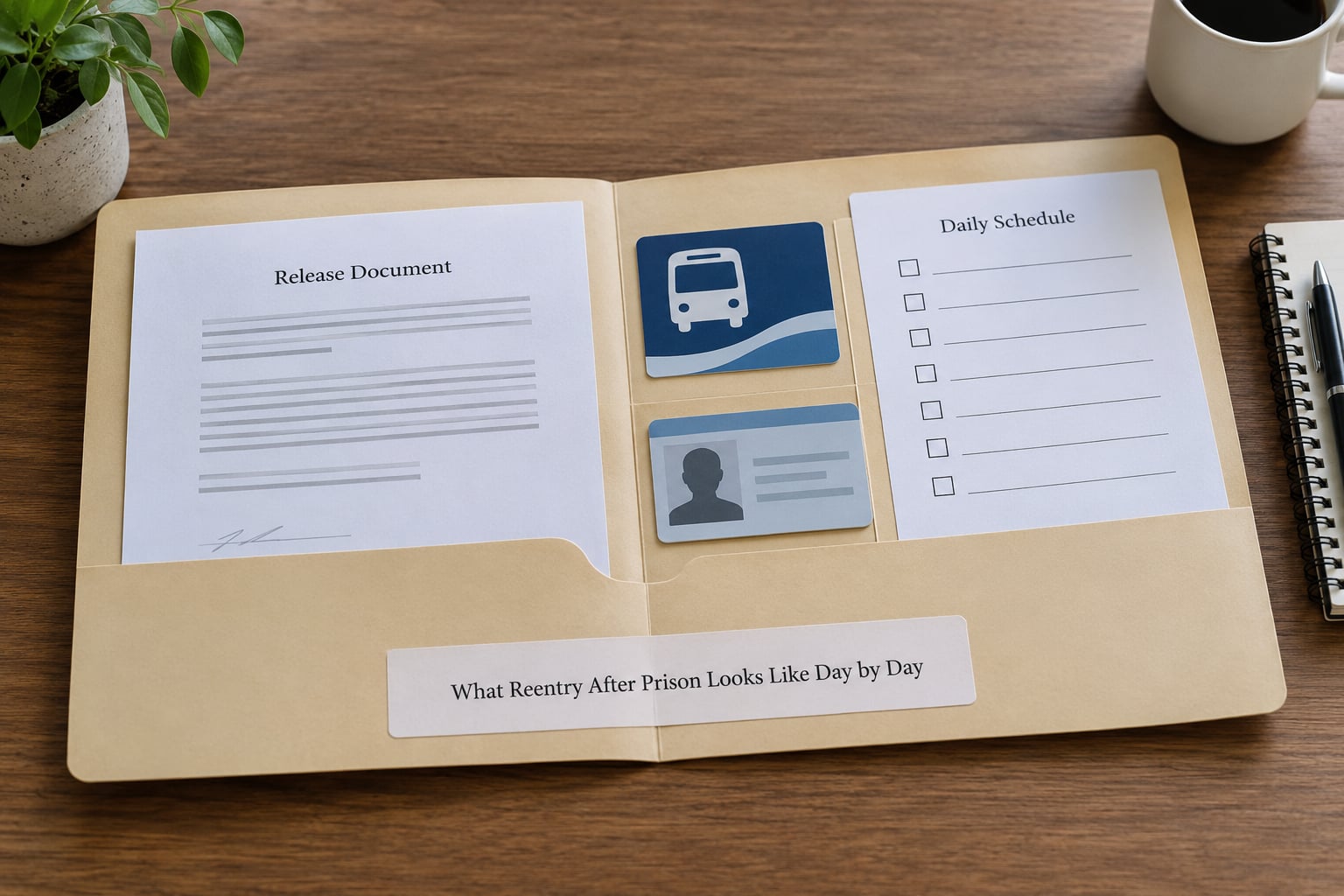
The first 24 to 72 hours are logistics, and logistics is where most people describe the worst of it. Release often happens early in the morning, which means the practical options for getting anywhere are limited. The ride home is the first decision, and it frequently comes down to a bus or a ride from someone who can pick you up.
Identification is the second hurdle. Almost everything else depends on having a photo ID: renting a room, opening a bank account, receiving benefits, applying for work. If release papers were not arranged in advance, or if the person has no other form of identification, that line can take weeks and a small amount of money to get through.
Where people sleep on night one varies enormously. Some go to a family home. Some go to a halfway house or a transitional program with a bed already assigned. Some end up on a relative’s couch, and some end up in a shelter with a bag of belongings and a curfew.
There are also obligations that start immediately. A probation or parole office may require an in-person check-in within a set number of days. Outstanding warrants, unpaid fines, and child support arrears may still be attached, and a missed appointment can put a person back in custody for a paperwork reason rather than a new crime.
Emotionally, the first days are quieter than people expect, and heavier in some ways. Someone released after a long sentence often describes the strangeness of ordinary noise, traffic, and having to make small decisions that no longer structure the day. That adjustment is normal, and it is not a sign that something is wrong.
A timeline of reentry
| Timeframe | What happens | What you need ready |
|---|---|---|
| First 24 hours | Release, transport home, belongings, deciding where to sleep | Photo ID, release paperwork, a destination address, someone expecting you |
| First week | Supervision check-ins, court dates, finding identification, contacting family | Supervision officer’s contact details, any outstanding case information, transit or ride arranged |
| First month | Signing up for health coverage and benefits, applying for work, addressing fines or child support arrears | Social Security number, release date paperwork, income and housing application forms |
| First year | Stabilizing housing and income, completing supervision, rebuilding routines | Steady contact with a case manager or peer support, treatment where needed, a support network |
How the Reentry Process Works After Release
Reentry usually begins inside prison, months or years before the gate opens, and it continues as an administrative process after release. Good programs treat it as a sequence rather than an event.
- Release planning. Ideally starting well before the release date, this covers identification, benefits, housing, treatment, and employment. The maxim repeated by reentry advocates is simple: reentry begins on Day 1, meaning inside the institution.
- The release itself. Paperwork, property, medication arrangements, and transport. Sometimes a halfway house placement is part of the release plan and is assigned by the releasing agency.
- Post-release obligations. Depending on the case, this means parole supervision, probation, court-ordered conditions, or none of these for people released outright after serving their full sentence.
- Community reconnection. Case management, treatment, employment services, and family contact, delivered by a mix of government agencies and nonprofit providers.
What varies enormously is the quality and availability of step four. Some states fund comprehensive reentry services; others have caseworkers with hundreds of people on their caseload. In rural areas, the nearest office may be hours away.
Finding Housing and Transportation
Housing is usually the first real bottleneck. Landlords are cautious, applications often ask about criminal history, and many people have no rental history or verifiable income at the moment they apply. A record creates friction even when the law does not require a rejection.
The options, roughly in order of how common they are:
- Family or friends. The most common arrangement by far, and often the most strained. It works best when the stay has a defined length and everyone agrees on it up front.
- Halfway houses and residential programs. Structured housing with rules, often assigned as part of release. Beds are limited and waiting lists are normal.
- Transitional and supportive housing. Programs designed to bridge the gap to permanent housing, often with case management attached.
- Shelter and emergency shelter systems. The fallback when nothing else lands, which adds curfews and limited storage to everything else.
- Subsidized or public housing. Available, but waitlists can run years, so applications should be filed immediately.
Transportation is the quieter half of the same problem. Without reliable transit, a job across town and a parole appointment across town are both out of reach. Many programs issue bus passes or cards for the first weeks for exactly this reason, and it is one of the highest-leverage things a family can arrange in advance.
Finding Work and Income
Work is where a criminal record has the most direct financial cost. Most employers run a background check, and the check produces a result that includes both old offenses and, depending on the state, arrests without convictions.
Research on this has found a consistent pattern: when a record is disclosed and employers still call the person back, the drop is significant. One widely cited study of employer callbacks found that disclosure of a criminal record cut interview invitations roughly in half.
Law also plays a role here. In many states, an employer is prohibited from asking about arrest records that did not lead to conviction, and the Fair Chance Act applies the restriction to federal agencies and federal contractors. Other states go further, including rules that delay asking about conviction history until after an interview. These laws change; check the current rule for your state before an interview rather than assuming.
There is always a lawful right to answer honestly. A short, factual explanation that names what has been completed since then usually lands better than silence or an evasive answer.
In the meantime, several things help:
- Getting a state identification and a copy of any certificate of record relief as soon as possible.
- Sealing or expunging eligible records, which is often faster than people expect and removes the question from the form entirely.
- Reconnecting with trade credentials and licenses that lapsed or were suspended.
- Using workforce development programs, community college, and paid work-study placements through vocational rehabilitation.
- Taking short-term income work while applying for something stable, so rent and supervision compliance are not competing with the job search.
Accessing Health Care and Mental Health Support
Health coverage is one of the most solvable parts of reentry, and one of the most commonly missed. In most states, Medicaid enrollment can be completed shortly before release or immediately after, and for people who were incarcerated on state or local custody, enrollment often happens through a facility process rather than a marketplace application.
The harder problem is continuity. Prescriptions written in a prison clinic frequently do not carry directly to a community pharmacy, and a person arriving without a working phone or address can miss the first appointment and lose the medication entirely.
Mental health and substance use care carry their own complications. Many people arrive with untreated or undertreated conditions, and some were stabilized on medication that requires a prescriber to continue it. Trauma-informed services matter here, because the transition itself is a stressor that can destabilize someone who was stable in a highly structured environment.
Crisis support should be identified before it is needed. A local crisis line, a partial hospitalization program, and a regular outpatient provider are three different levels of care, and people should know in advance which one they would call at 2 a.m.
Anyone with a specific diagnosis or medication question should work with a doctor, nurse, or pharmacist rather than relying on general guidance like this.
Reconnecting With Family and Community
Family contact is usually the emotional center of the transition, and often the practical one too. People consistently describe reuniting with children as the single thing that made reentry survivable, and it is also where expectations collide hardest.
Children grow. A ten-year-old is not the same person after a decade, and neither is the neighborhood. The returning person is often grieving for a version of a life that no longer exists, while simultaneously being judged by a community that remembers exactly what happened.
Support from family and friends is a protective factor. Peer support and a case manager who answers the phone are also protective factors, and the two work best together: family provides the daily structure, a professional handles the paperwork and the systems.
Isolation is the warning sign. Someone who stops answering messages, skips appointments, and has no scheduled contact with anyone is drifting, and that drift usually shows up before anything else does.
Legal Requirements and Record-Related Barriers
Supervision is a legal relationship with real consequences. Conditions commonly include staying in a specific county, reporting changes of address, attending treatment, avoiding certain people or places, and submitting to searches or testing. Violations do not have to be new crimes to trigger revocation.
On top of supervision, a person may leave custody with unresolved money matters: unpaid fines and court costs, an active warrant, or a child support balance accumulated during incarceration. These can affect housing applications, licensing, and sometimes wages.
Because the rules are state-specific and change, three things are worth doing early:
- Ask the public defender or a legal aid organization what remains open on the record, even after release.
- Ask the court clerk what paperwork is outstanding and what deadlines apply.
- Get a certified copy of the record and check whether anything is eligible for sealing or expungement.
This is general information, not legal advice. For anything with a court date attached, a public defender, legal aid organization, or the clerk’s office can give an answer specific to the case.
How to Build a Reentry Plan
A reentry plan is a list, not a philosophy. The useful version has names and dates on it, and it covers nine things.
- Release timing and exact conditions. Date, time, gate, and who is picking up.
- Documents. Photo ID, birth certificate, Social Security card, release paperwork, and any certificate of record relief.
- Transportation. Ride or transit card for the first week, and a plan for getting to appointments.
- Housing. A confirmed address with a defined length of stay, not an open invitation.
- Health care. Coverage activated, prescriptions filled, a regular provider identified.
- Work and income. Applications ready, short-term income lined up, benefits filed.
- Legal obligations. Every court date, check-in, and condition written down with a calendar.
- People. A case manager, a peer support contact, a clinician if treatment is ongoing, and one family member who knows the schedule.
- Money for the first weeks. A realistic figure for transport, food, phone service, and fees, set aside before release.
The three E’s of reentry
The framework most reentry advocates use for long-term stability names three goals:
- Education — earning a credential, finishing a degree, or completing literacy and digital skills work that opens doors.
- Employment — steady, lawful income, ideally with benefits, rather than a sequence of short-term jobs.
- Entrepreneurship — small business ownership, where it fits, often as an alternative to a labor market that does not offer a clean record a fair shot.
None of the three is a substitute for the nine-item list. They are what reentry looks like after the immediate crises are handled.
Frequently Asked Questions
Where do people go after they are released from prison?
Most people leave custody with a plan already arranged, either to family or to a halfway house or transitional program assigned by the releasing agency. Others have nowhere confirmed and end up in emergency shelter that first night. The deciding factor is almost always whether release planning happened in advance. People who ask their case manager about housing and identification months before their release date have far better options than those who plan in the last week.
How hard is it to find a job with a criminal record?
Harder than the statistics suggest, and harder than most employers would tell you. Studies of callback experiments found that disclosing a record roughly halves interview invitations. Much of the drop comes from automatic screening filters rather than a human decision, so a role may be closed off before anyone reads the application. State laws restrict what employers may ask, and sealing or expunging an eligible record removes the question entirely.
Can you get health insurance after prison?
In most states, yes, and often quickly. Medicaid enrollment can usually be completed during the release process or immediately afterward, and people in state or local custody often qualify regardless of income. The harder issue is continuity of care: prescriptions, therapy appointments, and ongoing treatment rarely transfer automatically from a prison clinic to a community provider, so someone should confirm their first appointment and pharmacy before release, not after.
How do people rebuild relationships with family after years inside?
Slowly, and with a lot of unmet expectations on both sides. Children and partners have changed during the years served, and the returning person is often grieving for a life that no longer exists while being judged by a community that remembers what happened. Families report that honesty, consistency, and small repeated contact work better than one big emotional attempt. A clear plan for where someone will stay and for how long prevents most family conflict.
What is the 85 rule in prison?
It is a federal capacity planning figure, not a law and not a release rule. The Bureau of Prisons has long used 85 percent of rated capacity as a target for how full facilities should be, which means prison systems build and staff to a number below full occupancy. It matters to reentry only indirectly: staffing and housing decisions made around that target affect crowding inside, which in turn affects the conditions and programs available to people preparing for release.
What are the three E’s of reentry?
Education, employment, and entrepreneurship. It is a framework used by reentry advocates to describe long-term stability rather than the immediate crisis of the first weeks. Education covers credentials, literacy, and digital skills. Employment covers steady lawful income with benefits. Entrepreneurship covers small business ownership as an alternative for people the labor market does not accommodate. Reentry programs are often evaluated on how well they help a person reach these three goals.
Where to Begin
What reentry after prison looks like comes down to a small number of concrete things done early: secure photo identification and release paperwork, confirm exactly where you are staying and for how long, arrange transportation and transit for the first week, contact a reentry service or case manager before you leave, and write down every court date and check-in obligation you have.
Everything else, housing, work, health coverage, family, builds on those five. Get them right in the first week and the rest of the year becomes ordinary hard work instead of an emergency.
For deeper research on how people actually experience the transition, the Urban Institute’s Returning Home study series follows formerly incarcerated people in several states over time, and the National Institute of Justice and the Prison Policy Initiative both publish accessible overviews of reentry barriers and outcomes.