A ballot measure is a proposed law, constitutional amendment, bond, or question that goes directly to voters on a statewide or local ballot. To read a ballot measure before voting, work through six items in a fixed order: the official number, the ballot title, the plain-language summary, the measure type, the fiscal note, then the legal text and the arguments on both sides.
That order matters because the parts arrive in the reverse of their usefulness. The title is the shortest and most politically loaded; the legal text is the longest and most revealing. Readers who go top to bottom and quit early end up voting on wording. Readers who follow the order below spend 10 to 15 minutes per measure and know what they are actually deciding. This guide was updated in October 2026 and follows current practice in state and local elections offices across the country.
Table of Contents
- What You Need
- Step-by-Step: How to Read a Ballot Measure Before Voting
- 1. Identify the Exact Measure and Its Type
- 2. Read the Plain-Language Summary
- 3. Examine the Full Legal Text
- 4. Check the Fiscal and Implementation Effects
- 5. Compare Supporters’ and Opponents’ Arguments
- 6. Check the Campaign, Courts, and Local Context
- Common Mistakes and How to Fix Them
- Frequently Asked Questions
- What is a ballot measure?
- Why are ballot measures hard to understand?
- How do I find the text of a ballot measure?
- What is a fiscal impact statement on a ballot?
- Can ballot measures be repealed after they pass?
- How do I know if a ballot measure is misleading?
- A Final Check Before You Vote
What You Need
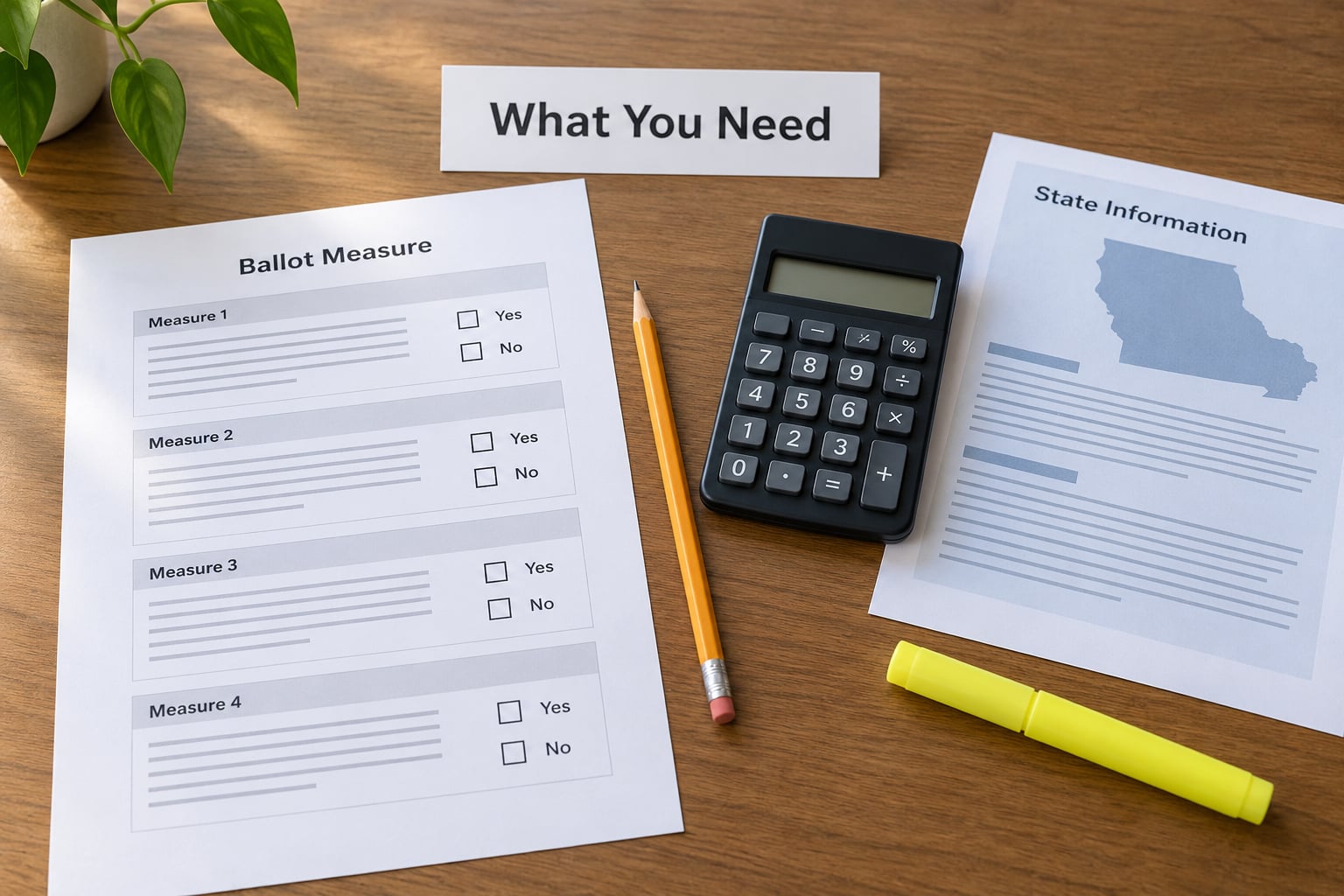
You need eight things, and every one of them is free. None requires a subscription or a request.
- Your sample ballot. It carries the official measure number and letter for every item you will see, which is how you match a pamphlet page to a line on the ballot.
- The voter information pamphlet mailed to every registered voter, or the digital version from your state or county elections office. It holds the ballot question wording, the plain-language summary, the fiscal note, and both sets of arguments.
- The full legal text of the measure. This is the drafted section or bill, and it is usually an attachment rather than the pamphlet’s main body.
- The public hearing record. Testimony and committee records from the hearings, which show who testified and what officials said about the cost.
- Campaign finance filings. State disclosure sites list who spent money on each side. Money shapes the arguments, so it is part of reading them.
- A nonpartisan guide. League of Women Voters and state civic organizations publish nonpartisan voter guides with recommendations and reasoning.
- A note-taking method. One page per measure with the number, the summary in your own words, the dollar figure, and the effective date.
- Ten to fifteen minutes per measure. Less than that and you skim; more than that and you will not finish the ballot.
If you only have your phone and five minutes, prioritize in this order: the ballot number, the summary, the fiscal note, the arguments. The legal text is the payoff, but only after those four.
Step-by-Step: How to Read a Ballot Measure Before Voting
1. Identify the Exact Measure and Its Type
Start by pinning down the official number, the title, and the ballot question, because a measure’s type decides how you read everything after it. Write down the number and letter exactly as they appear on your sample ballot, then find that same number in the pamphlet.
Next, find the type. The type tells you who wrote the text, whether it can be changed by ordinary legislation afterward, and how it interacts with existing law.
| Measure type | Who wrote it | What a yes vote does |
|---|---|---|
| Constitutional amendment | Legislature or citizen initiative | Adds to or changes the state constitution, which outranks statutes |
| Statutory amendment | Legislature or citizen initiative | Adds to or changes state statute, which a legislature can revise |
| Direct initiative | Petition signers, drafted by outside counsel | Places drafted text directly on the ballot |
| Indirect initiative | Petition signers, drafted by the legislature | Requires the legislature to write the text first |
| Veto referendum | Petition signers | Refers a law already passed to voters to approve or reject |
| Legislative referral | The legislature | Puts a bill the legislature passed before voters |
| Automatic referral | The constitution, without a new vote | Sends a measure to voters on a set schedule |
| Local ordinance or charter amendment | City council or local voters | Changes city rules or a city charter |
| Bond or millage measure | Local government or school district | Authorizes borrowing or a property tax increase for a stated purpose |
Constitutional and statutory amendments are the distinction that matters most. A constitutional amendment sits above the legislature, so changing it later usually means winning another statewide vote, not persuading a legislative majority.
Local measures read differently from statewide ones. A millage on a school bond often carries a specific dollar amount and a specific list of buildings, which makes it easier to evaluate than a statewide measure phrased in general terms.
2. Read the Plain-Language Summary
The plain-language summary tells you the measure’s purpose and its main provisions in a few sentences. Read it first because it orients you, and treat it as orientation rather than a conclusion.
Summaries are prepared by a drafting committee and are usually accurate about what the measure does. They are not neutral about how it reads. If the summary says a measure protects something in one sentence and expands enforcement duties in a later one, both sentences belong in your notes.
Look for three things as you read: the effective date, the group covered, and the group exempted. A measure that applies to all employers except a handful still is a measure about all employers, and the exemption is usually found in the summary’s last paragraph.
3. Examine the Full Legal Text
The legal text is where the operative language lives, and reading it does not require a law degree. Skim for five specific things instead of reading start to finish.
First, the definitions section. A measure that defines a term broadly sweeps in more people than the title suggests. Second, exemptions, which are often tucked into a subsection rather than the title. Third, enforcement language, which tells you who sues, who inspects, and who decides.
Fourth, the agency authority section, which shows how much discretion you hand a department. A measure that says an agency may do something gives that agency a range of choices; a measure that says shall removes it. Fifth, the effective date and any delayed provisions, since a measure passed in November with a January start leaves a two-month gap where nothing is in force.
Also check the end of the text for a conflict-in-law or conflict-with-other-measures clause. When two measures touch the same statute, the clause tells you which one wins, and it can change the meaning of the whole proposal.
4. Check the Fiscal and Implementation Effects
The fiscal impact statement, also called a fiscal note, is the part of the packet most voters skip and the part that most changes a decision. A fiscal note is a written estimate prepared by a nonpartisan legislative fiscal staff of what a measure would cost and where the money would come from.
| A fiscal note usually covers | It commonly leaves out |
|---|---|
| One-time implementation costs | Ongoing administrative staffing needs |
| Annual operating costs to the state | Costs shifted to counties, cities, or school districts |
| Revenue raised or reduced | Long-term economic effects |
| Federal funding interactions | Cost overruns typical of large projects |
| Effective date tied to funding | Litigation costs if the measure is challenged |
Watch the phrase in the summary. Fiscal offices are careful, and a note that says an effect is unknown or cannot be determined tells you nobody has estimated it, not that the effect is zero. That is the single most misread sentence in most pamphlets.
Then look at the implementation timeline. A measure with a two-year phase-in, a required agency rulemaking, or a court case pending before it takes effect is a different political fact than one that starts on a fixed date.
5. Compare Supporters’ and Opponents’ Arguments
The arguments in the pamphlet are written by the campaigns on each side, not by the state, and each set is printed under a signature naming who wrote it. Read both sets in full before deciding which one you believe, and check each concrete claim against the text you just read.
A useful habit is to write down the one factual claim on each side that would change your mind if it turned out to be false. Usually each side has one, and usually only one side checks it.
Watch for half-truths, which are the standard distortion: a cost figure that covers the first year only, a benefit claim that describes the strongest version of the program, or a quote from a supporter who is described as a doctor without specifying the specialty. Nonpartisan guides exist for a reason, and they are the fastest correction for a claim you cannot verify.
6. Check the Campaign, Courts, and Local Context
Before you vote, look outward from the pamphlet. Campaign finance filings show who spent money on each side and, often, the organization that drafted the measure. Editorial positions and nonpartisan endorsements tell you how a given group reasoned, which matters more than whether you agree with the conclusion.
Then check existing law and the courts. If a similar provision is already being litigated, or if a state supreme court has ruled on the constitutional question your measure raises, that changes the odds of what happens next. For local measures, the practical detail lives at city hall: whether the council has studied the issue, and whether the project has an engineer or a design.
Public hearing records are the least-used source in the packet. Testimony from agency staff, budget officials, and local administrators tends to be blunter than the pamphlet language, and it is where you learn what the state thinks the measure will cost.
Common Mistakes and How to Fix Them
Mistake one: voting the headline. The ballot title is drafted to be memorable and sometimes to be misleading. One common pattern pairs a friendly title with a body that does something narrower, and another reverses the polarity so a yes vote blocks something most voters support. Fix: read the ballot question, which is written to be neutral, before you read anything else.
Mistake two: skipping the definitions. Terms like qualified facility, covered individual, and eligible entity carry the actual scope, and a broad definition silently expands a measure’s reach. Fix: read the definitions section first, before the operative sections.
Mistake three: treating approval as implementation. A passing measure is a legal change on paper, not a working program. Rulemaking, contracting, staffing, and litigation all sit between passage and results. Fix: read the implementation timeline and the effective date, and treat the two as separate questions.
Mistake four: ignoring the fiscal note. Most bad decisions on measures come from a skipped cost estimate. Fix: write the annual figure and the funding source on your notes page, and notice whether the effect is unknown rather than zero.
Mistake five: treating campaign claims as facts. A mailer is an advertisement with a signature. Fix: pull any specific number or quote out of the mailer and find it in the fiscal note or the legal text before you let it change your vote.
Mistake six: stopping at the summary. The summary is designed to be sufficient for a fast read, which means it leaves out exemptions, enforcement, and agency discretion. Fix: give the legal text ten minutes even when the summary seemed clear.
One more habit worth adding: read each measure twice, once before and once the morning you vote. What looked like a small technical change in a section you skimmed tends to look different once you know the number is on your ballot.
Frequently Asked Questions
What is a ballot measure?
A ballot measure is a proposed law, constitutional amendment, bond, or question that appears on a statewide or local ballot for voters of that jurisdiction to decide directly. It arrives either through a citizen initiative, a referendum, or a referral by the legislature. Each measure carries a number, a ballot title, a plain-language summary, a fiscal note, arguments on both sides, and usually the full legal text.
Why are ballot measures hard to understand?
Ballot titles have a statutory length limit of about 25 words in many states, so complex policy gets compressed into a phrase that reads well rather than accurately. Readability analyses cited by Ballotpedia put the average Flesch-Kincaid grade level of statewide ballot titles at 16, roughly two years of college. Add sweeping definitions, buried exemptions, and money campaigns on both sides, and confusion is built into the format.
How do I find the text of a ballot measure?
Look up the official measure number on your sample ballot, then find that number in your state or county voter information pamphlet, where the full drafted text appears as an attachment. Your state legislature’s site hosts the bill or drafted section, and the state elections office keeps measure files. Ballotpedia carries the full text and plain-language summary for most measures in every state.
What is a fiscal impact statement on a ballot?
A fiscal impact statement, also called a fiscal note, is a written estimate of what a measure would cost and where the money would come from, prepared by nonpartisan legislative fiscal staff. It typically covers one-time implementation costs, annual operating costs, and revenue effects. It commonly omits county and city costs, long-term economic effects, and litigation costs, and it says so in its own text.
Can ballot measures be repealed after they pass?
Statutory measures can usually be changed or repealed by the legislature, and a legislature can also decline to fund a measure it passed. Constitutional amendments are far harder to undo because they sit above statute, so reversing one normally requires another statewide vote and a threshold that is often higher than the original. A bond authorization passed by voters is similarly locked in by contract, which is why bond measures are read as one-time decisions.
How do I know if a ballot measure is misleading?
Compare the ballot title with the plain-language summary. If the title promises a benefit the summary does not describe, or if the title is written so a yes vote sounds like a rejection, you are looking at framing rather than policy. Also check the effective date, look for exemptions buried in subsections, and test whether the measure says shall or may, since that difference decides who has discretion.
A Final Check Before You Vote
Before you mark your ballot, run this last pass: confirm the measure number matches your notes, reread the fiscal note and write the annual figure down, note the effective date, and check whether the measure is constitutional or statutory. If you have time, read the definitions once more.
Then vote on substance rather than on the title. Save the official measure information, the fiscal note, and your own one-page notes, because a passing measure usually brings hearings, amendments, and budget decisions that the public will debate for years.