
Learning how to find local nonprofits worth supporting takes about ten minutes per organization and works entirely on a phone. Start with a cause you actually care about, build a shortlist from sources that index your own city rather than the whole country, then verify each group before you give: confirm its 501(c)(3) status, read whatever financial filing exists, and ask what your gift buys.
Here is the problem most donors hit. The big charity-rating sites cover large national organizations, so the food pantry two miles from your house, the after-school program, or the mutual aid group that met on a corner for eight months never shows up. And most of those local groups fall under roughly 75,000 dollars in annual revenue, the threshold above which federal filing requirements kick in. No filing means no public record, which is exactly why the work falls to you.
This guide walks through the whole routine: where to look, what to check, what to ask, and how to give in a way that actually fits your money and your time.
Table of Contents
- What You Need
- How to Find Local Nonprofits Worth Supporting
- Step 1: Define What You Want to Support
- Step 2: Build a List of Nearby Organizations
- Step 3: Verify That Each Organization Is Legitimate
- Step 4: Review the Mission, Programs, and Impact
- Step 5: Check Financial Health and Accountability
- Step 6: Ask Questions Before You Give
- Step 7: Choose a Support Option That Fits
- Common Mistakes
- Frequently Asked Questions
- How can I tell if a small local nonprofit is legitimate?
- What is a reasonable donation amount for a local nonprofit?
- Should I choose a restricted or unrestricted donation?
- How do I verify that a nonprofit is tax-deductible?
- What if a local nonprofit does not publish its finances?
- Can volunteering be as useful as donating money?
- Conclusion
What You Need

Four things, and you can assemble them in ten minutes.
- A cause, a population, or a place. Pick one: after-school tutoring, food insecurity, housing for a specific zip code, animal rescue, adult literacy. A narrow target is what turns an overwhelming list into three candidates worth reading.
- A realistic giving limit. Decide a monthly figure you would not miss, or a one-time amount, before you start. It keeps the process honest and stops you from committing more than you intended on an emotional afternoon.
- Places to look up organizations. The IRS Exempt Organizations Search, ProPublica Nonprofit Explorer, Candid (formerly GuideStar), your state charity register, and your local United Way or community foundation.
- About 20 to 30 minutes per group. Enough to skim a filing and send one email. If you only have ten, vetting two organizations thoroughly beats a survey of nine.
For groups too small to file anything, add local signals to your toolkit. School district and library partner lists, your city’s filed nonprofit listings, mutual aid networks, hospital community-benefit reports, and a decade of local news coverage all substitute for a financial filing. Long public presence is hard to fake.
How to Find Local Nonprofits Worth Supporting
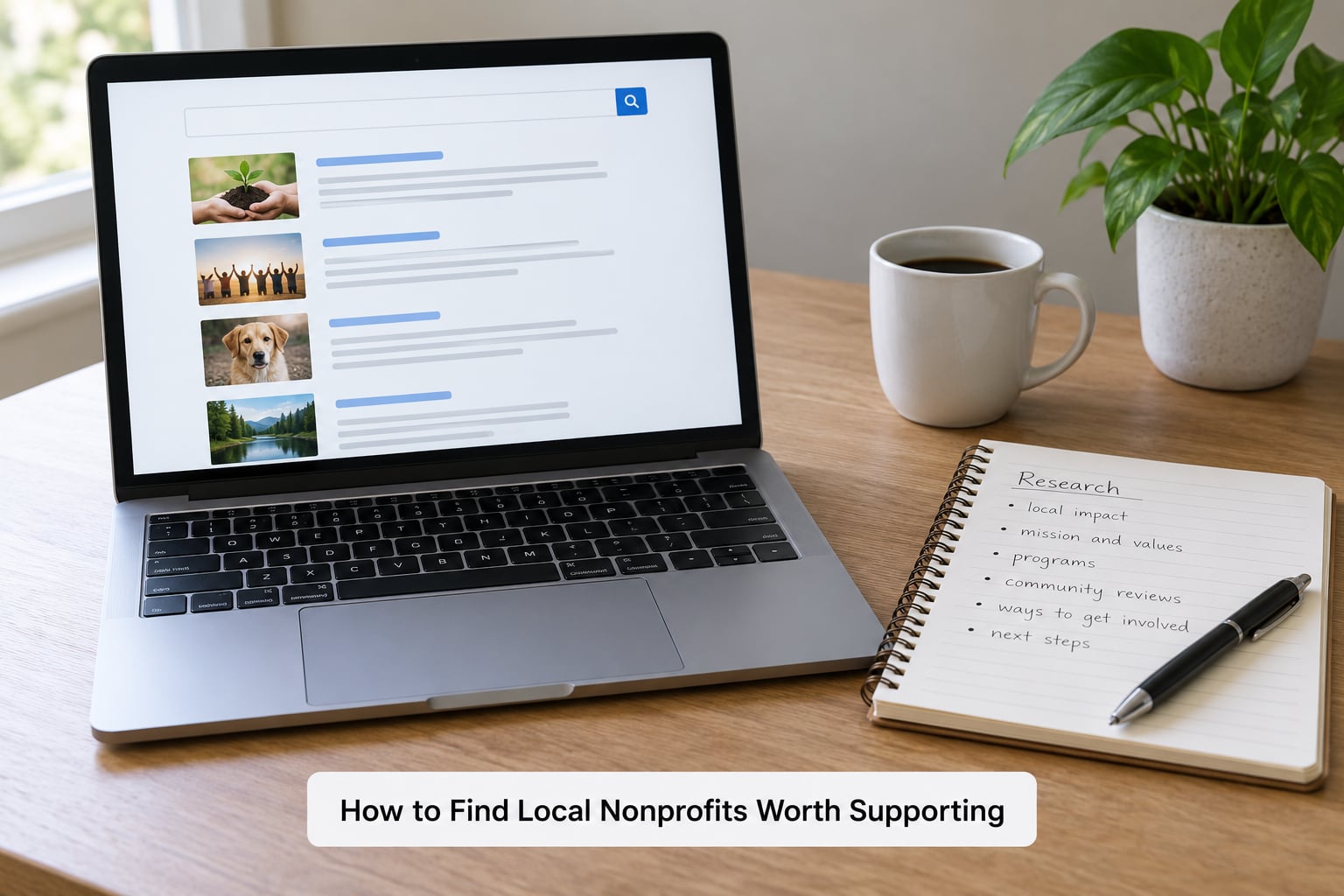
Finding and vetting a local nonprofit is a seven-step routine, and each step below opens with the answer before the detail.
Step 1: Define What You Want to Support
Narrow the field before you search, because that is what makes the rest of the work manageable. Name a cause, a group of people, or a neighborhood, and write it on one line.
“Local good” is not a filter. “Kids in the 27610 zip code who need after-school reading help” is a filter, and it tells you exactly which programs to look for and which number to ask for.
Then set the limit. A monthly cap you would not feel, or a single amount you can afford without rearranging anything, is the honest answer. Most people give better in small recurring amounts than in one large emotional gift that shows up on a credit card statement afterwards.
Step 2: Build a List of Nearby Organizations
Build the list from sources that index your area, because national directories will not surface the groups closest to you.
- State charitable registration records. Most states require nonprofits to register and file annual reports. The National Association of State Charity Officials keeps a directory of the regulator in each state.
- The IRS Exempt Organizations Search. Filter by state and city to confirm legal status and pull the EIN.
- Local United Way and community foundation partner lists. These are curated, and the community foundation usually publishes a grant history that tells you who it thinks does good work locally.
- Mutual aid and community hubs. Neighborhood networks, tenant unions, and mutual aid groups organize publicly, even when they are not incorporated as nonprofits.
- School districts, libraries, and hospitals. Partner lists show who is trusted enough to work with an institution that does its own vetting.
- Local media roundups and food bank maps. Regional magazines publish seasonal giving lists, and national food bank networks maintain locator maps of member pantries.
Geographic proximity matters more than people expect. A pantry you can reach in fifteen minutes will get a volunteer shift out of you when a distant one will not, and local presence usually means the organization knows its clients by name and answers the phone.
Step 3: Verify That Each Organization Is Legitimate
Legitimacy is easy to confirm and worth confirming, because it takes three lookups and removes almost all the risk of giving to something fake.
- Search the IRS Exempt Organizations Search by name. You should find a matching record with an EIN, a ruling year, and an address. No match is a reason to keep looking.
- Cross-check the details. The address and leadership names on the IRS record should match what the organization’s website and social accounts say.
- Check state registration. If a state requires registration, an organization claiming to operate there should appear in the state file.
- Look for a real physical presence. A street address, a phone number answered by a person, and staff you could meet are stronger evidence than any badge on a website.
Here is where tools help. Each one covers a different slice, and none of them covers small local groups well, which is why you still need to look.
| Tool | What it shows | Best for | Limitation |
|---|---|---|---|
| IRS Exempt Organizations Search | Legal status, EIN, address, ruling year | Confirming an organization exists at all | No finances, no program results |
| ProPublica Nonprofit Explorer | Form 990 filings in plain layout | Reading income, expenses, and officers | Covers filers only, roughly 75,000 dollars and up |
| Candid (GuideStar) | Mission, financials, leadership profiles | Fast side-by-side comparison | Self-reported data, deepest profiles behind registration |
| Charity Navigator | Rating, audits, accountability metrics | Organizations large enough to be scored | Ratings do not exist for most local groups |
| Charity Watch | Spending ratios and flagged concerns | Spotting contested spending patterns | Heavily weighted to spending ratios |
| BBB Wise Giving Alliance (Give.org) | Standards-based review | Checking solicitation practices | Coverage is limited and uneven |
| State charity regulator | Filings, investigations, enforcement | Local groups and complaint history | Records vary widely by state |
Step 4: Review the Mission, Programs, and Impact
A specific program beats a broad mission statement every time. Read the program pages and the annual report, and look for output you can picture: meals served, students tutored weekly, beds filled, rides completed.
Vague language is the warning. Statements about “empowering the community” tell you nothing about Tuesday. Concrete programs with named schedules, locations, and staff tell you whether the organization actually operates.
Check whether the output matches the community you care about. A well-run organization that serves one neighborhood perfectly can be a better use of your money than a larger one whose programs never reach your area.
Step 5: Check Financial Health and Accountability
If a Form 990 exists, read it, and if none exists, that is normal for small organizations rather than a red flag on its own.
On ProPublica Nonprofit Explorer or Candid, look at program services as a share of total expenses, the cost of raising each dollar, executive compensation, reserves, and whether the most recent filing is current. A group whose only report is three years old deserves a phone call instead of a conclusion.
Filings are self-reported and often flattering. In-kind donations of goods get counted as revenue, which can inflate both the numerator and the denominator and make a small food program look bloated. Treat ratios as one signal, not a verdict.
That caution matters because several ratio rules circulate widely and none of them is a legal standard:
- The 33% rule is folklore about capping administrative spending at about a third. It is not a threshold any regulator enforces, and charities with real compliance and accounting costs often exceed it while doing good work.
- The 30-70 rule is the informal version pushed by fundraisers, suggesting fundraising costs stay under 30 percent of related contributions. It is an aspiration, and for a first-year campaign the ratio is meaningless anyway.
- The 80-20 rule pushes program spending above 80 percent. It is a useful rough benchmark, but a food pantry whose donated goods are valued on the books can clear it while a youth mentoring program with real training costs can fail it.
- The rule of three usually refers to the three Ts (truth, transparency, trust) or three Es (effective, efficient, explainable) used as prompts for questions. It is a conversation starter, not a scorecard.
Where ratings services disagree with your own reading, trust the reading. The people running a fifteen-person organization are usually more transparent than any automated grade.
Step 6: Ask Questions Before You Give
A short email gets better answers than a phone call, because the recipient has time to write a careful response.
Ask what your money or your hours actually do, what the local priorities are this year, how restricted and unrestricted gifts differ, how outcomes get measured, what the safeguarding policy is for people who work with children or vulnerable adults, whether volunteer roles exist, and how the organization reports back to donors.
Two questions do most of the work: what does one hundred dollars buy right now, and who reports to the board. The first turns a mission statement into something concrete. The second tells you whether anyone is watching.
A workable email looks like this:
Hello, I am considering a small recurring donation to your after-school program. Could you tell me roughly how many students you served last term, what a monthly gift of twenty dollars would cover, and whether my gift would be restricted to that program or usable where it is most needed? Happy to share why I am asking if that helps.
Reply to something specific when you hear back, even if it is a thank-you with one detail. Organizations notice donors who ask again six months later.
Step 7: Choose a Support Option That Fits
Support is not only money, and the right form depends on what you actually have available.
- One-time gifts suit crisis relief and specific projects with a defined need.
- Recurring monthly gifts are what small local budgets actually plan around, and they cost you less attention than you think.
- In-kind goods work when the organization publishes a specific list of what it needs, such as gift cards for pantry clients, diapers, school supplies, or working appliances. Guessed donations get discarded and sometimes create disposal costs.
- Volunteering converts time into capacity. Many groups cannot afford staff hours but badly need someone on a Saturday.
- Pro bono skills matter more than people expect. Bookkeeping, grant writing, translation, legal help, and website work routinely go unfilled.
- Employer matching gifts and donor-advised funds can double or redirect a gift at no extra cost, and both are underused.
One more filter worth applying: who is employed and who decides. Organizations led by the people they serve, paying community members, and doing business with local vendors tend to stay accountable in ways a rating cannot show. Ask about that directly, and fund it when the answer is good.
Timing helps. Crisis appeals spike, year-end giving concentrates, and Giving Tuesday in early November brings most optional giving into one window. For steady local work, a small recurring gift started in a quiet month is worth more than a spike donation every December.
Common Mistakes
Almost every giving mistake comes from skipping one of the seven steps. These are the ones I hear about most.
Donating on the strength of the appeal alone. A moving video proves nothing about where the money lands. Fix: run the name through the IRS search and one filing lookup before you share the link, especially after a crisis.
Confusing a local branch with a national organization. A well-known national name on the logo does not tell you how the local affiliate spends money. Fix: treat the branch as its own organization and vet it separately.
Reading overhead ratios as a verdict. A charity spending heavily on administration may be paying for the accounting that keeps it compliant. Fix: look at output and outcomes alongside the ratios, and treat extreme figures as a reason to ask a question.
Ignoring restricted funds. Restricted money often cannot cover rent, salaries, or the bookkeeping that keeps the lights on, which is what actually keeps a small group alive. Fix: ask how much of the budget is unrestricted before restricting your gift.
Giving to a group you never looked at twice. A sudden appeal after a disaster can be genuine and can also be opportunistic. Fix: check for a multi-year public record. One good news cycle is not a track record.
Assuming every nonprofit has the same structure. A mutual aid group, a fiscal-sponsor project, and an incorporated 501(c)(3) are three different legal animals. Fix: ask which one you are dealing with before you ask for a tax receipt.
Treating no Form 990 as proof of anything. Small groups are exempt from filing. Fix: substitute the local signals you can check, namely institutional partnerships, named staff, a physical location, and years of visible work.
Giving in-kind without asking. Your gently used winter coats may be useless to the organization that needed new ones. Fix: request the current needs list every single time.
The short version of due diligence: legal status, current filing or a credible substitute, one conversation with a person, and a clear answer to what your gift does.
Frequently Asked Questions
How can I tell if a small local nonprofit is legitimate?
Look for four things together: a record in the IRS Exempt Organizations Search, a physical address and a phone number a person answers, staff and board names you can see, and a multi-year public record such as news coverage or institutional partnerships. None of these alone proves anything, but real organizations accumulate all four. If a group has no filing at all, ask how it is funded, who signs for it, and whether it works with a school, library, or city department that would have vetted it.
What is a reasonable donation amount for a local nonprofit?
Pick an amount you could repeat without rearranging your budget, and small monthly figures are usually more useful to a local group than one large gift. A recurring gift of 20 or 25 dollars covers real costs like supplies, transit, and part-time hours that a grant will not. Give more when your finances allow, and check whether your employer matches gifts or whether you can route a gift through a donor-advised fund.
Should I choose a restricted or unrestricted donation?
Unrestricted funds pay rent, salaries, and bookkeeping, which is what lets an organization survive a bad month. Restricted funds go exactly where you direct them, which matters when a program is genuinely underfunded and clearly scoped. Ask how much of the budget is unrestricted before you decide, then choose based on the organization’s stage. A ten-year-old group with a thin budget usually needs the flexible dollar first.
How do I verify that a nonprofit is tax-deductible?
Tax-exempt and tax-deductible are different things. Exemption is the organization’s status, confirmed through the IRS Exempt Organizations Search. Deductibility depends on your own situation: in the United States, charitable contribution deductions generally require itemizing, and you need a contemporaneous written acknowledgment from the organization. Ask the office for the receipt before you give, and confirm the ruling year and EIN on the IRS record.
What if a local nonprofit does not publish its finances?
Many small groups earn under roughly 75,000 dollars and file nothing, so silence is normal rather than suspicious. Substitute other evidence: a fiscal sponsor who publishes reports on their behalf, a city or state filing, a grant from a community foundation, or a simple budget they will share on request. What you are looking for is willingness. An organization that answers your budget question is showing you something a filing would.
Can volunteering be as useful as donating money?
Often, yes, especially for small groups whose biggest constraint is hours rather than dollars. A regular volunteer shift, board service, bookkeeping help, or grant writing can be worth more than a cash gift that arrives without anyone free to deliver the program. Volunteer once before committing, ask what skills are actually missing, and if money is genuinely the need, ask the organization rather than assuming.
Conclusion
Pick one cause and one neighborhood. Find two or three local organizations through your state register, the IRS search, and the partner lists of schools, libraries, or hospitals in your area. Read their mission and programs, look at whatever financial record exists, and send one email asking what your gift would do.
Then give something you can repeat, in the form that fits what you have. Ten minutes of checking protects your money and the community you were trying to help, and it is the only substitute for a rating that will never exist for a group your own size.