
Bail is the money, property or signed promise that lets an accused person leave jail while a criminal case is still pending, on condition that they return to court when called. Understanding how bail works in the United States matters because this one decision, usually made within 48 hours of an arrest, decides who waits in jail before anyone has been convicted of anything. Rules differ in every state, county and federal district, so this is general information rather than legal advice about a specific case.
Table of Contents
- What Is Bail and Why Is It Used?
- How Bail Works in the United States After an Arrest
- Who Sets Bail and How Is the Amount Decided?
- What Are the Main Types of Bail?
- Citation release
- Own recognizance (ROR)
- Unsecured appearance bond
- Cash bail
- Surety bond, usually called a bail bond
- Property bond
- Pretrial supervision and release to a treatment program
- How Much Does Bail Cost in the United States?
- How much bail costs across the United States
- What Happens to the Money After Release?
- What Conditions Come With Bail?
- Why Can the Bail System Affect People Unequally?
- What Should Someone Do After an Arrest?
- Frequently Asked Questions
- How much is bail usually in the United States?
- Can someone be released from jail without paying bail?
- Is the bail money refunded after the case ends?
- What happens if a person misses a court date while on bail?
- Can a family member pay bail for someone who has been arrested?
- A Clear Starting Point for Understanding Bail
What Is Bail and Why Is It Used?
Bail is security an accused person gives the court, usually money or a bond, so they can be released from custody until trial. Its purpose is narrow and practical: make sure the person shows up for court, and make sure they do not pose a danger to the community while the case is pending.
Bail is not a verdict. It says nothing about guilt or innocence, and paying it never means an accusation is true.
The word gets tangled with one other term almost immediately, and untangling it prevents most of the confusion. Bail is the release decision and the security behind it. A bond is the written instrument, and in everyday speech people use the two words interchangeably.
The Eighth Amendment to the United States Constitution prohibits excessive bail, which means bail can be set high but not arbitrarily high. The presumption of innocence is the deeper principle underneath bail: a person is innocent until convicted, and detention before trial is supposed to be a regulated exception rather than a punishment.
There is no universal right to bail anywhere in the United States, federal or state. What there is instead is a right to have bail set by a neutral decision-maker who considers the law, and in many states a right to ask for that decision to be reconsidered.
How Bail Works in the United States After an Arrest
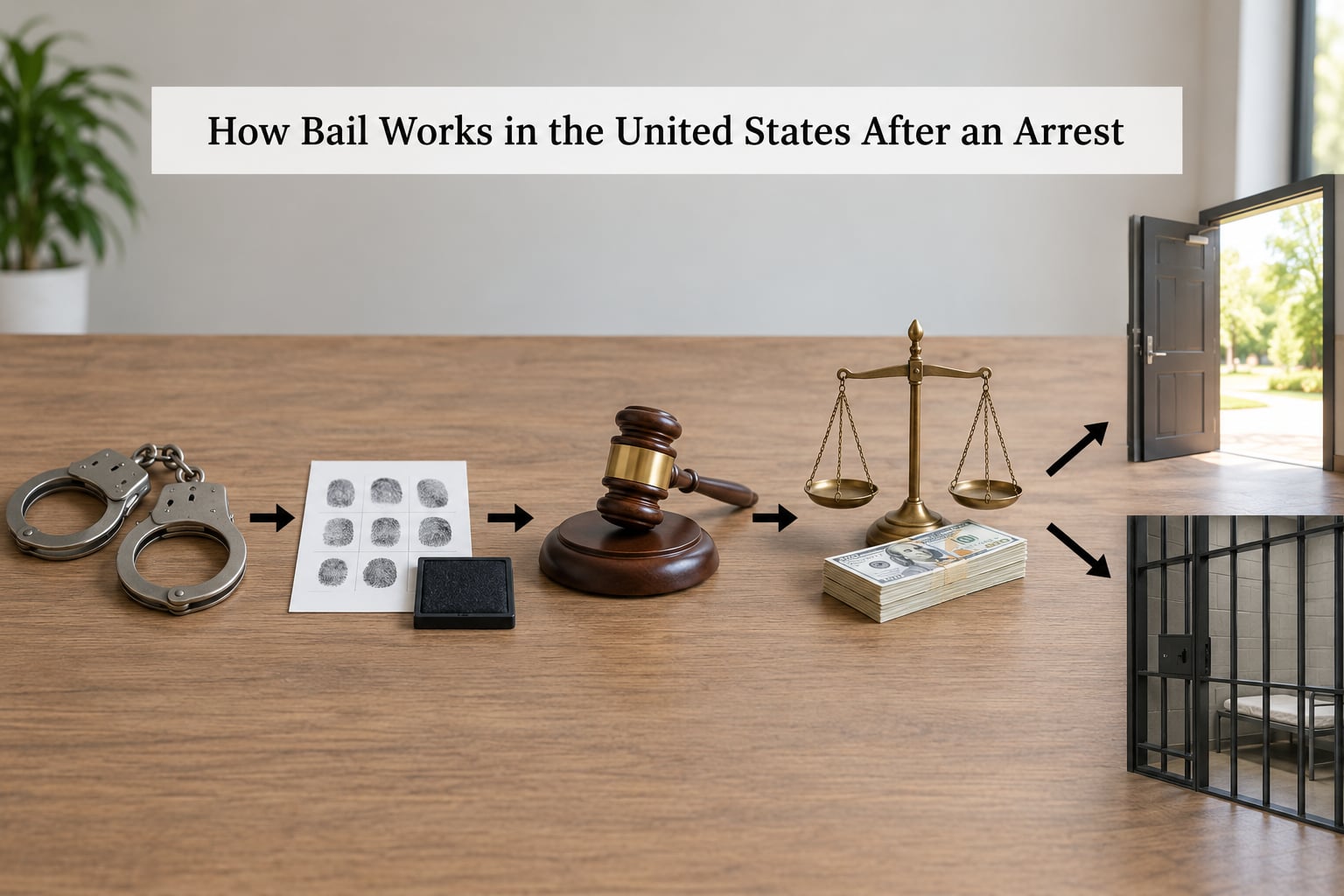
Arrest > Booking > Citation release or hold > First court appearance > Bail decision > Posting security > Case resolves > Refund or forfeiture
Most of the action happens fast, and a family often has hours rather than days to respond.
- Arrest and booking. The person is taken into custody, fingerprinted and photographed, then processed at the jail. Booking officers record the arrest circumstances, and the charge is entered into the court system.
- Citation release or a hold. For many low-level offences, an officer may issue a citation and let the person go until a court date. For anything more serious, the jail holds the person until a judge makes a release decision.
- First appearance before a judge. This happens quickly, usually within 24 to 48 hours. The Supreme Court set that outer boundary in County of Riverside v. McLaughlin in 1981, holding that a person arrested without a warrant must be brought before a magistrate without unnecessary delay.
- The bail decision. The judge hears from the prosecution and the defense. In many counties the arguments are short and rely on a standard bail schedule; in others the hearing is a full contest with evidence about the person’s record and circumstances.
- Posting the security. If the judge sets a money amount, the defendant or a family member posts cash with the court or hires a licensed bail bond agent to post a surety bond instead. Until that happens, the person stays in custody.
- Release under conditions. The person walks out with whatever restrictions the judge attached, plus a court date that they miss at their peril.
- The case moves forward. Pretrial release lasts as long as the case does. There is no fixed national limit, and a case can run a year or longer, with the bond and any collateral in place the whole time.
- Resolution. At the end, the bond is exonerated and the security returned under the terms described below, or it is forfeited because of a failure to appear.
Steps five and six are the ones that trip people up. A judge can set bail at 10,000 dollars, but if nobody posts the money or a bond within the time allowed, the setting is just a number on paper and the person remains in custody.
Who Sets Bail and How Is the Amount Decided?
A judge sets bail, and nobody else. Prosecutors can argue for a specific amount, defense lawyers can argue against it or ask for less, and bail agents can post it once it is set, but the decision belongs to the court.
Around that decision sit several other people with defined roles:
- The prosecutor presents the charge, the likely penalty and any argument that the person is a danger or a flight risk.
- The defense lawyer argues for recognizance release, a lower amount or non-monetary conditions, and can point to jobs, family, housing and treatment programs.
- The bail bond agent works on the commercial side, posting a surety bond for a fee and taking collateral. The agent has no authority to change the court-set amount.
- The court clerk receives the money, records the bond and issues the release paperwork.
- Pretrial services, where it exists, supervises released people and reports back to the court.
Judges weigh a predictable set of factors, and the mix differs by state:
- Flight risk. Prior failures to appear, whether the person has a job, a home, family and documentation in the area.
- Danger to the community. The nature and severity of the charge, prior convictions, and any alleged use of a weapon.
- Criminal history. Especially prior failures to appear and prior violent convictions.
- Community ties. Where the person lives and works, and who will know if they disappear.
- Ability to pay. In many states this is a stated statutory factor, and its effect on the size of the bond is a central point in the reform debate.
Many counties use a preset bail schedule: a standard amount for each charge class. That is faster, and it is where a surprising result comes from. A judge may set a nominal bond of one dollar for a low-level charge, or a first offender with no record, so the person is released without posting real money. The case does not become trivial because of that one-dollar figure. The full charge, the full court process and the full penalty exposure all remain exactly as they were.
Everything above describes a state and county system. Federal cases follow a separate statutory framework, where 18 U.S.C. 3142 sets out the factors and the Bail Reform Act of 1984 added detention hearing procedures.
What Are the Main Types of Bail?
Each type of release differs in what you hand over, whether you get it back, and who the court can come after if the defendant does not appear. Getting that third column right is what matters most to a family member signing paperwork.
Citation release
Officer issues a citation, no money, nothing to reclaim. Common for minor offences where the person is arrested away from home and released pending a court date.
Own recognizance (ROR)
No money at all. The defendant signs a promise to appear and is released. Refundable is not a relevant question because nothing was posted. Liable: the defendant alone, and the court can revoke the release and issue a bench warrant. For first offenders and low-level charges this is far more common than most people expect.
Unsecured appearance bond
Still no money posted, but the defendant is on the hook for the full amount if they fail to appear. Often used with a modest cash bond and conditions attached. Liable: the defendant.
Cash bail
The defendant or family deposits the full set amount, or a percentage of it under a percentage deposit bond arrangement. Refundable, in principle, if the defendant appears at every hearing. Liable: the person who posted it. This is the option with the largest up-front cost and the lowest fee, and the reason many families choose a bond instead.
Surety bond, usually called a bail bond
A licensed bail bond company posts the full amount on the defendant’s behalf in exchange for a nonrefundable premium, commonly about 10 percent of the set amount, plus collateral. Liable: the defendant, and often a family member who signs as a co-signer and becomes financially responsible for the premium and the collateral. In practice, many households reach a bail bond through a commercial agent rather than by posting the money themselves.
Property bond
The equity in a home, a vehicle or other property is pledged as security for a bond. Refundable if the defendant appears. Liable: whoever owns the property, which is often an elderly parent or a spouse who never set foot in a courtroom.
Pretrial supervision and release to a treatment program
No large payment, but a structured program of check-ins, testing, classes or residential treatment administered by a court or a community provider. Refundable: not applicable. Liable: the defendant, with revocation and re-arrest if the conditions are broken.
How Much Does Bail Cost in the United States?
The honest answer is that there is no single price, because the amount a family owes is the sum of two very different numbers. One is the amount the judge set, which is security and is generally returned. The other is the cost of avoiding that payment up front, which is usually not returned at all.
How much bail costs across the United States
Some jurisdictions cap bail outright. Where no cap exists, the set amount is driven by the charge and the factors listed earlier, and the practical ceiling for a low-level defendant who cannot pay is very low indeed, because the money simply does not exist.
The three figures people search for most, using the common industry premium of about 10 percent:
- On a 1,000 dollar set amount: paying cash means posting 1,000 dollars and getting it back at the end of the case. A bail bond costs about 100 dollars, none of which comes back, plus collateral.
- On a 10,000 dollar set amount: cash means posting 10,000 dollars, which many families cannot do in a single afternoon. A bond costs about 1,000 dollars, nonrefundable, and the agent will typically want a car title, jewelry or a lien on a home as collateral.
- On a 100,000 dollar set amount: cash is out of reach for most households. A bond costs roughly 10,000 dollars, still nonrefundable, and the collateral requirement becomes serious, often a second property or a titled vehicle.
Two other costs sit outside the premium. Court filing and service fees are charged on top, and forfeited bonds are the largest risk of all, because they turn a service fee into a debt several times the original set amount.
So is it better to pay bail or bond? If the money genuinely exists and the case is short, posting cash directly is cheaper, since the premium is a pure loss. If the money does not exist, or exists in a family emergency fund, a bond is the only realistic route, and the real question becomes who signs the contract and what they are agreeing to.
Premiums and rules vary by state and change with the market, so the specific numbers come from your own bail agent and your clerk of court rather than from an article. The figures above illustrate the structure, not a quote.
What Happens to the Money After Release?
Money posted on cash bail comes back when the case ends and the defendant has satisfied every obligation. The court issues an order exonerating the bond, and the clerk refunds what remains after deducting court costs, any fines and, where a judge orders it, restitution.
The refund is not instant. Clerks in many jurisdictions run batches, and it is common to wait weeks after the case closes before money is actually returned. Families should ask the clerk, at the outset, what the refund process looks like locally and how long it takes, because nobody explains it unless you ask.
If the defendant misses court, the bail is forfeited. A bench warrant is issued, the bond is called, and the money is gone unless the defendant is later arrested and returned to custody within the period the bond allows. That is the single largest financial risk in the whole arrangement.
Collateral follows a similar logic. It is held by the agent or the court, sometimes for a year or more, and it can be seized if the bond is called. A family member who signs as a co-signer is the one who absorbs that hit, which is why the signature deserves a careful read rather than a hurried one at a bondsman’s office.
What Conditions Come With Bail?
Bail is rarely just money. A judge can attach conditions that continue for the entire case, and common ones include:
- Reporting to a pretrial services officer or check-in calls
- Electronic monitoring, usually an ankle device with a curfew
- Drug and alcohol testing
- No-contact orders with alleged victims or witnesses
- Stay-away orders from a workplace, a school or a specific address
- Passport surrender and limits on travel outside the county or state
- Surrender of firearms
- Requirements to keep a job, attend school or enter treatment
A violation does not make the original charge true. It creates a new problem: the release can be revoked, a warrant can issue, and the person who posted the bond can lose their money.
Why Can the Bail System Affect People Unequally?
Bail is designed to assess risk, but it operates through a money filter. When a bond is set at 10,000 dollars and a household cannot raise that amount, the effective outcome is pretrial detention for a person who has not been convicted, and a public defender is often working the case from inside custody. Someone with savings, a family member with equity in a home, or a cousin willing to sign as a co-signer walks out that same afternoon.
That gap is the core criticism researchers make. Studies following defendants released pretrial, including the Manhattan Bail Project dating back to the 1960s and later work published by the Vera Institute of Justice, have generally not found that release increases failure-to-appear rates when people are given support. Critics of cash bail point to pretrial detention statistics that show a large share of the jail population has never been convicted of the charge before it.
Several states have changed the system in recent years. New Jersey and Alaska moved away from cash bail for most offences, New York adjusted its rules in 2020, and California voters replaced a 2020 ballot measure that had moved further in that direction. The federal Bail Reform Act of 1984 created detention hearings for defendants facing serious charges, a framework the Supreme Court upheld in United States v. Salerno in 1987.
The argument against wholesale abolition is that money is a reliable incentive to appear, and that courts need some way to detain the small number of people who pose a serious risk. Reforms that remove money often pair that change with reinvestment in court staff, risk assessment tools and pretrial supervision. Without that investment, critics warn, the practical result can simply be a slower and less predictable release process rather than a fairer one.
What Should Someone Do After an Arrest?
If someone has just been arrested, the useful actions are limited and mostly administrative. Nothing below is legal advice, and the single most valuable step is hiring a criminal defense attorney who practices in the county where the case is filed.
- Find out the charge, the court and the address. A call to the jail can confirm the booking, and the court clerk’s office can confirm where the case is filed and the next appearance date.
- Contact a criminal defense lawyer the same day. Bail is decided at the first appearance, which may be within 48 hours. A lawyer can argue for recognizance, argue against a set amount, and flag a charge that may be eligible for diversion or dismissal.
- Get the bail amount in writing. The figure announced on a phone call to the jail is worth confirming directly with the clerk before anyone signs a contract or wires money.
- Understand who is liable before signing anything. A bail bond contract is a financial obligation that can outlive the case. Ask what collateral is required, what happens if the defendant is arrested again on the same charge, and what the refund terms are.
- Track every date. Write down every hearing, and treat the obligation as absolute. Practitioners in this field note that many failures to appear are logistical rather than deliberate, caused by no notice of a schedule change, work hours, transport or childcare. None of those reasons stop a warrant from issuing.
- Stay in contact through official channels. Use the court website, the clerk and the attorney. Court staff cannot give legal advice, but they can confirm dates, the bond status and how to check on a case.
Frequently Asked Questions
How much is bail usually in the United States?
There is no set national figure. The amount depends on the charge, the county bail schedule and the individual circumstances of the defendant, and some states cap bail by statute. For a defendant who cannot pay, the practical ceiling is low: what a household can raise in a few hours, or what a bondsman will cover for a nonrefundable fee.
Can someone be released from jail without paying bail?
Often, yes. Own recognizance releases, unsecured appearance bonds, citation release, pretrial supervision and release into treatment programs all involve no money being posted. These are common for first offenders and lower-level charges, and a defense lawyer can ask for one at the first appearance. The amount is not always what families expect.
Is the bail money refunded after the case ends?
Cash bail is generally returned once the case is over and every appearance has been made, after the court deducts filing fees, fines and any restitution ordered. The bond itself is exonerated. A bail bond premium is different: it is a fee for the service and is never refunded. Refunds often take weeks, so ask the clerk early.
What happens if a person misses a court date while on bail?
The court can revoke the bond, issue a bench warrant and, in a bond case, demand the full set amount from whoever posted it. A cash deposit is forfeited. The original charge is unaffected, but the arrest that follows can add new problems. Transportation, work schedules and childcare are the most common causes, and none of them excuse the missed date.
Can a family member pay bail for someone who has been arrested?
Yes. Posting cash, signing a property bond, hiring a bail bond agent and acting as a co-signer are all common, and most cases involve a family member rather than the defendant. Be aware that a co-signer becomes financially responsible for the premium and can lose collateral if the defendant fails to appear. Read the contract and confirm the refund terms first.
A Clear Starting Point for Understanding Bail
The short version: bail is a deposit or a bond that buys temporary freedom before trial, a judge sets it at the first appearance after arrest, and the money comes back only if the defendant appears as ordered. Some states have moved away from cash bail for most offences, others still run on it, and the details differ by county.
If this affects someone you know, the first four things to pin down are the charge, the court handling the case, the type of bond that applies, and a qualified criminal defense attorney in that county. Everything else follows from those four.