Knowing how to attend a public comment session comes down to four things: you find the meeting’s posted agenda, confirm that a comment period exists, register to speak through the channel that body uses, and deliver one clear request inside a two or three minute limit. Most bodies let anyone speak, most meetings are open to the public, and none of it requires you to be an expert or represent an organization.
Here is the part nobody tells first-timers: a comment rarely flips a vote that night. It does put your words into the public record, in front of staff who write the policy, and on the record of an election the official answers to. That is a slower lever than people expect, and a real one.
Everything below is jurisdiction-variable. State open meetings laws differ, and many bodies write their own comment rules into a posted policy. Where a specific deadline or limit appears here, treat it as an example of the kind of number to look for, then confirm it against your own agenda.
Table of Contents
- What You Need to Attend a Public Comment Session
- Step-by-Step: How to Attend a Public Comment Session
- Find the Public Meeting and Confirm Its Rules
- Prepare What You Want to Say in Advance
- Register or Sign Up to Speak
- Arrive Early or Join the Online Meeting Early
- Listen Before Your Name Is Called
- Give a Clear Public Comment
- Submit Written Comments or Follow Up Afterward
- Common Mistakes and How to Fix Them
- Frequently Asked Questions
- Do I need to register in advance to speak at a public comment session?
- Can I attend a public comment session online or by phone?
- What if the agenda changes and my issue is not listed?
- How long should my public comment be?
- Can I bring written materials or visual aids?
- What if I disagree with the agency’s decision or treatment of an issue?
- What to Do First
What You Need to Attend a Public Comment Session
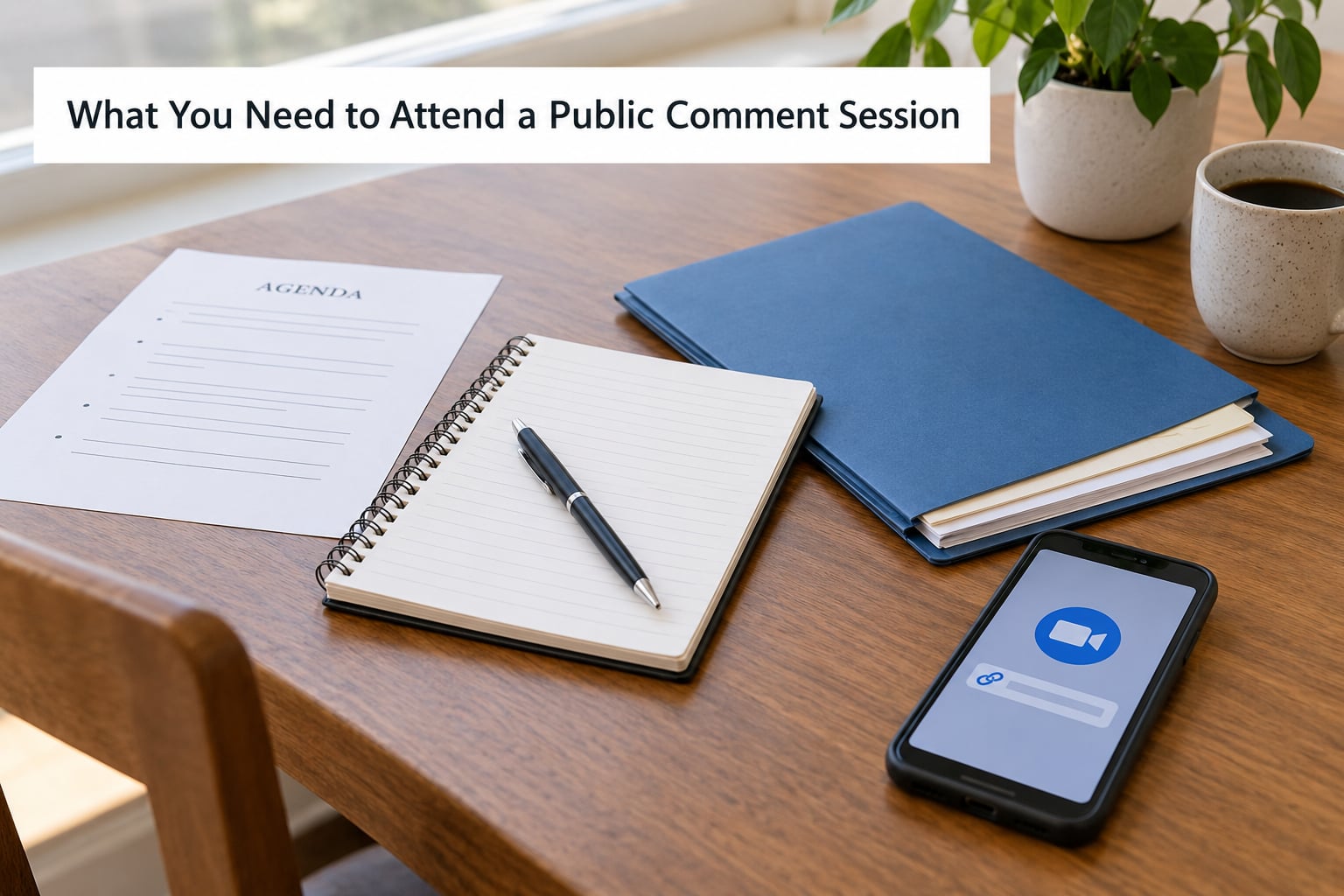
You need less than most people imagine. Almost every body supplies the forms; your job is to find them and fill one out.
- The posted agenda. Download it the day before. It carries the date, time, location, item numbers and the name of every item up for a vote. City clerks usually post agendas through a portal such as Legistar, Granicus or PrimeGov, or on the city website under meetings and agendas.
- The public comment instructions. A separate policy document or web page, often linked from the agenda portal, spells out the sign-up deadline, the per-speaker time limit, and whether comments are item-specific or general.
- A request to speak card, or speaker slip. A one-page form with fields for the date, item number, item name, printed name, and whether you are speaking in favor or in opposition. Most meeting attendants hand these out at the door.
- Photo ID. City hall and courthouses increasingly screen at the entrance, and some buildings require ID to enter the chamber at all. Bring the government-issued one you use most; a school ID is often fine for students.
- Your time limit, in writing. Two minutes and three minutes are both common. Knowing the number in advance is the single biggest reducer of first-time panic.
- Any accommodation you need, requested early. Sign language interpretation, a real-time transcript, a language interpreter, a seated spot, or a large-print agenda usually requires notice, sometimes a business day ahead. Email the clerk.
- Your supporting documents. One clean copy for the clerk, one for yourself, and one more than you think you need.
What you do not need: an organization, a title, professional credentials, or a polished presentation. A resident affected by the decision is the whole qualification in most jurisdictions.
Step-by-Step: How to Attend a Public Comment Session
Find the Public Meeting and Confirm Its Rules
Start with the official notice, not a social media post. Search your city or county name plus the body you care about, city council, school board, planning commission or board of supervisors, and look for the meetings and agendas page. The notice tells you the date, the start time, the room or the video link, and whether a public comment period is on the agenda.
Some bodies list a general public comment item. Others break comment into item-specific slots tied to the agenda number, where you can only speak about that item. A few bodies have no comment period at all, and in some states that is entirely the council’s choice. If the agenda has no comment item, call or email the clerk before the meeting and ask whether comments are taken another way.
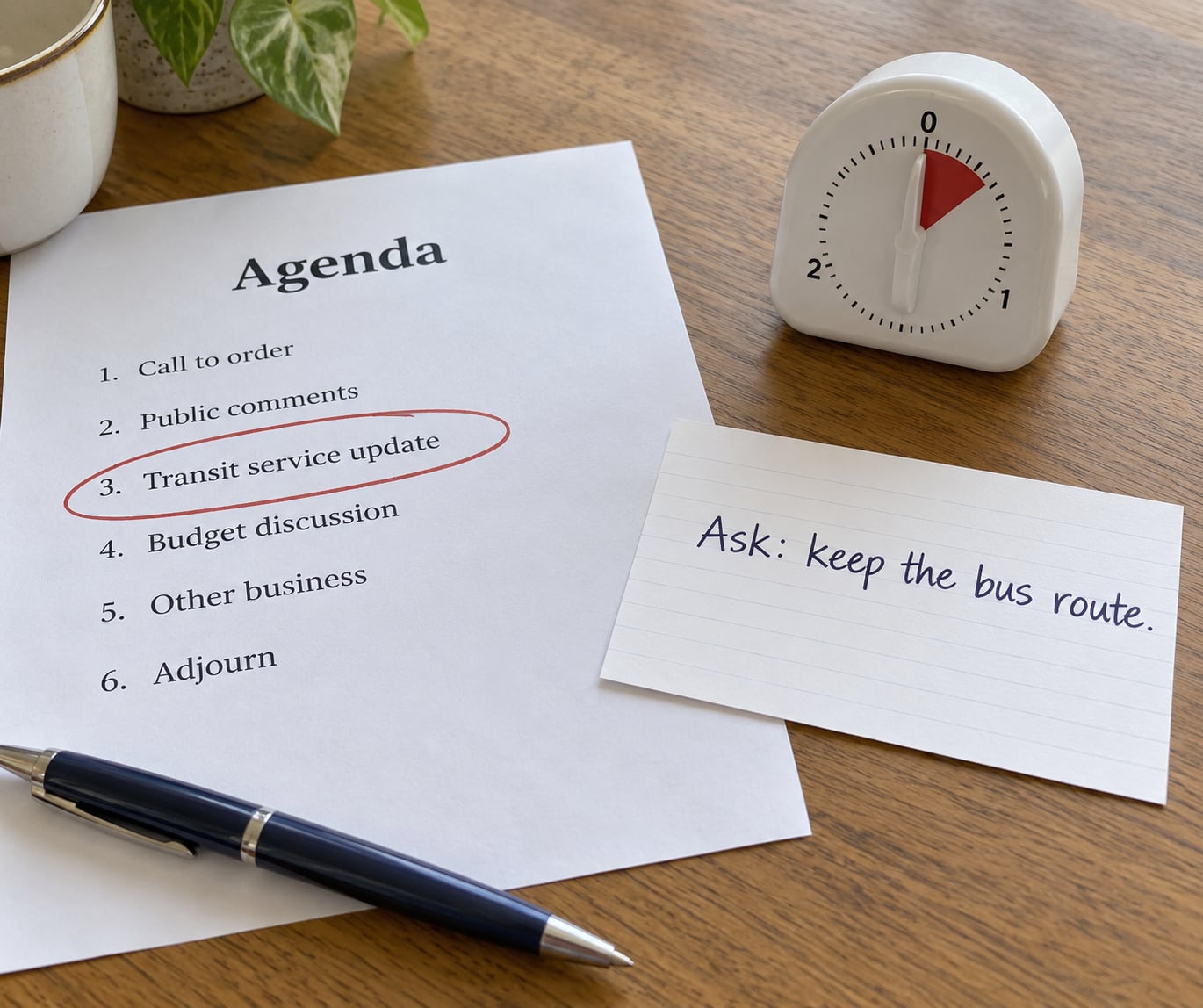
You will know this step worked when you can state four facts: the date, the sign-up deadline, the time limit, and which channel the body uses. Write them on the agenda you printed.
Prepare What You Want to Say in Advance
Pick one decision and one position. A comment that asks for three unrelated things gets less than a comment that asks for one thing clearly.
Then choose your support. A middle school teacher in Indianapolis told advocates that scripted talking points he read from a statewide campaign made no impression, and that one story about how a policy played out in his own classroom landed with officials and press. Specificity beats volume. Bring a date, a parcel number, a block, a street, an item number, a measured number from a public document.
Write to the clock. Draft roughly 150 to 200 words for a two-minute comment and time yourself out loud, standing up, at a normal pace rather than your reading-to-yourself pace. Cut one paragraph. Then cut one sentence.
Prepared does not mean scripted. Bullets you can glance at will sound like a person; a page read word for word sounds like a document, and a bad microphone will punish you for it anyway.
Register or Sign Up to Speak
There are four channels, and they differ more than most people expect. Find the one your body uses before you show up.
| Channel | How you sign up | Deadline | Time limit | How speakers are picked |
|---|---|---|---|---|
| In-person card | Fill a request to speak card at the meeting attendant’s table | Usually until the item is called, sometimes a set cutoff | Often 2 or 3 minutes | Order you signed up |
| Advance registration | Online form, email, or a phone line listed on the agenda | From a few hours to a week ahead | Usually set, sometimes shorter for remote | First come, or a random draw when demand exceeds slots |
| Written comment | Email, portal, or a comment card handed to the clerk | Usually until the meeting, sometimes after | Often a word cap, commonly 300 to 500 words | Read into the record by staff, not spoken aloud |
| Virtual raise-hand | Raise your hand in the video tool, or call a phone line for a passcode | Locked when the chair calls the item | Often 1 to 3 minutes | Queue, sometimes split between in-person and remote |
Registration asks for very little: name, address, which item, and how to reach you. Ask for the language or accessibility accommodation in the same message, and keep a copy of what you submitted. You are looking for a confirmation email or a speaker number. No confirmation means you were probably added to a paper list, which is fine, but check when you arrive.
Arrive Early or Join the Online Meeting Early
Aim to be there 20 to 30 minutes early. That buffer absorbs the security line, the metal detector, the elevator wait and the room-finding confusion that eats other people’s margins.
At the venue, check in with the meeting attendant, ask whether you are on the speaker list, and ask where the agenda is being handed out. Note the time limit card if they have one. If you are online, join 10 minutes early, confirm your microphone and camera work, find the raise-hand control, and read the chat rules. Virtual attendees are frequently muted and unmuted by the chair, sometimes without warning.
Arriving early is not a guarantee of speaking. It gets you a chair near the aisle and a card in the right pile, nothing more. Some bodies cap the number of speakers per item and pull names at random when the list is full.
Listen Before Your Name Is Called
Public comment usually sits early on the agenda, which surprises people. You will speak cold, with no warm-up speaker, and the room will already be looking at the microphone when your name comes up.
Follow the agenda order and write down the item number as each item is called. If the item you care about comes up as part of a consent agenda, a block of routine items approved in one vote, say so when you get your turn. Some chairs will let you speak on a pulled item, some will not, and the difference is decided by their posted policy rather than by your preference.
If the body changes the item under discussion mid-meeting, adapt. Say plainly which item you are speaking to, and if it is genuinely off the agenda, ask the chair whether you may comment on general business. Do not argue at the podium about whether you may speak.
Give a Clear Public Comment
Stand. Face the chair, not the officials’ bench, and speak to the microphone rather than to a person. Start with a structure and it will carry itself under pressure.
- Name and connection. “My name is ___, and I live in ___.” A ward, a street, or a school is enough. Say whether you speak for yourself or for a group.
- The item. “I’m speaking on item ___, the ___” Use the number and the title from the agenda.
- One or two specific points. What happened, to whom, and what it means. Numbers, dates, addresses. One personal example beats three abstractions.
- The ask. One action, said out loud. “I’m asking the council to ___.” Vague grievances give officials nothing to do, which is why they often do nothing.
- Thanks. “Thank you for your time.” Then sit down. Do not add an outro.
Fill in the template and you are done: My name is ___. I live in ___. I’m speaking on item ___. The issue is ___. It affects ___ because ___. I’m asking you to ___. Thank you.
If the timer beeps while you are still talking, stop mid-sentence, say “I have more, and my time is up, thank you,” and step back from the microphone. That is a normal thing that happens to prepared speakers every meeting.
Stay away from attacking staff, other speakers, or a named individual. Personal attacks and threats are the fastest route to being ruled out of order and removed, and they put a stop to the part of your comment that was actually useful.
Submit Written Comments or Follow Up Afterward
Spoken comment is not the whole record. Email your comment to the clerk the same night, while it is fresh, using the agenda item number in the subject line. Many bodies read submitted comments into the minutes after the meeting.
Keep your own copy of everything: the agenda, the card you filled out, the email you sent and any confirmation. Minutes are usually posted within a week, and reading them tells you whether your comment was recorded accurately and whether the item is moving to a committee, where you can follow up on the record you just made.
Then call or email your representative’s office. Council attention during public comment is inconsistent, and a direct note to the office of the member who represents you is often read the same week. A public comment that lands in the record and a personal note to the office are two different channels, and using both is the habit that pays off.
Common Mistakes and How to Fix Them
Missing the sign-up deadline. Advance registration closes early, sometimes 24 hours before, sometimes a week. Check the policy page, not just the agenda. Fix: put the deadline in your calendar the moment you find it, and treat the in-person card as a backup, not a plan.
Speaking to the wrong item. You prepared for the zoning vote and the item was moved to a later date. Say which item you are speaking on, and if it is not on the agenda, ask the chair whether general comment is open. Fix: memorize the item number.
Running over the time limit. The chair cuts you off, sometimes mid-word, and it feels like an insult. It is not. Fix: write to 60 percent of the limit, put the ask in the first half, and stop when the bell rings.
Reading someone else’s script word for word. Officials have heard that language before, and it reads as borrowed. Fix: keep the argument, lose the phrasing. Write it in your own words even if it is rougher.
Going after staff or other speakers. It changes the subject from your issue to a fight. Fix: name the problem, not the person. If a staff report is wrong, say which line of it is wrong and what the correct figure is.
Making a claim you cannot support. Fix: bring the source, or drop the claim. “Eleven people” beats “everyone.”
Arguing with the chair. Once you have made your ask, the podium is closed to debate. Fix: if the chair rules against you, say “I understand, thank you,” and take it up with the clerk afterward.
Nervous about speaking in public. Worth its own note. You are almost never the only non-staff person at the microphone. The room is small, half the audience is checking their phone, and the officials have heard hundreds of these. Write the first line down on a card so you can read it if your hands shake, and stop trying to sound official.
Frequently Asked Questions
Do I need to register in advance to speak at a public comment session?
It depends on the body. Many city councils and school boards offer an online or phone registration that closes a day or more before the meeting, and some will not take walk-up speakers once the item is called. Others rely entirely on a request to speak card at the door. The agenda and the body’s public comment policy page will say which applies, and the clerk’s office can confirm it by phone.
Can I attend a public comment session online or by phone?
Usually yes. Most bodies now stream meetings and accept remote comment, either through a raise-hand function in the video platform or through a phone line with a passcode. Remote slots are sometimes separate from in-person slots, and remote speakers are often held to a shorter time limit. Join early, test your audio, and find the raise-hand control before the meeting starts.
What if the agenda changes and my issue is not listed?
Ask the chair whether general public comment is open, and say which issue you want to raise. Some bodies also allow you to request that an item be pulled from the consent agenda for discussion, though the rules for that vary widely and some chairs decline. If the item was continued to a future date, note the new date in the record and follow up at the next meeting.
How long should my public comment be?
Two or three minutes is the norm, and one minute is common for remote speakers. Write to about 60 percent of the limit so a slow start or a surprise does not cut you off. Roughly 150 words fits two minutes at a normal pace. Put your ask in the first half of the comment, because the chair’s timer is not negotiable and you may lose the last thirty seconds.
Can I bring written materials or visual aids?
Usually yes, and often you do not need to ask. Most bodies hand a copy of your materials or your written comment to the clerk so it attaches to the record, whether or not you speak. Posters, slides, and large display boards are more often restricted, and some chambers ban them. Email the clerk a few days ahead to confirm and to ask about size, quantity, and whether handouts are distributed to members.
What if I disagree with the agency’s decision or treatment of an issue?
Criticism of an agency’s decision, its policy, or a public official is generally protected. The limits are time limits, rules about relevance to the agenda item, and prohibitions on threats, harassment, and defamation. Describe the decision, explain its effect on you concretely, and make one specific request. If you are removed or refused the microphone, ask the chair to state the rule being applied, and take the details to the clerk afterward.
What to Do First
Find the official meeting notice and download the agenda. Read the public comment instructions on the same site and write down the deadline, the time limit, and the channel. Pick one item and one ask, and draft 150 words about it. Then show up early, sign up, and say the thing in your own voice. That is the working version of how to attend a public comment session, and it takes about ten minutes of preparation.
If your council holds no comment period at all, that is a fact worth surfacing to the body in writing, and to your neighbors, because the people who never checked are the reason it went unnoticed.