You have the right to stay silent beyond giving basic identification, the right to refuse a search of your vehicle, and the right to ask for a lawyer the moment you are arrested. Those protections come from the Fourth and Fifth Amendments, and no officer needs your permission to write you a ticket. What are your rights during a traffic stop is really two questions: what the Constitution protects you from, and what state law still requires of you. The first is settled nationally. The second changes from state to state.
This guide covers the whole encounter, from the moment the lights come on through the paperwork afterward. It is general information, not legal advice. If you are facing a charge, talk to a traffic attorney in your state, because the details that matter most are the ones that vary by jurisdiction.
Table of Contents
- What Are Your Rights During a Traffic Stop?
- What Are Your Rights During a Traffic Stop, in Short
- Do You Have to Stop When a Police Officer Signals You?
- Do You Have to Identify Yourself During a Traffic Stop?
- Can You Ask Whether You Are Being Detained or Arrested?
- The three versions of a roadside encounter
- Do You Have to Answer Questions During a Traffic Stop?
- The trick question pattern, and why it exists
- Can the Police Search Your Car?
- Can the Police Search You or Your Passengers?
- What Are Your Rights During a Traffic Stop If the Officer Becomes Unreasonable?
- Can You Record a Traffic Stop?
- Can You Refuse a Breath Alcohol Test?
- What Happens If You Are Arrested?
- Can You Request a Traffic Citation Instead of Arrest?
- Are Your Rights Different If You Are a Minor, Driver with a Permit, or Passenger?
- What Should You Do After a Traffic Stop?
- Frequently Asked Questions
- Can you refuse a traffic stop if you believe it is unfair?
- Does staying silent prevent an officer from finding probable cause?
- Can an officer order you out of the car if you have not been arrested?
- Is it illegal to refuse a police officer’s request to search your vehicle?
- Can you call emergency services during a traffic stop to record it?
- What should you do if an officer says you are being arrested?
- Conclusion
What Are Your Rights During a Traffic Stop?
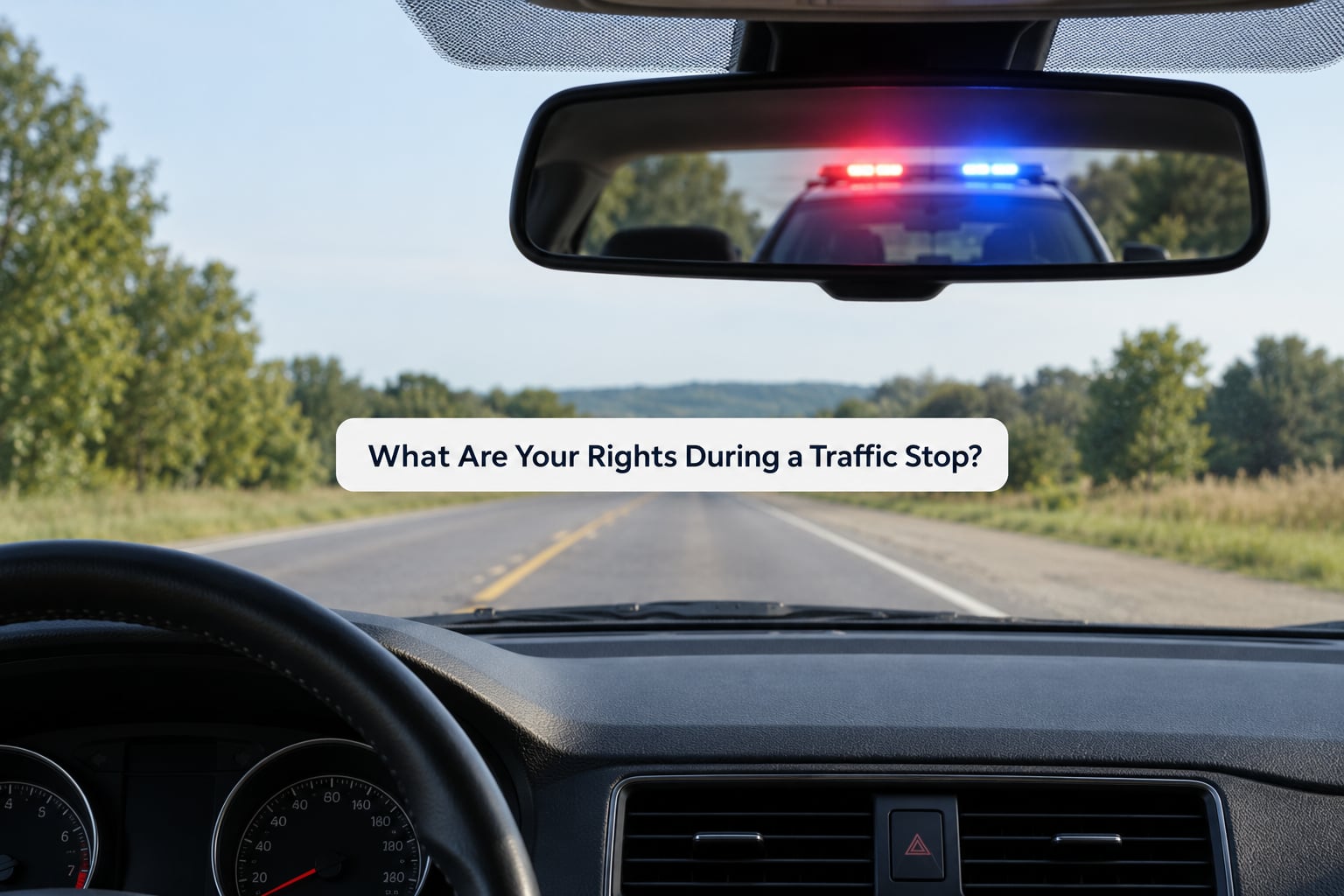
What are your rights during a traffic stop? You may remain silent except for identification where your state requires it, you may decline any search, and you may ask for counsel if you are arrested. You may not argue, flee, or refuse anything a lawful order requires.
Two different bodies of law are in play at the same time. The Constitution sets a floor that no state may cross, and the Fourth Amendment governs searches while the Fifth Amendment governs statements. State traffic codes then add obligations on top, such as carrying a license, registering the car, and identifying yourself on demand in some states.
So the practical answer is that you keep far more protection than most people expect during the questioning phase, and far less freedom than most people think once an officer has lawful grounds to hold you. Keep that tension in mind for the rest of this guide.
What Are Your Rights During a Traffic Stop, in Short
- You can decline a search of your car, and your refusal can never be used against you as evidence of guilt.
- You can remain silent and say nothing beyond identification, and saying so out loud is allowed.
- You can ask, at any point, whether you are free to go.
- You can ask for a lawyer, and once you do, questioning generally stops until a lawyer is available.
- You can record a police officer performing public duties in most states.
- You can refuse field sobriety tests and, in many states, a preliminary breath test.
- You can ask for a supervisor or a plainclothes officer’s identification.
- Handing over your license is not the same as consenting to a search.
Do You Have to Stop When a Police Officer Signals You?
Yes. When an officer signals you to pull over, you are required to stop, and you are required to do so promptly. A reasonable driver usually has only a short window to find a safe place to stop, and pulling over miles later or several blocks past an officer can draw its own charge.
The flip side is that the officer’s signal still has to be reasonable. A signal that is ambiguous, or that would require you to stop somewhere genuinely unsafe, gives you room to proceed carefully and pull over at the first lawful opportunity. Common situations include a dark stretch of road with no shoulder, heavy fog, or a freeway exit ramp where stopping would be dangerous.
If the signal is unsafe, the practical move is to signal your intent, reduce your speed, and stop as soon as you safely can. Then say plainly that you did so for safety. Officers hear that explanation far more often than people assume, and it removes any question about why you took time.
Do not treat the signal as optional because you disagree with the underlying violation. The stop itself is not a verdict. Even if the reason for the stop turns out to be invalid, the only way that becomes clear is after you have stopped safely.
Do You Have to Identify Yourself During a Traffic Stop?
Nationally, the Supreme Court has not held that you must always give your name during a routine traffic stop. Several state courts have reached similar conclusions. But a number of states impose their own identification duties, and in those states refusing to give a name can itself become the charge.
Indiana is the most-cited example. Its Stop and Identify law requires a driver who is lawfully stopped to identify themselves on request, and the refusal statute has been read by courts to carry misdemeanor exposure. Texas, Florida, Virginia, Maryland and California all handle identification differently from one another, and some have narrowed their statutes over the years.
That is the honest answer: the identification rule is state-specific, and it is the part of this topic where a national guide hits its limit. If you drive across state lines, know the rule of the state you are in, not the one you live in. A cheap way to check is your state’s motor vehicle authority website, which publishes its own stop and identify statute.
Can You Ask Whether You Are Being Detained or Arrested?
You can ask, and asking is one of the most useful things you can do. The wording that works is simple: “Am I free to go?” or “Am I under arrest?” The answer tells you which set of rules applies.
The three versions of a roadside encounter
A voluntary conversation means the officer has no right to make you stay. You can end it and drive away at any time. This is rare in practice, because officers usually have some reason for approaching you.
An investigative stop, sometimes called a Terry stop after the 1968 Supreme Court case, means the officer has reasonable suspicion that a crime or violation is occurring. That is enough to briefly hold you, question you, and if the officer has reason to believe you are armed, pat down the outer clothing. It is not enough by itself to open your trunk or glove box.
An arrest means probable cause to believe you committed a crime. Now Miranda warnings apply before questioning, and you have the right to counsel. An officer may also search you and the areas of your car within reach.
Most roadside encounters sit between the first and second categories, and the label matters less than what the officer does next. If you hear the word arrest, stop talking immediately.
Do You Have to Answer Questions During a Traffic Stop?
You do not have to answer questions that might incriminate you. The Fifth Amendment protects you from compelled self-incrimination, and it applies on the shoulder of the road just as it does in a courtroom. Silence itself is protected, and so is saying out loud that you are choosing silence.
Miranda warnings change the analysis after they are given. Before the warnings, an officer can sometimes ask questions and use your answers, though statements made without warnings can still be suppressed if the questioning was coercive. After the warnings, anything you say is generally admissible, which is the entire reason the warnings exist.
One point people miss constantly: the right to remain silent is not the right to leave. Declining to answer a question is protected. Driving off before the officer lets you go is not.
The trick question pattern, and why it exists
The question drivers report hearing most is some version of “Do you know why I pulled you over?” or “Do you know what you did wrong?” It is not a trick in the sense of a trap. It is an invitation to talk, and the Fifth Amendment protects you from being compelled into accepting it.
A safe response is polite and noncommittal: “I’d rather not discuss it without a lawyer present, is that okay?” If an officer pushes on why you are being quiet, you can repeat the same sentence. Invoking the right is legal, and it generally cannot be punished. Users in police-interaction forums say the version that ends things fastest is exactly that sentence delivered in an ordinary tone, without sarcasm.
Do not volunteer explanations, do not speculate, and do not argue that the officer is wrong. Arresting someone for obstruction is uncommon but real, and it converts a ticket into a custody event.
Can the Police Search Your Car?
Only for a recognized legal reason. An officer’s request is not one, and an officer’s belief that you look suspicious is not one either. The main justifications are consent, probable cause, a search warrant, a vehicle inventory after an arrest, and the search of areas within your immediate control at the moment of arrest.
Probable cause means a fair probability that the car contains evidence of a crime. A traffic violation such as speeding does not give an officer probable cause to search. Stronger indicators do: the smell of alcohol, a description of the driver matching a crime broadcast, contraband in plain view, or an open warrant.
A consent search exists only if you give it, freely, and you can withdraw consent before the search ends. Many people hand over a license and then assume they agreed to more. They did not. Handing over your license, registration and proof of insurance is a separate act from opening a glove box.
An inventory search happens after an arrest and is meant to catalogue and secure the vehicle. You may be present, and a standard form of documentation helps if you believe items were missing when the car was released.
Here is what to say when asked:
“I appreciate you asking, but I do not consent to a search of my vehicle right now.” Say it once, calmly, and then stop talking about it. There is no legal penalty for declining, and a refusal is not evidence of guilt in any court.
Can the Police Search You or Your Passengers?
A person search is more tightly limited than a vehicle search. The usual bases are consent, arrest, safety concerns during a stop, and the belief that a person is armed and dangerous.
The safety basis is the one drivers encounter most. Officers are permitted to order occupants out of the vehicle and to separate driver from passengers for safety, and that ordering does not require probable cause or an arrest. You do not have to consent to a pat down, though a pat down of the outer clothing is permitted if the officer reasonably believes you are armed and dangerous.
A person can also be searched on arrest, including the areas of the vehicle within that person’s immediate control. That reaches the passenger compartment, not the trunk. An officer cannot justify opening the trunk of a passenger’s belongings without a separate reason.
Police may also search when exigent circumstances exist, such as an officer smelling the odor of raw marijuana at a car window. Courts differ sharply on that smell today, so do not assume either outcome.
Use reasonable force and comply physically if you are searched or restrained. Resistance escalates a stop into a use-of-force report, and that report will outlast your objection.
What Are Your Rights During a Traffic Stop If the Officer Becomes Unreasonable?
Your rights are unchanged by an officer’s mood. Unreasonable force, a search without a legal basis, or conduct based on your race, your perceived accent, or another protected characteristic are all things you can challenge, and none of them become legal because the officer was having a bad day.
Still, the thing that helps you most in the moment is not resistance. It is calm compliance plus documentation. Argue later, on the record, with a lawyer. Do not argue at the shoulder of the road.
Three practical steps. First, state the issue once in neutral words, such as “I would like to speak with a supervisor,” and then stop. Second, note the time, the location, the officer’s name or badge number, and any witnesses. Third, get body camera footage requested promptly, because many agencies overwrite or auto-delete footage on a short cycle, sometimes within days.
Disproportionate stops are a real pattern, and they are worth knowing about. The Supreme Court’s 1968 decision in Terry v. Ohio set the standard for investigative stops, and a large body of research since has tested whether officers meet it consistently. Studies have repeatedly found stops distributed unevenly across racial groups, even after accounting for population and enforcement activity. If a stop felt targeted rather than routine, that pattern is exactly what a civil rights attorney looks at later.
Escalation routes after the fact usually run through the department’s internal affairs unit, a civilian review board where one exists, a complaint to the state attorney general or a licensing agency, and in serious cases a federal civil rights claim. The exclusionary rule applies to criminal cases: evidence from an unconstitutional search can be suppressed, and a good lawyer raises that issue at a suppression hearing before trial.
Can You Record a Traffic Stop?
Yes, in most states. Recording a police officer performing official duties in public is protected by the First Amendment, and courts in most jurisdictions treat it as ordinary protected speech.
The caveats are worth knowing. Some states require that all parties be aware of a recording. A small number restrict recording in specific sensitive settings. Separately, a driver who uses a phone to record while driving can be cited for that, regardless of the constitutional protection, so recording hands-free, mounting the device, or having a passenger record are the low-risk approaches.
Keep distance, keep your hands visible, and do not argue with the officer about the recording. Interfering with an officer is a separate offense from recording, and confusing the two in the moment is how a recording becomes a citation.
If you are arrested, keep recording if you can do so safely. Audio and video taken from inside a car have been used in court to challenge officer conduct, and dashcam footage from the rear and front of a vehicle is often the clearest evidence available.
Can You Refuse a Breath Alcohol Test?
The answer depends on what kind of test is on offer, and this is where a lot of confident internet advice goes wrong. Refusing a physical sample such as a breath, blood or urine test is legally different from refusing to answer a question, because the Fifth Amendment protects speech, not the physical body.
Field sobriety tests are physical and coordination tasks, and most states let you decline them without automatic penalty. A preliminary breath test on the roadside is also commonly refusable, though some states have attached consequences to it. An evidentiary breath or blood test taken at the station is harder to refuse, because the driver’s license statute you accepted when you were licensed usually makes it a privilege you can lose.
That last piece is what people call implied consent. It means that driving on a public road is treated as accepting the obligation to submit to testing, and refusing is usually legal in the short run but expensive in the long run. It can trigger an administrative license suspension that operates separately from any criminal case, and sometimes the officer will ask you to sign a refusal that is really a consent with a different label.
Refusal can end in arrest, a suspended license, increased insurance rates and a court date. Read what you are signing before you sign anything at the station.
What Happens If You Are Arrested?
An arrest is not a conviction, and it is not the end of your say in what happens. Once you are arrested, several protections switch on at once.
You must be told what you are arrested for and, in most cases, be advised of your Miranda rights. You have the right to consult an attorney, and if you cannot afford one, a court-appointed attorney is provided at no cost to you in serious cases, and in many jurisdictions in misdemeanor traffic cases as well.
You generally have one phone call. Keep the number of a person who can post bail rather than someone who will argue with a jail about the facts of the charge. Anything you say in the car or at the station before warnings are read can be used against you, and so can anything you say in a way that sounds like an admission.
You can also be handcuffed before anyone reads you your rights. Being restrained is not the same as being questioned, and an officer does not have to read Miranda the moment your hands go behind your back. What matters is whether questioning begins without the warnings.
Can You Request a Traffic Citation Instead of Arrest?
You can ask, and the request itself is harmless. But the answer depends on the alleged violation, the officer’s policy, and what your state law allows.
Officers routinely issue citations for moving violations because a ticket takes minutes and an arrest takes hours. Custody is reserved for situations where a citation cannot secure the driver’s appearance, where the officer believes the person is a flight risk, or where the investigation has shifted from the stop into something more serious.
Saying “Would a citation work here?” is fine. Saying “You cannot arrest me” is not, because the officer decides in the moment and you do not know what facts are in front of them. Ask once, then follow instructions.
Are Your Rights Different If You Are a Minor, Driver with a Permit, or Passenger?
Yes, in ways that depend on your age, your license status and whose car you are in.
A fully licensed driver has the baseline set out above. A learner permit holder is usually treated more like a minor for identification purposes, and in many states an officer can ask a permit holder to identify themselves as a matter of course.
A minor held at the roadside may have a right to have a parent or guardian present during questioning, depending on the state’s custody statutes and your age. Officers often call a guardian before questioning a young person. The rule is not uniform, so it is worth knowing your state’s age threshold before you need it.
A passenger is not the driver. You cannot be cited for the driver’s violation, but you can still be ordered out of the vehicle and searched if the officer has a lawful basis. You may also be asked to identify yourself, and refusal carries different risk in Stop and Identify states than it does for a driver.
Where you are a passenger in someone else’s vehicle, the practical guidance is narrow and clear: stay quiet, stay polite, do not argue on the driver’s behalf, and if you are searched, comply physically while noting that you did not consent.
What Should You Do After a Traffic Stop?
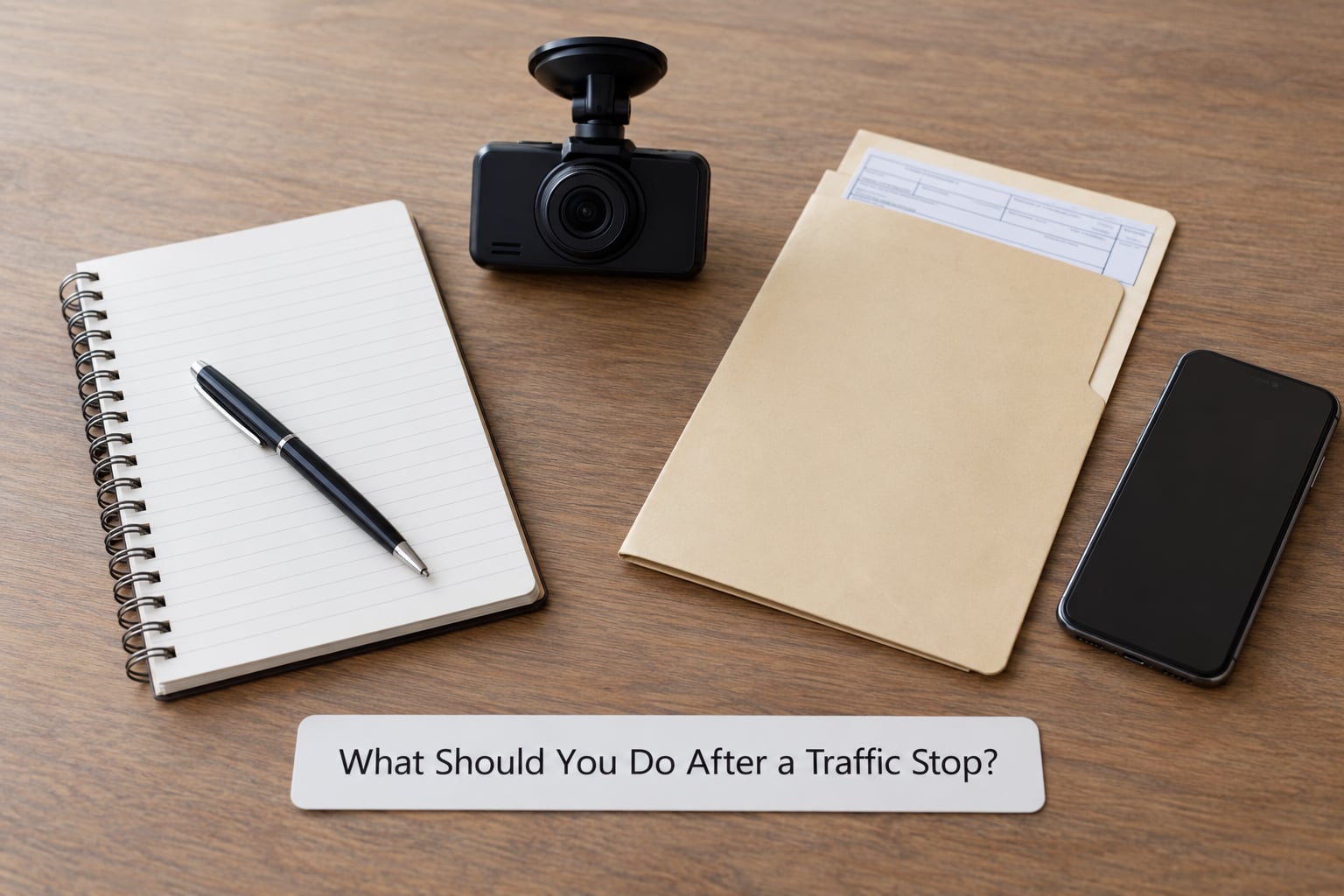
The ten minutes after the stop ends shape what happens next. A short written record beats a hazy memory months later, especially if you want to contest the citation.
Write it down as soon as you are safely parked: the date, the time, the location, the officer’s name and agency, the vehicle description, the reason given, and the names of any witnesses. Save your dashcam and phone footage rather than deleting it, and keep the citation itself, since the court date printed on it is the deadline that matters most.
Then look at the citation itself. Traffic citations carry a response deadline, and missing it forfeits your chance to contest, often converts the ticket into a default judgment, and can add fees. Check what the ticket alleges rather than assuming it matches what the officer said at the scene, because officers sometimes write the code differently from what they told you.
If a point, a suspension or an insurance increase is at stake, get a local traffic attorney. If you cannot afford one, legal aid organizations, law school clinical programs and bar association referral services handle a large volume of traffic matters at low or no cost. Any of them can tell you whether a suppression hearing on the search is worth filing.
Frequently Asked Questions
Can you refuse a traffic stop if you believe it is unfair?
No. Once an officer signals you, you must pull over safely and promptly, and you cannot decline on the grounds that the stop seems unfair or biased. The validity of the stop is a question for a court, not the shoulder of the road. What you can control is what happens during the stop: decline a search, decline to answer questions beyond identification, and record the encounter.
Does staying silent prevent an officer from finding probable cause?
It does not, and staying quiet is not evidence of a crime. An officer can develop probable cause from the smell of alcohol, a description on a broadcast, contraband in plain view, or an open warrant, none of which depend on you talking. Declining to answer questions and declining a search are legally neutral, and neither can be presented to a jury as evidence that you were guilty.
Can an officer order you out of the car if you have not been arrested?
Yes, in most states. Officers are routinely permitted to order the driver and passengers out of a vehicle during a lawful stop for their own safety, and that order does not require probable cause or an arrest. You can ask why, but you generally need to comply. Passengers may also be moved to a separate area of the vehicle while the stop continues.
Is it illegal to refuse a police officer’s request to search your vehicle?
No. An officer cannot search your car without a warrant, probable cause, an inventory basis, or your consent, and simply declining is never a crime. Your refusal cannot be used against you as evidence of guilt. Note the limit: if the officer has probable cause already, for example a strong smell of alcohol, the search may proceed anyway and your objection belongs in court, not at the roadside.
Can you call emergency services during a traffic stop to record it?
You can, but placing a call while driving is the problem, not the recording. If your passenger can dial, a speakerphone call keeps your hands free and your attention forward. Some states require all parties to consent to a recording, and a few restrict it in sensitive settings, so check your state law first. Never argue with the officer about whether the recording is legal.
What should you do if an officer says you are being arrested?
Ask whether you are under arrest, then stop answering questions and ask for a lawyer. You can be handcuffed before any rights are read, because restraint is not the same as questioning, but questioning should not continue once you have asked for counsel. You generally get one phone call, so use it to reach someone who can post bail rather than someone who will argue the facts.
Conclusion
Knowing what are your rights during a traffic stop protects you mostly in the first two minutes. Stay calm, keep your hands visible, stop the car when you are signalled to, give identification and documents where your state requires it, and decline anything you are not required to do. Ask short, clear questions about whether you are free to go, and if you are arrested, ask for a lawyer and stop talking.
Do not volunteer an explanation, do not argue, and do not resist physically. Then, once you are somewhere safe, write down everything you remember and keep whatever you recorded. If the consequences look serious, a traffic attorney in your state is worth the consultation. Rules vary by state, and this guide is general information rather than legal advice.
Last reviewed: October 2026.