
Jury duty is a temporary civic obligation: your court picks names at random from lists of eligible residents, mails you a summons, and asks you to show up so a fair group of ordinary people can decide a case. Most people who report are sent home the same day, many never get past the waiting room, and the whole thing usually takes less time than the envelope makes you fear.
This guide walks through how jury duty works and what to expect at every stage, from reading the summons to the verdict. Rules, pay, and exemptions differ by state and by court, so treat the specifics on your own paperwork as the authority here.
Table of Contents
- How Jury Duty Works in the United States
- How jury duty works and what to expect, step by step
- Who Receives a Jury Summons?
- How to Read and Respond to Your Summons
- What Disqualifies Someone from Jury Service?
- How to Ask for a Postponement or Excuse
- What Happens During Jury Selection
- What kind of questions do you get asked as a juror?
- How people get removed from the panel
- How Jury Duty Works on Jury Selection Day
- What to Expect During a Trial
- What you cannot do once you are seated as a juror
- What to wear to jury duty and what to bring
- Jury Pay, Expenses, and Job Protection
- What to Do If You Cannot Serve
- Frequently Asked Questions
- Can my employer fire me because I am serving on a jury?
- Do I have to serve if I do not speak English well?
- What happens if I miss the deadline on my jury summons?
- Can a juror refuse to serve because a case conflicts with my beliefs?
- Can I be punished for discussing a jury trial with family or friends?
- What to Do First
How Jury Duty Works in the United States
Jury service exists because the people charged with deciding criminal and some civil cases are not judges and not lawyers. They are a random cross-section of the community, which is the idea the Sixth Amendment wraps in the phrase “impartial jury of the fair cross-section of the community.” The Seventh Amendment extends a similar jury right to many federal civil cases.
There are two very different juries, and a lot of anxiety comes from not knowing which one your summons is about.
| What you need to know | Trial jury (petit jury) | Grand jury |
|---|---|---|
| Purpose | Decides the facts in a particular civil or criminal trial | Decides whether to issue an indictment that charges someone with a crime |
| Questions asked | Bias screening, personal background, attitudes about the case | Mostly one-sided: the prosecutor presents evidence and witnesses |
| Length | One day for many people, occasionally several weeks | Typically a matter of weeks, sometimes months |
| Secret | No, jurors may usually talk after the trial | Yes, grand jury materials and testimony are sealed |
| Sentences | Return a verdict; a judge imposes sentence | Return an indictment, which is just a formal charge |
How jury duty works and what to expect, step by step
- You get a summons in the mail. It names the court, your juror number, your reporting date, and how to respond.
- You respond by the deadline. Most courts use an online form, a phone line, or a mail-back card.
- You complete a juror questionnaire. Short questions about your address, occupation, availability, and any legal history.
- You report on your date. Arrive early, pass security, hand in your summons, and get a juror badge or sticker.
- You wait in the jury assembly room. A bailiff or court clerk explains the day, and someone calls groups into courtrooms as needed.
- You go through voir dire. A judge and the lawyers ask whether you can be fair in this particular case.
- You are seated, sworn in, and hear the case. If you were not selected, you are usually released for the day and excused from returning for a period of years.
- You deliberate and return a verdict. Jurors weigh the evidence, and the foreperson delivers the answer to the judge in open court.
Who Receives a Jury Summons?
Courts cannot pick jurors by hand, so they build a master list from public records: voter registration rolls, driver license and vehicle registration files from the DMV, state ID records, and sometimes tax or professional licensing files. Then names are pulled at random, or by lot from a smaller list in larger courts.
There is a reason the list is built this way. The idea is that a jury should look like the community where the case happened. If one neighborhood or demographic is systematically missing from the box, the panel is not a fair cross-section, and defense lawyers can challenge it. That challenge has a name: a Batson challenge, filed when one side argues that prospective jurors were removed because of race, sex, or another protected characteristic.
Three things worth holding onto. First, a summons is not a seat. Most people who report are never seated on a jury. Second, the drawing is random enough that income, education, and legal troubles do not shield anyone, which is exactly the point. Third, eligibility rules are set by the jurisdiction, so a twenty-year-old in one state may qualify while the same person in a neighboring state does not.
How to Read and Respond to Your Summons
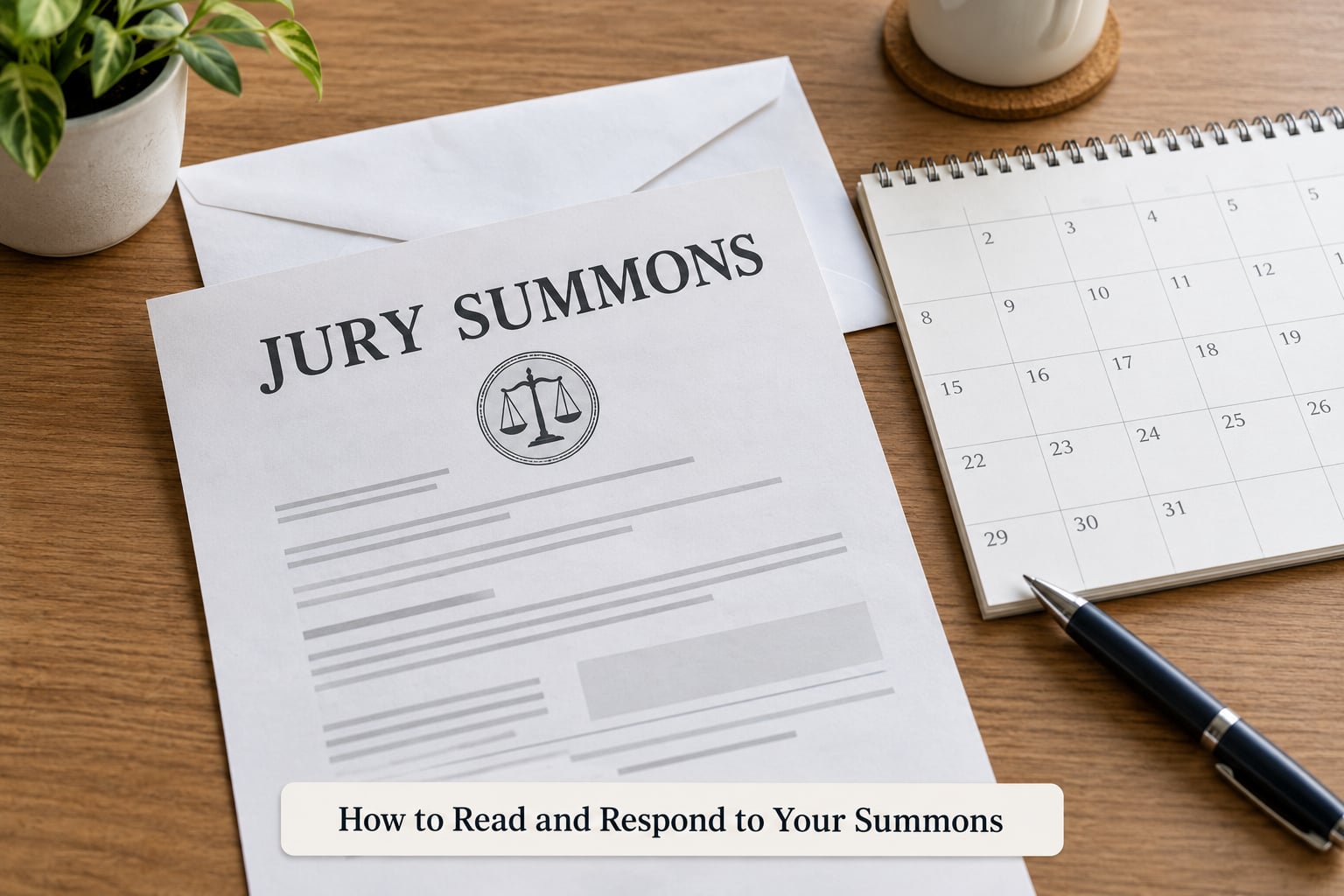
Open the envelope the day it arrives and find four things: your juror number, the name and address of the court, your reporting date, and the response deadline with instructions. The juror number is how the court finds you in its system, so keep it where you can find it again.
The response method matters as much as the deadline. Some courts do everything online, some use a toll-free number, and still others want the card mailed back. If your summons is more than a few days past the response date, call the jury office number printed on it rather than assuming you are off the list.
Do not assume another state’s process matches yours. A friend’s description of a call-in system tells you nothing about your county, and copying a form from a different court can send your response to the wrong place. When the instructions look unclear, the clerk’s number on the summons is the fastest way to a real answer.
What to have ready before you respond: your juror number, a calendar showing the deadline, and a realistic look at which week or weeks you are genuinely free. Courts take a stated availability more seriously than a general plea, which is why the questionnaire asks about work, childcare, and medical appointments.
What Disqualifies Someone from Jury Service?
Automatic and conditional disqualifications both exist, and the list is set by each state and by federal law. Common factors include being under the age of majority in your state, lacking U.S. citizenship, living outside the court’s district, and having a felony conviction or a conviction that seriously damages your credibility as a witness. Citizenship matters in a specific way: non-citizens are generally barred from both petit and grand jury service.
Conditional disqualification is more common than people expect. If you cannot read or understand basic English, or cannot hear and understand testimony without an assistive device, you may be excused. So may active-duty service members, police officers, and in some states, ministers, teachers, and certain medical professionals facing a genuine conflict of interest.
Language is worth a closer look. Federal law gives jurors the right to an interpreter, and many courts offer translated questionnaires and interpreters in the assembly room. A weak grasp of English is not a personal failing to be hidden; it is a logistical fact to raise at check-in so the court can fix it.
How to Ask for a Postponement or Excuse
Postponement and excusal are two different requests. A postponement moves your obligation to a later date, often a year out, and you stay in the pool. An excuse takes you out for good or for a long fixed period. Ask for a postponement first unless your reason is permanent, because postponements get granted far more often.
Reasons that tend to have legs: a scheduled surgery or a medical condition a short deferral would resolve, a birth or adoption date, a child’s school start or a move, active military duty, a prepaid non-refundable trip, a bereavement, or a genuine and recent layoff. Honest, specific, and documented beats vague and emotional every time.
| Usually granted | Usually not granted |
|---|---|
| Medical treatment with a date attached | “I just don’t want to” |
| Newborn or infant care at home | General dislike of courts |
| Military orders or a mandatory work shift you cannot move | A vacation booked after you receive the summons |
| Non-refundable prepaid travel | An unverified claim that you “cannot afford it” |
Ask early. Deferral requests usually have the same deadline as the response itself, and a request filed after that date is a different conversation entirely. Never invent a medical condition or a hardship that does not exist; courts compare answers, and a false claim is treated as contempt rather than as a scheduling problem.
What Happens During Jury Selection
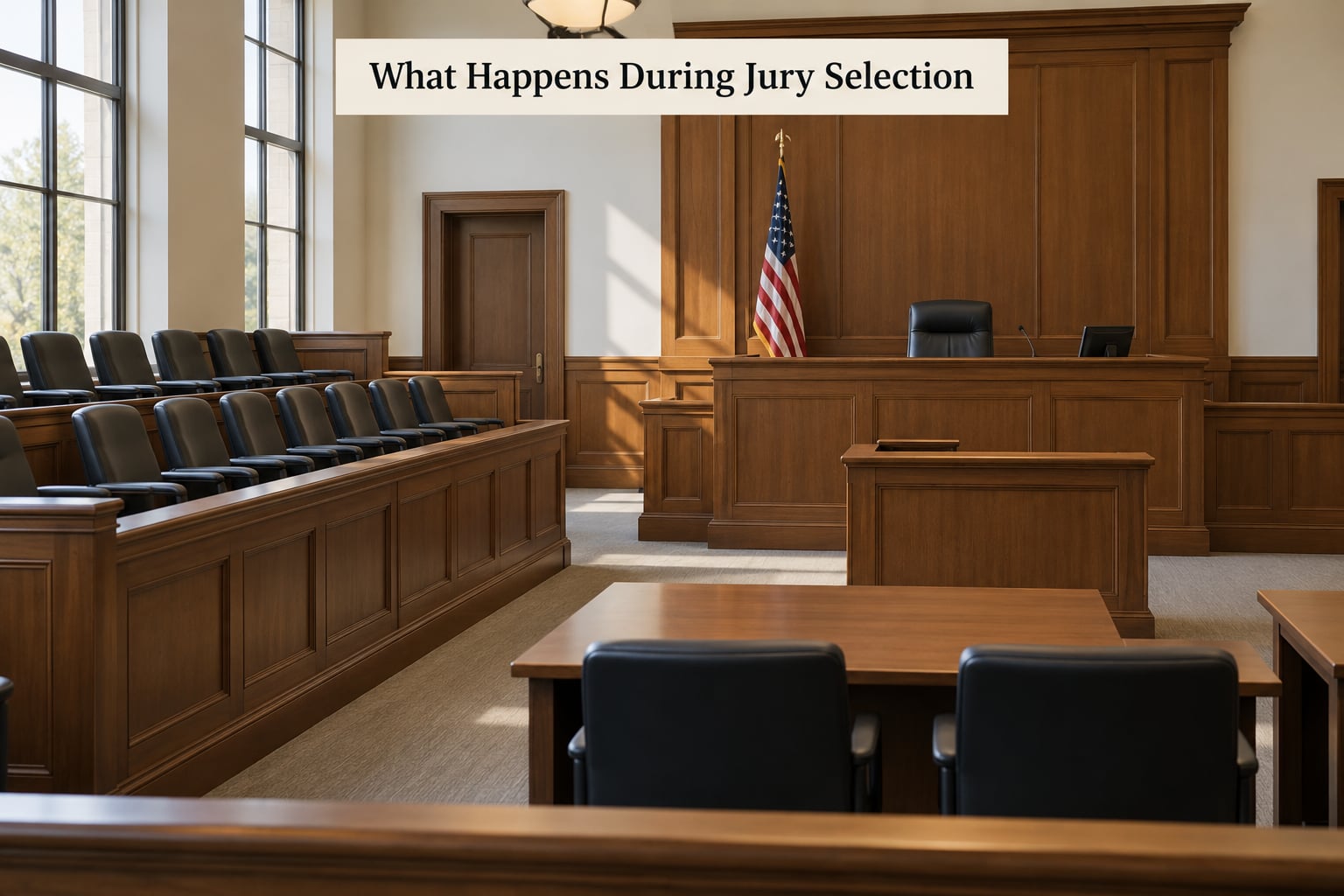
Jury selection is the step people dread most and understand least. The formal name is voir dire, French for “to speak upon,” and it is simply a screening conversation: the judge and both lawyers are checking whether you can be impartial in this case, not whether you are a good juror for one side.
Expect to be sworn in as a group and hear the judge describe the case in plain language first. Expect a court clerk or bailiff to run the room. Expect that a good share of the panel will be dismissed and let go by noon, and expect to wait a long time before that happens.
What kind of questions do you get asked as a juror?
Real jurors describe a questionnaire that covers far more ground than people anticipate. Typical questions include:
- Your name, and the name of your spouse or partner
- Whether you have children, and their ages
- Your occupation, employer, and how long you have worked there
- Whether you have ever been involved in a case in this court
- Whether any party, witness, or lawyer in the case is someone you know
- Clubs you belong to, hobbies you pursue, and where you get your news
- Your general attitude toward the police, the courts, or the law
- Whether you have discussed the case or read anything about it
Some questions come from the judge, who asks the same ones of every person in the box. Others come from the lawyers, who are hunting for a reason to remove someone. In a criminal case, the prosecutor may be the one asking about your views on the death penalty or a plea deal; the defense may ask about law enforcement. There is no trick version of this. Answer honestly and briefly, and say “I don’t know” or “I don’t remember” when that is the true answer.
How people get removed from the panel
Removal happens two ways. A for cause removal requires a stated reason tied to bias or inability to serve, and the judge decides. A peremptory challenge, or peremptory strike, needs no reason at all; each side gets a limited number and uses them on whoever they like. In practice, peremptory strikes are where most people leave, and the order is usually presented to the court as lists of names being read aloud.
If you are not chosen, courts often seat a small group of alternates. Alternates sit through the trial, hear everything, and step in if a seated juror cannot continue. If nobody is dismissed, you may be released and told that you will not be recalled for a couple of years.
How Jury Duty Works on Jury Selection Day
Here is how a realistic first day goes. You arrive 30 minutes early because security is slow. You hand your summons to a clerk, get a badge, and spend a while in an assembly room with coffee, phones on silent, and a wall clock everyone keeps glancing at.
Mid-morning, a bailiff reads a list of juror numbers. Maybe forty people are summoned to Courtroom 3B. The judge explains the case, the lawyers do their questioning, and a foreperson is chosen from whoever is seated. Often the judge seats a panel, starts the trial, and then uses the first recess to finish picking.
The part nobody warns you about is the waiting. Reported waits range from twenty minutes to an entire day, and the reason is usually that the court is waiting on a witness, a transcript, or the other side. Nothing you do moves that along. Ask questions only of the bailiff, keep your summons with you, and plan the day around the idea that you might not be chosen at all.
Two practical notes. Courts rarely run to a fixed end time, so leave the rest of the day open. And if the judge or clerk gives you an instruction, treat it as the rule, not as a suggestion.
What to Expect During a Trial
Most trials follow a rhythm you will learn quickly. The lawyers make opening statements, then witnesses take the stand one at a time, then exhibits go up on a screen or through a paper exchange, then each side cross-examines. The judge gives instructions on the law, the jury deliberates in a private room, and a verdict is read aloud in open court.
There are breaks for the lawyers to argue, a lunch recess, and a daily schedule that most courts keep close to a normal workday, though some run long. A civil case that reaches a jury is usually shorter than a criminal one. A jury that cannot agree is a hung jury, which usually means a new trial and a new panel.
What you cannot do once you are seated as a juror
Once you are sworn in, the rules get strict. Do not research the case online, read about it, or listen to coverage. Do not post about it on social media, including a vague post about “sitting on a jury this week.” Do not talk to anyone about it, including your family, outside the deliberation room. Do not visit the courthouse to watch the trial you are sitting on. Do not read juror questionnaires that other jurors have handed back. Breaking these rules is juror misconduct, and the penalty can be a fine or a contempt of court charge.
After the trial ends, the rules loosen. In most cases you can talk about having served, though many jurors in serious cases say they keep quiet out of habit, and some courts ask jurors to wait before discussing the verdict.
What to wear to jury duty and what to bring
Jeans are fine. Almost every courthouse asks for business casual, which in practice means a collared shirt, a sweater or plain top, and no shorts, no tank tops, no ripped jeans, and no clothing with slogans or graphics on it. You will be walking through metal detectors and sitting for hours, so comfortable shoes matter more than looking formal.
Bring a photo ID, your summons, your juror number, a charger, a book or something to do during long waits, a light snack, and any medication you need. Phones are usually allowed in the assembly room and silenced in court. Do not bring a laptop or anything bulky, and leave your valuables at home or in the car.
Jury Pay, Expenses, and Job Protection
Pay for jury service is set by the government running the case, so a federal jury and a county jury pay differently. Federal law sets a small daily fee for jurors plus travel costs or a mileage allowance, with a higher rate after the first two days, and your employer may or may not be required to top it up. State and local systems work the same general way with very different numbers, and many courts publish their own schedule on their website.
Employment protection is the part that matters most to working people. Federal law and most state statutes prevent an employer from firing or threatening you for jury service, and many states also require the employer to continue paying you for the days you serve, though plenty of states do not. If you are self-employed, on commission, a full-time student, on hourly pay, or a gig worker, that protection is thinner, and the cost lands on you.
So here is the honest accounting. Service is usually unpaid or near-unpaid. Add lost wages, childcare, transit or parking, and meals, and a multi-week trial is a real financial event for a household living paycheck to paycheck. Ask the court clerk in advance whether a service letter is available for your employer, and ask about mileage reimbursement and any hardship funds before you are seated, not after.
What to Do If You Cannot Serve
If serving is genuinely impossible, the process is narrow and time-sensitive. Contact the jury office using the number on your summons, and do it before the response deadline rather than after. Many courts will let you submit a written request alongside your response form, and some have an online hardship form.
Write down the specific facts: the date of the procedure, the name of the condition, the date of the flight you cannot cancel, the school year your child is starting. Ask for an accommodation if you need one, whether that is a ramp, a support person, a large-print copy of the form, or an interpreter, and request it at check-in if you did not ask in advance.
Two things to avoid. Do not simply skip the reporting date without calling, because a missing juror forces the court to delay the trial and can create a contempt problem. And do not let the deadline pass quietly, because courts assume a non-response is a refusal to appear rather than an oversight.
Frequently Asked Questions
Can my employer fire me because I am serving on a jury?
Generally no. Federal law and nearly every state statute protect you from firing, demotion, or threats because you are serving, and many courts hand you a service letter proving the dates. Some states also require the employer to keep paying you, which is not the same as protection from firing. If your employer pushes back, ask the clerk for that letter in writing and check your state statute.
Do I have to serve if I do not speak English well?
You should tell the court, not decide for yourself. Courts provide interpreters and translated materials, and a limited grasp of English is not usually a reason to be disqualified. If you cannot follow the proceedings without help, raise it at check-in or when questioned so the judge can arrange an interpreter. Withholding the issue until the trial is underway causes far more problems than saying something early.
What happens if I miss the deadline on my jury summons?
Call the jury office immediately, using the number on the summons, and explain that you are late rather than avoiding the call. Most courts will reschedule you and treat it as an administrative problem, especially for a first slip. What they do not forgive is silence, because a no-show juror can delay a trial and may lead to a contempt proceeding. One prompt phone call usually resolves it.
Can a juror refuse to serve because a case conflicts with my beliefs?
A personal or moral objection to a case is not a recognized excuse in most jurisdictions. Judges routinely deny those requests, and a stated unwillingness to follow the law can count against you during selection. A narrow set of situations does allow a challenge, including when the case involves your employer or a close relative, or when a sincerely held religious practice genuinely conflicts. Those need to be raised specifically, not argued generally.
Can I be punished for discussing a jury trial with family or friends?
Yes, during the trial. Once you are sworn in, discussing the case with anyone outside the deliberation room, including your spouse, is a violation that can lead to a mistrial or contempt of court, and posting about it online can end your service and draw discipline. Social media is the riskiest version of this. After the trial ends, most courts allow you to talk about having served.
What to Do First
Open the summons today and write the response deadline on a calendar. Complete the response honestly, using the method the court specified, and keep the juror number somewhere you will find it again.
If the instructions do not make sense or your circumstances genuinely do not allow service, call the jury office number on the summons before the deadline and ask for a postponement rather than a permanent excuse. After that, follow the paperwork: show up early, dress comfortably, and let the judge set the rules for everything else.