
Last updated: October 2026
Cash bail reform is the push to end or sharply limit money as a condition for releasing someone from jail before trial. It replaces paying your way out with a hearing about flight risk and public safety, using recognizance bonds and other non-monetary release options instead of a dollar figure. What counts as reform differs by state, and the rules keep changing.
Most people do not learn how bail works until it happens to somebody they love. A brother, a son, a neighbor gets arrested over something small, and suddenly the family is hunting for a bondsman, a cashier and a way to post ten percent of a number that was set in a few minutes. This guide is for readers who want the system explained before that happens, and for anyone who wants to judge reform proposals on what they actually do.
One note before we start. Every state sets its own rules, state laws change often, and nothing here is legal advice about a specific case. If someone in your family has been arrested, talk to a public defender or a private criminal defense attorney rather than relying on a general article.
Table of Contents
- What Is Cash Bail Reform?
- How Does Cash Bail Currently Work in the United States?
- What is the difference between bail and a bond?
- What Problems Is Cash Bail Reform Meant to Address?
- How Do Common Cash Bail Reform Models Work?
- Why do reformed states get different results?
- What Happens During Release and Under Court Supervision?
- What Does Cash Bail Reform Cost, and Who Can Benefit?
- What Are the Arguments For and Against Cash Bail Reform?
- The case for reform
- The case against reform, and the honest caveats on both sides
- How Do You Find the Cash Bail Rules in Your State?
- What Should Readers Look for When Comparing Reform Proposals?
- Frequently Asked Questions
- Does cash bail reform mean that defendants are released without any conditions?
- Can someone be held without cash after a bail reform law takes effect?
- How much can cash bail reform save defendants in bond premiums?
- Is cash bail reform available in every state?
- What should a person do after an arrest if they cannot afford bail?
- Conclusion: Start With Your State’s Release Rules
What Is Cash Bail Reform?
Cash bail reform is a set of legal changes that reduces, restricts or replaces the practice of holding a dollar amount as the price of walking out of jail before trial. The money is meant to guarantee one thing: that the person shows up for court. Reform keeps that goal and changes the method.
Three things reform is not. It is not the same as abolishing bail altogether. Most reformed systems still require people to appear, and most still let a judge detain someone when the evidence supports it. It is not a federal rule. There is no national cash bail reform law, so each state, and in some cases each county, writes its own rules. And it is not one policy. States that all count as reforming bail often produce very different results on the ground.
The core idea is simple. Whether you go home tonight or spend weeks in custody should turn on how likely you are to appear and how dangerous you are, not on whether your family can put up money. Reform moves that decision from the size of a bank account to a hearing in front of a judge.
How Does Cash Bail Currently Work in the United States?
The traditional process starts at arrest and ends at a first appearance before a judge, usually within a day or two. The judge sets a bond, and the defendant has a few ways to satisfy it. If none of them work, they wait in jail for the rest of the case, sometimes for months.
| Stage | What generally happens | Main concern |
|---|---|---|
| Arrest | Officers take the person into custody and book them, setting an initial bond amount from a schedule or at an officer’s discretion. | The schedule amount often has nothing to do with what the person can pay. |
| First appearance | A judge reviews the charge, hears arguments about release, and either sets a bond, releases the person, or orders detention. | The judge may not yet know much about the defendant’s job, family or record. |
| Paying the bond | The defendant pays the full amount in cash, posts a surety bond through a bail bond company, or gets released on their own promise to appear. | Only one of those options depends on the defendant’s own money. |
| While the case runs | Conditions may apply, such as GPS monitoring, check-ins, treatment programs or travel limits. | Missing a condition can put the person back in custody, sometimes with a warrant issued in their name. |
| Resolution | Plea, trial or dismissal. If the case ends without a conviction, a posted cash bond is normally returned to whoever paid it. | If the defendant skipped court, that cash can be forfeited instead. |
What is the difference between bail and a bond?
The distinction confuses a lot of readers. Bail is the money itself, or the legal promise secured by money. A bond is the mechanism that posts it. A surety bond, the type a bail bond company sells, is a promise by the company to pay the full amount if the defendant fails to appear, usually for a non-refundable premium of roughly 10 to 15 percent of the bond. The bondsman also wants collateral, which can be a car, a home or a signature on a financial guarantee.
So when a family hears that the bail amount is fifty thousand dollars, the realistic choices are usually two: find the full amount, or pay a bondsman five to seven and a half thousand dollars for a promise that does not even cover the fifty thousand. That gap is the entire argument in one number.
What Problems Is Cash Bail Reform Meant to Address?
Reformers point to a mismatch that the Brennan Center for Justice and similar research organizations have documented for years: pretrial detention in the United States is decided largely by money. Here are the figures cited most often, each with the source attached.
- Pretrial detainees make up more than 70 percent of the US jail population, roughly 536,000 people at the time of the Brennan Center’s count.
- The bond premium a bail bond company charges is generally 10 to 15 percent of the bond amount, and it is not refunded.
- People held pretrial are about four times more likely to be sentenced to prison than people released before trial, according to the Brennan Center’s summary of the research.
- Black and Latino men have historically been assessed bail amounts roughly 35 percent and 19 percent higher than white men for comparable charges.
- In Maryland, Black defendants were charged more than double the bond premiums of all other defendants combined, despite Black residents making up about 30 percent of the state’s population.
The Brennan Center also reports that New Jersey’s reform cut its pretrial detention population by 67 percent, and that Philadelphia released more than 1,700 people pretrial without a measurable drop in appearance rates or an increase in new offending.
Behind those numbers sit four recurring harms. First, an inability to pay turns a misdemeanor into a jail stay. Second, detention costs people their jobs, housing, childcare and family support before any court has found them guilty. Third, time in custody makes pleas less voluntary, because the alternative to a plea is months locked up. Fourth, crowded local jails are expensive and, in many counties, over budget.
Reform does not automatically fix any of this. It changes the mechanism, and the results depend on how the new mechanism is run.
How Do Common Cash Bail Reform Models Work?
Cash bail reform is not one thing. There are six approaches that show up repeatedly in state statutes, court rules and county pilots, and most real systems mix two or three of them.
| Model | Purpose | Possible benefit | Limitation |
|---|---|---|---|
| Release on recognizance | The defendant promises in writing to appear, with no money posted. | Fast and free. Cost drops to nothing for many cases. | Depends on follow-up when someone does not appear; some courts prefer it for low-level charges only. |
| Cash-free alternatives | Unsecured appearance bonds, property bonds, or supervised release programs. | Keeps a court link to the defendant without demanding a large sum. | Monitoring costs money, and finding the capacity to supervise everyone is a real constraint. |
| Risk-based release | A judge weighs flight risk and public safety using a validated tool or a hearing record. | Points at the defendant most likely to skip court or reoffend rather than the defendant least able to pay. | Algorithms can reproduce the bias they were meant to remove if the underlying arrest data is skewed. |
| Reduced or capped bonds | Laws limit how high a bond can go for low-level offenses, or cap bonds by charge severity. | Keeps money as an option without letting it dominate ordinary cases. | Cap amounts still exclude people who cannot pay them, so the equity gain is partial. |
| Treatment pathways | Drug, mental health and veterans courts channel defendants into services instead of detention. | Addresses the reason a person is in front of a court at all. | Program slots are limited, and completion depends on the treatment being available locally. |
| Data-driven accountability | Courts and counties publish appearance rates, detention figures and racial breakdowns on a schedule. | Makes the results visible so a reform cannot quietly drift. | Good reporting is rare, and the appearance-rate question is genuinely contested by researchers. |
Why do reformed states get different results?
Because the label is not the policy. New Jersey, which reformed in 2017, restricted money bail heavily and paired it with judges, clerks and risk tools. New York’s 2020 amendments took a different route, restricting money bail by charge severity. Illinois went furthest, ending cash bail for most offenses through its Safe Fair and Equitable Release Act, with the pretrial release provisions phasing in during 2021 and expanding in 2023. Same headline, three different systems.
Readers in online communities often notice this and say so: people frequently support reform in principle while objecting to a specific statute, and those are different arguments. Agreeing that money should not decide custody does not tell you whether a given bill is well designed.

What Happens During Release and Under Court Supervision?
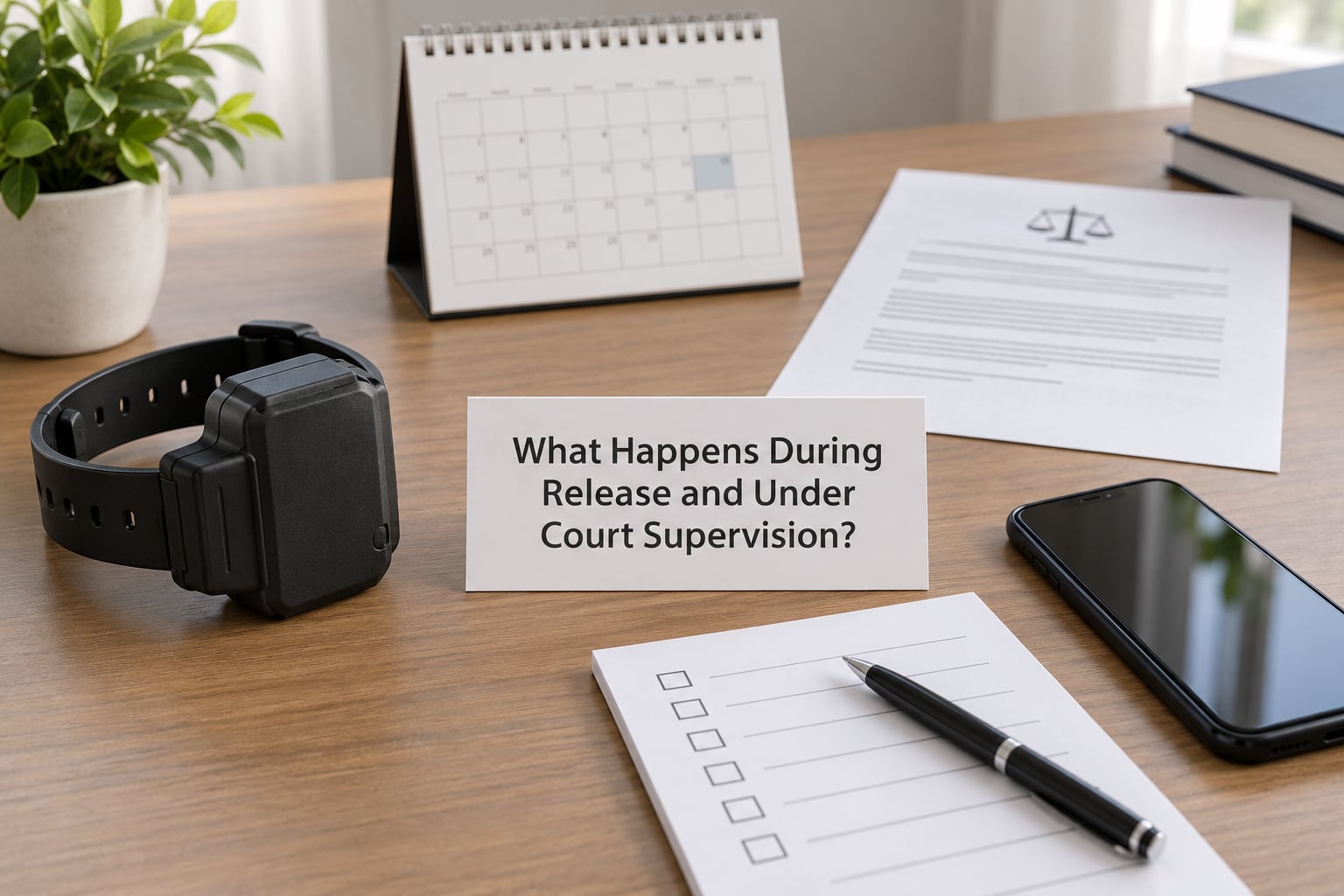
Losing the cash requirement does not mean losing conditions. Under a reformed system, most released people still sign something, report to someone, and answer to the court until the case ends. What changes is that the price of that oversight is usually not a lump sum.
Common conditions include GPS or ankle monitoring, scheduled check-ins by phone or in person, curfews and travel limits, and mandatory participation in treatment or counseling programs. Some jurisdictions require weekly reports to a community supervision officer. Others ask a defendant to pass a drug test. The list is set by the judge who orders it, and by statute.
When someone misses a check-in or tests positive, the usual response is graduated. A missed call may mean a warning. A missed appointment may mean a modified condition. Repeated violations can lead to a warrant, more restrictive conditions, or detention. The point of the ladder is to keep a technical mistake from turning into the same outcome as cash bail, which is jail by default.
Supporters of monitoring programs argue that a condition you can follow is better than a bond you cannot. Critics answer that the equipment is expensive, that the conditions can be set in ways that are hard to meet, and that violations can still land people back in custody over a missed appointment rather than a serious new charge.
What Does Cash Bail Reform Cost, and Who Can Benefit?
The honest answer is that the money moves rather than disappears. Removing a bond premium saves the family a large one-time fee. Someone else, usually a court, a public defender’s office or a supervision agency, pays for the program that replaces it. Local pretrial incarceration has been estimated at roughly 13.6 billion dollars a year, which is the pool that savings would have to come out of to matter to a county budget.
| Cost | Who pays it today | Who might pay it after reform |
|---|---|---|
| Bond premium of 10 to 15 percent of the bond | The defendant or the family | Usually nobody, on cash-free releases |
| The full bond amount when paid in cash | The family, often refundable at case end | Mostly avoided, though it still exists for some charges |
| Electronic monitoring equipment and check-ins | Often not applicable | County courts, sometimes contracted out to vendors |
| Public defense for a longer case | The county or the state | Still the county, though detention shrinks the file |
| Jail beds, medical care and food | The county or city budget | Falls if fewer people are held pretrial, at a per-day rate |
| Treatment and re-entry services | Underfunded, when funded at all | Would need earmarked savings to grow |
Who benefits first depends on the design. In a system that emphasizes recognizance and unsecured bonds, families feel the relief immediately and courts feel it slowly. In a system that requires a supervised release assessment for every case, the work lands on court staff, which is why a handful of large courts, including the supervised release project in New York City that reported an 88 percent appearance outcome, have struggled with capacity.
One question readers rarely hear asked: does the money saved ever get reinvested in public defense or treatment? Often it does not. The savings are real for defendants and real for county budgets, but a budget line that shrinks is not the same as a program that grows.
What Are the Arguments For and Against Cash Bail Reform?
Both sides of this debate make arguments worth taking seriously. Here they are in comparable form, because the evidence underneath them is genuinely mixed.
The case for reform
Money bail creates two tiers of justice. One tier walks out of jail the same afternoon and goes back to work. The other waits. That is the strongest argument, and it does not depend on predicting recidivism. It depends on noticing that the difference between two defendants is often a bank balance.
Reform also protects the presumption of innocence. An unconvicted person held for weeks loses income, housing and employment before any judge has found guilt, and defense lawyers regularly describe clients who plead guilty to get out rather than fight a case they could plausibly win. Detention also raises the stakes for the accused, which is the same coercion problem in a different form.
The case against reform, and the honest caveats on both sides
Critics argue that a narrow list of offenses eligible for cash-free release leaves judges with no tool when someone appears dangerous at short notice. They point to appearance rates as the practical test, and they argue that courts have cut detention without building the supervision capacity to replace it.
There is a real weakness in the pro-reform evidence too, and honest coverage mentions it. Aggregate appearance-rate comparisons after reform are contested methodologically: opponents argue that a person released on recognizance who never returns is never counted as a failure, while a defendant on cash bail who fails to appear is counted, so the two groups are not being measured the same way. Supporters answer that the underlying data is consistent across jurisdictions and that reported failure-to-appear rates under reformed systems have stayed within a narrow band. Most readers looking into this will find both claims are partly right.
The other honest caveat is that reform does not remove risk, it reallocates it. A system that detains fewer people relies on supervision, check-ins and follow-through to catch the small number who would have skipped court. That trade only works if the supervision is funded and answered to.
How Do You Find the Cash Bail Rules in Your State?
Bail rules are not uniform and they are not easy to find. County-level practice can differ from state statute, and schedules are updated by court administrative order. This search order works:
- Your state or county court website. Look for a bail schedule, a local rule on release, or a published order from the presiding judge. Most courts post their bond schedule as a PDF.
- The court clerk or administrator’s office. A phone call can establish what bond applies to a specific charge, which no website will tell you reliably.
- Your public defender. In counties with a public defender’s office, they handle release hearings and know the local practice. Ask whether a violation of pretrial release is possible in your case and how the court treats a violation.
- A legal aid organization. Civil legal aid groups handle bond assistance and sometimes run bail funds that post money for people who cannot pay.
- A criminal defense attorney. If there is any risk of a jail sentence, this is not a place to economize. A lawyer can request a bail reduction, argue for non-monetary release and, where a reform statute applies, invoke its provisions directly.
Two more practical notes. First, ask what the bond amount is tied to: the charge, the judge, or a statewide schedule. Those three answers lead to three different places to argue. Second, if your state has reformed its bail law, confirm the reform is in effect where you are. Coverage in 2026 is full of stories about states that passed a reform and then narrowed or delayed it, and a law on the books is not always a law running in your courthouse.
This is general information, not legal advice. Rules change, and nothing here tells you what will happen in a particular case.
What Should Readers Look for When Comparing Reform Proposals?
Most bills are described the same way, so the differences show up in the details. These are the questions worth asking before supporting or opposing a proposal in your state.
- Who is eligible? Cash-free release for all offenses, for low-level offenses only, or for offenses below a dollar threshold? A bill covering only misdemeanors leaves most of the detention population untouched.
- What decides release? A risk assessment tool, a judge listening to arguments, or a checklist that is easy to apply? Each leans somewhere different.
- How is information verified? Address, employment, immigration status, and prior record all get checked, and each check can filter some defendants out of release quietly.
- What do the alternatives cost? If monitoring and supervised release require money the county does not have, the alternative to cash bail becomes detention by another name.
- How are violations handled? A missed check-in should not produce the same outcome as a new charge. Ask what a graduated response looks like in the statute.
- Are racial disparities measured? A reform that does not publish outcomes by race cannot tell whether it worked.
- Who provides oversight? Regular public reporting on detention numbers, appearance rates and failure-to-appear rates is the difference between a policy and a promise.
That last item is where cash bail reform has been weakest. Advocacy organizations have pushed hard for published numbers, and the states that do publish them are easier to evaluate than the states that do not.
Frequently Asked Questions
Does cash bail reform mean that defendants are released without any conditions?
No. Most reformed systems still impose conditions. A person released under a cash bail reform statute typically signs an appearance agreement, reports to a supervision officer, wears monitoring equipment, submits to check-ins, or enters a treatment program. What changes is that the price of not meeting those conditions is usually a return to court on a new hearing rather than an automatic stay in jail for want of funds.
Can someone be held without cash after a bail reform law takes effect?
Yes. Cash bail reform limits or removes money as the deciding factor, it does not remove the court’s authority to detain. Judges can still hold someone without cash when a statute allows detention for the charge, or when the hearing record shows a serious flight risk or danger to the community. Which offenses qualify for detention without money depends on the specific state statute and its schedules, which is why the law has to be checked where you are.
How much can cash bail reform save defendants in bond premiums?
On a cash-free release, the entire premium disappears, which for a typical bond means roughly 10 to 15 percent of the bond amount, paid once and never refunded. Families who paid full cash bonds in the past still get that money back at the end of a case, so the saving is smaller there. What varies enormously is the county’s cost, since monitoring and supervision replace the premium and have to be paid from somewhere.
Is cash bail reform available in every state?
No. There is no national bail reform law in the United States, so what applies depends entirely on where you are and on the charge. Some states have ended cash bail for most offenses, others only restrict it by offense severity, and others have left traditional money bail in place with no changes. Rules also vary by county in some states, and several states have amended or delayed reforms they passed earlier, so check the current law rather than an old summary.
What should a person do after an arrest if they cannot afford bail?
Get a lawyer involved quickly, and ask the public defender’s office in your county first if you cannot afford private counsel. Ask what release options exist that do not require money, what the bond is tied to, and what conditions would come with a non-monetary release. A bail fund or legal aid organization may be able to help, and in most places a request for a reduced bond can be made at the first appearance. Do not sign anything without understanding what it commits you to.
Conclusion: Start With Your State’s Release Rules
Cash bail reform is a set of changes that limits, restricts or replaces money as the condition for pretrial release, and it is implemented state by state with rules that shift from year to year. The practical first step is narrow and simple: find out what your own state and county currently do with money bail, and when you find out, check whether the reform you have read about is actually running in your courthouse.
After that, talk to someone qualified. A public defender, a criminal defense attorney or a legal aid organization can tell you in ten minutes what applies to a specific charge, and that conversation is worth far more than any general article, including this one.