Solitary confinement is controversial because it locks a person into a cell roughly 23 hours a day with almost no human contact, while research and first-hand accounts document lasting psychological harm, and because it falls hardest on people who are already vulnerable. Officials defend it as a necessary tool for control. Critics, including the UN special rapporteur on torture, argue it amounts to a form of torture that provides little measurable safety benefit. That tension, between a security claim and a humane-treatment duty, is the heart of the debate.
The practice itself is not new. What changed over the last forty years is its scale: restrictive housing that once sat at the edge of a prison system now runs through the middle of it, and the reasons people give for it have widened from protecting a witness to managing a pandemic and a protest.
Table of Contents
- What Is Solitary Confinement?
- What a day inside actually looks like
- Why Is Solitary Confinement Controversial?
- What Are the Mental Health Effects?
- Why solitary confinement is controversial on mental health grounds
- What Are the Physical Effects?
- How Does Solitary Confinement Affect Human Rights?
- Who Is Most Likely to Be Placed in Isolation?
- Why Is Solitary Confinement Used in Prisons?
- What Reforms Could Reduce Its Use?
- Frequently Asked Questions
- Is solitary confinement legal in the United States?
- How long can someone legally be held in solitary confinement?
- Does solitary confinement cause long-term mental health problems?
- Are disabled and mentally ill prisoners at greater risk in isolation?
- What is the difference between solitary confinement and protective custody?
- What alternatives do prisons have for managing disciplinary violations?
- Conclusion
What Is Solitary Confinement?
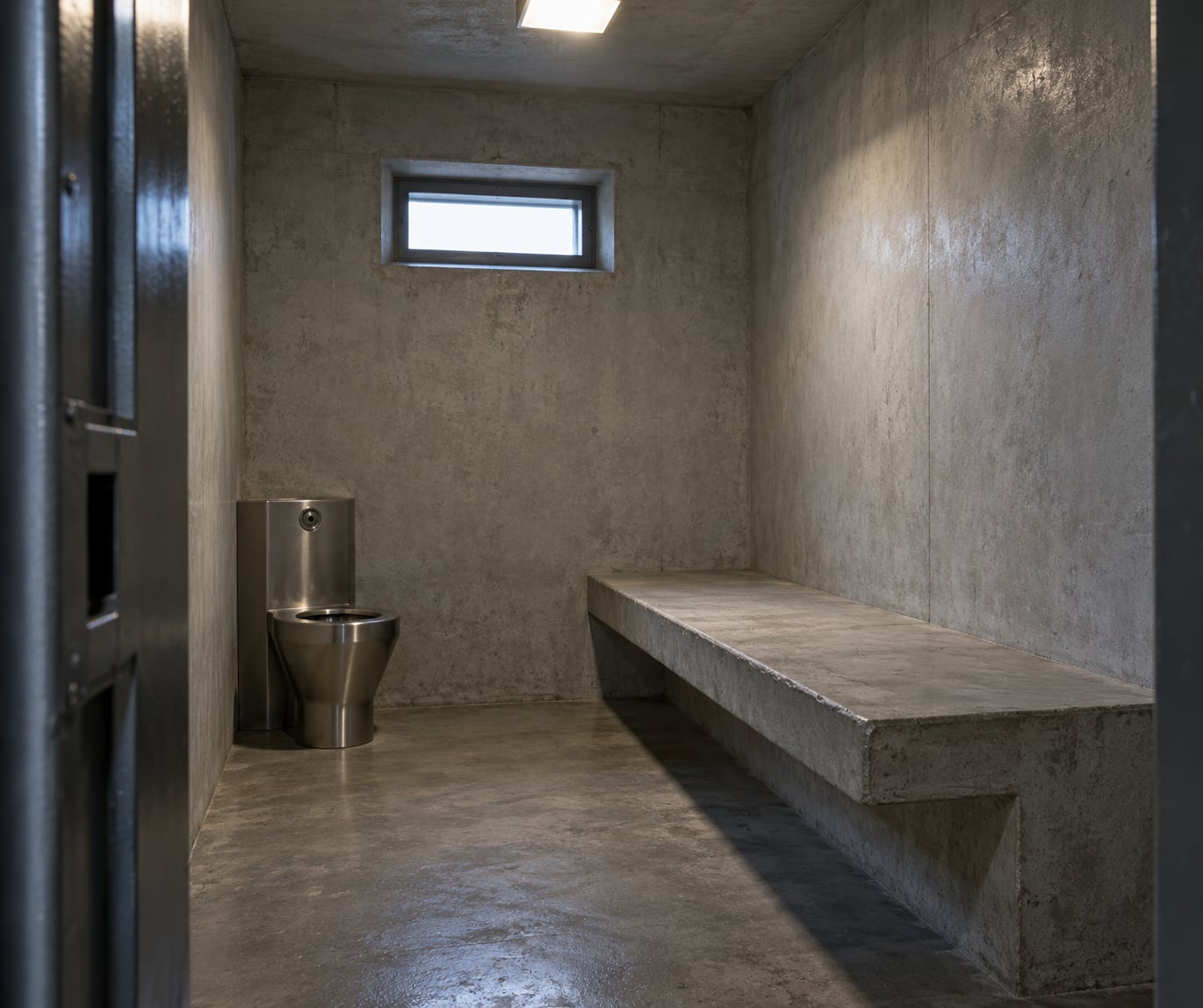
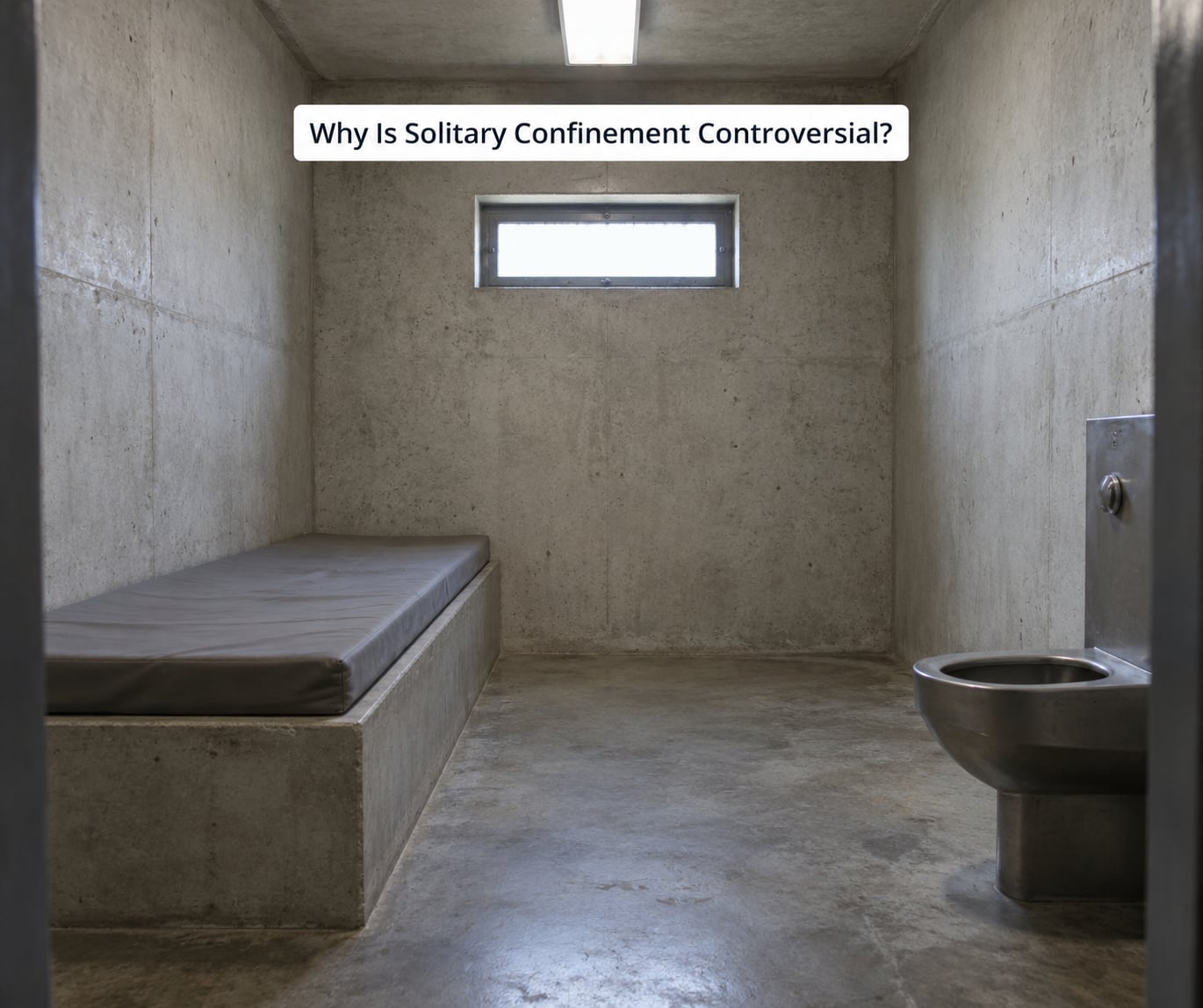
Solitary confinement is the isolation of an incarcerated person from everyone else, in a cell where they eat, sleep, use the toilet, and typically take exercise. Under the most common US arrangement, that adds up to about 23 hours a day inside the cell, with an hour of movement in a small enclosed space often no bigger than a parking space.
The terminology is genuinely confusing, and the confusion matters because the label determines which rules apply. Punitive segregation is isolation handed down as discipline for a rule violation. Administrative segregation is isolation for staff convenience or safety, such as pending investigation, a fight, or a search of the cell. Some people sit in both at once, in what researchers call double segregation, and that combined time is often uncapped.
Other labels mean roughly the same thing in different places. A SHU, or Security Housing Unit, is the general-population version used in New York and elsewhere. An SMU is a special management unit, reserved for the most disruptive or highest-security people. Supermax describes a whole high-security facility built around that idea. Locally, prisoners often just call it the hole, and the pink room is a nickname for a women-only isolation cell, an older usage most associated with Pennsylvania lockups and the cracked, painted-over windows advocates photographed there.
There is no single national limit. Each state, and often each facility, sets its own maximum, which is why someone held 30 days in one state may face 120 days in the next.
What a day inside actually looks like
Reading, writing, drawing, and limited exercise are usually permitted, and often that is the entire menu. A person confined for 15 days commonly describes the same arc: boredom in the first few days, then a strange drift where time stops feeling linear, then disorientation and hearing things that are not there. Whether they sleep through the day instead of the night is not a matter of choice, because with no clock, no window and no schedule, the body settles into whatever rhythm it finds.
Why Is Solitary Confinement Controversial?
The controversy comes down to five problems that critics say cannot be separated: the documented harm, who ends up there, how little oversight exists, how thin the evidence is that it works, and the way it collides with basic obligations of humane care.
- The harm is documented and severe. Decades of research link isolation to anxiety, depression, psychosis, cognitive impairment and suicide risk. This is not a fringe claim; it is the consensus of the field.
- It is not evenly distributed. Black and Latino people are placed in isolation at higher rates than white people, and so are people with mental illness, people with disabilities, people in protective custody, and people who have not yet been convicted.
- Oversight is thin. In many facilities a person can be isolated repeatedly without a hearing, without fresh medical review, and without anyone outside the prison chain of command approving it.
- The safety evidence is weaker than the rhetoric. Supporters present isolation as essential to prevent violence, but research and the experience of facilities that abolished it point to other causes, including staffing levels, contraband, and overcrowding, as the real drivers of assaults.
- It conflicts with basic obligations. International standards treat prolonged isolation as a form of torture, and most democratic legal systems owe their prisoners a duty of care that isolation appears to breach.
Supporters answer all five points. They argue that a small number of people cause most assaults, that a cell away from the population is the only way to stop a fight, and that removing the tool would leave staff with nothing. That argument has real weight in a violent facility, which is exactly why the debate rarely resolves.
What Are the Mental Health Effects?
Why solitary confinement is controversial on mental health grounds
The core finding is that isolation is psychologically toxic in a way ordinary incarceration is not, and that the harm comes from removing stimulation and human contact rather than from confinement alone.
Dr. Robert Grassian’s early studies of people held in restrictive housing at Wisconsin and Iowa found rates of acute anxiety, psychosis and suicidal thinking far above the general prison population, and described a pattern now sometimes called prison isolation syndrome: a distinctive set of symptoms including sensory distortions, mood swings, an inability to concentrate, and depersonalization. A 2021 analysis of health records from the Massachusetts Department of Correction, led by researchers at Harvard, reported substantially higher rates of psychiatric illness among people held in isolation than among the general population, and higher rates of infectious disease as well.
Suicide risk is the sharpest worry. Deaths in isolation are not uncommon, and in each case the pattern of warning signs people describe, invisible withdrawal, rage, then numbness, is the same pattern.
First-hand accounts add what a study cannot. Across Reddit threads on r/AskReddit, r/AskMen, r/AMA and r/NoStupidQuestions, people who spent time in isolation repeatedly described the same turning point around the third day, a kind of disassociation and the onset of hearing things that were not there. One person who had spent 17 years in and out of confinement put it plainly: the hole is tolerable for about two weeks, and then it becomes genuinely unbearable and you start hearing things. Another described how people write on toilet paper with smuggled pens, a small detail that does more work than any abstract claim about autonomy.
One caution is fair. The research shows elevated risk across populations; it does not predict what will happen to any individual person. Plenty of people come through isolation without a diagnosis, and some had symptoms before they arrived. The point is not that everyone breaks. It is that a practice with a documented capacity to cause lasting harm is being used on thousands of people, most of whom were never charged with an assault.
What Are the Physical Effects?
Physical health gets less attention than mental health, and the pattern is the same: cells are designed for control, not for a body to live in.
- Sleep disruption. With constant light, noise from the corridor, and no reliable day or night, sleep fragments and circadian rhythm degrades.
- Inactivity and deconditioning. An hour in a cage is not exercise. Muscle loss, joint stiffness and slowed circulation follow, and the effect compounds for older people and those with existing conditions.
- No temperature control. Isolation cells are often hot, poorly ventilated and sometimes cold, and a person cannot regulate their own comfort.
- No natural light. Days without sunlight worsen sleep problems and low mood, and many isolation cells have no window at all.
- Skin, bowel and urinary problems. Living in one space with limited hand-washing and no proper bathing compounds minor issues into infections and constipation.
People also describe losing track of their body entirely. Without a mirror, exercise or sunlight, it is hard to know what shape you are in, and former prisoners talk about the physical shock of crowds and normal noise on the other side, a sensitivity that outlasts the confinement itself.
How Does Solitary Confinement Affect Human Rights?
Two legal traditions matter here, and the tension between them is a large part of why the practice stays contested.
Internationally, the UN Mandela Rules, adopted in 2015, set the most influential modern standard. They cap isolation at 22 hours a day, limit consecutive use to 15 days as a last resort, and prohibit it for children, for people with disabilities, and for pregnant women, women in labour and women who have just given birth. In 2011, UN special rapporteur on torture Juan Mendez reported that prolonged and indefinite solitary confinement can amount to torture. The United States has not ratified the treaty underlying the rules, but many countries that have are bound by an equivalent.
In the United States, the Eighth Amendment is the main route, and the Supreme Court has ruled against extreme isolation twice. In Hutto v. Finney (1977), the Court held that thirty days in isolation could violate the ban on cruel and unusual punishment. In Hope v. Pelzer (2002), it found Louisiana’s conditions unconstitutional. Liability generally requires deliberate indifference, established in Estelle v. Gamble (1976) and Farmer v. Brennan (1994), which is a demanding standard and explains why cases rarely succeed.
Due process is the second front. Wolff v. McDonnell (1974) requires notice and a hearing before punishment is imposed, yet in many facilities a designation of mental illness, an administrative hold or a disciplinary write-up substitutes for that hearing. Disability law adds a third: the ADA and the Section 504 Rehabilitation Act have been used successfully to challenge isolation imposed on people placed in mental health segregation without proper clinical justification.
Results vary by jurisdiction, and I would not overstate any single case. The honest summary is that courts have found extreme isolation unconstitutional while leaving ordinary, regulated isolation largely intact. The strongest claims have gone to the longest, most arbitrary cases.
Who Is Most Likely to Be Placed in Isolation?
Disproportionate impact is one of the strongest arguments against the practice, and the numbers behind it are hard to argue with. A Yale Law School study of federal data found roughly 41,000 people in isolated confinement, about 5% of the prison population, with higher shares in local jails.
Those people are not a random sample.
- Race. Black prisoners are isolated at markedly higher rates than white prisoners. A 2015 analysis by the New York State Task Force on Punishment and Suppression of Prison Violence found that while Black men make up a large share of the prison population, they are held in solitary at a far higher rate than white men, and that over half of the people in the most punitive isolation in New York were Black men.
- Pretrial status. People who have not been convicted of anything are disproportionately confined, which is isolation by association with an accusation rather than a conviction.
- Mental illness. Placement in mental health segregation overlaps heavily with isolation, and people with mental illness are frequently the hardest population to place in a therapeutic setting.
- Disability and age. People with mobility, sensory or intellectual disabilities face cells that are hard to navigate, and older prisoners are placed in them routinely.
- Gender and identity. Women, pregnant women, and LGBTQ people face isolation for victimization and protection as often as for misconduct, with transgender and gender-nonconforming people at particular risk.
High placement rates do not by themselves prove discriminatory intent, and correlation is not intent. But they do raise a serious equity question that officials have to answer, and the answers offered so far have not satisfied the people most affected.
Why Is Solitary Confinement Used in Prisons?
The stated reasons are not unreasonable on their face. Facilities use isolation to separate people involved in a fight, protect a witness or a victim, investigate an assault or contraband, control a disturbance, enforce discipline after a rule violation, and manage risks such as communicable disease outbreaks. During COVID, physical separation was the only available tool in a crowded jail. During the 2020 prison protests, isolation became a punishment for collective expression, which is a use few defenders will claim today.
The criticism is about consistency rather than motive. Designations are often vague, so a person can be held without a clear charge. Days accumulate across separate designations without ever triggering a ceiling. Review, where it happens, is conducted by the same staff who made the placement. And the practice is cheaper to defend politically than to replace, because alternatives require hiring people.
Staff absorb part of the cost too. Officers in isolation wings describe constant alerts, threats through food slots, and the slow erosion of trust that follows. The officers’ own argument is the best version of the pro case: violence in general population is a real problem, and a tool that exists but is never used is not a plan.
What Reforms Could Reduce Its Use?
Most of the policy proposals are not exotic. They are budget and procedure questions, which is why progress has been slow.
- Hard day limits with no stacking. Several states cap punitive segregation by infraction, but the cap means little if a person can be re-designated on day 28. Counting total consecutive time fixes the most common workaround.
- Independent review. A medical or mental health professional outside the housing chain should approve any placement beyond a few days, and a supervisor should review every 7 to 14 days by rule, not by request.
- Real due process. Notice, a reason, a chance to respond, and an appeal for anyone held more than a few days.
- Transparent reporting. Release placement numbers by race, charge, length of stay and reason. New York requires a monthly report, which is exactly why the disparities became visible.
- De-designed cells. Daylight bulbs, a working clock, a window or translucent panel, and a normal toilet are cheap, and facilities that have tried them report less self-injury.
- Programming instead of idle time. Step-down plans, out-of-cell exercise, mental health treatment, and therapeutic communities give people something to work toward and a reason to leave isolation.
- De-escalation and training. Most assaults are impulsive and few are reported. Training staff in conflict resolution, and getting staffing levels right, addresses the cause rather than the symptom.
- Alternatives for discipline. Loss of privileges, extra chores, restriction of commissary and phone time, and structured behavior programs can carry most of the disciplinary load.
The cost argument cuts toward reform. Segregation cells are expensive to build and staff, and they concentrate medical crises that then need hospital beds. States that have reduced isolation have generally reported reduced assaults alongside reduced self-harm, which suggests the two are not as opposed as the debate pretends.
Several states have moved in this direction, some further than others. North Carolina eliminated punitive segregation entirely in 2020. Colorado caps punitive segregation at five days per infraction and 30 days in total. New Jersey limits it to 15 consecutive days for sentenced prisoners. Ohio’s limit is 18 days, extendable to 25 with review. Pennsylvania allows the longest stretch in the country, up to 120 days. These are policy rules, not federal law, and they change.
Frequently Asked Questions
Is solitary confinement legal in the United States?
Yes, and that is the core of the controversy. There is no federal statute banning it, and no national cap on length. The Supreme Court ruled in Hutto v. Finney in 1977 that thirty days could be cruel and unusual, and in Hope v. Pelzer in 2002 struck down Louisiana’s conditions, but most isolation is lawful if the facility follows its own written rules. Those rules, and the maximum length, are set by each state and often each facility.
How long can someone legally be held in solitary confinement?
It depends entirely on where the confinement happens. Most states set maximums ranging from a few days to about thirty, with Pennsylvania among the highest at up to 120 days. The weak point is stacking, where a person is released from one designation and immediately placed in another, so total time exceeds the cap. Administrative segregation, which is supposed to be temporary, is often uncapped. Federal rules leave the issue to agency policy.
Does solitary confinement cause long-term mental health problems?
The research consistently finds elevated rates of anxiety, depression, psychosis, impaired concentration and suicidal thinking among people held in isolation, and early studies by Dr. Robert Grassian found rates far above the general prison population. Effects can persist after release, particularly sensitivity to noise and crowds. That research describes risk across a population, not a certainty for any one person, and some people enter isolation with symptoms already present.
Are disabled and mentally ill prisoners at greater risk in isolation?
Yes, and this is one of the clearest findings in the field. People with mental illness are placed in isolation at higher rates, and isolation reliably worsens the conditions they already have. People with mobility, sensory or intellectual disabilities face cells built for control rather than access. The UN Mandela Rules prohibit solitary confinement for people with disabilities, and disability law in the US has been used to challenge placements made without proper clinical justification.
What is the difference between solitary confinement and protective custody?
The setting is often identical, and the difference is the reason. Punitive segregation is a consequence, imposed for a violation or an investigation. Protective custody places someone away from the general population to keep them safe, often after they were assaulted or threatened. Critics argue protective custody is used to silence victims and witnesses and that it becomes open-ended. Supporters say it is the only way to keep someone alive.
What alternatives do prisons have for managing disciplinary violations?
The main alternatives are loss of privileges, restrictions on commissary, phone and recreation time, extra cleaning and other assigned work, behavior programs with defined goals, and restorative practices such as mediation between the people involved in a fight. Most facilities use these already for minor infractions. The argument for reform is that the same tools can carry most of the load for serious discipline, reserving isolation for the narrow cases where nothing else works.
Conclusion
Why solitary confinement is controversial has a short answer: it imposes documented psychological and physical harm as a matter of routine, lands disproportionately on people who are already at risk, and is overseen too thinly to catch its own worst cases. The defenders’ objection is legitimate, and any serious reform has to keep a real option available for a violent emergency.
The useful next step is not argument but documentation. If this affects someone you know, find the facility’s written segregation policy, the maximum number of consecutive days it allows, who reviews a placement and how often, what medical review looks like, and what alternatives are required to be tried first. Those five details tell you more about that facility than any statewide rule does.