
Recidivism rates stay high in the United States mostly because the conditions people meet after release line up with the exact situations that produce new arrests: unstable housing, legal bars on jobs and benefits, treatment that stops at the prison door, and supervision rules that count a missed appointment as a return. Layer on top of that a measurement system that folds technical violations into the total, and the headline number ends up larger than the share of people who commit a new serious crime.
There is a second, quieter reason. The widely quoted figures come from old cohorts, and more recent data shows returns falling steadily, so a number that hasn’t moved in a headline is often a number nobody refreshed.
This guide separates what the research supports from what gets repeated, and it treats personal choice as real rather than as a footnote.
Table of Contents
- What Does Recidivism Mean?
- Why Do Recidivism Rates Stay High?
- Why recidivism rates stay high even when programs exist
- Which Problems Raise the Risk of Returning to Prison?
- Who is most likely to reoffend?
- How Housing and Poverty Affect Reentry
- How Health and Substance-Use Needs Affect Recidivism
- How Probation and Parole Can Increase Risk
- How Race, Gender, and Structural Inequality Shape Recidivism
- Which Reentry Strategies Can Help Reduce Recidivism?
- How Can Communities Support Successful Reentry?
- Frequently Asked Questions
- Does a high recidivism rate mean reentry programs do not work?
- How is recidivism different from the criminal justice reentry rate?
- What is the link between homelessness and recidivism?
- Can probation or parole violations increase prison admissions?
- How much does race affect US recidivism rates?
- What is the first step to lowering recidivism locally?
- Conclusion
What Does Recidivism Mean?
Recidivism is the return of a person who has been released from custody to the criminal legal system within a set period, most often three years. The rate itself is the percentage of a released group that meets that definition. The definition sounds simple until you notice that states measure three different things and publish all three under the same word.
| Measure | What it counts | What it misses | BJS figure, 2008 release cohort, three years |
|---|---|---|---|
| Re-arrest | Any new arrest, including for offenses that never become a charge | People who commit crimes and are never caught | About 66% |
| Re-conviction | A new conviction on a new charge | Arrests that collapse into dismissal or a diversion program | About 48% |
| Re-incarceration | A return to prison or jail, including for a supervision violation | People sent back to county jail or diverted out of the system entirely | About 49% |
Those three figures come from the Bureau of Justice Statistics, which followed people released from prison in 24 states in 2008. They are the numbers behind almost every “two thirds of people released from prison come back” claim, including ones still circulating in 2026.
A fourth category does not appear in that table because it is not a measure of crime at all. A technical violation is a breach of a release condition, such as missing a reporting appointment, being at the wrong address, or testing positive, with no new crime involved. When a person goes back to prison for that, the return counts as re-incarceration in the federal data.
Two further mechanics matter before you compare any numbers at all. The first is the cohort model: states take everyone released in a single year and ask what happened to them within three years, which means one person cycling through release and reincarceration four times gets counted four times. Prison Policy Initiative argues that weighting each person once drops the adjusted national figure to roughly a third of the release cohort rather than the roughly half the raw count suggests.
The second is that states define their own rules. On three-year re-incarceration, the Council on State Governments figures spread from roughly 19% in South Carolina to roughly 59% in Alaska, and those states are not measuring the same thing. A state that counts only new convictions will look better than a state that counts returns for missed appointments, regardless of how its residents actually behave. This is why the question of which US state has the highest recidivism rate has no clean answer.
The same caution applies across borders. The United States gets cited most often in international comparisons because it measures re-incarceration broadly and counts technical violations as returns, not necessarily because people here reoffend more than people in Norway, where a figure near 30% comes up constantly in online discussions. Cross-country ranking is close to meaningless once you know how many different things are being called the same word.
So how high is recidivism really? Honest answer: high, and falling. The Council on State Governments estimates national three-year return-to-prison rates have dropped by about 23% since 2008, which is a real decline that headline statistics rarely reflect because they keep quoting the 2008 cohort.
Why Do Recidivism Rates Stay High?

Strip away the politics and the reasons reduce to a short list. Each one is boring, specific, and documented, which is exactly why it gets lost in arguments about punishment.
- Housing instability on day one. Many people leave custody with nowhere to sleep, no address, and no way to satisfy an address requirement on their release paperwork.
- Legal bars on work and money. A conviction can remove access to occupational licenses, public benefits, housing, and credit, often for years, regardless of whether the person paid their debt.
- Treatment that stops at release. Medication and therapy are frequently interrupted, and the referral list a person receives on the last day rarely leads to an appointment.
- Supervision that counts missed appointments. A missed check-in can be treated as harshly as a new felony and send someone back to prison.
- Programs with waiting lists. GED classes, vocational training, and reentry services are frequently oversubscribed, so the person who needed the program most often cannot get into it.
- Long sentences and late release. People who come out older have less energy, fewer networks, more health problems, and less time left in the labor market.
- Enforcement where you live. Re-arrest depends partly on how much policing a neighborhood receives, which has little to do with what anyone does there.
These do not operate one at a time. Losing a license job leads to lost income, which leads to losing housing, which leads to a missed appointment with a probation officer, which is a technical violation, which is a return to prison. That chain is why single-factor explanations never quite add up.
Individual behavior sits inside all of this and deserves to be named. People in prison reform forums argue about it constantly, and they are right that a meaningful share of returns trace to untreated addiction, unprocessed trauma, or choices that support systems fail to address. Some of it is a decision. Most people released have never had a stable address or a driver’s license in their adult lives, which makes the decision harder than it looks from outside.
Why recidivism rates stay high even when programs exist
Programs are not the missing piece so much as access is. A GED course with a waitlist longer than its enrollment does nothing for the person on it. A treatment referral handed over at a gate, without a warm handoff to an appointment that exists, does nothing either. Reentry work that only functions during the thirty days after release runs out of road exactly when the housing falls apart.
There is also the sequencing problem. Someone needs a job before a job will hire them, needs an address before a landlord will consider them, and needs to be at a probation office at nine in the morning in a county with no bus service. Programs that solve one of these get blamed for failing at the other four.
Which Problems Raise the Risk of Returning to Prison?
| Risk factor | How it affects reentry | Where the pressure shows up |
|---|---|---|
| No stable housing | Affects every other requirement, including compliance with supervision | Shelter waiting lists, doubled-up arrangements, addresses that change monthly |
| Unemployment or unstable work | Removes money, structure, and a daily reason to be somewhere | Callback gaps, licensing bars, shifts that end without notice |
| Untreated substance use or mental illness | Relapse follows withdrawal, craving, and untreated symptoms | Waiting lists, insurance loss, appointments scheduled across a county |
| Technical violations | Counts as a return to prison without a new crime | Missed appointments, address changes, positive tests |
| Young age at release | Less accumulated stability and a shorter window to rebuild it | Early-twenties releases, peer networks formed inside |
| Long prior record | Triggers harsher supervision terms and fewer legal options | Repeat supervision, detention pending revocation |
| Loss of a driver’s license or ID | Blocks licensed work, appointments, and benefit access | Court-ordered suspension, DMV requirements, fees |
Who is most likely to reoffend?
People convicted of property, drug, and public-order offenses return at higher rates than people convicted of violent offenses. That is counter-intuitive until you control for age: only about 25% of people released after a violent offense are re-arrested for a violent offense within three years, largely because they come out older and further from the age range where most offending happens.
Younger age at release, a prior record, unemployment, unstable housing, and untreated health conditions raise the odds further, usually in combination rather than alone.
How Housing and Poverty Affect Reentry
Housing is the variable that quietly governs everything else. A person without a fixed address cannot hold a job reliably, cannot receive mail, cannot complete a supervision requirement, and cannot be found by a treatment program that tries to call them.
Poverty compounds it. Low wages plus a record means an employer who can legally decline without giving a reason. Many states and cities have adopted Ban the Box policies that delay the background-check question rather than ban it, which helps on paper and does nothing for a hiring manager who simply moves to the next resume.
Driver’s license suspensions for unpaid fines are a good example of how one administrative failure cascades. No license means no delivery, no driving job, and no reliable way to get to a probation appointment, which then becomes a technical violation. The fine was usually small. The consequence is not.
Losing health coverage at the same moment someone loses housing makes reentry harder in a way that is easy to miss if you have never had to schedule a doctor appointment without insurance. It is also why why recidivism rates stay high has as much to do with paperwork as with behavior.
How Health and Substance-Use Needs Affect Recidivism
Addiction and mental illness are among the strongest predictors of return, and the mechanism is mostly continuity of care. Treatment inside custody is frequently interrupted by release, and the receiving program on the other side may have a waitlist, a different insurer, or no appointment slot in the same week as the release date.
Chronic conditions add their own drag. Untreated hypertension, diabetes, or hepatitis C do not send anyone back to prison directly, but they produce emergency room visits, missed shifts, and prescriptions that cannot be filled, and each of those erodes stability.
This is general background, not medical advice. Anyone with a substance use or mental health condition should work with a clinician or a treatment program directly rather than acting on anything read here.
How Probation and Parole Can Increase Risk
Supervision can function as a support structure, and some people genuinely need the check-ins. It can also function as a trap, because many of the conditions attached to it depend on things a person does not control, like holding a job at a fixed address while dealing with a health crisis.
Technical violations are the hinge. Prison Policy Initiative, citing 2021 Council on State Governments data, reports that about 29% of prison admissions in 2021 were people returning for technical violations rather than new convictions. A missed appointment during a shift change is technically a prison sentence.
Case management capacity matters just as much. An officer carrying several hundred cases cannot verify an address change before bed, run a treatment referral, and call an employer, and when that capacity is missing, revocation hearings tend to move on paperwork rather than circumstances.
Rules and consequences vary substantially by jurisdiction, so what counts as a violation in one state is not a violation in another. That is also why supervision policy is one of the few levers that can move rates quickly in either direction.
How Race, Gender, and Structural Inequality Shape Recidivism
Race and gender do not change anyone’s individual choices. They change the odds that get set before a person arrives at the moment of choice, in three ways that show up directly in these numbers.
First, enforcement intensity. Re-arrest is a function of where a person lives as much as what they do, and Black neighborhoods carry a disproportionate share of police presence. Second, collateral consequences. A conviction carries legal penalties that continue long after the sentence, and those penalties fall hardest on people who started with the least. Third, sentencing. Longer sentences mean later release, which means older release, which raises the measured risk for reasons that have nothing to do with rehabilitation.
Gender runs along its own lines. Women released from custody face a housing landscape shaped by violence and by custody status itself, and they are more likely to have lost their children to placement decisions. Disability adds another layer, since a record interacts with an already narrow set of workable jobs.
Any framing that treats these patterns as evidence about any group’s inherent criminality is reading the measurement instead of the reality.
Which Reentry Strategies Can Help Reduce Recidivism?
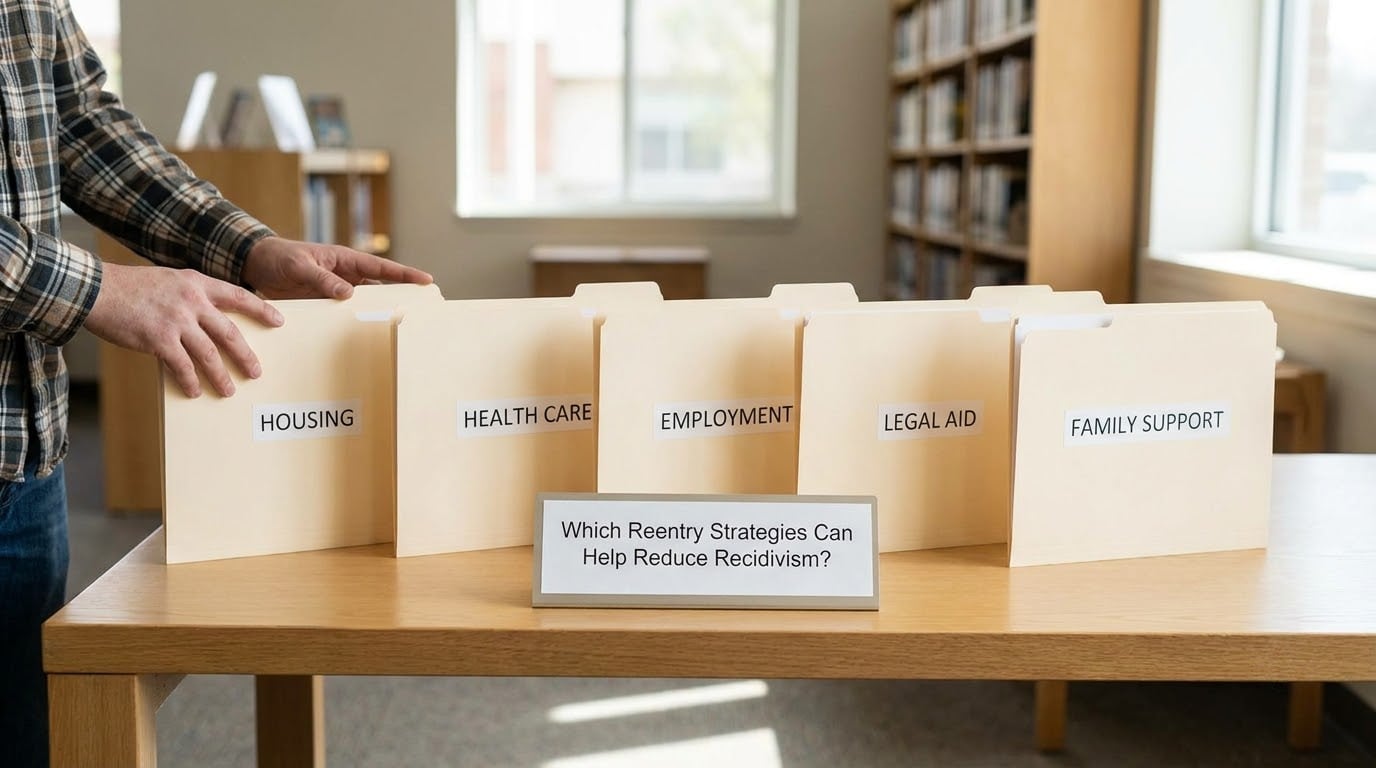
The approaches with the most consistent support share one feature: they address a need directly, early, and for long enough to hold.
- Stable housing, including subsidized and supportive housing. Housing programs produce the clearest practical shift because they remove the instability that cascades into everything else.
- Treatment access with a warm handoff. Continuing medication and therapy across the release date, with an actual appointment, beats a referral sheet every time.
- Quality legal representation at revocation hearings. A large share of technical-violation returns could be contested by someone who knows the rules.
- Skills and employment support, including credentials earned inside. Programs that produce a real certification rather than a certificate of attendance open doors that a resume cannot.
- Immediate cash assistance. Rent and transportation money in week one prevents the cascading failures that produce the return in month two.
- Family engagement and mentoring. A person who does not have to explain the situation from scratch every appointment is more likely to keep showing up.
- Graduated supervision. Fewer conditions, lower caseloads, and a real chance to earn back freedom reduce the number of returns caused by supervision itself.
Program outcome claims deserve scrutiny. A corrections-industry company reported that participants completing its Men of Valor program returned at under 10% against a national figure of 75%, which is the kind of number that should prompt a question about who was selected and who was counted rather than a conclusion. Forum readers consistently discount sources with a financial stake in corrections, and that instinct is reasonable.
How Can Communities Support Successful Reentry?
Most reentry plans fail in the boring middle, between release day and month three. What helps tends to be specific and unglamorous.
- Families: an address that lasts longer than a month, help with a DMV appointment, and someone who answers the phone. Practical help beats advice.
- Employers: describing jobs in terms of task rather than title, and posting pay range, lets more people who are legally eligible actually apply.
- Educators and community colleges: treating a credential earned inside as transferable removes a barrier that costs nothing to fix on paper.
- Nonprofits and service groups: focusing on the months after the program ends, when most reentry support disappears.
- Local officials: restoring license reinstatement pathways, covering release medicaid, and funding case management are unglamorous items with direct returns.
The framing to avoid is that individuals are alone responsible for overcoming conditions built to defeat them. Agency matters and it is real. So is the fact that a supervised person cannot fix a housing shortage, a licensing board, or a county with no bus route.
Frequently Asked Questions
Does a high recidivism rate mean reentry programs do not work?
Not necessarily. A high rate can reflect measurement choices, technical violations counted as returns, and people released without housing or treatment rather than program failure. Programs that solve one barrier still get judged on all of them. The better read: look for programs with matched comparison groups and multi-year follow-up, and treat single-program success rates published by vendors with caution.
How is recidivism different from the criminal justice reentry rate?
Recidivism measures how many released people return to the system. The reentry rate is broader: it describes how many people are released each year, how many are under supervision, and how states deliver services during that period. One describes outcomes, the other describes the volume of people moving through the system and the support available to them.
What is the link between homelessness and recidivism?
Housing instability is one of the most consistent predictors of return, largely because it sabotages everything else. Without a fixed address, a person cannot hold steady work, receive mail, keep a treatment appointment, or satisfy a supervision requirement. Homelessness also concentrates people in areas with heavy police presence, which raises re-arrest independent of behavior.
Can probation or parole violations increase prison admissions?
Yes, and often more than new crimes do. Prison Policy Initiative, citing 2021 Council on State Governments data, reports about 29% of prison admissions in 2021 were returns for technical violations rather than new convictions. A missed reporting appointment, an address change, or a positive test can produce a prison sentence, and standards for what counts vary by state.
How much does race affect US recidivism rates?
Race is not a direct cause of offending, but it shapes exposure to enforcement and the legal consequences of a conviction. Re-arrest depends partly on where a person lives and police presence there, and collateral sanctions on housing, licenses, and benefits last longest for people who began with the fewest resources. Measured gaps partly track those systems rather than conduct.
What is the first step to lowering recidivism locally?
Find out how many people return locally and why, using your own state data rather than national headlines, and separate returns for new convictions from returns for technical violations. That single split usually reveals whether supervision policy or unmet basic needs is the bigger local lever. Then check whether release-day identification, coverage, and housing referrals actually connect to anything.
Conclusion
Why recidivism rates stay high is not one failure but an accumulation: housing that does not hold, work that a record blocks, treatment that ends at the gate, supervision that punishes a missed bus, and a statistical system that counts all of it as a return. Individual choices sit inside that accumulation, and so does the fact that the national return rate has fallen by roughly 23% since 2008 even as the old figures persist.
If you want to see movement, start with stable housing, treatment that survives the release date, supervision calibrated so it helps rather than trips people up, and reentry support that runs past the first thirty days. Those four are where the leverage is.