
A habit you have carried for years runs on cue-response memory, not on motivation, which is why willpower alone keeps failing you. To break a habit you have had for years, you map the real trigger and the need it serves, then change the cue, add friction, and install a replacement that delivers a comparable reward. Most people need months, not three weeks.
I have watched people white-knuckle through January and be back to square one by February. The pattern is so common it has its own name in the research: all-or-nothing thinking. Set the standard impossibly high, miss it once on a bad Thursday, and conclude the plan failed. Meanwhile the actual habit, the one that has quietly run your evenings for a decade, never got a plan at all.
Here is the part that changes the approach. A habit formed over years is not stored as a decision. It is stored as an association: this cue, in this context, means this response, and it ends in relief. Behavioral researchers call this habit memory, and Wendy Wood’s work on it is the clearest summary of why nagging yourself does almost nothing. When a behavior stops depending on conscious goals, goal-setting stops being the lever.
That is good news, actually. An association can be rebuilt. You do not have to erase the old one; you out-compete it, cue by cue, week by week, until the new response starts firing on its own. Here is how, in eight steps.
Table of Contents
- What You Need
- Step-by-Step
- Define the Habit Without Judging Yourself
- Map Your Triggers and Rewards
- Reduce the Cues That Start the Habit
- Build a Replacement for the Missing Need
- Start Small and Practice Consistently
- Adjust the Plan as Your Life Changes
- Prepare for Lapses Without Abandoning the Plan
- When a Long-Standing Habit May Need More Support
- How Common Years-Long Habits Break Down
- Common Mistakes
- Frequently Asked Questions
- How long does it take to break a habit you have had for years?
- Should I stop all at once or reduce a long-standing habit gradually?
- What if I lose motivation before the habit is gone?
- How do you deal with strong urges when the old habit is available?
- Can a lapse mean I have failed?
- When should I ask a healthcare professional for help changing a habit?
- Conclusion
What You Need
You need five things, and three of them cost nothing.
A habit record is the essential tool. For two weeks, note when the behavior happens, where it happens, what happened just before, and what you got out of it. A paper notebook works. A notes app works. What does not work is memory, because the version you remember is the version that flatters you.
You also need one replacement activity, chosen before you begin, not during a moment of craving. See step four for how to pick one that actually fits.
A tracking system can be as simple as a calendar you mark each day you hold the line. The point is the record of evidence, and a chain of marks you would rather not break.
Support is optional but powerful: a friend who knows your plan, a group, or a counselor. A small reward completes the kit. It should be something cheap and immediate, because a habit without a payoff loop tends not to survive contact with a hard week.One note on when to bring in professional help. If the behavior involves alcohol, drugs, gambling, food restriction or binge eating, compulsive spending, or self-harm, treat that as a clinical question from the start. A therapist, a physician, or a local support line can give you a plan built for that specific pattern, and none of the steps below will substitute for it.
Step-by-Step
Define the Habit Without Judging Yourself
Write the behavior down in terms someone else could observe and count. Not stop being stressed, but sits in the parked car for eleven minutes before going inside. Not eats badly, but finishes a sleeve of biscuits at 9pm while watching something.
Vague definitions are the reason most quit attempts fail. You cannot track what you have not described, and a habit described in moral language tends to produce moral reactions, which are exactly what you are trying to remove from the loop.
Include four details: when it happens, where it happens, how often, and what happens immediately before and after. The before-and-after pair matters most, because the thing that happens right after is usually the reward you are actually chasing.
Map Your Triggers and Rewards
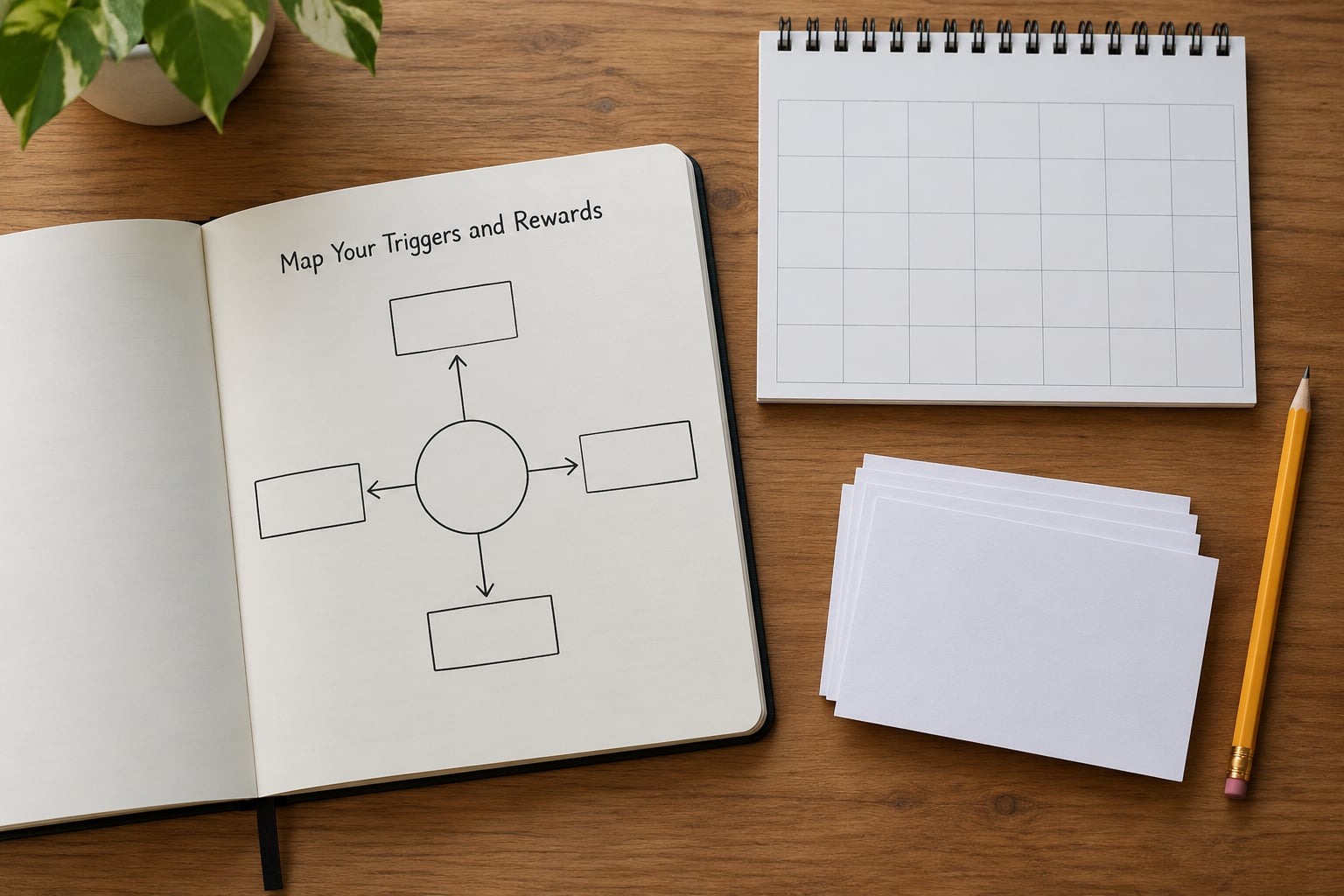
Every habit has a shape: cue, routine, reward. The cue is the signal your brain uses to start the clock. The routine is the behavior itself. The reward is what the behavior gave you, which is usually relief, distraction, connection, or energy rather than pleasure in any obvious sense.
Triggers come in four families. Emotional ones are boredom, dread, loneliness, irritation. Environmental ones are a specific chair, a time of night, a notification sound, a drive past a particular intersection. Social ones are the people you are with or the fact that everyone is doing it. Habitual ones are simply that it follows the previous action, like a chapter ending that turns into the next episode.
Look at your two-week record and mark the highest-risk situations. Not the easiest day. The hardest one. The Tuesday when the house is quiet and the meeting was bad and the phone is within arm’s reach. That specific combination is where you will win or lose the habit.
Then answer one question honestly: what does the habit give you that you are not getting elsewhere? Dr. Adi Jaffe calls the original discomfort a habit’s hook. Most long-standing habits are solutions to something real. The habit is not the problem. It is the problem’s clumsy solution.
Reduce the Cues That Start the Habit
Now change the environment rather than the willpower. This is the step that does the most work for the least effort, and it is the one people skip.
Take the cue away. Charge your phone in the kitchen instead of the bedroom. Move the snacks to a shelf you would have to stand up and walk to. Change your route so you no longer pass the shop that sells what you keep buying.
Make the old routine harder. A browser that requires a password before social media. A TV with a timer on the remote. Friction does not make you a better person; it just buys you the eight seconds where a choice becomes possible.
Change the timing or the location. Behaviors are welded to contexts. Behaviors that only ever happened on the couch can survive intact if you only ever happen on the couch, so start doing the thing you want to replace in a place the old response has no claim to.
Attack the bundle too. Long-standing habits rarely arrive alone: late scrolling stretches the evening, the stretched evening produces the wake-up alarm, the alarm produces the snooze. Changing one member of the cluster loosens the rest, which is why many people choose the easiest one to start.
Finally, use life transitions as free leverage. A move, a new job, a breakup, a new baby, a retirement, a recovery milestone. These break the context cues that hold habits in place. If you have one coming, this is the cheapest window you will get.
Build a Replacement for the Missing Need
Elimination without replacement is why most quit attempts collapse under stress. You removed the coping tool and left the coping need open. Something fills that gap within days, often something worse.
So find out what the habit was doing for you, and pick a substitute that does roughly the same job. If the reward was relief from anxiety, a ten-minute walk, a few slow breaths, or writing one paragraph about the worry can carry some of that load. If the reward was connection, the replacement has to involve people. If it was stimulation, standing up and doing twenty push-ups gives you a hit of something physical. If it was rest, the honest answer might be that you need real rest, not a substitute for it.
Make the replacement easy to start. Effortful alternatives fail precisely when they are needed, which is at 11pm on a bad day. Put the book on the pillow, the shoes by the door, the charger in the kitchen. The replacement should cost less than five seconds of decision-making.
This is the piece that habit reversal training, a well-studied behavioral approach, is built on: awareness training, a competing response, relaxation practice, and reinforcement. In plain terms, notice the urge, do something incompatible instead, settle your body, and give yourself a reason to keep going.
Start Small and Practice Consistently
Pick one achievable first action and repeat it. Ten minutes of walking. One episode instead of four. One honest paragraph in a journal. If you cannot name an action you could do on your worst day this week, it is too big.
Practice for a defined stretch rather than aiming at a vibe. Most behavioral approaches use a set number of repetitions, because repetition is what builds the association. Expect to feel vaguely wrong for a few weeks. That discomfort is not a sign that you are failing; it is the shape of an old path going quiet.
Track it. Self-monitoring is the least glamorous and most useful part of the whole process, because the data tells you which situations support change and which ones you are still losing. People who log tend to keep going after a bad week; people who rely on memory tend to quit.
On the timeline, retire the 21-day rule. That number came from a study of people forming new habits, not unlearning old ones, and it has been repeated past all usefulness. The widely cited automaticity research found a median of around 66 days to automaticity for a new behavior, with a range stretching to months. For habits you have run for a decade, expect the old response to keep resurfacing for months after the new one starts feeling easier. Progress is uneven, and it is not a straight line.
Adjust the Plan as Your Life Changes
Once a week, look at three things: which triggers came up, whether the replacement actually got used, and whether your environmental changes held. Then make one adjustment based on what you see.
If the replacement keeps failing at the same moment, the replacement is wrong, not you. Pick something smaller or better matched to the need. If a cue you thought you had removed keeps appearing, remove it further. If a good week happened, write down exactly what was different that week and try to repeat that one condition.
One change at a time. People who try to fix sleep, diet, screen time, and a drinking habit in the same month cannot tell which one helped or which one wore them out.
Prepare for Lapses Without Abandoning the Plan
With a habit this old, a lapse is not a surprise. It is a scheduled event. Build the recovery sequence before you need it.
First, name what happened without a verdict. One bad night is not a character flaw and it does not erase eight good ones. All-or-nothing thinking is the single biggest predictor of full relapse in this literature.
Second, find the trigger in the two minutes afterward. What was the emotion, who was there, what time was it, what had gone wrong that day? Write it down.
Third, notice that the old response felt good, and that is precisely why it survived a decade. It is not evidence that your plan failed.
Fourth, get back to the next scheduled instance. Not tomorrow, not Monday. The next one. People in r/productivity describe catching themselves mid-habit and switching to the new behavior as the highest-leverage move there is, because it breaks the automaticity that would otherwise have carried them the rest of the way.
Fifth, if lapses start clustering around specific stressors, treat the stress as the target. Job insecurity, a sick parent, discrimination at work, money pressure, a home that does not feel safe. A habit that carries you through a hard stretch is doing its job. Working out what it is holding up, and building something more durable in that spot, is a longer project than quitting.
When a Long-Standing Habit May Need More Support
Some patterns are not habits in the everyday sense, and no amount of environmental design will be enough. Watch for escalating amounts of the behavior, difficulty stopping even when you want to, using it to feel physically ill or emotionally numb, hiding it, or continuing despite clear harm to relationships, work, or health. Compulsive skin picking, hair pulling, gambling, and disordered eating all sit in this territory.
Talk to a doctor or a mental health professional if any of that sounds familiar. There is no shame in it, and it is a request for a different tool rather than a verdict on your character. If you are in immediate danger or thinking about harming yourself, contact emergency services or a crisis line in your area right away.
How Common Years-Long Habits Break Down
This table maps four habits people often carry for decades to their cue, the need underneath, a replacement that fits, and one friction tactic. It is a starting point for your own record, not a template to follow exactly.
| Habit | Typical cue | Underlying need | Replacement | Friction tactic |
|---|---|---|---|---|
| Late-night scrolling | Bed, lights off, phone in hand | Transition relief and quiet | Ten minutes of reading, or a phone parked outside the bedroom | Charge the phone in the kitchen |
| Emotional eating | Stress, end of a work day | Comfort and a feeling of being cared for | Shower, a call with a friend, a small prepared meal | Keep the biscuits out of the house for two weeks |
| Nail biting | Boredom, waiting, watching TV | Self-soothing under low-grade tension | Clipping a piece of paper, keeping hands busy on a commute | Bad-tasting nail polish, short nails for a month |
| Hitting snooze | Alarm, staying in bed | Avoidance of the day’s first demand | Phone across the room, shower immediately | Alarm across the room, volume up |
| Overwork | Deadline pressure, evenings | Worth and control | Scheduled non-work hours with a hard stop | Close the laptop at a set time |
Two patterns in the table are worth pulling out. First, most of these cues are physical rather than emotional, which means the fix is a physical change. Second, the needs are not trivial. Nobody learned to bite their nails because they wanted an annoying habit; it was once a reliable way to soothe something.
Common Mistakes
Setting an all-or-nothing standard. The rule is: any slip invalidates everything, therefore quit entirely. The correction is a floor rather than a ceiling. Not a single cigarette in a week instead of none. A ceiling of perfection produces a floor of zero, and zero is where people live after a bad week.
Describing the habit in moral terms. Calling yourself lazy, weak, or undisciplined turns a behavioral pattern into an identity, and identity-level shame is one of the strongest triggers for relapse. Describe the behavior and its triggers instead. You can be honest about what is happening without turning it into a verdict on who you are.
Changing everything at once. The diet, the sleep, the screens, the drinking, the discipline. This burns out within a fortnight, and when it collapses you have learned nothing. People in r/getdisciplined consistently argue the opposite: sequence change across months, one habit at a time, and treat the rest as not currently in scope.
Relying on motivation. Motivation is a weather pattern, not a structure. It was not what kept the old habit running for a decade, and it will not carry the new one. Environment design is what runs on a day when you feel flat, which is most days.
Ignoring the trigger map. Going straight to replacement without working out what triggered the behavior produces a plan that works in calm conditions and collapses under stress. The two hardest situations in your record are where the plan has to hold, so they are where you design it.
Picking a replacement that does not meet the need. Telling a stressed person to relax is not a plan. If the reward was connection, a breathing exercise will not replace a phone call with a friend, and you should not pretend otherwise. Match the replacement to the function.
Deleting old routines without replacing them. Remove the cue, yes. But leave a gap and the gap fills, often faster than the original behavior did.
Treating one lapse as proof the method failed. A single occurrence says almost nothing about a method’s long-term value. What matters is the direction of the trend over weeks.
A few persistence tips that do the quiet work. Track your record every single day, including bad ones, since gaps in the record become gaps in your commitment. Tell one person your plan so that someone notices. Keep the replacement embarrassingly small. Expect the first two weeks to be the hardest and the improvement to arrive gradually rather than as a switch.
And expect to succeed imperfectly, several times, before the change holds. That is the actual shape of breaking a habit you have had for years, and readers on r/lifehacks and r/selfimprovement describe it the same way: change the meat of the habit while keeping the trigger and the reward, and it tends to last longer than white-knuckling ever does.
Frequently Asked Questions
How long does it take to break a habit you have had for years?
Expect months, not weeks. The often-cited automaticity research found a median near 66 days for people forming new habits from scratch, which does not describe decades-old behaviors. For a habit you have run for ten years, old responses keep surfacing for months after the new one starts feeling easier, and cue strength, how much the habit does for you, and the support around you all change the number.
Should I stop all at once or reduce a long-standing habit gradually?
Reduce gradually when the habit carries real function, such as stress relief or social belonging, because sudden removal leaves the need unfilled and something else fills the gap. Stopping abruptly makes more sense for habits that add little, like a mindless scrolling habit or a snack you eat standing at the counter. Either way, remove the cue and install a replacement from day one.
What if I lose motivation before the habit is gone?
That is the normal condition, not a sign the plan is failing. Motivation was never what sustained the old habit either. Keep the plan in the environment instead: phone charged elsewhere, replacement item ready, record visible. Motivation tends to return after a few weeks of consistent behavior, not before it, so build for the flat stretch rather than waiting for the feeling.
How do you deal with strong urges when the old habit is available?
An urge typically peaks and falls within minutes rather than growing without limit. Let it rise, name it out loud, and use a competing response that your hands and body cannot do at the same time, such as leaving the room or doing twenty push-ups. Removing access matters more: if the habit is available in that moment, you are making the fight harder than it needs to be.
Can a lapse mean I have failed?
No. A lapse is one episode; a relapse is a return to the old pattern. With a habit that has run for years, lapses are near-certain and are not evidence the method is wrong. What matters is how fast you return. Write down what triggered it, notice what the reward was, and get back at the next scheduled instance rather than waiting for a Monday or a fresh month.
When should I ask a healthcare professional for help changing a habit?
Reach out when the behavior is escalating, when you cannot stop even though you want to, when it causes physical or emotional harm, or when it involves alcohol, drugs, gambling, food restriction or binge eating, compulsive spending, or self-injury. A doctor or therapist can build a plan for that pattern and refer you to specialist support. If you are in immediate danger, contact emergency services or a crisis line in your area.
Conclusion
Breaking a long-standing habit is a repeatable process, not a test of character: map the cue, name the need, change the environment, install a replacement, track it, review it weekly, and return quickly after lapses. Months is the realistic unit of measurement for a habit carried for years, and progress that wobbles is still progress.
Start with three things this week. Write down one week of when, where, and what just before, so you can see the real trigger instead of the one you assume. Pick your single hardest situation and remove the cue from reach there. Choose one replacement small enough to begin on your worst day, and put the calendar out tonight.
None of this is a test you can fail permanently. If it is on your list for 2026, it is a pattern that was learned, and learned patterns can be unlearned, slowly and without shame.