To build a habit that sticks, you need a small action attached to a cue you already hit every day, a reward you actually enjoy, and a plan for the day you miss. Skip the 21-day rule: in a 2010 study, the median time it took people to reach automaticity was 66 days, and the slowest took over eight months.
That is the part almost every habit article gets wrong. The 21-day figure came from a surgical recovery observation, not from habit research, and it quietly sets people up to abandon something that was working fine. By day 21 most people are still building, not done.
What follows is the system I use and the one that keeps showing up in the places where people actually talk about this, from r/Habits threads to r/productivity. It is not a productivity system. It is a way to make one behavior reliable enough that it stops needing a daily decision from you.
Table of Contents
- What You Need
- Step-by-Step: How to Build a Habit That Sticks
- Step 1: Define one repeatable action
- Step 2: Start small enough that you cannot fail
- Step 3: Use triggers and cues
- Step 4: Design your environment
- Step 5: Make the reward immediate
- Step 6: Never miss twice
- Step 7: Track it, then review the system
- Common Mistakes
- Habits to start with if you are new
- When the plan has to bend
- Frequently Asked Questions
- How long does it take to build a habit that sticks?
- What is the smallest effective way to start a new habit?
- How do I restart after missing several days?
- Is motivation necessary to maintain a habit?
- How do I know if my new habit is too difficult?
- Can I build more than one habit at the same time?
- Start With One Repeatable Action
What You Need

Five things, and you probably own all of them already.
One specific behavior. Not a goal. A goal says “get healthier this year,” and you can hit it for one good week in June and never think about it again. A behavior says “walk for ten minutes after lunch.” If you cannot write the habit as a thing you do, you do not have a habit yet.
A starting point small enough to embarrass you. Read one page. Floss one tooth. Put your clothes in the hamper. On r/Habits and r/selfimprovement, the advice that gets repeated most is almost insultingly small, and that is exactly why it works. You are not choosing the size you wish you could work at. You are choosing the size you will actually do on a Tuesday when you are tired.
A cue that already exists. Every habit needs a door to walk through. Breakfast, brushing your teeth, closing the laptop, the kettle clicking off, sitting down in the car. You already do these a dozen times a week, and they cost no willpower at all.
One tracking method. Paper calendar, index card, or an app. Pick one. A pen on a wall calendar that hangs where you will see it beats a sophisticated app you check once a week.
A decided response to missed days. Decide now, while you are calm, what happens the first time you skip. This one decision is the difference between a bad day and a broken streak.
Step-by-Step: How to Build a Habit That Sticks
Step 1: Define one repeatable action
Write the habit as a sentence with a verb, a time, and a place. “Read one page of my book” beats “read more.” “Floss before brushing at night” beats “take better care of my teeth.”
The version that works is the one you could do on your worst night of the year. You are describing day one, not day ninety, and you can grow later. When you know how to build a habit that sticks, this definition is where you start, because everything after it depends on it being repeatable rather than impressive.
How you know it worked: someone else could read it and know what you did. If it needs interpretation, it is not written yet.
Step 2: Start small enough that you cannot fail
Set the bar so low that skipping requires more effort than doing it. Two minutes of stretching. One glass of water with breakfast. One email to the person you have been meaning to answer.
This is not a warm-up phase to move past in week two. For a lot of habits, two minutes forever is genuinely enough. For reading, one page often turns into twenty without any plan from you.
How you know it worked: you have done it five days in a row without needing a decision.
Step 3: Use triggers and cues
Anchor the new habit to something you already do, using the formula people in r/productivity keep independently rediscovering: after I [current habit], I will [new habit].
The anchor has to be specific and stable. “After I wake up” is too loose, because waking up covers a range of mornings. “After I pour my first coffee, I will take my vitamins” is tight. Squats while the coffee brews works because the kettle gives you a three-minute window you were going to spend staring at your phone anyway.
How you know it worked: several days pass and you did the habit without once thinking about doing it.
Step 4: Design your environment
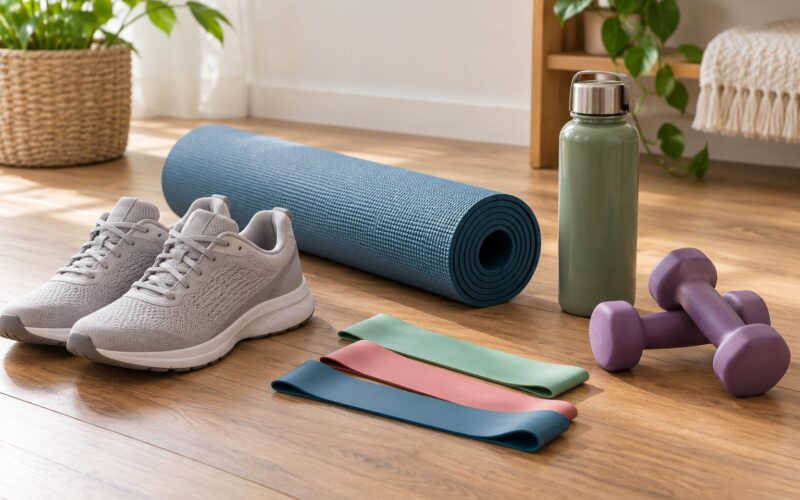
Most of what people call willpower is actually a room arranged against them. Put the book on the pillow so it is the obvious thing at bedtime. Leave the running shoes by the door. Move the phone charger to the kitchen so the phone is not in the bedroom.
For a habit you want to reduce, the same logic runs in reverse: make the cue invisible and make the alternative effortful. Charles Duhigg’s habit loop in The Power of Habit describes this as cue, craving, response, reward, and Nir Eyal’s Hooked gave the design side of it a name, habit stacking. James Clear’s four laws in Atomic Habits compress it further: make it obvious, attractive, easy, satisfying.
How you know it worked: you stopped having to rearrange the room each morning.
Step 5: Make the reward immediate
Long-term benefits do not reinforce habits. The reward has to arrive within minutes, or the loop never closes.
Pair the walk with a podcast you only listen to while walking. Pair the reading with the good chair and tea. Pair the tidying with the end of something you were dreading. This is how to build a habit that sticks on a long timeline: the habit is not carrying the reward by itself, you are bolting one onto it.
How you know it worked: you notice a small lift when you do it, before you have any result to show.
Step 6: Never miss twice
Missing once is a lapse. Missing twice in a row is how a former habit becomes a former life. The rule is simple and it is the most useful thing in this article: you may miss a day, you may not miss two.
People on r/getdisciplined describe the all-or-nothing trap precisely. Skip once and it feels like evidence that you are the kind of person who does not do this, and the second skip confirms the story. The counter is to make the recovery smaller than the skip would have been. Do the one-page version. Do two minutes. Do it badly.
How you know it worked: a missed day produces a plan, not a verdict.
Step 7: Track it, then review the system
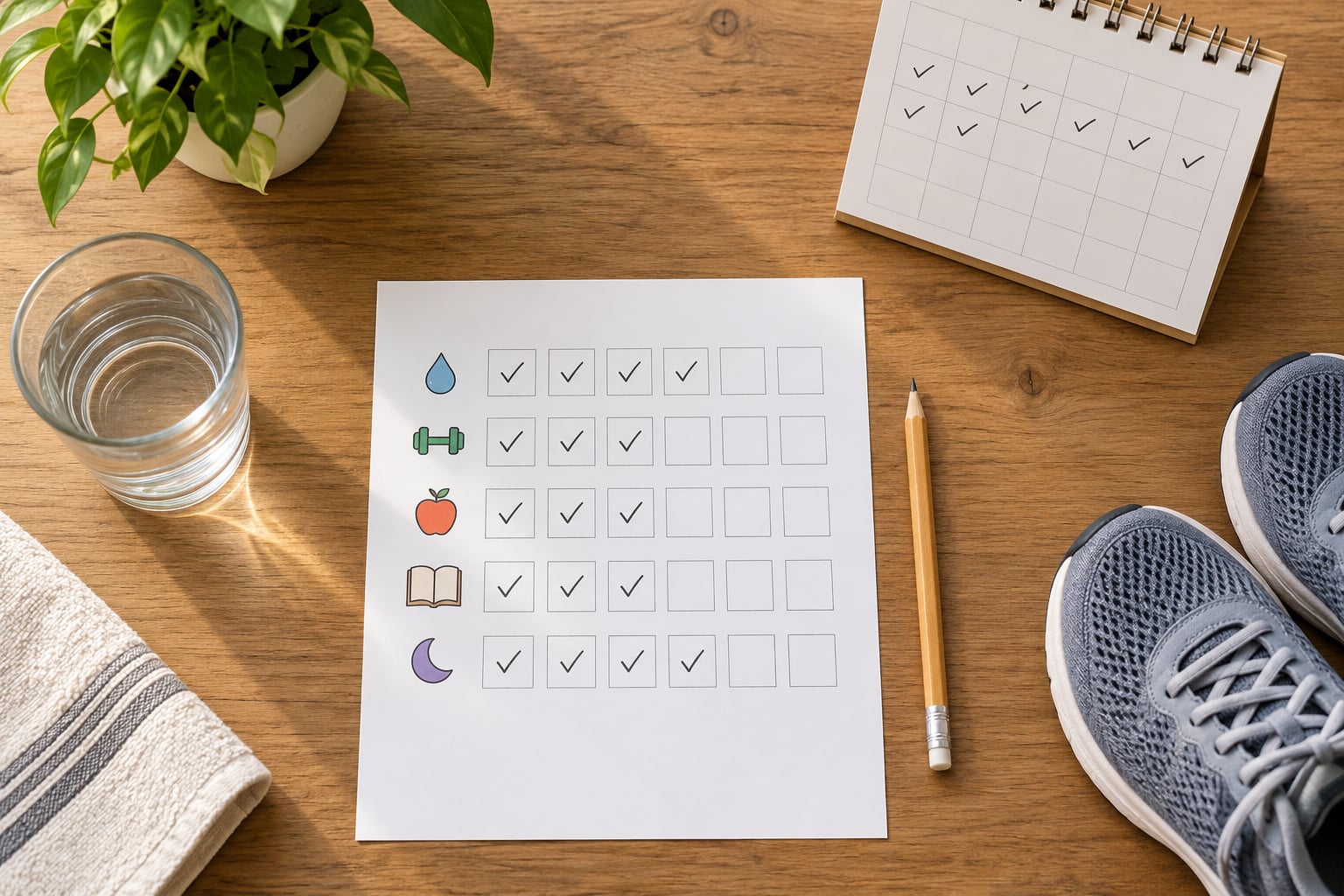
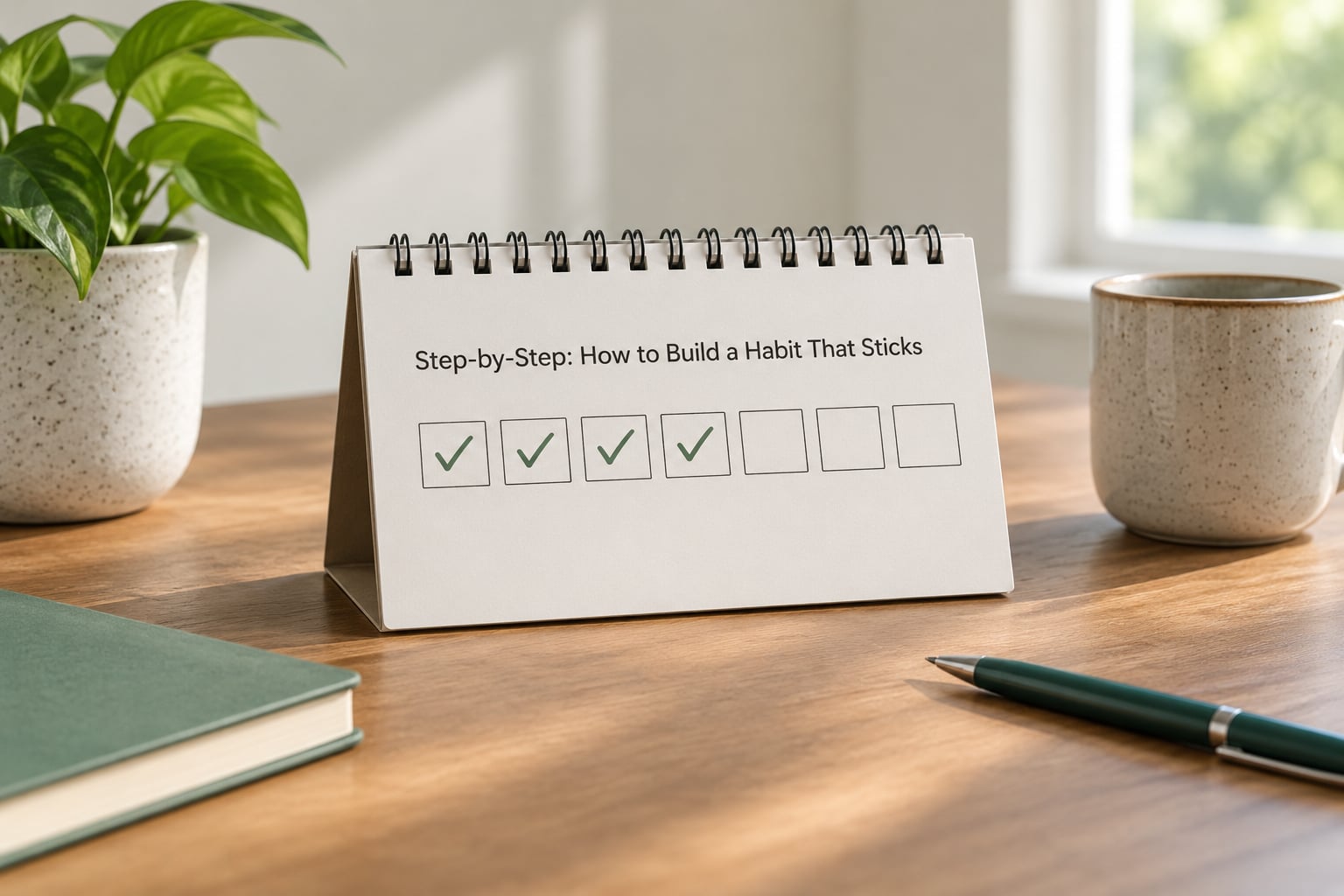
Mark the calendar each time you do it. Seeing a row of marks is more persuasive than any argument you could make with yourself, and the row is the whole reward for the first month.
Then review every two weeks. If you are missing more than you expect, the habit is too large, not too weak. Shrink it. Tracking is a diagnostic tool, and once the routine is stable you can stop counting without losing the habit.
How you know it worked: you can predict your own behavior and occasionally surprise yourself in the right direction.
Common Mistakes
Most habits do not fail because you lacked discipline. They fail for a short list of structural reasons that are worth diagnosing, because each one has a fix.
- Starting too big. Thirty minutes on day one is a plan, not a habit. Fix: cut the size in half, then half again.
- Treating a goal as a habit. “Lose weight,” “save more,” “get fit” describe outcomes you cannot check off daily. Fix: name the physical action underneath.
- Waiting for motivation. Motivation is a feeling that arrives before behavior, not a supply that behavior draws down. Fix: define a minimum version you do on low-energy days.
- Running on willpower. You already know what willpower feels like by day four. Fix: spend that effort on the room instead of the argument.
- The day three to five dip. Novelty wears off right about here and it feels like the habit has stopped working. It has not; the fun part is what was carrying it. Fix: expect the dip and pre-plan the smallest version for it.
- Stacking onto an unstable anchor. If you attach the new habit to something you already miss regularly, the new habit inherits those misses. Fix: pick an anchor that happens every single day.
- Adopting five habits at once. You cannot tell which change caused the exhaustion. Fix: one habit until it is boring, then the next.
- Quitting on the first miss. This is the big one. Fix: never miss twice, and treat the rest of the day as the recovery.
- Judging yourself by the streak instead of the trend. Fix: count over the month, not the day.
Habits to start with if you are new
Pick something with a built-in reward and almost no setup: drink a glass of water with each meal, wash your bowl right after eating, hang clothes in the hamper instead of the chair, say one thing you appreciate out loud. These are so small that skipping them costs more than doing them.
When the plan has to bend
Shift work, caregiving, chronic illness, a new baby, a bad stretch of depression, a job change. Most habit advice is written for a person with an unbroken week and it quietly assumes that the reader has slack in the day, and a lot of people do not. If your week is genuinely unpredictable, anchor to the cue that survives the disruption rather than the one that gives the most impressive version of the habit.
If a habit is tangled up with mental health, eating, alcohol, nicotine, or medication, talk to a doctor, therapist, or pharmacist before you build a plan around it. That is not a failure of self-reliance. Habit change is not a moral test, and the same week can be a bad week rather than a bad person.
Frequently Asked Questions
How long does it take to build a habit that sticks?
In the 2010 study by Lally and colleagues, which followed 96 people choosing one daily behavior, the median time to reach automaticity was 66 days, and individual results ranged from 18 to 254 days. So the familiar 21-day rule is at the very fast end of the observed range. Plan in months, not weeks, and expect simple behaviors to form faster than hard ones.
What is the smallest effective way to start a new habit?
Make it small enough that doing it on your worst day still feels possible: one page, one glass of water, two minutes of stretching, one tooth. The size is not a placeholder to grow out of. A version this small survives travel, illness, and bad weeks, and a habit you actually keep is worth more than an ambitious one you abandon in a fortnight.
How do I restart after missing several days?
Do not restart from zero. Put the action back at its smallest size today, and treat the missed stretch as information rather than failure. Ask whether the habit was too large or whether the cue disappeared with your schedule, then fix that specific thing. Coming back after a gap is normal and the loop still resumes, it just takes a few repetitions to re-tighten.
Is motivation necessary to maintain a habit?
Not once it is running. Motivation is useful for starting but it fades within a couple of weeks, and habits that depend on it tend to collapse in month three. What holds a habit up afterward is a stable cue, low friction, and a reward you still like. Decide in advance what your minimum version is for the days you feel nothing, and that version is what keeps the habit intact.
How do I know if my new habit is too difficult?
Look at the pattern rather than the feeling. If you skip more than twice in the first two weeks, or if you need real recovery time after doing it, the size is wrong. Halve it. A habit at the right size feels almost boring and leaves energy over for the rest of your life, while a habit that is too large quietly trains you to see the whole idea as a failure.
Can I build more than one habit at the same time?
You can, but most people are better off building one at a time. Two habits with separate cues is realistic, especially if one is already automatic. The trouble starts at three or four new things at once, because you lose the ability to tell which change is causing the tiredness and which one is actually working. Finish the first until it is unremarkable, then add the second.
Start With One Repeatable Action
Write down one action today. Shrink it until it feels too easy. Attach it to something you already do every day without thinking, and mark a calendar for two weeks.
Then adjust. When it is too hard, make it smaller. When it stops feeling like work, let it grow. Most of what people need in order to learn how to build a habit that sticks is not more discipline but a system that survives a bad week, and two weeks of marks is enough data to know whether yours does.