
Knowing how to help a child who is being bullied at school comes down to four things, in this order: listen without overreacting, write down what happened, report it through the school’s official process, and give your child concrete ways to stay safe. It takes a few calm hours spread across several days, not one big conversation, and the hardest part is staying steady while your child is upset. Reviewed October 2026.
Parents usually already know the right instinct. The instinct to march into the office, find the other child, or demand an immediate punishment is the one that most often makes things worse, because a child who thinks their parent will lose their temper stops telling them things.
This guide walks through the seven steps that hold up: what to gather before you call the school, how to write an incident log, what to ask for in writing, and what to do when the school says it will monitor the situation and nothing changes.
Table of Contents
- What You Need
- Step-by-Step
- 1. Listen without asking your child to prove the bullying
- 2. Help your child make a safety plan
- 3. Document what happened
- 4. How to report to the school when your child is being bullied
- 5. Ask for specific and proportionate action
- 6. Keep checking in after the school responds
- 7. Build support beyond the school
- Common Mistakes
- Frequently Asked Questions
- What should a parent do if their child does not want to talk about the bullying?
- How soon should I contact the school after my child reports bullying?
- Should I confront the child who is bullying my child?
- Can my child be suspended for fighting back against a bully?
- What if the school says it will monitor the situation, but nothing changes?
What You Need
Most parents start at the wrong end. They call the teacher first, get a polite voicemail, and only later discover the district has a form, a named coordinator and a timeline. Before your first conversation with the school, find these five things.
- The anti-bullying policy. Most districts publish one online. Look for the definition they use, because schools often handle physical, verbal and online bullying under different procedures.
- The designated contact. Districts name a coordinator, and nearly every school has a counselor, an assistant principal or a campus safety officer who is formally responsible for reports.
- The reporting channel. An online form, a district email address, a phone line, a mailbox. Find the one that produces a written record.
- Your child’s teacher and counselor. You need names, not just office hours.
- A private time and place at home. Not in the car on the way to practice, not over dinner with siblings in the room.
One thing to decide in advance: you are not going to investigate. You will not send your child to ask what the other kid meant, you will not quiz classmates, and you will not handle this alone.
Worth defining here, because most disagreements with a school come down to definitions. Bullying is unwanted aggressive behavior that is repeated and involves a real or perceived power imbalance. Two children arguing once with roughly equal power is conflict. Behavior that repeats, is one-sided and is reinforced by the group is bullying, and schools are required to respond to it under their policy.
Step-by-Step
1. Listen without asking your child to prove the bullying
Pick a calm time, not the moment they come home angry. Sit at the same level as them and let the story come out in pieces.
Ask neutral, open questions: what happened, where, who was there, what was said. Avoid the questions that shut a kid down. Why didn’t you tell me, why didn’t you fight back, and don’t you think this is silly all make the next disclosure harder.
Validate before you problem-solve. Saying that it makes sense to be angry here does more for trust than any plan you build afterwards. If your child is in immediate danger, has been physically injured, has been threatened with a weapon or reports sexual assault, treat it as an emergency and contact the school and local authorities right away rather than waiting for the paperwork.
2. Help your child make a safety plan
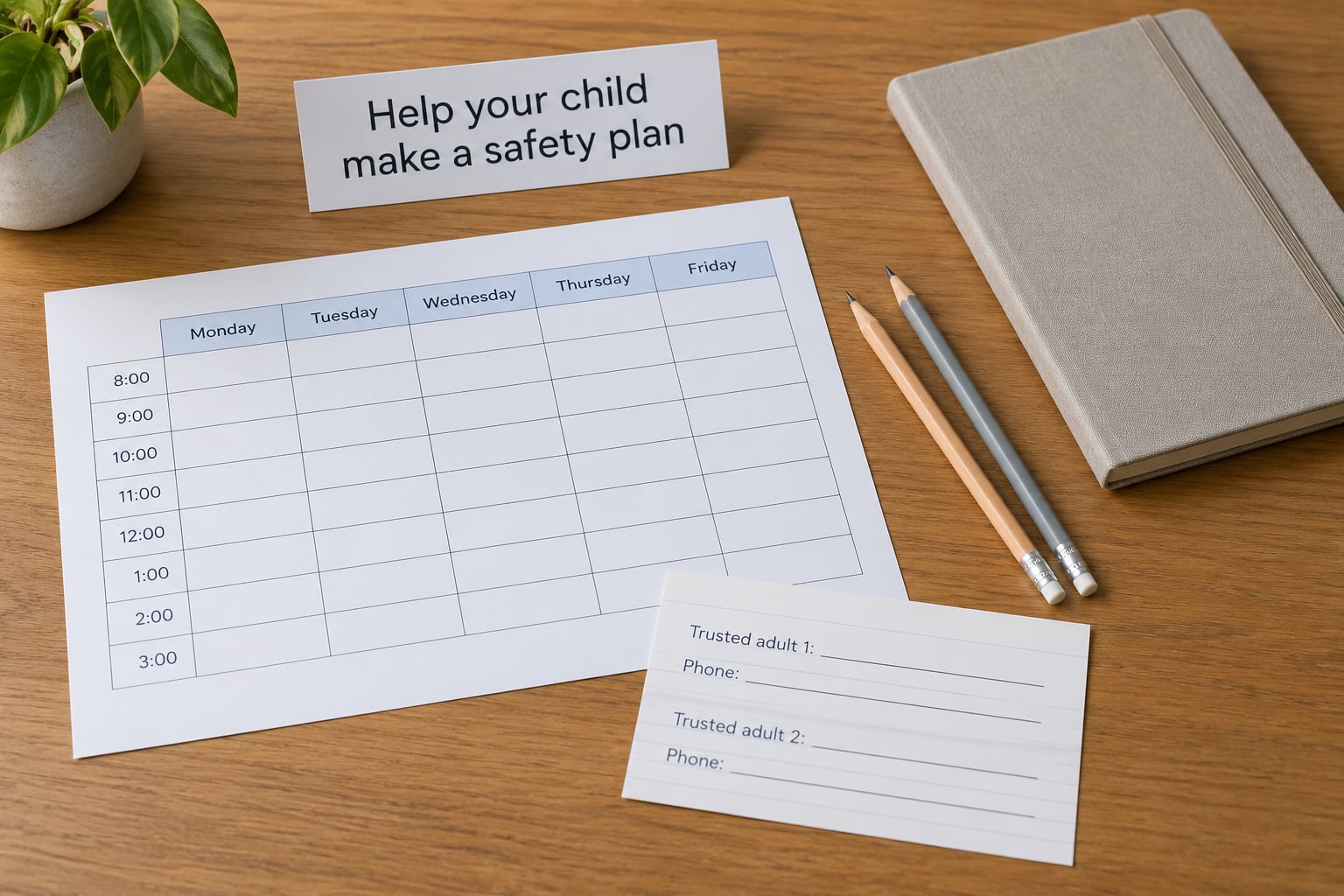
Turn the general worry into specifics. Together, write down where the bullying happens, at what times, who is involved, and what route or timing avoids it.
Name two or three adults at school who can act, not just one. A counselor is often more useful than the homeroom teacher, because the counselor hears about everything and has authority to change a schedule.
Pick one peer who is a friend rather than someone who will gossip. Agree on what your child does if no adult is around: go to a specific location like the office, the library or a bathroom with a stall at the end, and wait. A plan with a named destination is worth more than advice to walk away.
Put the trusted adult contact information somewhere your child carries it, and agree on the one sentence they will use with an adult: I need help, something is happening every day in the hall by the lockers.
3. Document what happened
Start an incident log the same week. Memory fills in gaps fast, and a log is what turns a conversation at the front office into a documented case.
Record these columns for each incident: date, time, location, what was said in direct quotes where you can recall it, who was present, what action was taken, who was notified, and how your child felt afterward. Note every time you reported it before and what response you received, including the date and the name of the person you spoke with.
Keep it factual. A log full of conclusions reads as a parent’s argument, while a log of dates, times and words reads as a record.
For online incidents, capture screenshots with timestamps, save the message thread, and note the platform and group name. Save them somewhere outside the device, since screenshots get lost with phones.
One caution: secretly recording conversations is illegal in some states even when you are a participant, so check your state’s law before relying on a phone in a pocket. Written notes taken during and after the conversation are always safe.
4. How to report to the school when your child is being bullied
Use the official channel rather than a hallway conversation. Send the report in writing by email or the district form, and ask for confirmation that it was received. A verbal report to a teacher creates no record you can point to later, which is the single most common reason parents feel stuck.
Keep the first report short and factual: who, what, where, when, what your child needs to feel safe at school. Attach the incident log. Avoid assigning motives or accusing named students of a pattern you have not documented.
Then ask three specific questions in the same message. Who is the person responsible for investigating this? Can I have a written record of the report and the response? When will we meet to review what happens next?
Parents on parenting forums describe one recurring pattern: they report to a teacher, the teacher tells the counselor, and nobody confirms anything happened. If you do not get a response within two school days, send the same report to the counselor and the principal at the same time.
5. Ask for specific and proportionate action
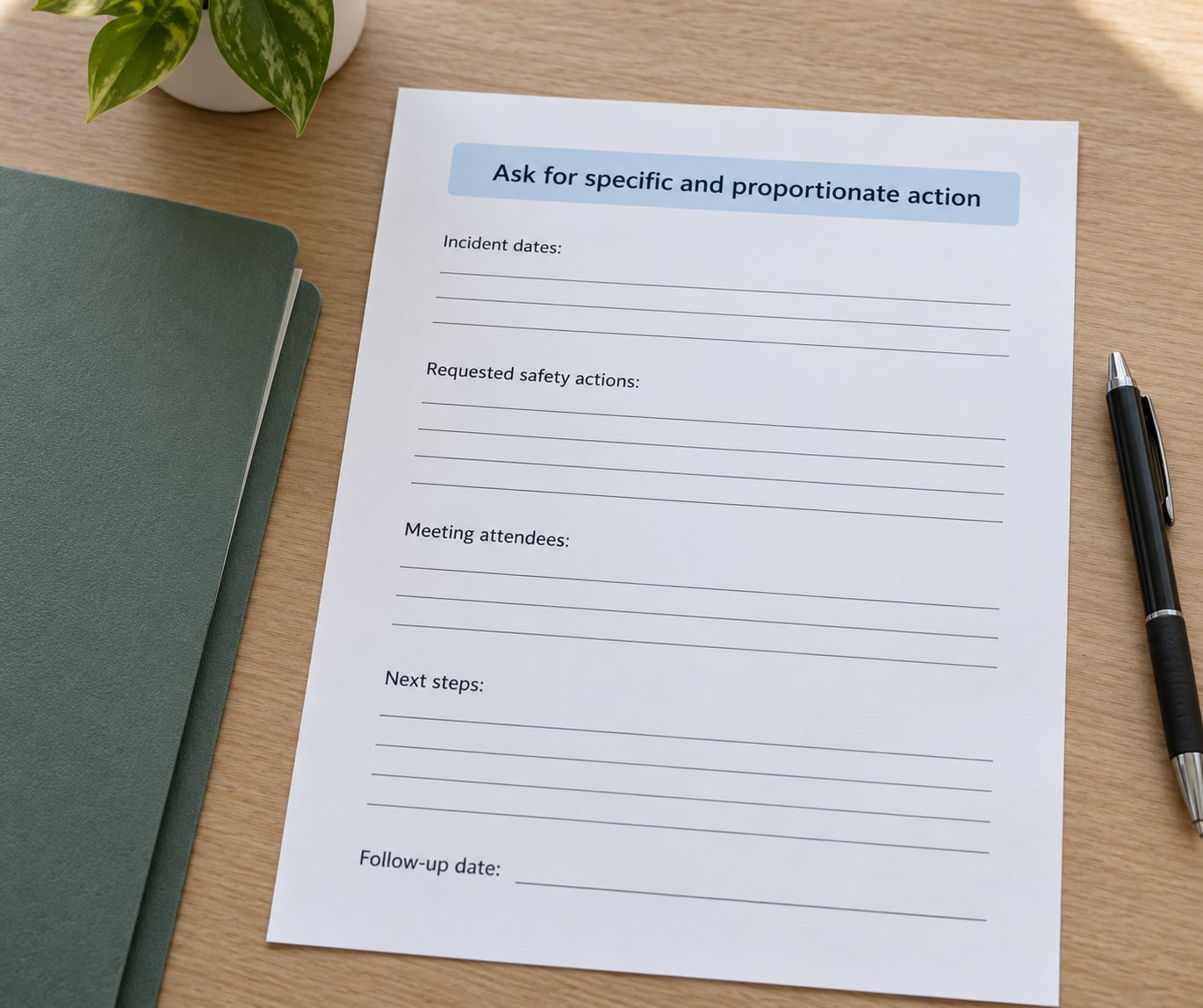
Ask for changes, not punishments. A request the school can actually implement looks like supervision in the hallway between classes, moving one student’s seat, adjusting arrival or departure routines, arranging a check-in with the counselor, and a scheduled follow-up meeting with a date on the calendar.
Framing matters. Schools are constrained by policy and by state law on discipline, and a request for a specific consequence often gets refused on those grounds while a safety request gets approved. Say what you want to prevent, not what you want to be punished.
Ask who will be responsible for each measure and how you will be told it is working. Put those answers in an email you keep.
Before the meeting, write down your requests so you deliver them cleanly instead of re-telling the whole story. Bring your child to age-appropriate parts of it. Being heard by an administrator is itself part of the repair.
6. Keep checking in after the school responds
Interventions fail quietly, so watch rather than assume. Ask short, specific questions daily for the first two weeks: how was the walk in, who did you sit with, what happened at the lockers.
Watch for changes in sleep, appetite, attendance, and physical complaints. Stomachaches and headaches that appear only on school mornings, dread at the door, dropping grades and withdrawal from activities a child used to love are all reasons to keep the school informed and to mention them to a pediatrician.
Also watch for retaliation, which is itself a policy violation. If your child is punished for something they did after an incident, say so in writing the same week and ask which policy was applied.
Set a review date before you leave the first meeting, and treat the meeting as the start of a two-week observation period rather than the finish line. Keep a short weekly note of what changed. When a measure is working, say so in writing too, so the school keeps it.
7. Build support beyond the school
Recovery happens outside school hours. Trusted family, a steady peer group and activities your child is genuinely good at all rebuild the self-image that bullying erodes.
Use the professionals who exist for this. The school counselor and school psychologist are free to families in most districts. A pediatrician can rule out what looks like anxiety but is a physical problem, and can point you onward if symptoms persist.
If your child keeps waking at night, refuses school repeatedly, has stopped eating with friends or says they would be better off not being around, that is a mental health concern, not a phase. Call your pediatrician, and in the US you or your child can reach the 988 Suicide and Crisis Lifeline by call or text.
For a child who is deaf, hard of hearing or who uses an interpreter or AAC device, ask the school in writing how reports get made accessible, and keep a record of any barrier your child hits reporting an incident.
Common Mistakes
Most unsuccessful responses are not unkind. They are the reactions almost every parent has at 7pm after hearing about an incident.
- Minimizing it. Kids who hear that it was probably just a joke learn to stop telling you. Try instead: I am glad you told me, and I am taking it seriously.
- Telling your child to fight back. A fight can end the bullying today and get your child suspended tomorrow under a zero-tolerance rule, which hands the other child leverage. Teach disengagement instead.
- Confronting the child who is bullying your child. Adults rarely see what actually happens in hallways and group chats, and an adult confrontation usually moves the behavior somewhere you cannot see it.
- Going to the other child’s parents first. For some families this works, but for many it produces a denial, a defensive counter-accusation and an escalation. Go through the school unless you already know that family well.
- Posting publicly about it. Naming the other child online spreads the story further and identifies your child as the one who reported.
- Sending your child to investigate. It puts them in the hallway with the person who is hurting them and makes them a tattler to their peers.
- Withdrawing your child from school. Staying away sometimes feels safer and often is not. Treat a transfer as a weighed decision after the school has had a documented chance to respond, not as the first move.
- Relying on one conversation. One meeting is a starting point. Bullying stops when the behavior is confronted repeatedly and by people with authority over the setting.
- Promising a specific outcome. You can promise that you will follow up, that you will write it down and that you will keep going. You cannot promise that a child will be suspended.
Three habits that make the rest easier. Keep one shared log so nothing depends on memory. Keep your communication factual and short, because long emotional emails get less read and record less. Follow up on a schedule you set yourself, since nobody else is going to remind you.
Frequently Asked Questions
What should a parent do if their child does not want to talk about the bullying?
Wait. Pushing produces nothing useful and teaches your child that telling you is uncomfortable. Name it gently instead: I can see something is going on, and I will not be mad. Write down what you have noticed on paper and leave it where they can read it. Many children talk sideways first, through a note, a text or a joke. Once you have a single detail, ask one low-pressure question about that detail and let the rest come later.
How soon should I contact the school after my child reports bullying?
The same day, in writing, for anything that happened that day. The school is required to have a reporting procedure, and a report filed while the memory and the details are fresh is far easier to act on. If your child was hurt or threatened, call instead of emailing. Then send the written report anyway, so there is a record. If you hear nothing back within two school days, resend it to the counselor and the principal.
Should I confront the child who is bullying my child?
No, not directly. Adults rarely see what happens in hallways, bathrooms or group chats, and an adult confrontation tends to push the behavior out of sight rather than stop it. The useful move is to give the school the documented pattern and ask for supervision changes. Going to the other child’s parents sometimes works, but only where you already know the family and can keep it factual. Otherwise it usually produces a denial and an escalation.
Can my child be suspended for fighting back against a bully?
Yes. Many schools apply zero-tolerance rules to fighting without asking who started it, so a child who defends themselves can lose the same number of days as the child who attacked. That is a common outcome, not a reason to accept it. Report the incident with the log showing the prior pattern, ask which policy was applied and request a review of the discipline. Teach your child that disengaging protects them, and do not punish at home for a response you did not approve.
What if the school says it will monitor the situation, but nothing changes?
Put monitoring in writing. Send a short email saying that you understand the plan, then state which observable things you will be watching over the next two weeks, such as no incidents at the lockers or a counselor check-in twice a week. If nothing changes, ask for the next rung in writing: counselor, principal, district office, then the school board or your state education agency. Parents who escalate this way get a response far more often than those who wait quietly.
Start with the next calm conversation. Ask one question about what happened, write down the date, time and place, and read your school’s anti-bullying policy that evening so you know the named contact before you send anything. That single report in writing, with a request for a specific safety measure and a follow-up date, is where most of this changes.