
An apology gets accepted when three things land clearly: what you did, that you understand how it landed, and what you will do differently. Learning how to apologize in a way people accept comes down to those three, not to how sorry you sound. Most apologies fail on wording, and the wording is fixable.
The pattern is consistent across relationship researchers and therapists. An effective apology names the specific behavior, owns it without a “but” or an “if,” acknowledges the effect on the other person, offers something concrete, and then asks for nothing in return. Aaron Lazare, the psychologist who wrote The Apology, put the first move bluntly: you cannot apologize for something you have not acknowledged out loud.
This guide walks through the six steps in order, the phrases that quietly cancel your apology, the words to use instead, and a short protocol for the moment they do not accept it. It takes about twenty minutes to read and the six steps take roughly ten minutes to say out loud. Last updated in 2026.
Table of Contents
- What You Need
- Step-by-Step: How to Apologize in a Way People Accept
- 1. Clarify What You Did and Why It Hurt
- 2. Accept Responsibility Without Excuses
- 3. Say It Clearly and Sincerely
- 4. Name the Impact Without Demanding Forgiveness
- 5. Offer a Specific Repair or Change
- 6. Give the Other Person Time and Follow Through
- Common Mistakes
- Frequently Asked Questions
- What if the other person does not accept my apology?
- Can I apologize if I did not intend to hurt someone?
- How do I apologize without sounding defensive or making excuses?
- Is saying sorry enough when I caused harm?
- How should I apologize in writing instead of in person?
- What if the harm happened at work or in public?
- Start With the Truth and Keep the Responsibility
What You Need
Before you speak, you need four things settled, and skipping any one of them is what turns a good intention into another failed apology.
The facts, in order. What did you actually do, who was affected, and what has changed since. If you are still reconstructing events, wait. Guessing at details in front of the person who lived them is worse than saying nothing for a day.
Whether an apology is the right move. Sometimes it is not. If the harm is still ongoing, or you have not decided whether you will change the behavior, apologize anyway and you will be describing a temporary condition as a permanent one. People can tell the difference between remorse and relief at having finished a hard conversation.
Timing. Apologizing within a few hours of a small mistake reads fine. Apologizing four seconds after a big one can read like defusing, because a person who is still flooded does not hear words clearly. Longer for serious harm, sooner for small harm, and never later than the next conversation you would have had anyway.
Privacy. Apologize privately unless the harm was public. If the mistake happened in front of other people, repair it in front of them, but keep the emotional content of the apology to a private conversation afterward.
Choosing the channel. In person for close relationships, because tone carries more than words. In writing when the distance is large, when the person needs to re-read it, or when a call would put pressure on them to respond immediately. A short letter people can read twice lands better than a rambling voice message they cannot escape.
The repair, roughly sized. You do not need the perfect amends before you speak, but you need a sense of what making it right looks like. If you have no idea, say so plainly and ask what would help rather than guessing.
Step-by-Step: How to Apologize in a Way People Accept
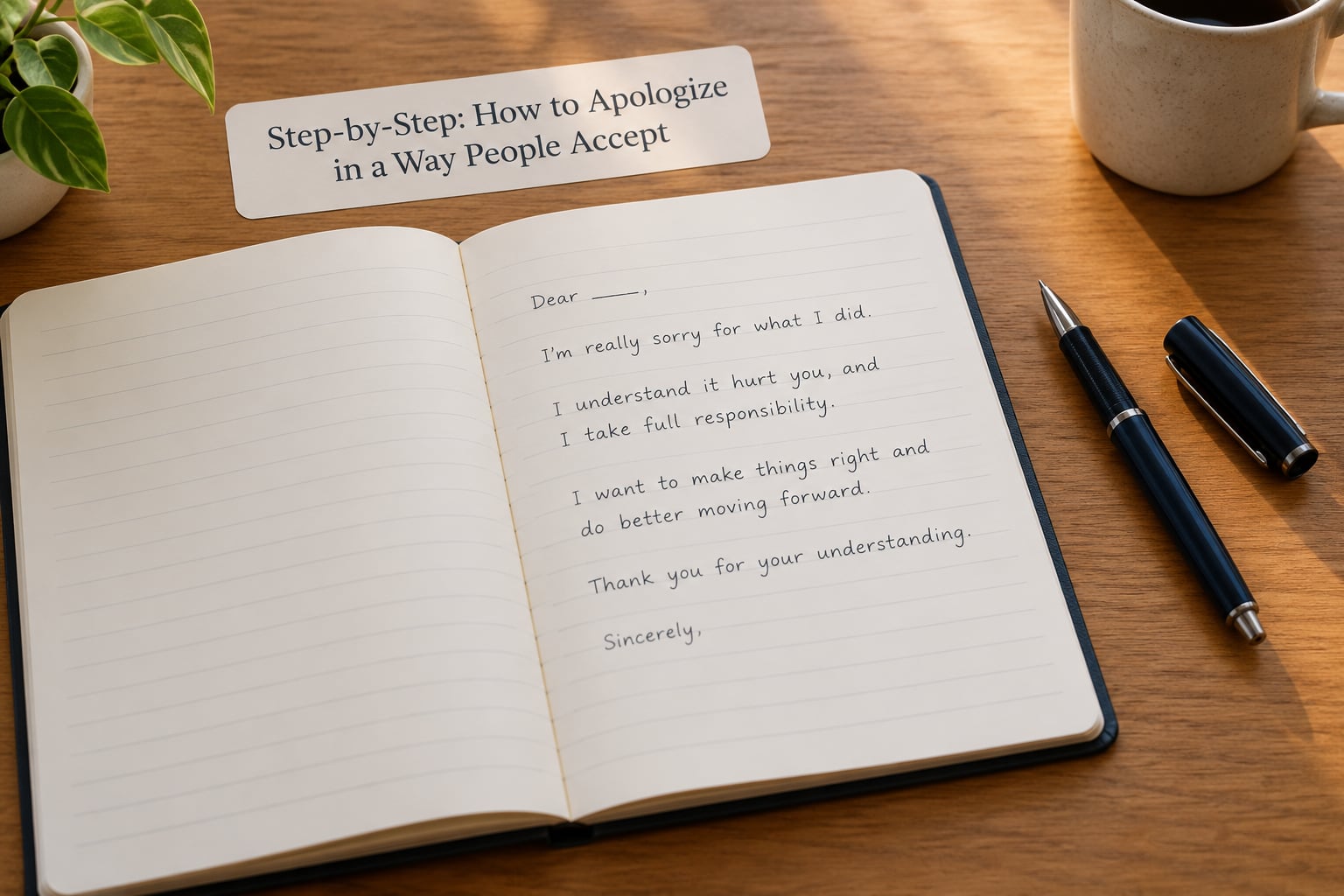
The six steps below are in the order that works, not the order that feels natural. Most people start at step four, ask for forgiveness too early, and wonder why it lands badly.
1. Clarify What You Did and Why It Hurt
Name the specific behavior, not the general category. “I am sorry for what happened with the money” is a category. “I took the cash from the community fund in March and said it had been misplaced” is a behavior, and only the second one lets the other person nod and say yes, that is what happened.
Context belongs after the acknowledgment, never before it. Leading with the background reads as a defense in disguise, because from the listener’s side, the context arrives as an explanation for why you should be forgiven sooner.
How to tell it is working: the other person responds to the facts rather than to your character. If they say “yes, that is what happened,” you have cleared the first hurdle. If they correct a detail, stay with the correction instead of arguing.
2. Accept Responsibility Without Excuses
Use unhedged language. “I hurt you,” “I was wrong,” “I decided that and it was a bad decision.” Researcher Jamie Schumann’s work on what makes apologies effective keeps responsibility at the center, and trust researcher Beth Polin’s five-part model, popularized in 2025 reporting on the topic, puts it first too: if you can only fit three parts into a short apology, responsibility is one of them.
Keep intent and effect separate. You may well have meant something kindly, and you still made a bad call. “I didn’t know it would upset you” invites the reply that not knowing never made it feel better. Responsibility means the outcome is yours regardless of the motive, which is a hard idea for people who consider good intentions a complete defense.
How to tell it is working: you say the words and your chest gets tight, which is usually the right sign. If you feel a strong pull to explain, wait ten seconds before you do. Most of the time the explanation is not needed, and it will be heard as one.
3. Say It Clearly and Sincerely
Keep it short enough to say calmly. Twenty to forty seconds of plain speech beats two minutes of prepared prose, because prepared speeches sound like speeches. A flat, fast delivery is what people describe as fake, so slow down and let the pauses sit.
A workable structure is four beats: the specific behavior, responsibility for it, the effect on them, and one sentence about what changes. That is the whole thing. Guy Winch, writing about the five ingredients of an effective apology, calls the acknowledgment of impact the most skipped and most important part, and it is the beat most people drop under pressure.
If you are practicing how to apologize in a way people accept, write it out once, cut every sentence that explains, and read it aloud to yourself before you deliver it. Anything you would be embarrassed to have the person read over your shoulder, remove.
How to tell it is working: you do not flinch at the silence afterward. Silence after an apology is normal processing time, not rejection, and treating it as rejection pushes you into filling it with nervous extra words.
4. Name the Impact Without Demanding Forgiveness

Say what you think it did to them, using their words if you have them. “I think telling you that at the party made you feel like an outsider in a room you had been coming to for years.” That sentence does more repair work than three paragraphs of remorse, because it proves you were paying attention.
Then hand control back. “You do not have to respond now, or ever, and I am not asking you to say it is okay.” Researchers who study apologies consistently report the same thing: when people apologize without implying a debt of forgiveness, acceptance tends to follow rather than stall. Asking to be forgiven outright often produces a polite yes that means nothing.
One 2023 survey of 2,025 US adults found that 73 percent had apologized at some point without meaning it, which tells you how well people can spot the performative version. Do not ask for reassurance in the same breath as the apology. If they comfort you, they are now doing your emotional work.
How to tell it is working: they are still talking to you. Anger is fine. A subject change is fine. What is not fine is being asked to reassure you, and if that happens, stop: “You do not need to make this easier for me.”
5. Offer a Specific Repair or Change
Move from words to something they can check later. Three kinds of amends work: direct repair, which replaces the damage, such as fixing the thing you broke or returning what you took; practical repair, which covers costs, such as paying a bill or covering a shift; and behavioral repair, a change in what you do, such as a different process or a conversation you will have this week.
Be careful with behavioral promises that are large and untestable. “I will always respect your boundaries” cannot be verified. “If a work thing comes up on a weekend, I will tell you by Thursday whether I am taking it” can. Dr. Polin’s model treats repair as the part that rebuilds trust, and trust is built on verifiable behavior, not sincerity.
In workplace situations, the repair often includes what you will do differently for the team, not just for the person you wronged. If the same thing could happen again to someone else, the apology that holds up includes the systemic fix.
How to tell it is working: the person can describe the change without you explaining it. If they cannot, the promise was too vague to count.
6. Give the Other Person Time and Follow Through
Then do the hard part, which is stopping. Send the apology and then leave them alone. Forum conversations about apologies keep landing on the same point: you are not guaranteed forgiveness, so treat the message as the end of your obligation and the beginning of theirs.
One follow-up is reasonable, sent weeks or months later rather than days, and it should be about the change rather than about acceptance. “The new process for picking up shifts is in place and I wanted you to know” lands. “Have you thought about what I said?” does not.
After the first follow-up, stop. People on advice forums describe repeated apologies as harassment, and they are not wrong. A second unanswered message turns an apology into a request, and a request has to be answered.
How to tell it is working: over months, small things stop being issues. That is what rebuilt trust looks like in practice, and it is slower than anyone wants.
Common Mistakes
These are the errors that come up again and again, in research and in the advice forums people actually read. Each one has a correction you can make in the next apology you give.
1. Saying sorry without being sorry. The word “sorry” has worn down from use. If the sentence would be identical no matter what you did, it is a noise, not an apology. Correct it by naming the actual behavior.
2. Explaining your intent. “I only said it because I was tired” hands the problem back to them. Intent is a separate conversation, and only when they ask for it.
3. Making it about the apology instead of the harm. Statements about how hard it was to say, or how much it is costing you, put your discomfort at the center of their hurt. Correct it by going back to what you did.
4. Over-apologizing. A constant reflexive sorry carries no information and can read as manipulation once people notice the pattern. Readers in the forums warn about this specifically. Apologize once, properly, for real things.
5. Accepting blame you did not earn. Taking responsibility for something you did not do is as dishonest as denying what you did, and it invites doubt about your judgment of the whole situation. Own your share plainly: “I said that, and it was wrong of me to say it, and here is the part of the decision I got wrong.”
6. Promising a fix you cannot deliver. “I will never do that again” is not a plan. Name the specific change that has a date attached to it, and keep the small version of that promise.
7. Following up too fast. A second message three days later reads as pressure. Give it time, send it once, and make it about the change.
The wording swaps below are the fastest fixes. Most apologies fail on phrasing, not on feeling.
| Phrase that backfires | What it signals | Say this instead |
|---|---|---|
| I’m sorry but I was really stressed | The harm is partly their fault for pressuring you | I said that and it was wrong of me to say it |
| I’m sorry you feel that way | Their reaction is the problem | That landed badly and I understand why |
| If I hurt you, I am sorry | You doubt whether you did | I know I hurt you |
| I apologize if you were offended | You are the one being oversensitive | I understand that comment was hurtful |
| Forgive me for making you feel abandoned | You are the one with the feeling problem | I left you alone that week and that was wrong |
| Can we put this behind us? | You want the conversation over, not the harm repaired | I am not asking you to move past it |
One more distinction worth keeping: remorse is feeling bad about what you did, repentance is deciding to stop doing it, and restitution is making it right where possible. People use all three words for the first one, and an apology with remorse but no repair tends to feel hollow.
Plenty of apologies are not apologies at all, though they are shaped like them. Watch for the version that puts the other person’s character on trial, the version that turns the apology into a compliment about your own growth, the version that is really a request for them to reassure you, and the version that arrives with an attached condition like “but only if you stop bringing it up.” Schumann’s list of defensive strategies names the mechanics: justify, excuse, minimize, blame, deny. Any one of them in your apology turns it back into a defense.
How to tell a real apology from a shaped one, if you are on the receiving end: it names something specific that only the person who did it would know, it does not require you to say anything, and nothing in it asks you to manage the apologizer’s feelings. Those three tests catch nearly everything.
Frequently Asked Questions
What if the other person does not accept my apology?
Accept it and stop. An apology is a statement of responsibility, not a transaction, and acceptance belongs entirely to the person who was hurt. Do not send a second message asking why, do not explain your feelings about it, and do not try again with a better version. Keep the change you promised, mention it once months later, and let their behavior over time tell you where things stand.
Can I apologize if I did not intend to hurt someone?
Yes. Intention and impact are separate things, and you can own the impact while still believing your intent was decent. Say what you did and what it did to them, and leave your motive out of it unless they raise it. The phrase to avoid is any version of if I hurt you, because that hands them the argument over whether they were hurt enough.
How do I apologize without sounding defensive or making excuses?
Use short declarative sentences and refuse every clause that explains. Write your apology down, then delete any sentence containing but, because, since, or honestly. What remains is usually enough. If the urge to explain gets strong while you are speaking, say instead: I would rather not explain it right now, I just want to be clear that I own it.
Is saying sorry enough when I caused harm?
No. Sorry on its own costs one sentence and asks nothing of the person. Add the specific behavior, one sentence on how it affected them, and one concrete thing you are changing. Research on repair work treats amends as the component that rebuilds trust, and a 2023 survey of 2,025 US adults found most people have apologized without meaning it, so the word alone is nearly worthless on its own.
How should I apologize in writing instead of in person?
Keep it short, plain and specific, and end by handing control back rather than asking for a reply. Written apologies suit long distance, situations where the person needs to re-read what you said, and moments when a call would pressure them to respond on your schedule. Read it once out loud first, delete every explanatory clause, and give them a realistic amount of time before following up.
What if the harm happened at work or in public?
Separate the two halves. Handle the public repair in public, briefly and without excuses, name the fix and the timeline, and then take the personal part of the apology to a private conversation. At work you can own your part fully while declining to accept blame for decisions other people made, and if there is an active process, a neutral route such as HR or a mediator often works better than a direct one.
Start With the Truth and Keep the Responsibility
Start by naming the actual thing you did, out loud, without a clause attached to it. Then acknowledge how it landed, offer one specific change you can be held to, and let the other person decide what happens next.
That is the whole method behind how to apologize in a way people accept. It takes far less courage than defending yourself and it works far more often, because it asks nothing from the person except the chance to be heard.