
To have a difficult conversation with a coworker, write down the specific behaviour, its impact on your work, and one clear request, then raise it privately with neutral language and agree on next steps. Most of these talks take about 20 minutes and go better than people expect, as long as you skip the accusations.
The reason these conversations get avoided is usually fear. People assume the worst outcome is a shouting match or a permanent rift, so they say nothing, and the problem quietly grows until it is bigger than the original issue. That avoidance is what keeps a conflict alive, not the conversation itself.
What follows is the full arc, from deciding whether to have the talk at all through to the written follow-up, with phrasing you can adapt. If you have been putting this off for a while, the most useful part is probably step three, the opening lines. Work through it in order and you will be ready in about half an hour of preparation time. Updated for October 2026.
Table of Contents
- What You Need to Have a Difficult Conversation With a Coworker
- Know when the conversation is not yours to have alone
- Decide whether you need the conversation at all
- Step-by-Step
- Step 1: Define the issue and decide what you want
- Step 2: Choose the right time, place, and format
- Step 3: Open the conversation without escalating it
- Step 4: Listen, clarify, and handle defensiveness
- Step 5: Set a boundary and agree on next steps
- Step 6: Close the conversation constructively
- Step 7: Document the discussion and follow up
- Common Mistakes
- Frequently Asked Questions
- What if I need to have a difficult conversation with a coworker I dislike?
- How can I have a difficult conversation with a coworker who interrupts me?
- What if my coworker becomes angry or emotional during the conversation?
- How do I have this conversation with a coworker I do not see regularly?
- When should I involve a manager or HR instead of talking to my coworker?
- What should I do if the problem continues after the conversation?
- Conclusion
What You Need to Have a Difficult Conversation With a Coworker
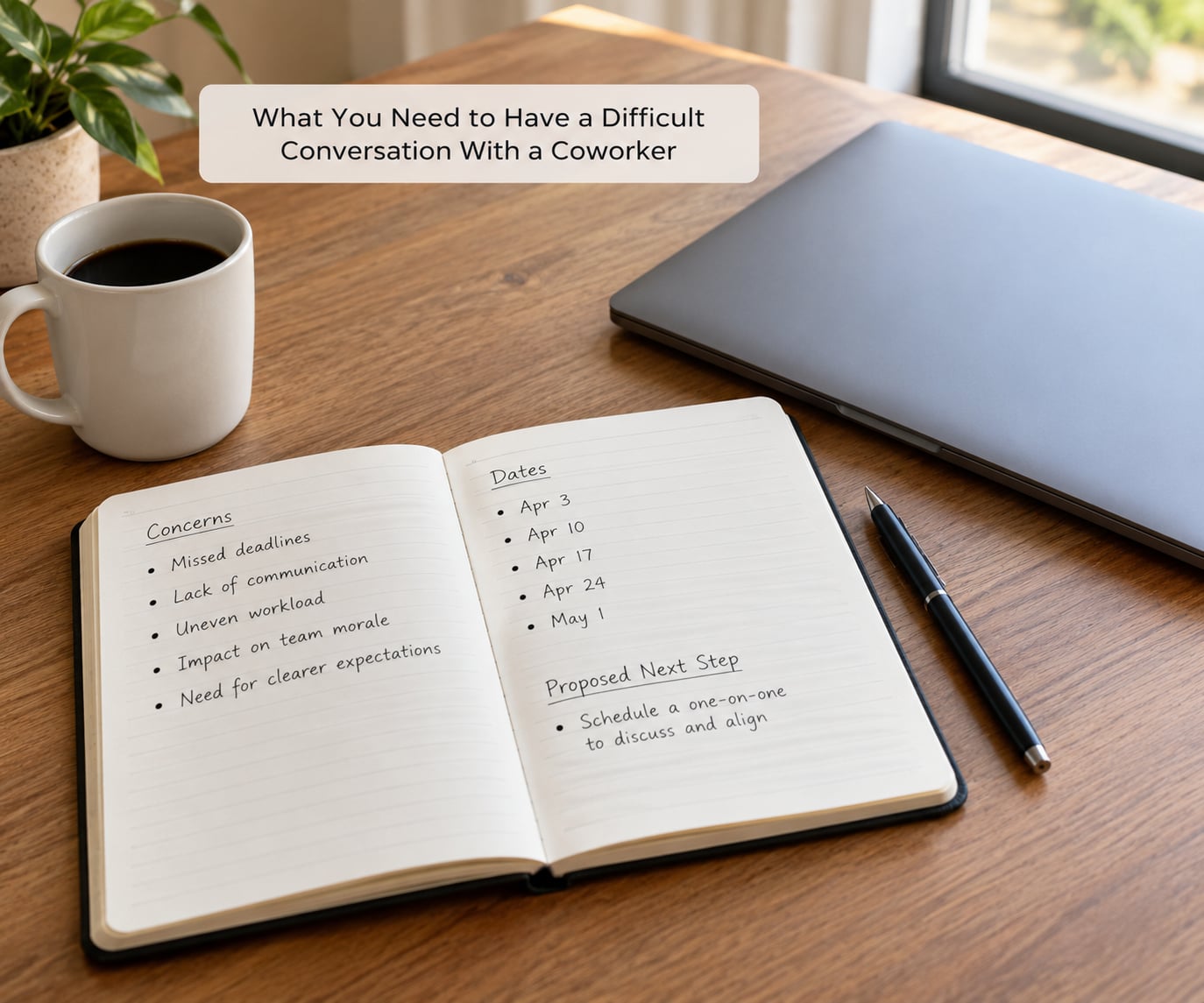
You need four things before you speak: one specific behaviour, one example you can date and describe, a clear request, and about half an hour of uninterrupted time in a place where you can both talk without being overheard.
Here is the pre-conversation checklist:
- One specific behaviour. Not “you are difficult to work with” but “three of the last four Tuesday stand-ups ran past the time we set and cut into my update.”
- A dated example or two. Your memory of an event is worse than you think. Write down what happened while it is fresh, and keep it neutral, like a note to a stranger.
- One request, maybe two. Know what a good outcome looks like. “Kickoff notes in the shared doc by 4pm” beats “be more communicative.”
- Enough time to finish. Fifteen minutes is the floor. Thirty is better. Rushed conversations create more mess than they fix.
- A private setting. A small room, a walk outside, or a video call with cameras on. Not a hallway, not a group Slack channel, not a public email reply.
Before you walk in, spend five minutes on your own assumptions. Write down what you think their motivation is, then put a question mark on it. “He does not respect my time” is a story you have told yourself. “He has interrupted me on four calls this month” is a fact, and facts are the only thing worth saying out loud.
Know when the conversation is not yours to have alone
Some problems are not ordinary peer friction and should not be handled in a one-to-one conversation between you and your coworker. Harassment, discrimination, retaliation for raising a concern, threats or intimidation, and any safety risk all belong with a manager, an HR representative, or your company’s formal reporting channel rather than in a private chat with the person involved.
Retaliation is the part people most often miss. If someone has already complained about the behaviour to HR or to management, or if you are being treated differently after raising a concern yourself, that is a retaliation risk and you should go straight to HR or a manager rather than arranging a talk with the coworker.
A second signal: if your manager already knows about the problem and has done nothing, the conversation has already happened at the level it should have. Repeating it with your coworker is not persistence, it is escalation without a paper trail. Ask your manager directly what they would like you to do.
Decide whether you need the conversation at all
Not every irritation deserves a talk. Ask yourself three things. Can you name a specific behaviour that repeated? Did it affect your work, your time, or your ability to do your job? Would it bother you if it happened again in three months?
If all three answers are yes, have the conversation. If the answer is really “I dislike this person and their personality reminds me of something unpleasant,” you are running a different, lower-stakes conversation about your own reaction, and forcing a feedback talk usually makes things worse. Behaviour is fair game. Personality is not.
Step-by-Step
Step 1: Define the issue and decide what you want
Separate what you observed from what you concluded about it. What you observed is something a camera could have recorded. What you concluded is a guess, and guesses are what turn a conversation into a fight.
Then decide the outcome. Most people arrive at these talks without one, which is why nothing changes afterward. You want the meetings to end on time. You want your name on the work you did. You want the jokes about your team to stop. Pick one, and hold the other complaints back for another day.
Weak and strong versions of the same message, for comparison:
- Weak: “You never listen and you make meetings a nightmare.”
- Weak: “Your attitude has been really stressful for the team.”
- Strong: “In the four Tuesday syncs since the 8th, I have not finished my update twice because we ran over. I would like us to stick to the 25 minutes we agreed on.”
- Strong: “When my customer complaint came back to me on Tuesday with nothing done, I had to re-explain it to the client. I need the handoff to happen the same day.”
An I-statement is simply a sentence that starts with “when X happened” and describes your reaction. A you-statement starts with “you” and assigns a trait. I-statements are not a soft way to attack; they are just a way to keep the sentence about facts you can verify.
Step 2: Choose the right time, place, and format
Ask for the meeting rather than springing it. People handle “can we talk for twenty minutes Thursday afternoon” far better than an unannounced ambush, and a little warning lets them arrive calm instead of defensive.
Aim for neither right after the incident nor at 4:45pm on a Friday. Too soon reads as an ambush and your own adrenaline is still high. Too late at the end of the week means the conversation happens while both of you are mentally elsewhere. Mid-morning on a normal weekday is usually the sweet spot.
For remote and hybrid teammates, use video rather than Slack or email. Flat text strips out tone, pauses, and facial cues, and the same sentence that would land fine in a room reads as hostile in a channel. If you must write first, keep it to two lines: name the topic, ask for time, and say it is not an emergency.
Never choose a public format deliberately. Using a group call or a public thread to corner someone is not candor, it is a power move, and it ends your chance of the actual conversation happening.
Step 3: Open the conversation without escalating it
Skip the small talk and the throat-clearing. Do not open with “we should probably talk about something” and then wait while both of you guess. Say what you want to talk about, why, and then stop talking.
Three openings you can adapt almost word for word:
- “I want to talk about the handoffs on the Atlas account. Thanks for making time.”
- “Can we talk about what happened in Tuesday’s review? I have a specific concern and I would like to hear your side of it.”
- “I have noticed something about how the Tuesday syncs are running, and I would like to talk it through with you rather than keep guessing.”
Then follow this order, every time: the specific situation, the observed behaviour, the effect it had. That sequence is often called the situation-behaviour-impact model, and it is worth learning because it keeps you from blurting out a conclusion before you have the evidence for it.
End the opening by handing the floor over. “That is what I have seen. What is happening on your side?” works far better than following your opening with a second and third point, which turns a conversation into a presentation.
Step 4: Listen, clarify, and handle defensiveness
Most of the skill here is not in what you say, it is in what you let the other person finish saying. People discount feedback that interrupts them, and they discount it further when they can feel you preparing your rebuttal while they are still on sentence two.
Four tools keep it from turning into a fight:
- Reflect. “So what I am hearing is that the client contact was reassigned and you found out from the ticket.”
- Ask rather than assert. “Was there something about the scope that was not clear from my side?”
- Validate without agreeing. “That makes sense given what you were dealing with that week. I still need the handoff to happen though.”
- Summarise before you respond. Three sentences, then your reply.
Disagreement is fine. Disrespect is not, and the two are easy to confuse under pressure. “I do not agree with that and here is my reasoning” is a conversation. “Are you always this dramatic?” or a raised voice or a personal jab about your competence is not, and the moment it crosses that line you name it plainly: “I am willing to keep talking, but not like this. Let us take a break and try again tomorrow.”
If the conversation is going badly in a way that is not about disagreement, you can end it. “We are both too heated to do this properly. Let us pick it up Friday.” Nothing is lost, and a pause taken early reads far better than a bad finish.
Step 5: Set a boundary and agree on next steps
A boundary tells someone what you will do, not what you want them to do. “I will stop coming to you first about scheduling” is a boundary. “You need to respect my time” is a request dressed as a rule, and it tends to get argued with.
Be concrete about the behaviour you need changed, and about what happens next if it does not. Most conversations fail at this step because nothing was ever agreed.
- Workload: “When the queue is over ten items, can we agree who takes what rather than both of us guessing?”
- Communication: “Can we agree that a decision made in a meeting gets posted in the channel that day, even if it is one line?”
- Deadlines: “If you are going to miss a date, can you tell me the day before instead of the morning of?”
- Credit: “When you use my analysis in the deck, can the slide say whose work it is?”
Finish with who does what by when. “You will post the agenda the night before, I will have the numbers ready by 10, and we start on time.” Vague agreements become nothing agreements inside about two weeks.
Step 6: Close the conversation constructively
Close by summarising the agreement out loud and asking the other person to reflect it back. If their version differs from yours, you have just caught a misunderstanding for free, and that is worth the extra two minutes.
Agree on a check-in. Two weeks is the usual gap, long enough for something to change, short enough that it has not become normal. For a recurring problem, a standing five-minute weekly touchpoint is easier than repeated difficult talks.
Thank them for the conversation. It is not small talk, it is the message that you were aiming at the problem rather than at the person, and it is the sentence most people remember the next day.
If nothing was agreed, say so neutrally and close anyway. “We did not get to a solution today, and I would like to come back to it next week.” Endings that do not resolve things are normal; endings that end in a personal attack are the thing to avoid.
Step 7: Document the discussion and follow up
Send a short written note the same day, while it is still accurate. A few lines is plenty.
Template: the date and who was present, the topic in one sentence, the specific example you raised, what you asked for, what was agreed, and the next check-in date. Keep it boring. “We discussed the Tuesday sync running over. I asked that we stick to 25 minutes. Sam agreed to post the agenda the night before. We will check in on the 22nd.”
A personal note in your own diary is a different thing from a workplace record. Personal notes help you stay accurate and remember dates. A formal record is usually kept in a shared system, follows your company’s HR process, and is what you would be willing to hand to a third party. Know which one you are writing before you write it, because a private vent about a colleague is not evidence of anything.
If the behaviour continues after a clear conversation and a check-in, the second conversation is shorter and more formal. “We talked on the 4th about the handoffs. This is the third client escalation since then. I need this to change today, and if it does not, I am going to ask [manager] how we handle it.” Then do exactly that, on the date you named.
Common Mistakes
Most bad outcomes trace back to one of a handful of avoidable errors, and each has a straightforward correction.
| Instead of | Say | Why it works better |
|---|---|---|
| “You are so passive aggressive.” | “When the deadline slipped on Tuesday, I found out from the client email.” | Describes behaviour you can prove, not a personality you are guessing at. |
| “You never listen to me.” | “In the last four syncs I got cut off before finishing my second point.” | Counted, dated, and hard to argue with. |
| “You took my idea and passed it off as yours.” | “The 14th proposal uses the pricing model I built on the 9th without a mention. I would like that credited.” | Names the fix instead of the offence. |
| “You are being unprofessional.” | “The comments about the contractor in the client channel on Thursday were not okay with me.” | Points at the event, leaves room for their explanation. |
| “We need to talk, ASAP.” | “Can we find thirty minutes Thursday to sort out the release schedule?” | No threat, a real time, and it does not sound like an ambush. |
The ambush. Catching someone in a hallway or calling them into a meeting with no warning. People defend themselves when surprised, not when they are wrong. Ask for the meeting.
The rehearsed speech. Reading from notes produces a tone nobody can argue with, which is exactly the problem. Learn the first two sentences and the facts; let the rest be a conversation.
Overexplaining. Ten minutes of history before you get to the point buries the request. One example is usually enough. Two is plenty.
Promising outcomes you do not control. “If you do this again I will go to HR” works only if you will actually do it and only if it is your place to do it. Otherwise frame it as a next step you will take, not a threat.
Trying to win. The goal is a workable agreement, not admission of fault. Once you start hunting for the sentence that proves you were right, the conversation is over even if you won the point.
Saying nothing when it does not change. The most common failure is not saying the wrong thing, it is never having a second conversation. Decide your check-in date before you part, and hold it.
Three habits keep the rest of it manageable. Write the facts down before you speak so you are not working from memory. Assume there is a version of the story you cannot see, and go looking for it. And if you notice your own voice rising, hand the floor to them for two minutes without using it.
Give yourself permission to have the talk and not get everything you wanted. People who speak up usually get more of what they asked for than the ones who never did, even when the conversation is uncomfortable in the moment.
Frequently Asked Questions
What if I need to have a difficult conversation with a coworker I dislike?
Separate the person from the problem. Disliking someone is normal and is not a reason to raise it at work. What is a reason is a repeated behaviour that affects your work, such as interrupting you, missing commitments, or taking credit. Speak to that specific behaviour, with dates, and leave their personality alone. If the only issue is that you dislike them, protect the relationship instead: stay professional, limit the contact you rely on, and do not stage a confrontation you want to win.
How can I have a difficult conversation with a coworker who interrupts me?
Name the count, not the character. Say that in the last four meetings you were cut off before finishing your second point, and that you need to finish your update before discussion opens. Then agree on a mechanism: finish your point first, or send your update in writing beforehand so interruptions cost less. Ask open questions afterwards, because a person who is interrupted constantly is often the person who is never heard to the end.
What if my coworker becomes angry or emotional during the conversation?
Do not match the volume and do not retreat. Acknowledge the feeling, slow the pace, and redirect to the fact you came to raise. Say that you can see this matters to them, then restate the specific behaviour and the request. If they raise their voice, name it and take a break rather than pushing through it. Anger in a conversation is usually a signal that they feel cornered, and pausing often defuses more than arguing.
How do I have this conversation with a coworker I do not see regularly?
Ask for a video call rather than writing the whole thing in Slack or email, because flat text strips out tone and gets misread. Send a short scheduling note that names the topic, asks for time, and says it is not an emergency. Lead with the dated example you can prove, since you have no body language to soften it. If the relationship is too thin for a formal talk, an email that states the observation, the impact, and the request works fine.
When should I involve a manager or HR instead of talking to my coworker?
Involve them when the issue is harassment, discrimination, retaliation, threats, or anything affecting safety, since those belong in a formal reporting channel rather than a private talk. Escalate when your manager already knows about the problem and has not acted, and when a second conversation after a clear request has produced no change. Escalating is not a failure, so frame it as a process question rather than an accusation about your coworker.
What should I do if the problem continues after the conversation?
Hold the check-in you agreed on, then have a second, shorter and more formal conversation that names the specific dates since the first talk. Say plainly that this is now a pattern and what you need to change. Send a written summary after that conversation too. If it continues, tell your manager or HR what you raised, when you raised it, and what happened next, and ask how they want to handle it.
Conclusion
Start with three things on one page: one specific behaviour, one desired outcome, one concrete next step. Then ask for the meeting, name the fact in the first thirty seconds, listen long enough to hear their side, and agree on who does what by when.
Keep it calm, private, and about behaviour rather than character. And if what you are dealing with is repeated harassment, discrimination, retaliation, threats, or a safety concern, skip the peer conversation and use your workplace’s formal channels. That is not escalation for its own sake, it is the process working as intended.