To choose a quote to guide your year, pick a short attributed line that matches a value you actually want to practice, test it against a real decision, and put it somewhere you will see daily. The whole process takes about twenty minutes, and the hard part is not finding quotes. It is choosing between five good ones.
Most people stall at that choice. They gather twelve candidates, admire all of them, and settle for the one that looks best in handwriting.
This guide gives you a method instead of a mood. It covers where good candidate lines actually come from, how to check that the person you think said it really did, and how to test whether a quote survives a bad month. Works the same for 2026 as for any year you have left.
Table of Contents
- What You Need Before You Start
- How to Tell Decoration From a Guiding Principle
- How to Choose a Quote to Guide Your Year in Five Steps
- 1. Name What You Want to Practice Before You Search for Words
- 2. Search Beyond Your Usual Sources
- 3. Test the Quote Against a Real Situation
- 4. Look for a Better Fit When Two Candidates Both Pass
- 5. Put It Somewhere You Will Actually See
- Common Mistakes and How to Correct Them
- Frequently Asked Questions
- What is the best quote to guide my year?
- Does my quote have to be my own original words?
- How do I check who really said a quote?
- What is the difference between a quote of the year and a word of the year?
- Can I use a religious or spiritual quote if I am not religious?
- What do I do if I picked the wrong quote?
- Conclusion: Start With the Value, Not the Line
What You Need Before You Start
You need three things, and none of them cost money.
A quiet ten-minute block. A notebook, a notes app, or a voice memo you can transcribe later. And a sentence about what you want more of this year than last year, in your own words. That sentence is your raw material. Everything else is editing.
One thing worth naming up front: a guiding quote is not decoration. Decoration says something true in a nice font and changes nothing. A guiding quote is a decision filter, and you put it in front of a choice and ask whether that choice moves you toward the line or away from it.
If you cannot finish the sentence “I want this year to feel more like ___,” keep reading anyway. That gap is normal, and the method below is built to work around it rather than through it.
How to Tell Decoration From a Guiding Principle
| Sign | It is decoration | It is a guiding quote |
|---|---|---|
| On a bad week | Feels embarrassing or irrelevant | Still says something you agree with |
| At a crossroads | Does not help you decide | Gives you a question to ask yourself |
| Explaining it to a friend | Needs two minutes of setup | One sentence, no footnotes |
| Origin | You cannot trace it | You know who said it and where |
How to Choose a Quote to Guide Your Year in Five Steps
The method runs from naming the value you want, through sourcing candidates, to testing and using the winner. If you want to shortcut it, step three is where most of the sorting happens.
1. Name What You Want to Practice Before You Search for Words
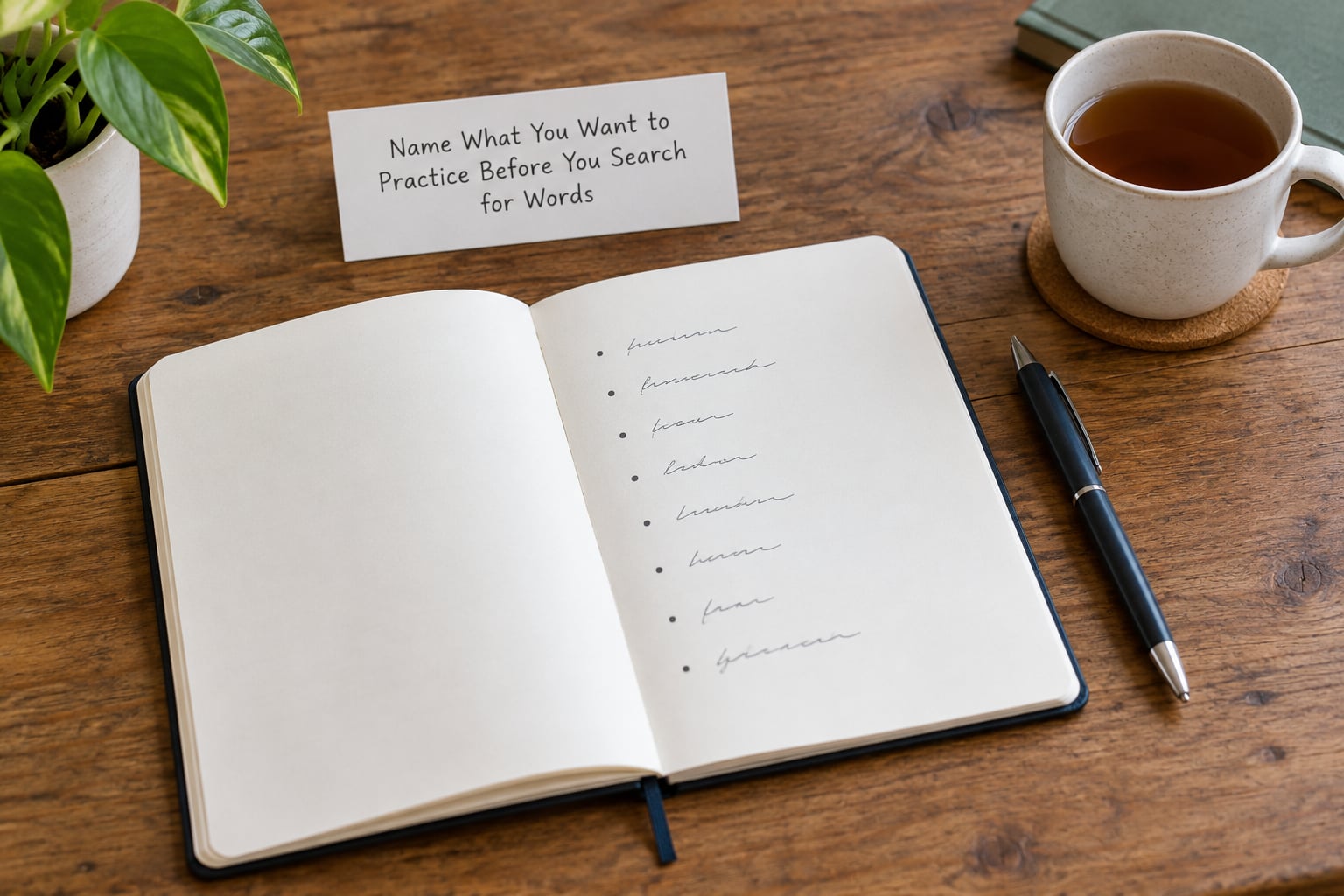
Write down one value in plain language, not one quote. Patience. Steadiness. Curiosity. Accountability. Then add the reason in a half sentence, because the reason is what separates a guiding quote from an aspirational poster.
“Courage” alone will hand you a battle cry you skip past. “Courage, because I keep agreeing to things I do not want” will hand you a line you can actually use. Search from the reason, not the virtue.
These prompts help when the value will not come:
- What did I say no to too many times last year?
- What kept draining me that I keep explaining away?
- What did I want more of, and quit halfway through?
- Who do I admire right now, and what specifically about them?
- What am I trying to stop doing?
- What would make this year feel lighter, not more productive?
- What did I learn the hard way that I want to remember?
Take those away with you on a walk rather than sitting at a desk. Most people get the honest answer in the middle of a third question.
One note before you go further. Guiding quotes are not the same thing as an institutionally chosen Word of the Year. Oxford picks its word from public debate and word-frequency data to describe a year, while the ritual here is private and chosen by you to direct one. Different jobs, and people search for both.
2. Search Beyond Your Usual Sources
Where you find candidates matters more than how many you collect. Most people search the same three sources, which is why their options feel borrowed.
Books and the margins of books are the obvious one. Then poems, which are short by design and often reward rereading. Letters and diaries do the work that speeches do not, because nobody performs in a letter to someone they love.
Music is underrated. A lyric that survives twenty years of hearing is doing something a poster never will.
And the least-used source is your own material: last January’s journal entry, the message a friend sent you in a hard month, something a grandparent said once that you wrote down badly, the sentence from a eulogy you read. People consistently report that the line which sticks hardest is one they found in their own archive rather than one they found online.
| Source | Why it produces candidates you will keep |
|---|---|
| Your journal or notes | The phrasing already matches how you think |
| Saved messages and voicemails | Written by someone who knows your actual life |
| Letters and eulogies | Specific, unperformed, usually short |
| Poetry | Built to be read once and remembered |
| Speeches and interviews | Good rhythm, easy to say out loud |
| Songs you have known for years | Already survived the test of time |
| Lines overheard in real life | The least generic option available |
Collect ten, not three. Three feels like a decision and turns into a coin flip. Ten gives you something to compare, which is the entire point of step four.
Check the wording while you collect. Search the exact phrase in quotation marks and see what comes back. A line with three different attributions floating around is a line to leave in the parking lot until you settle it.
3. Test the Quote Against a Real Situation
This is the step that separates a guiding quote from a nice line, and it takes about five minutes per candidate.
Think of one ordinary decision coming up in the next few weeks. Not the big dramatic one. A project you were not asked to take. A trip you are not sure you can afford in time. A friend who needs a weekend you had planned for yourself. Something small enough that you will actually face it.
Now read the candidate and answer one question: does this line tell me how to act, or only how I wish things were?
If it only flatters, it fails. “You are meant for great things” is a compliment, not a filter. “Attention is the beginning of devotion,” from Mary Oliver’s Upstream, tells you where to point your focus on a Tuesday afternoon when two tasks compete.
Run every finalist through the same five checks:
- Does it fit on one line? Under roughly fifteen words. Longer lines fail as a daily reference point because you stop recalling them.
- Does it hold up read out loud? Say it twice. If you stumble or need to add words, it is too long or too clever.
- Can you source it? Author and work, at least roughly. This is the credibility check, covered in the next section.
- Does it change a real decision? Would you have behaved differently this week with and without it?
- Will you still believe it in month six? Mentally move to a bad month. Does it collapse or hold?
The fifth check is where the aspirational ones die. A quote about relentless momentum sounds excellent in January and becomes insulting by March.
4. Look for a Better Fit When Two Candidates Both Pass
When everything passes, the remaining questions are about voice, not truth. Comparing finalists is where people who know how to choose a quote to guide your year spend their time, because this is the step that is usually skipped and usually matters.
Voice. Does the line sound like someone who has done the thing, or someone describing it? Lines with a cost in them usually beat lines with only a triumph in them.
Emotional temperature. Steady or fiery? A quote that raises your heart every time you read it can be exhausting by week six. One that lowers the volume can keep working.
Length and rhythm. Short and blunt, or short and gentle? Try both on your actual morning. Which one do you not resent at 7am?
Specificity. A broad slogan applies to everything and decides nothing. A line with a concrete image in it filters better.
And if two finalists still tie, swap one word for something closer to your own life. Not a rewrite of the sentiment. One substitution: a season, a place, a verb. The line stops being a poster and starts being yours.
Write down the reason you picked it in one sentence. That sentence is the thing to reread in month four when the quote has stopped feeling exciting and you need to remember why you chose it.
5. Put It Somewhere You Will Actually See
A quote nobody sees is a quote that stopped existing in February. Pick one place and commit to it for the year rather than scattering it across five.
The journal opener works best for people who write daily. One line at the top of the first page of each month is more useful than the same line every entry, because it gives you a monthly check-in built in.
A planner or yearly grid page suits bullet journal and Hobonichi users, who already treat that first spread as the year’s declaration.
A desk card or a sticky note in the car handles days that never reach a journal. A phone lock screen beats a wallpaper because a wallpaper is decoration you stop seeing within a week, while the lock screen is the one thing you read every single day.
Then add the follow-through: a monthly reset of five minutes. Read the line, ask whether it earned its place, and adjust how you are using it. Bullet journal and planner communities tend to share picks publicly in a thread, and the mild accountability of other people reading your choice is a real reason it sticks.
Common Mistakes and How to Correct Them
Choosing a quote because it is popular. Popularity tells you nothing about fit. A line everybody else picked in January was chosen by people you do not know. Correct it by asking which quote answers your sentence from step one, not which one you have seen before.
Choosing words that judge you. Lines about winning and dominating work as a rebuke, not a companion. The correction is to pick the quote you would still read on a bad Tuesday, which is nearly always a different quote than the one that excited you in the first place.
Treating a quotation as a whole philosophy. Twelve words cannot tell you how to live. It can only nudge a decision that was already going to go one way or the other. Use it as a tiebreaker and a reminder, then let your actual goals and to-do lists handle the rest.
Skipping the attribution check. Misattributed lines are everywhere, and repeating one costs you credibility with exactly the kind of person who would read what you wrote. Search the exact phrase in quotes, then confirm it appears in the named author’s published work. “You miss 100% of the shots you don’t take” is regularly credited to Wayne Gretzky, who in a 1984 interview attributed the idea to his father. “I have not failed, I’ve just found 10,000 ways that won’t work” is a fair summary of an Edison filing, not his sentence. Drop anything you cannot source.
Skipping the goal and keeping only the quote. A quote with no paired intention tends to fade by week three. Write one concrete thing you want to have done by the end of the year, so the quote has something to point at.
Nothing comes to you. This is the most common objection, and it is solvable. Use any attributed line you like as a placeholder and choose a replacement in six weeks. Planning ahead from nothing, then letting what actually happened correct it, is how most people arrive at a quote they keep. Choosing the same theme two years running is not a failure either; sometimes a year needs repeating.
Frequently Asked Questions
What is the best quote to guide my year?
The best quote is the one that survives your worst month, not the one that impresses you most in January. Test candidates against an ordinary decision you will face soon, and keep the line that changes what you do rather than the line that sounds impressive. Length matters too: under roughly fifteen words, because anything longer stops being a usable daily reference.
Does my quote have to be my own original words?
No. Most people borrow the wording and make the choice personal. What has to be yours is the reason: one sentence explaining why that line is the right one for the year you are actually having. Copying the quote without that reasoning is what makes a chosen line feel borrowed in month two.
How do I check who really said a quote?
Search the exact phrase in quotation marks and see which source keeps coming up, then confirm the line appears in that author’s own published work. If several names attach to one sentence, treat it as unsourced until you can trace it. A useful shortcut is to check whether the credited person ever said it in a book, interview or speech.
What is the difference between a quote of the year and a word of the year?
A word of the year is a single term you return to, and it works because of what the word means. A quote of the year is a short attributed sentence, and it works because of how it sounds and what it asks you to do. Many people keep both: a word as the theme, a quote as the instruction.
Can I use a religious or spiritual quote if I am not religious?
You can, as long as the line points to something you already believe or can stand behind without borrowing someone else’s theology. Many well-known lines are about attention, patience, endurance or grief rather than doctrine. The test is whether you can put it on your lock screen and still feel at home reading it every morning.
What do I do if I picked the wrong quote?
Replace it, and treat that as the design working rather than failing. Set a monthly five-minute check: read the line, ask whether it still describes how you want to be spending your days, and swap it if not. People who revise in month four usually stay with the practice far longer than people who force a bad fit until December.
Conclusion: Start With the Value, Not the Line
Here is the whole thing in one pass. Write the value you want to practice, gather ten candidate lines from your own material first and the wider world second, test each against an ordinary decision coming up, keep the one that still sounds right in a bad month, and put it where you will read it daily.
Ten minutes now buys you a line you will still find useful in November. If nothing comes to you, borrow one, and give yourself permission to replace it in six weeks. The quote is a tool, and you are the one holding it.