
Most people don’t find community after a move by getting better at small talk. They find it by joining one thing with a fixed schedule, showing up to it week after week, and letting the same faces turn into familiar faces. That repeated contact is the engine behind how to find community after moving to a new place, and it works far better than any single party, event, or app.
It also takes longer than most advice admits. People who have actually moved describe months rather than weeks, and most of them describe a dip in the middle, when the novelty of the new place wears off and nobody has invited you anywhere yet. This guide is written for that stretch of the story, and it reflects what newcomers were reporting as of 2026.
If someone has told you to just join a club and you came away feeling more alone, you did not do it wrong. A club is one door into a room that has many other doors.
Table of Contents
- What You Need
- Step-by-Step: How to Find Community After Moving to a New Place
- Start With One Familiar Interest
- Explore Local Groups That Meet Regularly
- Choose Places Where Conversation Is Easy
- Volunteer for a Cause You Care About
- Use a Simple Weekly Connection Routine
- Build Friendship Beyond the First Conversation
- Common Mistakes When Looking for Community After Moving
- Frequently Asked Questions
- How long does it take to find community after moving to a new place?
- Where do I start when I don’t know anyone in the new city?
- How can I meet people after moving without spending money?
- How do I handle awkward or disappointing interactions?
- How do I find communities that reflect my identity or values?
- How do you make friends in a small town where there is less going on?
- Conclusion
What You Need
You need four things to start, and none of them are money or confidence. The first is two or three hours a week you can protect, ideally on the same day, because the value comes from the repetition rather than from the activity itself.
The second is a reliable way to find out what is actually happening. Your city’s parks and recreation calendar, the public library’s event page, the bulletin board by the library entrance, the weekly city newsletter, and the local volunteer agency are all better sources than a generic app, because they list things that are really running.
The third is a way to get there. In a car-dependent suburb, that may mean choosing activities within a fifteen-minute drive of home so the trip never becomes the reason you stop. The fourth is a small set of interests or values to aim at: two or three things you would do anyway if nobody were watching.
That last one matters more than the first three. A group built around something you care about gives you a reason to talk that is not a performance, and it means you will still want to show up in month four when the newness is long gone.
Step-by-Step: How to Find Community After Moving to a New Place
Community after a move is built in a predictable order: start with one familiar activity, find a group that meets repeatedly, place yourself where conversation is easy, add work that puts you in the same room as the same people, keep it on a routine, then let one or two of those relationships turn into actual friendship. Each step feeds the next, and skipping ahead rarely works.
Start With One Familiar Interest
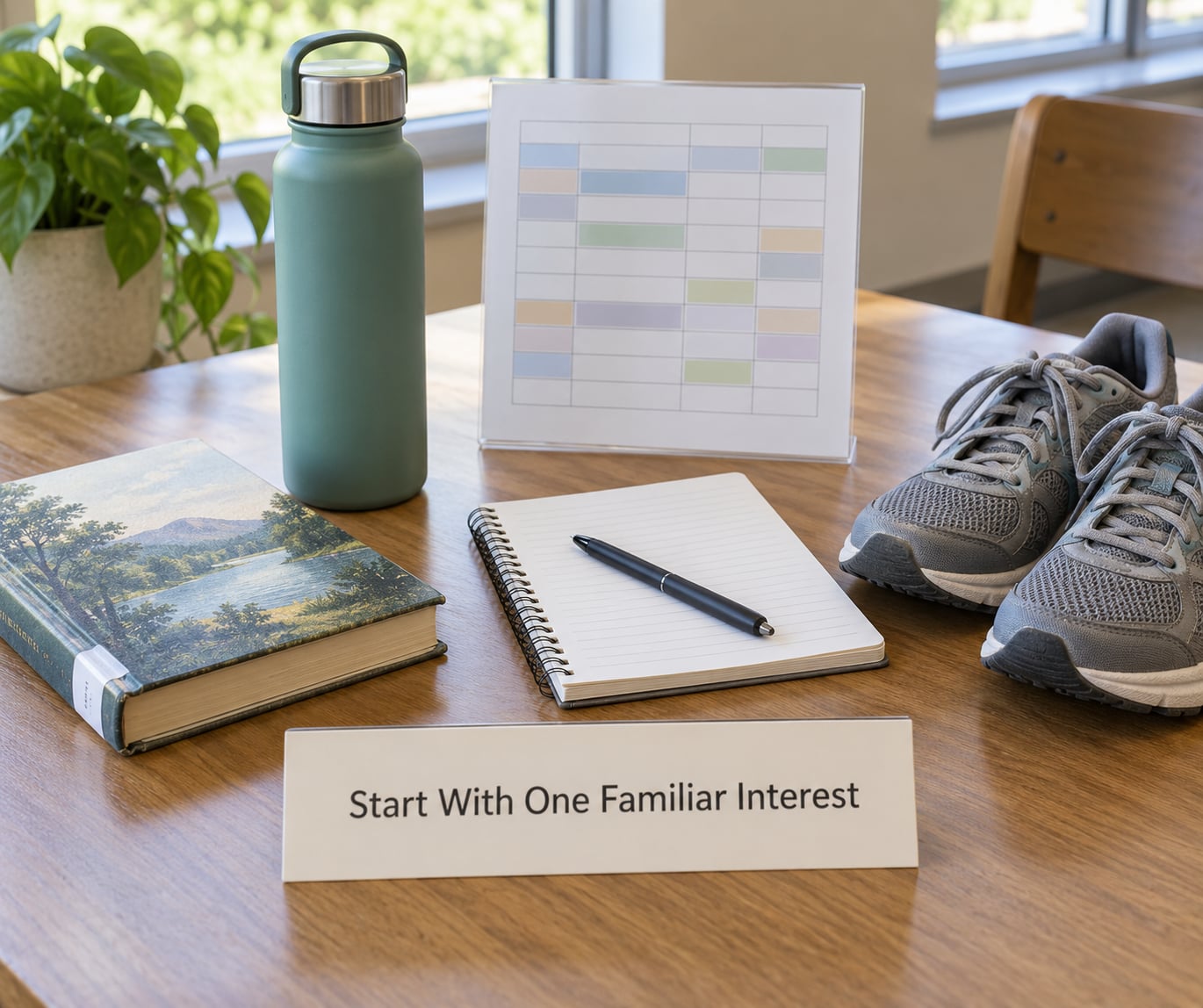
Begin with something you already know how to do, because you want the activity to be easy and the social part to be the stretch. A beginner pottery class, a community garden plot, a Tuesday night recreational soccer league, a community choir rehearsal, or a craft workshop all work because the conversation has somewhere to land.
Starting is mostly a phone call and one sentence: tell them you moved here recently, what you are interested in, and ask whether a beginner can still join this session. Nobody has ever been turned away from a beginner slot for being new to the neighborhood, and a lot of people in the room are one or two sessions ahead of you and remember exactly what it felt like.
You will know it is working when you walk in a second week and someone says your name before you say theirs. That is the whole signal, and it usually arrives around the third visit. One of the most repeated recommendations in relocation threads, including a top comment in r/AskReddit, is simply to get a library card, because libraries host free programs, conversation groups, and language exchanges that put regulars and newcomers in the same room.
Explore Local Groups That Meet Regularly
Prioritize anything that meets more than once a month, and be honest about groups that meet only once. One-time events are fine as an entry point, but they cannot build familiarity, because nobody is expecting you back.
Five sources cover almost every town in the country: the public library, the parks and recreation department, the community center, faith communities, and volunteer organizations. In a small town, add the volunteer fire department, the school board, little league, the historical society, and the county recreation calendar, which is usually a single page listing everything that is happening all year.
If you are not religious, or have no children, or work from home, the usual defaults shrink. Athletic clubs, mutual-aid networks, adult education classes, arts groups, the public library’s discussion calendar, and civic groups like a neighborhood association or a parks advisory board replace them. Many of these hold public meetings where you can sit in the back and listen before you ever have to speak.
Online groups count too, as a starting point rather than an answer. Local Facebook groups, city subreddits, and Discord servers for clubs are useful for finding out what exists and who is running it. The failure mode is staying there: reading a thread about a Saturday clean-up is not the same as being the person who shows up with gloves.
Choose Places Where Conversation Is Easy
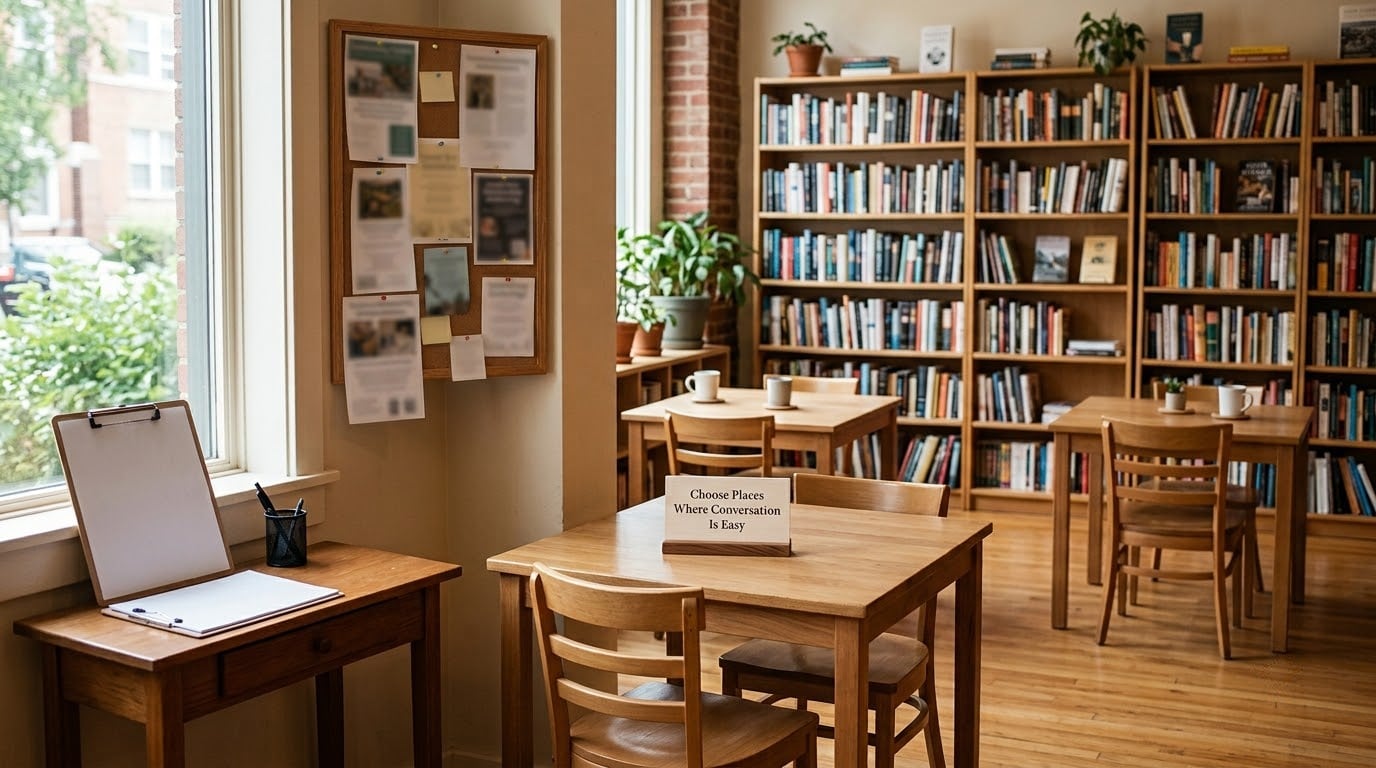
Third places are spaces that are neither home nor work, where the same people return often enough to become regulars. Cafes, libraries, recreation centers, bookstores, farmers markets, laundromats, barbershops, and community rooms all qualify, and in a small town there may be only one or two, which makes them worth naming by name.
The mechanism is simple. You pick a place, you go at roughly the same time, you sit in roughly the same spot. After three or four visits the person behind the counter knows your order, and the regularity itself becomes an invitation, because now you are a person there rather than a stranger in a room.
Two practical adjustments make it easier. Go slightly off-peak, since a packed table gives you no opening, and pick an activity-shaped place over a silent one, because a person reading alone at a library table is not available and a person waiting for a book class is. Bring one small, repeatable thing: a book to exchange, a chess problem, a dog that wants to be petted.
Volunteer for a Cause You Care About
Volunteering works better than almost anything else because it hands you a task. Two people sorting canned goods or tutoring a teenager in reading have a reason to talk that does not require either of them to perform socially, and the conversation happens while their hands are busy.
Choose something that recurs, even if the shift is monthly. Food distribution, mutual aid, trail cleanup, tutoring through a school or library, an animal shelter, a blood drive, or a community fridge restock all create a reason for the same people to be in the same place on the same date. VolunteerMatch and local volunteer agencies list openings, and asking for a recurring shift rather than a single session is the request that gets you a standing role.
It also lowers the stakes. If you are new, tired, or not good with strangers yet, being useful is a legitimate way to be present. One person in r/relocating described a month of Saturday shifts at a food pantry, where the same four volunteers became the first people in the new city who greeted her by name, and none of them had been friends in any other sense when it started.
Use a Simple Weekly Connection Routine
One recurring activity, one message to someone you have already met, and one familiar local place each week is enough. That is roughly three hours, and the routine matters more than the total time because it is what makes you the same person in the same room instead of a series of one-off visitors.
Plan for the weeks when you are tired or disoriented, because those are the ones that end habits. Keep the anchor and drop the rest. If the Wednesday class is too much, still go to the library on Saturday for twenty minutes, because a small consistent thing beats a big occasional one. Consistency is what other people are reading when they decide whether you are a regular or a visitor.
The other risk is doing too much. Over-scheduling is the most common way newcomers burn out by week five, and a packed calendar of new things leaves nothing for the part that actually works, which is sitting in one room long enough to be known. Two anchor commitments a month will carry you further than five different events a month.
Build Friendship Beyond the First Conversation
A friendship after a move is not built on a single good chat. It is built on repeat contact that keeps happening without anyone deciding to make it happen, which is why the acquaintance stage feels like a plateau instead of a failure. Weak ties, the casual relationships that make up most of a person’s network, are the on-ramp; they are what make the deeper friendships reachable, not a consolation prize.
Three moves turn an acquaintance into a friend. First, exchange contact information with a reason attached: my number is on the sign-up sheet, or add me to the group thread. Second, make a specific and low-pressure invitation, because open-ended hangs rarely get accepted, something like: I’m new here and this is the only evening I’m free, want to grab coffee after on the twelfth? Third, follow up within about two days, with a short message that gives them something easy to answer.
Follow-up does not have to be clever. A photo from the event with a line about what was funny, a link to the thing the group discussed, or a quick note that you thought of them is plenty. If someone does not reply, you are not being rejected; you have your answer and you keep showing up to the same place.
You can also make yourself the reason people meet. A potluck in your building, a game night, a book exchange, or a monthly potluck at the community center costs little and puts you at the center of a room in a way that joining never will. Several relocation threads also note that the exhaustion nobody warns you about is the endless performing of meeting people’s friends; hosting once buys you back a month of that labor.
Common Mistakes When Looking for Community After Moving
Expecting instant belonging. A new city feels empty long before it feels lonely, and the gap is normal. Belonging shows up after months of showing up, so judge your first month by attendance rather than by how close anyone feels.
Trying five new things in one month. The instinct makes sense and it backfires, because you never reach the third visit anywhere. Pick two things, keep them for a season, then add a third.
Staying online. Local groups and city subreddits are good for finding out what is happening and terrible for replacing being there. Use them to discover an activity, then leave the screen.
Ignoring the practical constraints. If a class costs money you do not have, a group meets across town during your work hours, or a building has steps and no ramp, the obstacle is not your personality. Look for the county recreation calendar, library programs, mutual-aid work, and shift swaps, which trade money and daytime hours for willingness.
Treating every interaction as a potential close friend. Nobody expects your life story in week two. Aim for familiarity first, and let the closer relationships be the ones that survive a month of ordinary contact.
Ignoring the grief. Moving is a loss as well as a gain, and people who leave reluctantly or abruptly often delay reaching out because they are still processing the old place. Naming that honestly to yourself, or to a therapist, usually comes before the social recovery does.
Frequently Asked Questions
How long does it take to find community after moving to a new place?
For most adults, three to six months. People who have moved repeatedly report the same pattern: a friendly first month, a low stretch in the middle when the novelty is gone and nothing has formed yet, then a slow build from regular places and a few people. The variable is repetition, not charm, so anyone in a fixed weekly group tends to move faster than someone waiting for a natural friendship to arrive.
Where do I start when I don’t know anyone in the new city?
Start where you are already needed instead of where you hope to be liked. Get a library card, put your name down for a recurring volunteer shift, and sign up for one weekly class at the community center. Each of those gives you the same people a second and third time, which is the only reliable basis for a relationship. Do one of them for a month before adding anything else.
How can I meet people after moving without spending money?
Plenty of the best entry points are free: public library programs and discussion groups, parks and recreation calendars, mutual-aid projects, food pantries, community gardens, neighborhood association meetings, and free city recreation leagues. The cost that matters is usually time and bus fare rather than membership fees. Pick two things inside your budget and repeat them, since access without repetition does very little.
How do I handle awkward or disappointing interactions?
Assume the first few are clumsy rather than meaningful. Most people in a new room are also unsure of themselves, and a short conversation that ends oddly usually means nothing. Do not over-read a non-reply to a follow-up message either; people get busy. Keep going to the same place, keep your tone easy, and judge a group by how it feels after a month of consistent attendance, not after one evening.
How do I find communities that reflect my identity or values?
Look for organizations built around a shared identity rather than a general vibe: cultural associations, language groups, advocacy chapters, faith communities, heritage societies, professional associations, and identity-based clubs. If none exist locally, connecting with people from that community elsewhere online is a normal first step, and local chapters often appear once a group has a few members. Being the first regular in a new chapter is a role, not a failure.
How do you make friends in a small town where there is less going on?
Small towns have fewer options but higher attendance per option, which actually works in your favor. Volunteer with the fire department, the food pantry, or the library reading program, join little league or the school board, and go to the same café or counter every Saturday morning. Two or three regulars in one place will know you faster than a dozen one-off events would.
Conclusion
Choose one recurring local activity that matches something you already care about, and attend it twice. That is the first action, and the whole method fits in it: same activity, same day, same faces, until the room starts to know your name. Everything that feels like belonging in a new place is built on that repetition, and it starts long before it feels like anything.