Kids notice skin color and hair texture differences by about six months old, point out differences by age two, form judgments about people by age three, and can show racial attitudes much like adults’ by age five. There is no such thing as too young to begin, so knowing how to talk to kids about racism at different ages matters more than most parents expect.
The honest truth: you will say the wrong thing. You will pick the wrong moment, use a word that lands badly, or go quiet when your kid asked something sharp. That is not a failure of love or a sign you should stop trying. It is the ordinary texture of raising a kid in a complicated world, and repair counts for more than polish.
What follows is a framework you can reuse for years, plus real language for five age bands, from a toddler who points at someone’s face to a teenager who argues with you about a video they saw at 2 a.m.
Table of Contents
- What You Need
- Step-by-Step: How to Talk to Kids About Racism at Different Ages
- How to Talk to Kids About Racism at Different Ages: 2 to 4 Years Old
- How to Talk to Kids About Racism at Different Ages: 5 to 7 Years Old
- How to Talk to Kids About Racism at Different Ages: 12 to 14 Years Old
- How to Talk to Kids About Racism at Different Ages: 15 to 17 Years Old
- How to Respond When a Child Assents to a Racist Idea
- Common Mistakes
- Frequently Asked Questions
- What should I do if my child repeats a racial slur?
- Should I talk to my child about racism even if it never comes up?
- How do I respond when my child says racism is not real?
- Are books, movies, and videos enough to teach children about racism?
- When should I involve a school counselor or therapist?
- Conclusion
What You Need
You do not need perfect words. You need preparation, a clear goal, and one concrete example from your own child’s world.
A calm setting. Not a lecture, not a dinner table with six people watching. Side by side in the car, on a walk, while cleaning up. Young children hold onto emotions more tightly when an adult is looking at them straight on, and teens shut down the moment it feels like an interrogation.
One specific example. Abstract ideas bounce off concrete thinkers. Instead of “racism is when someone is unkind because of race,” use something your child can picture: one kid not invited to the game, a name for a hairstyle or a lunch food used as an insult, a rule at school that gets enforced on some kids and not others. Specificity is what makes it land.
A clear goal for this conversation. Pick one. Not “explain all of racism.” One goal might be: your child learns the word racism and knows it is wrong. Or: your child knows that if someone is mean because of how they look, that is not their fault. One goal per talk keeps it from turning into a lecture nobody absorbs.
Optional: a book, a show, or a real person. A picture book carries the conversation so you do not have to carry all of it alone, and it gives your child something to point at and ask about afterward. A neighbor or teacher from a different background, mentioned by name, does more for a child’s understanding than any worksheet.
One more thing to decide before you start: what you will not promise. You cannot promise it will be fine, that racism is gone, or that you will always be there to fix it. You can promise that unfairness gets named, and that your child will not hear about it from silence.
Step-by-Step: How to Talk to Kids About Racism at Different Ages
The same six moves work from age two to age eighteen. Only the vocabulary and the depth change.
1. Pick a natural opening. Something your child raised, or something you both saw: a video, a neighbor, a headline on your phone, a kid who was left out. Do not manufacture a serious talk out of nothing. Forced conversations teach kids that the topic is heavy and loaded, which is exactly the wrong association.
2. Name the unfairness in one or two plain sentences. Say what happened and why it was wrong. Keep it short enough that they can repeat it back to you, because if they cannot repeat it, it did not land.
3. Listen before you correct. Ask what they noticed and what they think about it. Children often say the surprising true thing first, and your job is to catch it before you talk over them.
4. Ask one open question. “How do you think that felt?” or “What would you do if that was you?” Open questions keep the child doing the thinking. Closed questions, “So you agree that’s bad, right?”, make them perform your opinion for you.
5. Model a response. Children learn more from watching what you do than from hearing what you say. Did you include the kid? Did you say something to the adult who was being unfair? Did you tell your child that you are also figuring some of this out?
6. Follow up later. Not in the same conversation, where it turns into a second lecture. A few days or weeks later, check in: “I’ve been thinking about what we talked about. Have you thought more about it?” Ongoing dialogue is the whole mechanism. One talk is a data point, not a result.
| Age | What they understand | Core message | What to avoid |
|---|---|---|---|
| 0 to 2 | Differences in skin, hair, and language; not yet meaning | People are different and we treat everyone with kindness | Long explanations, scolding for noticing |
| 3 to 5 | Fair and unfair, with a self-centered lens | It is not okay to be mean because of how someone looks | Lectures, graphic news, adult concepts like systemic racism |
| 6 to 8 | Rules that are fair versus rules that are not | Some people are treated unfairly because of race, and that is called racism | Euphemisms like “unkindness,” making them memorize a speech |
| 9 to 12 | Groups, reputation, and that adults disagree | Patterns exist and many adults are still working on them, including you | Lecturing without listening, defending yourself first |
| 13 to 17 | Systems, media, history, their own identity | You are capable of forming a view, and you can revise it with evidence | Talking down, treating every topic as a political fight |
How to Talk to Kids About Racism at Different Ages: 2 to 4 Years Old
At this age you are not teaching a concept. You are setting a tone: noticing race is allowed, and treating people well is what we do.
Toddlers categorize constantly. They sort the blocks, sort the dogs, sort the people at the park by who will share a snack. If nobody gives them a simple frame for the sort they do by skin, they will build one out of whatever they hear most.
Say it in two sentences. Try: “People look different on the outside, and we are all kind on the inside. Some people are treated mean because of how they look, and that is not okay. I will always help you.”
When a two-year-old points at someone in an elevator and says the skin is funny, do not scold and do not lecture. Try: “You noticed her skin. It is different from yours, like your hair is different from mine. Her skin is not funny and not weird. It is just how she is.” Keep it under fifteen seconds. That is enough at this age.
What to avoid: any long explanation, any mention of graphic news, and any signal that this is a topic you find alarming. Children read the emotion on your face faster than the words, and if you treat skin color as a crisis, they will learn it is one.
One real scene: a four-year-old refuses to share a toy with a visiting cousin who has darker skin. That is a hard moment, and the useful line is short. “You can play together and also keep your special toy. You do not have to share everything. But we do not decide who gets treated better based on skin.” Then move on. Reconciliation for a three-year-old is a specific act, not a speech.
How to Talk to Kids About Racism at Different Ages: 5 to 7 Years Old
Now you can introduce the word racism itself, and children at this age can handle it in a concrete scenario.
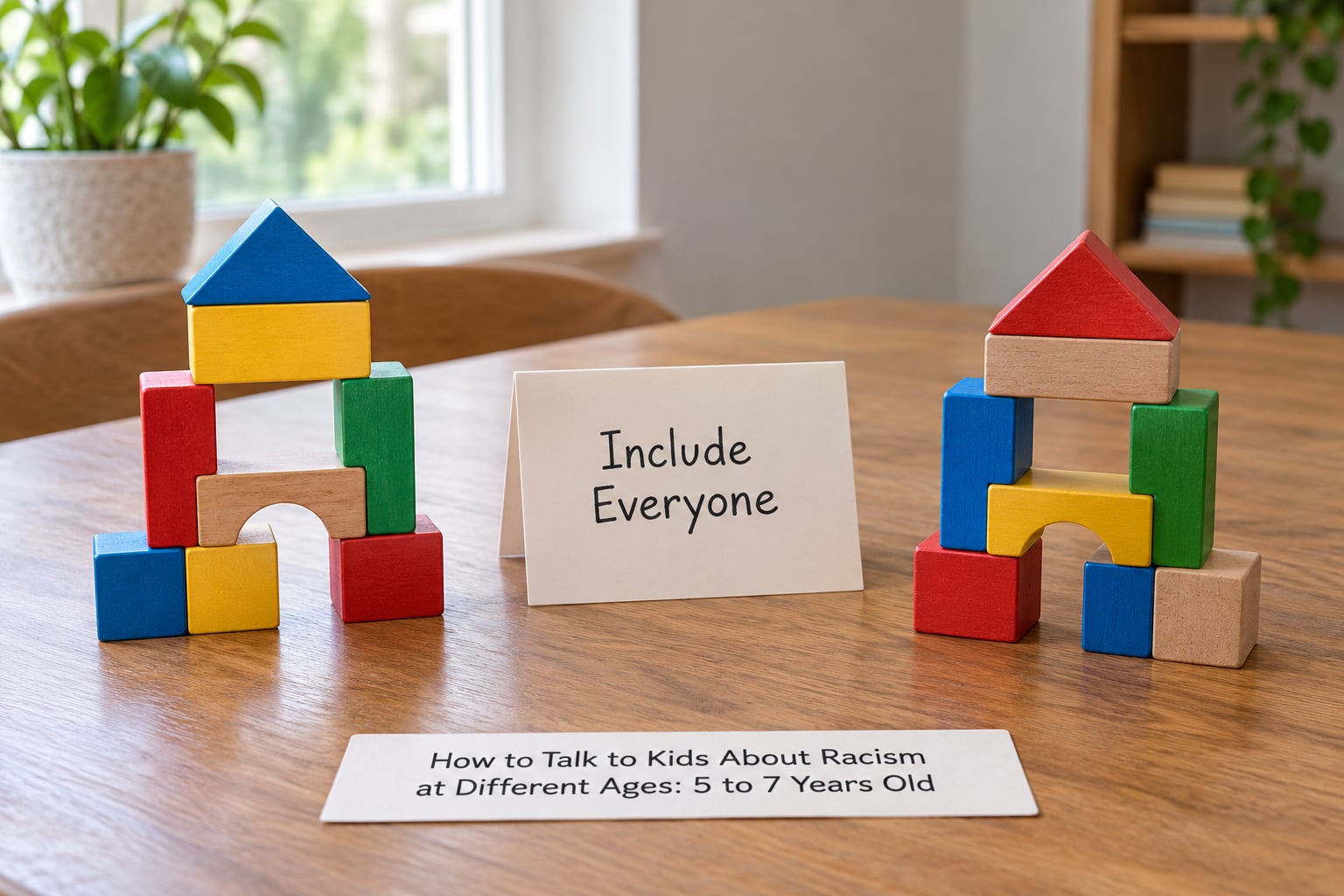
Kids this age understand rules, and they can spot a rule that is enforced unevenly. That is your whole doorway in. Watch for the moment two kids break the same rule and only one gets in trouble, and use it directly: “That rule was applied differently. That is not fair. When people get treated worse because of their race, we call that racism.”
Give them a script they can actually use. Children remember three things and forget a speech. These are the three:
“That is not fair.” Then stop. No lecture needed. Plain refusal to laugh is often enough at this age.
“I do not like that. We do not say that here.” A boundary, said once, in a normal tone.
“I am going to tell an adult.” For anything physical or repeated, and let them know you will back that up.
Then give them one action that is safe and small. Include the kid. Ask the grown-up a question. Sit with the person who is being left out. Ask your child what they would do, and take the answer seriously even when it is clumsy.
What to avoid: calling it “prejudice” or “discrimination” without the simple word first. Adults often reach for a softer term out of politeness, and a seven-year-old needs the plain noun. Racism is the word they will hear from other kids anyway, so it should be the word they hear from you first.
Also avoid promising to fix it. A six-year-old who asks why a classmate was suspended twice for the same thing is asking a real question, and the honest answer is: “I do not know. That does not seem fair, and I am going to ask.” Adults who pretend they know everything teach kids to stop asking the useful questions.
How to Talk to Kids About Racism at Different Ages: 12 to 14 Years Old
Early adolescents can handle systems, history, and power, if you keep the frame steady and stop turning it into a debate you need to win.
Twelve-year-olds are usually comfortable arguing with you, which means they are ready for harder material. But they are also building an identity, and this is the age where a lecture makes them defensive and a genuine question makes them generous.
Four prompts do most of the work here:
Representation. “Who gets to be the hero in the movies we watch? Do you ever notice who plays the doctor, the teacher, the villain?” Kids count characters faster than you do.
Discipline. “Why do you think some kids get sent out of class more than others?” Let them speculate. Their theory will usually be honest even when it is wrong, which gives you something to work with.
Neighborhoods. “Why do we have more parks in some parts of town than others?” Money and zoning answer this one, and it is a good door into structural racism without you needing to lecture about it.
Safe challenge. “If you saw someone being disrespected at school, what are your options?” Most teens underestimate the risk and overestimate the power of a public confrontation. Help them sort which options are safe, which are anonymous, and which are worth taking to an adult.
What to avoid is the one parents worry about most: making every issue a political campaign. Your kid’s report card, a neighborhood debate, and a national argument do not all need your closing statement. If a conversation keeps turning into you defending a position instead of helping your child think, say plainly: “I have an opinion. I would like to hear yours first.” Then listen longer than is comfortable.
One more thing for this age: tell them when you do not know. “I do not know how that got that way, and I would rather find out than guess.” That single sentence does more for honest reasoning than any lecture on integrity.
How to Talk to Kids About Racism at Different Ages: 15 to 17 Years Old
A teenager is not a child with better vocabulary. They are a person forming an adult worldview, and treating them as a partner is the whole difference.
By fifteen, the questions get sharper and more personal. Who am I. Why does that rule apply to me and not to him. Why does my friend get treated like that. What do I actually believe, and how do I know whether it is a belief or just something I absorbed.
At this age, the conversation usually starts with something online. A meme. A video of an incident. A group chat they are in but will not show you. Start with the media rather than the argument: “Who made this, who is it trying to get you to feel, and how do you think it works?” Teenagers respect a request to analyze more than a request to obey.
Implicit bias comes up here, and it needs a plain definition: “Unfair ideas about people that sit in the background of your head without you noticing. You cannot always catch them, but you can look for them.” Then apply it to yourself out loud. “I have caught mine saying things about neighborhoods. I am still working on it.” Modelling beats lecturing, especially now.
Racial identity questions come up hard at this age. If your child is Black, brown, Asian, Indigenous, or multiracial, they will start noticing how others read them, and the question of who they are becomes louder. If your child is white, they will start asking what they are supposed to do with privilege they did not ask for, and a vague answer about being nice will not hold.
When a teenager challenges your view, try this: pause, say that you hear them, ask them to make the case, and then add yours with an honest label. “That is my perspective, and I could be wrong about parts of it.” Adolescents can handle disagreement. What they cannot handle is being managed.
How to Respond When a Child Assents to a Racist Idea
It will happen. A kid repeats a slur from the playground, or agrees that a group of people is dirty or lazy or loud. The goal is not to produce shame. Shame makes children hide the thought instead of examining it.
Step one: pause. If you snap, they stop telling you things. Take a breath first.
Step two: find out what they actually heard. “Where did you hear that?” or “What do you think that means?” There is often a gap between the sentence they repeated and the idea they hold, and the second is more useful to work on.
Step three: state the harm plainly. “That is a racist thing to say.” No preamble, no softening into “that is not a very nice thing.” Then: “It hurts people. It is not okay here.”
Step four: correct and give them something better. Not a fifty-item list. One usable alternative, such as: “If you do not like how someone looks, you can say the behavior. You do not need the word.”
Step five: decide whether anyone else needs to know. If other kids were there, a word with a teacher may prevent a repeat. If the words came from another adult, that adult should know.
A short version, for a public moment: “That word is not okay. Let us go talk about something else. We can talk more later.” Then actually talk later.
A longer version, at home, when a child says their friend said something awful: “Tell me more. How did it start? What did your friend do then? I want to hear the whole thing.” Often the story has more going on than the one sentence the child repeated.
If your own child is the one who said it, keep the correction between you unless the harm was real and public. A child who says something at the dinner table needs a parent conversation, not a lecture delivered to the whole table in front of guests.
Common Mistakes
Waiting until they are older. Most parents plan the first real conversation for age twelve or fourteen. By then the child has already formed attitudes, and you are no longer opening a door, you are arguing with someone who has a view. Start small at four; you will not have to catch up later.
Giving a lecture instead of a conversation. Fifteen uninterrupted minutes is too long for most kids under ten. If you are doing more of the talking than the listening, the content is not landing. Cut it to two sentences and ask a question.
Insisting they never encounter racism. It is not true and they know it is not true. Saying “that does not happen here” leaves a child without any framework for the day it does happen. Say instead: “You will meet people who are unfair, and I will help you figure out what to do.”
Using shame as a tool. “How could you say that?” teaches a child that some thoughts must be hidden from parents. Shame is also very hard to reverse later, when they are the ones with children.
Demanding a performance of tolerance. Asking a child to promise they will be nice forever, or to introduce themselves to a child of a different background on command, produces compliance, not habit. Real behavior grows from small repeated choices they choose themselves.
Arguing about whether the event was racist. “That was just a joke, it was not about race” is technically interesting and almost never helpful. A child asking about a moment usually already knows something was wrong and wants an adult to confirm it. Land the feeling first, then discuss the label later, if at all.
Promising you will fix everything. You cannot. Say what you can actually do: I will listen, I will believe you, I will tell the teacher, I will not make you feel like you made this up.
Talking to your child but not to the adults. If a grandparent, a coach, or a co-parent says the opposite out loud, your child gets two sets of rules and has to pick one. That conversation is uncomfortable and it is part of the work.
One practical fix across all of these: keep it short and return. A ninety-second honest conversation once a week, repeated for a year, beats four long talks a year that everyone dreads.
Frequently Asked Questions
What should I do if my child repeats a racial slur?
Say it is not okay, name why in one sentence, and ask where they heard it. Do not lecture in public, and do not use shame, because shame teaches kids to hide thoughts rather than examine them. Later, ask what they think the word means, since children often repeat a sentence without holding the idea behind it. Then give them one usable replacement, such as describing behavior instead of using the word. If other kids were present or the words came from an adult, tell that adult.
Should I talk to my child about racism even if it never comes up?
Yes, and you do not have to wait for a crisis. Short, ordinary mentions build a normal baseline: noticing that people look different, that names and foods and holidays come from specific places, and that treating people well is the family rule. A child who has heard five casual sentences about fairness handles a hard conversation at twelve far better than a child hearing their first one from a news alert.
How do I respond when my child says racism is not real?
Ask what makes them say that, and listen without interrupting. Then separate the claim from the experience: some people do not experience racism, and racism is still real and does happen to others. Ask whether they have ever noticed who gets stopped, who gets called on, or who gets invited in. Expect disagreement, and avoid demanding agreement as the price for the conversation.
Are books, movies, and videos enough to teach children about racism?
No, but they are a strong supplement and often the easiest way in. A book carries the hard content so the adult is not doing all the work alone, and it gives your child something specific to point at and ask about. Choose titles where a range of children appear as ordinary heroes and where the story ends with a problem actually getting solved. Then ask what they noticed before you comment.
When should I involve a school counselor or therapist?
Involve a counselor right away if your child is being targeted, if incidents repeat, or if the school response has not helped. Consider a therapist if your child is having trouble sleeping, withdrawing from friends, refusing school, or if their distress outlasts the situation by weeks. A counselor can also coach your child on handling situations you are not present for, which is often the harder part.
Conclusion
Start this week, not when it feels necessary. Pick one natural moment your child created, choose two sentences in their language, ask one open question, and listen longer than feels comfortable. That is the whole method behind how to talk to kids about racism at different ages: the same six moves, adjusted for what a two-year-old or a sixteen-year-old can hold. You will miss sometimes. Go back the next day and say you are still thinking about it. That repair is what your child actually learns from, and it teaches more than any script in this guide.