
Implicit bias is an automatic association that shapes how you judge people and make decisions without your awareness. You can hold one while sincerely believing in fairness, which is why it shapes outcomes in hiring, healthcare, school discipline and ordinary conversations without anyone deciding to be prejudiced.
Table of Contents
- What Is Implicit Bias and How Does It Affect Decisions?
- How Do Automatic Associations Develop?
- How Does Implicit Bias Affect Decisions?
- Where Does Implicit Bias Show Up Most Often?
- Hiring and promotion
- Healthcare
- Education and school discipline
- Policing, courts and lending
- Everyday social and customer interactions
- Intersectionality and compounding bias
- How Can You Tell Whether a Decision May Be Biased?
- How Can Individuals Reduce Bias in Everyday Decisions?
- Five ways to interrupt implicit bias in a single decision
- The Implicit Association Test and its limits
- A five-step personal bias self-audit
- What it feels like on the receiving end
- How Do Organizations Reduce Bias at the Institutional Level?
- What Should You Do After Acting on Biased Thinking?
- Frequently Asked Questions
- Is implicit bias the same as explicit prejudice?
- Can someone reject stereotypes and still make a biased decision?
- Are implicit bias tests accurate enough to use for hiring?
- Does implicit bias alone explain racial inequality?
- What can a person do to make a fairer decision at work?
- Conclusion
What Is Implicit Bias and How Does It Affect Decisions?
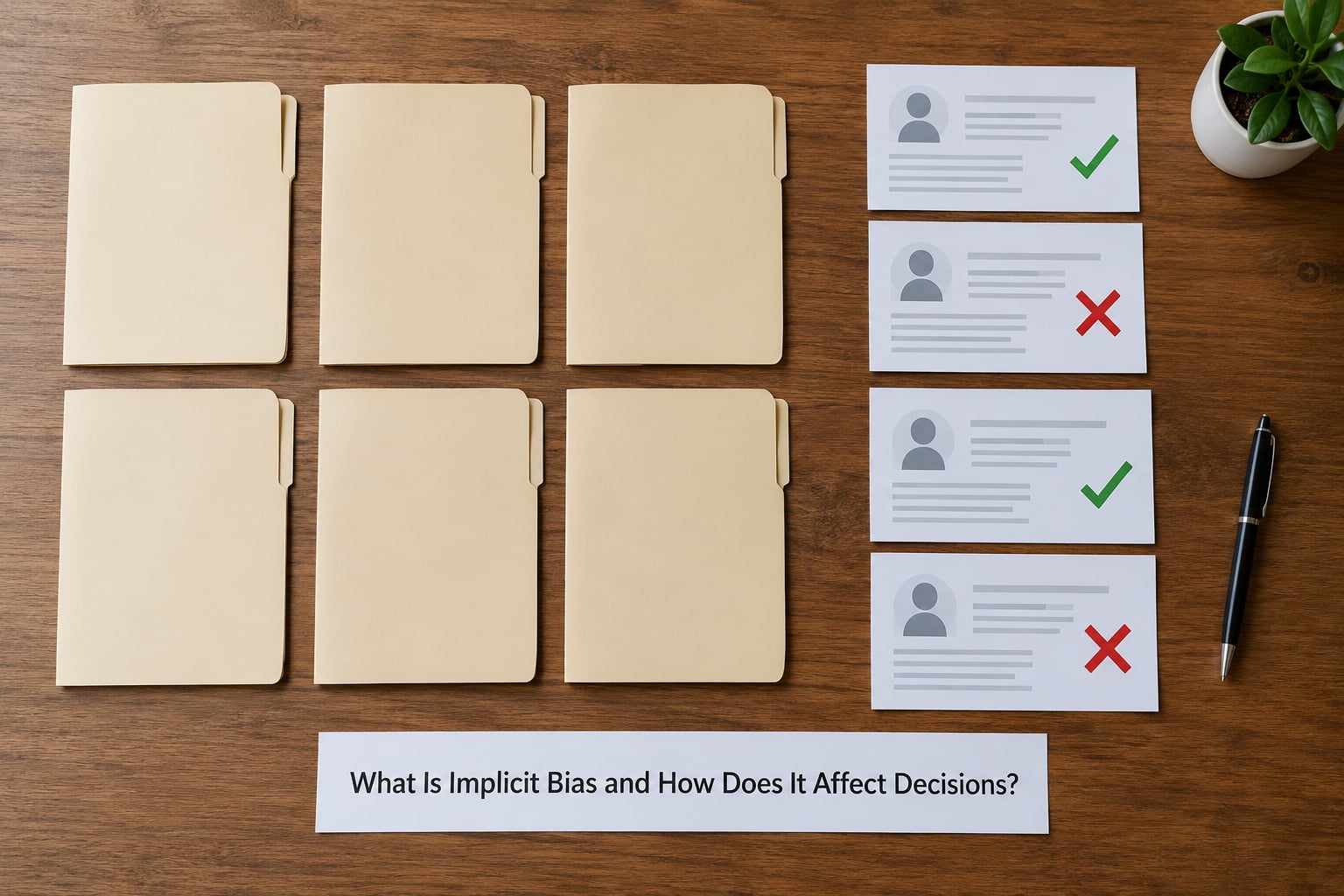
That is the short answer. Implicit bias is a mental shortcut: a connection between a group of people and a set of traits that fires quickly, without deliberation, and without your permission. It is association-based rather than belief-based, which is the part people miss. You do not have to believe the association to have it.
Consider a hiring manager scanning forty resumes in an afternoon. One applicant shares her name with the manager’s sister. Another uses a phrase the manager has seen before in a brochure. Neither application is read closely. Something got noticed, and that something shapes which three files make the interview pile.
Explicit bias is the deliberate version: a supervisor who decides in advance to reject a candidate because of a stated reason, or a policy written to favor one group on purpose. Implicit bias operates in a completely different way. It is fast, quiet and hard to trace back to the moment it mattered.
How Do Automatic Associations Develop?
The sequence runs from exposure, to association, to automatic interpretation. First you notice a pattern or hear a repeated message. Then you start grouping people into categories, which saves mental effort. Over many repetitions, a category picks up emotional meaning from culture, family, media and neighbors. After that, the category loads itself the moment you meet someone new.
Social identity theory, developed by Henri Tajfel and John Turner, explains part of this: people naturally sort themselves and others into in-groups and out-groups, then favor their own. Gordon Allport’s work on intergroup contact added that repeated, structured contact between groups can reduce the hostility that categorization creates.
Recognizing these associations does not excuse anything. Knowing a shortcut exists gives you the chance to use a different route. It does not move the decision off your plate, and it is not a defense in a hiring dispute or a disciplinary hearing.
How Does Implicit Bias Affect Decisions?
The effect runs through a five-step mechanism, and it usually finishes before conscious thought arrives.
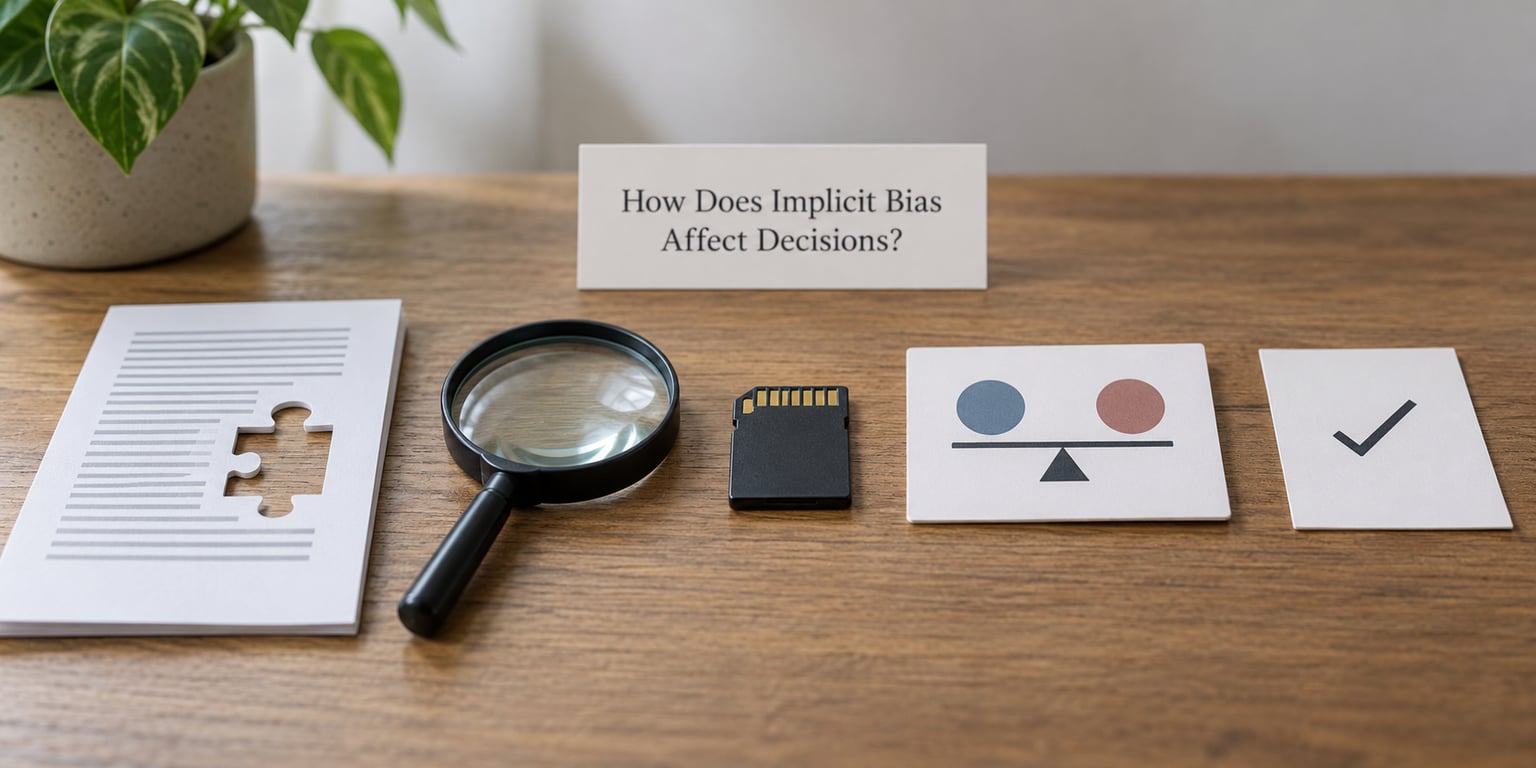
- Attention. What you notice in the first seconds of an interaction, a meeting or a file. Bias changes which details get registered at all.
- Interpretation. What you decide the details mean. The same pause reads as hesitation to one reader and caution to another.
- Memory. What you remember later. Information that fits an existing expectation gets stored more vividly.
- Judgment. The comparison against criteria, which feels neutral but is built from the first three steps.
- Action. The decision itself, plus the explanation you give afterward, which usually reconstructs a rationale rather than reporting the real mechanism.
Because the steps are fast and low on information, snap judgments are the most exposed. Time pressure, thin information and a crowded queue all push decisions toward step one and skip the rest.
Individual bias is only half the picture. Patterns that live inside policies, rubrics and software can produce the same disparity with no prejudiced person anywhere in the building. A form that asks for a name a certain way, a school that already reads one neighborhood as high-risk, a lending rule written decades ago: each one reproduces an outcome every time it runs.
Where Does Implicit Bias Show Up Most Often?
It shows up wherever a person makes a fast judgment about another person with limited information. That covers most institutions.
Hiring and promotion
The best-known evidence here is a field experiment by Marianne Bertrand and Sendhil Mullainathan, published in 2004. They sent otherwise identical resumes with either White-sounding or Arab-sounding names to help-wanted advertisements in the Boston and Chicago areas. White-sounding names received roughly 50 percent more callbacks. Nobody in the study knew a decision was being tested.
Bias also shows up in performance reviews, where vague language like “not a culture fit” absorbs judgment that never gets examined, and in promotion meetings where the candidates being discussed are not the same people in the room.
Healthcare
Clinicians make assessments under time pressure, with incomplete histories and with strong expectations about who complains and how. Research on pain treatment has repeatedly found differences in how pain is estimated and treated across groups, including patients whose mental health history is front of mind. Patients describe being believed later, or only after a specific request or a specific symptom list.
Education and school discipline
Teachers read behavior differently depending on group identity, which changes who gets spoken to, who gets warned, and who gets referred. In classrooms, subtle signals accumulate: who is called on by name, who is answered patiently, whose frustration is read as a rough day.
Policing, courts and lending
These domains carry the same mechanism with heavier consequences. Who gets stopped, who gets a warning, who is searched, who receives a lower offer on the same property. When discretion is wide and criteria are unpublished, attention and memory do more of the work than policy does.
Everyday social and customer interactions
The small versions are the most frequent: assuming a name before a face, reading a different tone into the same sentence, treating a stranger’s accent as a signal about competence. The stakes are lower, the habit is identical.
Intersectionality and compounding bias
Bias does not queue. Someone can be penalized for a combination of characteristics rather than for any single one, which is why outcomes for people at the overlap of several identities are often worse than any single-disparity number predicts.
How Can You Tell Whether a Decision May Be Biased?
You cannot read bias off a single decision, but you can look for patterns. Six signals are worth collecting.
- Outcome comparisons. Selection rates, referral rates, discipline rates, wait times, by group. The gap is the signal, not the verdict.
- Consistency of criteria. Do people who receive the same judgment give the same reasons? When identical performance produces opposite outcomes, the criteria are doing less work than the description claims.
- Firsthand accounts. People notice the moments they were treated differently, often before any data exists. Their accounts should start the review, not decorate it.
- Language patterns. Vague evaluative words carry decisions without specifying them. Track how often they appear and who they attach to.
- Selection rates over time. A process assessed once is a snapshot. A process examined across several cycles shows whether it is drifting.
- Distribution of opportunities. Who gets introduced, mentored, invited, given the harder assignment that leads to promotion.
One disparity never proves intent. Sample size, job relevance, local conditions and dozens of confounders sit behind every number. What a disparity justifies is a closer look, and a process that can be examined is worth more than a good intention nobody can verify.
How Can Individuals Reduce Bias in Everyday Decisions?
Nobody eliminates it. The goal is interruption: adding a step between the association firing and the decision going out.
Five ways to interrupt implicit bias in a single decision
- Define the criteria before you look. Write down what a good answer looks like before you meet anyone. Deciding afterward invites you to justify a decision you already made.
- Use a structured rubric. Same questions, same scoring, same order, for every candidate or case.
- Slow the moment down. If the decision is fast and thin on information, it is the moment most likely to be decided by a shortcut.
- Consult evidence and other views. Ask someone who was not in the room which evidence they would want.
- Review the decision afterwards. Log it, check it against the criteria, and compare over time instead of trusting memory.
The Implicit Association Test and its limits
The IAT, popularized by Project Implicit, measures how quickly people sort words and images into categories and reports the difference in response times. Critics make a real point: performance on it predicts individual behavior weakly, and the test has faced repeated methodological challenge. It is a reasonable window into automatic associations. It is not a valid screening tool for a hiring decision, and treating a score as a verdict about a person’s character is a misuse.
A five-step personal bias self-audit
Pick one recurring decision you make: hiring, feedback, who speaks first in a meeting, who gets patience.
- Write the criteria you think you use.
- Record your last ten decisions and the reasons you gave.
- Look for language that cannot be observed or checked.
- Compare your reasons across people who received different outcomes.
- Change one thing in the process and watch what changes over the next ten.
Awareness alone does not carry the load. People describe noticing an association and then feeling stuck, and that gap is why process changes matter more than good intentions.
What it feels like on the receiving end
People who are on the wrong end of these decisions often describe the same thing: not a single moment they can point to, but a pattern of small signals. Being interrupted less. Being talked over. Being told to soften a request. Holding the suspicion that something about them was read before they spoke, with no way to check.
That is the part usually left out of the textbook version. The person is not only losing the decision. They are carrying the second question, the one that has no answer, and they carry it again in the next interaction.
How Do Organizations Reduce Bias at the Institutional Level?
Personal goodwill does not scale, and a system that depends on goodwill fails quietly. What changes outcomes is structure: criteria published in advance, structured review, panels that include more than one perspective, and a record of how each decision was made.
Accountability does more work than awareness. People behave differently when the reasoning gets reviewed by someone else, and when nobody is measuring, even committed staff members drift back toward their habits.
Brief, one-off training has a weak evidence base. A 2022 meta-analysis by Vela and colleagues found that short implicit-bias programs rarely produced sustained behavior change, which matches what staff already say about mandatory sessions: a box to check, then nothing. Training helps most as one component inside a system that also changes criteria, interrupts routine decisions and tracks outcomes.
Regular outcome analysis matters as much as the safeguard itself. A rubric can quietly become a proxy for the thing it replaced, and only numbers over time reveal that. Any institutional approach should be checked for whether it works and whether it pushed harm somewhere less visible.
What Should You Do After Acting on Biased Thinking?
You cannot unmake a decision, but you can shorten the distance between the mistake and the correction.
For low-stakes everyday choices: acknowledge it plainly to the person affected, adjust what you said, and move on without turning it into a confession that asks them to comfort you. A quick “that was unfair of me, I am sorry” lands better than a long account of how your brain works.
For consequential decisions that follow you: pause the consequence if you still can, write down the process you actually used, bring in a colleague or supervisor who was not present, and correct the outcome where correction is possible. Then add one preventive step to the process so the same sequence is harder to repeat. When the decision is final, documentation and an appeal path are the honest options.
If you do not hold the decision, the useful moves are different. Ask what criteria were applied, request the record, name the pattern you have seen, and bring in someone who has standing to act.
Frequently Asked Questions
Is implicit bias the same as explicit prejudice?
No. Explicit bias is conscious and intentional: a person holds a prejudicial belief on purpose and acts on it deliberately. Implicit bias is automatic and below awareness: an association that shapes attention, interpretation and choice without the person choosing it or wanting it. They can coexist, and either one can produce discriminatory outcomes. The practical difference is that implicit bias cannot be removed by willpower alone, so it responds to process changes rather than to appeals to good intentions.
Can someone reject stereotypes and still make a biased decision?
Yes, and this is the central point of the concept. Implicit bias is association-based rather than belief-based, so a person can sincerely reject a stereotype and still have the association firing during a fast decision. Believing you are fair does not stop the shortcut from working, which is also why telling someone to try harder at being unbiased tends to fail. Changing outcomes requires changing the process around the decision.
Are implicit bias tests accurate enough to use for hiring?
They are not. The Implicit Association Test measures automatic associations through response timing, and its prediction of individual job behavior is weak. Researchers including McConnell and Leibold have argued that a few points of score difference do not predict a person’s conduct. Treating a test score as a screening threshold is an unsupported use of the instrument. These tests are useful for research and for learning about yourself, not for sorting applicants.
Does implicit bias alone explain racial inequality?
No, and saying otherwise is misleading. Group-level disparities are produced by many things at once: differences in wealth, education, housing, criminal record exposure, health access and political power. Implicit bias shapes individual decisions inside a system that already tilts, and that interaction matters. Removing personal bias cannot close a gap created by unequal resources, which is why structural changes carry more weight than awareness programs alone.
What can a person do to make a fairer decision at work?
Decide the criteria before you see the person, use the same structured questions in the same order for everyone, and slow down when the decision is fast and thin on information. Write down your reasoning, then check it later against the criteria rather than against your memory of the conversation. When you can, bring in someone who was not present for the original judgment. These steps are small, repeatable and measurable over time.
Conclusion
Implicit bias affects decisions when an automatic association slips into attention, interpretation, memory and judgment before deliberate thought begins. Self-awareness helps, but it is not enough on its own: fair outcomes come from criteria defined in advance, decisions that can be examined afterwards, and systems that are checked over time. Start with one action this week. Write down the criteria you use for a decision you make often, then look at who has passed through that process lately and who has not.