
Sadness is a normal, temporary response to something that happened, and it eases as the situation changes. Depression is a mental health condition in which low mood or loss of interest lasts two weeks or more and gets in the way of daily life. This guide walks through the difference between sadness and depression using duration, cause, symptoms, and the effect on your routine. It is general information, not a diagnosis. Only a qualified professional can tell you which one you are experiencing.
If you are searching for this answer at 2am, the sections that matter most are the daily-life comparison and the warning signs near the end. Read those first, then come back to the rest.
Table of Contents
- How to Tell the Difference Between Sadness and Depression at a Glance
- What Causes Sadness or Depressive Symptoms?
- How Long Do Sadness and Depression Usually Last?
- How Do Sadness and Depression Feel Different?
- How to Tell the Difference: Changes in Daily Life
- What Changes in Sleep, Appetite, Energy, and Thinking?
- Can Sadness Turn Into Depression?
- What Signs Mean You Should Talk to a Health Professional?
- Which Should You Choose?
- Frequently Asked Questions
- Can I be depressed without feeling sad?
- How long is sadness normal before it counts as depression?
- Does crying every day mean someone has depression?
- Can grief and depression happen at the same time?
- What should I do if I am not sure whether I am depressed?
- What to Do First
How to Tell the Difference Between Sadness and Depression at a Glance
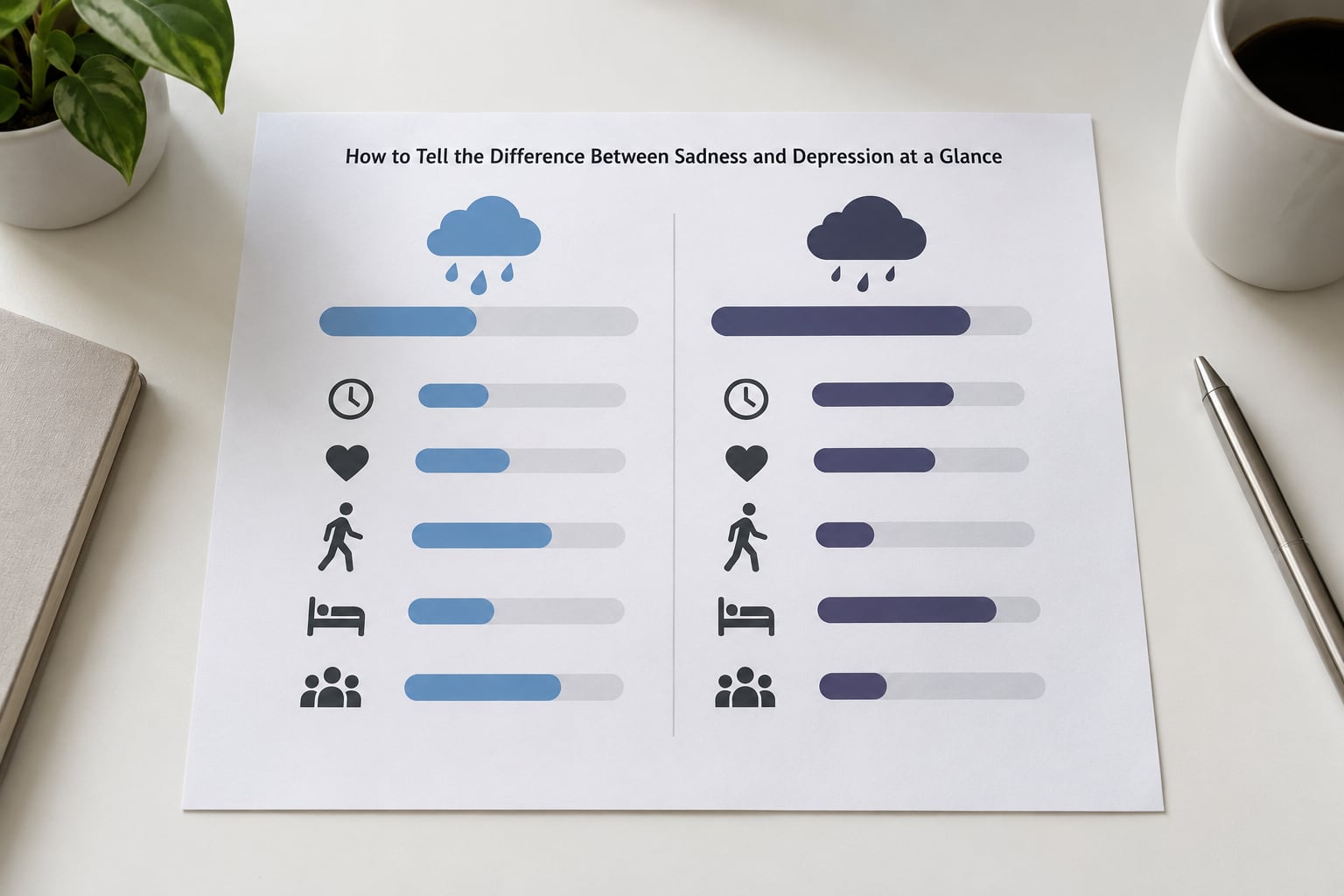
| What to look at | Sadness | Depression |
|---|---|---|
| Typical cause | An identifiable event or situation you can name | May have no clear cause, or feels out of proportion to what happened |
| Duration | Days to weeks, and it softens over time | Two weeks or longer, or recurring, and it does not really lift |
| Emotional texture | Feelings come in waves and you can still feel joy in the middle of them | Persistent low mood, emptiness, or numbness that spreads across most days |
| Ability to feel joy | Good news still registers, and time with people helps | Little or no pleasure in things that used to work, even with people who care about you |
| Daily life | Harder than usual, but you still manage your responsibilities | Work, school, hygiene, meals, or relationships start slipping |
| Sleep and appetite | May be disturbed for a while, then return to normal | Persistent change, including sleeping too much or being unable to sleep |
| Thinking and self-worth | Sad thoughts tied to the situation | Trouble concentrating, difficulty deciding, guilt or worthlessness that does not lift |
| Thoughts about death | Rare, and usually tied to the specific situation | Thoughts of death, dying, or self-harm that arrive without being prompted |
The two overlap more than the table makes it look. Bereavement can carry symptoms that meet diagnostic criteria, and a person can move from sadness into something longer-lasting without noticing the exact week it happened. Treat the table as a way to organise what you are noticing, not as a scorecard.
What Causes Sadness or Depressive Symptoms?
Sadness usually has a name attached to it. A breakup, a funeral, a diagnosis, a layoff, a fight with someone you love. You can point at the thing that did this, which is exactly what makes grief and disappointment feel proportionate.
Depressive symptoms often lose that address. The same loss is there, but the mood keeps going weeks after the funeral, or it shows up with no event behind it at all. That absence of a reachable cause is one of the more honest signals people notice in retrospect.
Several things can push depressive symptoms along, and none of them is a diagnosis on its own:
- Loss and grief. A death, a divorce, a job, a home, or a version of the future you had planned for.
- Trauma and unsafe environments. Prolonged stress, violence, discrimination, or instability can wear down a person’s capacity to cope.
- Chronic stress and burnout. Months of deadline pressure, caregiving, or financial strain with no recovery time.
- Medical conditions. Thyroid problems, chronic pain, anemia, and other conditions are linked with low mood and low energy.
- Medications and substances. Some prescriptions and some substances can flatten mood, and stopping them can do the same.
- Family history. A close relative with depression or bipolar disorder raises the likelihood.
- Isolation. Losing contact with people, or living without anyone who notices how you are doing, removes the buffer that catches a bad stretch.
More than one of these can be true at once, and none of them means a person has failed at coping. They are conditions in the world as much as anything inside it.
How Long Do Sadness and Depression Usually Last?
Two weeks is the number that shows up in mainstream clinical guidance, including the CDC’s plain-language explanation of depression: when a sad mood lasts two weeks or more and interferes with everyday functioning, it may be depression. That is the screening threshold doctors work from.
It is not a line you have to cross neatly. Plenty of people describe an episode that was clearly depression well before two weeks had passed, and plenty of people sit just under two weeks with symptoms that are not mild. Missing the threshold does not mean you are fine, and crossing it does not confirm anything.
Sadness tends to have a shape you can see from outside. It is heavy for a while, it comes in waves, and the waves get further apart. Weeks in, most people can point to stretches that felt better.
On the forum side of this question, one pattern repeats often: people describing years-long stretches who say they had no name for it at the time. Two weeks is a useful floor for a conversation with a professional, not a stopwatch for whether you are allowed to ask for help.
How Do Sadness and Depression Feel Different?
Sadness feels loud and specific. It attaches itself to a person, a place, a memory, and it swells when you encounter that thing. Grief often arrives in waves exactly like this, and it can coexist with genuine happiness on a good day.
Depression is often quieter and wider. People describe it less as amplified sadness and more as an absence: nothing feels much, nothing motivates, going through the motions takes everything they have. One comparison that keeps coming up in Reddit threads is that sadness is like being near a fire, while depression is like the whole room going cold.
A useful summary:
- Reachable cause: sadness usually traces back to a specific thing; depressive symptoms often cannot be traced back cleanly.
- Comes and goes: sadness tends to arrive in waves and ease; depressive symptoms sit at a low level across most of the day.
- Fades with time: the intensity of sadness usually softens week by week, even when the underlying loss is still there.
- Lasts a long time: depressive symptoms stay put, and doing ordinary things can require a level of effort that seems out of proportion.
- Still able to laugh: with sadness, good news lands and humour still works; with depression, even things you used to love go flat.
- Self-worth: sadness usually says something happened to you; depressive symptoms often bring the belief that you are the problem.
None of these are absolute. A person can be angry rather than sad, exhausted rather than tearful, or fine on the surface and hollow underneath. That is the part almost no medical article leads with, and it confuses people more than the crying does.
How to Tell the Difference: Changes in Daily Life
Functioning is the most useful thing you can check, and it beats any symptom list. The question is not whether you are sad enough. It is whether things you normally manage are now harder in a way that keeps going.
With ordinary sadness, a hard day still gets done. You go to work, you pick up the kids, you answer the message, and you are tired afterwards rather than stalled before you start. The cost is real but bounded.
With depressive symptoms, the pattern shifts. Showers start getting skipped. Meals become toast at 9pm or nothing at all. The hobby you had for six years sits untouched in the garage. Bills get paid late, or not. You can technically do all of it, but each one takes a drag that is hard to explain.
The objection that comes up most often in forums is about still functioning. If you can hold a job, parent, or keep showing up, does that rule depression out? It does not. Functioning while depressed is common, and it often takes more effort than the result suggests. The question is not whether you are coping. It is whether coping has stopped being something you can do without it costing you something you cannot afford.
Another thing worth tracking: whether the situation improves. When a hard week passes and you feel like yourself again, that pattern points toward sadness. When several good weeks happen and nothing moves, something else may be going on.
What Changes in Sleep, Appetite, Energy, and Thinking?
Sadness can touch sleep and appetite for a while. You have a rough few nights, or eat more than usual for a fortnight, and then it settles. Depression tends to be broader and stickier, and it can appear without an obvious reason.
| Change | More typical of sadness | More typical of depression |
|---|---|---|
| Sleep | Restless for a stretch, then normal patterns return | Insomnia or sleeping far too much, most nights, for weeks |
| Appetite | Comfort eating or going off food for a bit | Noticeable appetite or weight change that does not settle |
| Energy | Low while the situation is bad, better once it eases | Heavy fatigue even after rest, described as moving through water |
| Concentration | Hard to focus when upset, sharp again later | Rereading the same paragraph, losing the thread of a conversation |
| Decision-making | Some indecision while stressed | Even small choices feel unusually heavy or paralyzing |
| Self-worth | Regret or disappointment about what happened | Guilt, shame, or feeling worthless, and not convincing yourself otherwise |
One clarification that gets lost: anhedonia, the clinical term for losing pleasure in things you used to enjoy, is often the first symptom people spot after the fact. Several people in community threads say the mood was not what struck them. Losing interest was.
None of these changes on their own means depression, and physical symptoms can come from many causes. A doctor can check the medical ones, which is part of why a proper evaluation is worth the appointment.
Can Sadness Turn Into Depression?
Feeling sad does not mean depression is inevitable. Sadness is a healthy, self-limiting response to loss, and most people move through it with support and time. Treating it as a problem to be solved quickly tends to make it last longer, not shorter.
What is worth watching is the drift. When the reason you are sad fades and the feeling stays, or when the low mood starts showing up on days that have no trigger attached, that shift is worth taking seriously. It is not a failure of resilience. It is often a sign that the original sadness has become something that needs more support than rest and friends can offer.
Grief, adjustment, and depression can also exist together. A person can grieve a parent and meet the criteria for major depressive disorder at the same time, and a good clinician will work with both rather than forcing a single label. You are allowed to describe what you are feeling without picking a box first.
What Signs Mean You Should Talk to a Health Professional?
Book an appointment with a primary care clinician or a licensed mental health professional if you notice several of these:
- Low mood or loss of interest lasting two weeks or more.
- Changes to sleep or appetite that have not settled.
- Difficulty concentrating or making decisions at work, school, or home.
- Withdrawing from people you normally see.
- Feeling hopeless, worthless, or guilty most of the time.
- Using alcohol or drugs more than usual to cope.
- Feeling unmanageable, or unable to care for basic needs.
- Thoughts of death, dying, or self-harm that arrive without being prompted.
Symptoms can be milder than you expect and still count. Under-diagnosis is common, particularly in men and in people whose communities discourage naming distress. Do not wait until you feel like the worst version of yourself to raise it.
If someone has suicidal thoughts or might act on them, treat it as urgent. In the US and Canada, call or text 988 for the Suicide and Crisis Lifeline. The Crisis Text Line takes the same number by SMS, 741741. If there is immediate danger, call 911 or your local emergency number, or go to the nearest emergency department. Elsewhere, contact your local emergency service or a crisis line in your country.
You can also ask someone directly. Asking someone if they are thinking about suicide does not put the idea in their head, and it can open the only conversation that matters right now.
Which Should You Choose?
If your low mood has a clear cause, is easing week by week, and you can still handle your responsibilities, this is closer to sadness. Rest, connection, movement, and time are reasonable responses, and there is nothing wrong with feeling it fully.
If it has been two weeks or more, has no reachable cause, is not lifting even when things get easier, or has started affecting your work, your health, or your relationships, treat that as a reason to get an evaluation. A primary care clinician is a good first stop. They can screen for depression, check for physical causes such as thyroid problems, look at your medications, and refer you to a therapist or psychiatrist if needed. A screening questionnaire such as the PHQ-9 can help structure the conversation, but it is a screening tool rather than a diagnostic instrument.
Choose support earlier than feels justified. Nobody is required to hit every criterion before they are allowed to ask a question, and a clinician would much rather hear about week two than week six.
Frequently Asked Questions
Can I be depressed without feeling sad?
Yes. Depression does not always show up as sadness. Emotional numbness, apathy, irritability, anger, or a low grinding restlessness can stand in for it, and some people describe only the loss of interest rather than a drop in mood. That is why diagnostic criteria allow either low mood or loss of interest as the entry point. Self-assessment cannot diagnose you. A clinician can, and numbness or irritability lasting two weeks or more is worth raising.
How long is sadness normal before it counts as depression?
Sadness that has a clear cause and eases over days to weeks is usually considered a normal response to loss. Two weeks or more is the screening threshold in mainstream clinical guidance for depressive symptoms, especially when they interfere with daily life. It is a guideline rather than a hard cutoff, so milder or briefer symptoms can still deserve care. Nobody has to wait for the clock to qualify for help.
Does crying every day mean someone has depression?
Not on its own. Crying is a normal response to sadness and can happen daily during grief or a hard period without indicating a depressive disorder. What matters more is the pattern around it: how long it lasts, whether the feeling stays flat, whether you can still feel joy, and whether daily responsibilities are slipping. Crying that continues for weeks alongside those changes is a good reason to talk to a health professional.
Can grief and depression happen at the same time?
They can. A person may meet diagnostic criteria for major depressive disorder while grieving, and a competent clinician will treat both rather than forcing a single label. Grief often arrives in waves tied to reminders, while depressive symptoms tend to sit at a low level across most days. Both can also occur together in the same period. Only a professional can assess which is which, so describe your experience honestly instead of trying to name it yourself.
What should I do if I am not sure whether I am depressed?
Start with a primary care clinician. They can screen for depression, ask about duration and functioning, check for physical or medication causes, and refer you for therapy if it fits. You do not need to be certain beforehand. In the meantime, track your sleep, energy, interest in things you enjoy, and how well you are managing daily tasks for two weeks. If you have thoughts of self-harm, contact 988 or emergency services right away.
If you have thoughts of self-harm, or you think you might act on them, contact 988 in the US and Canada, text 741741 for the Crisis Text Line, or call your local emergency number. In other countries, use your local crisis line or emergency service. Staying with someone while they get help matters too.
What to Do First
Notice three things: the pattern of your mood, how long it has been there, and what it is doing to your daily life. Write it down for two weeks if you can, since memory is not reliable on this.
Then tell one person you trust. Naming it out loud is where most people report the biggest drop in shame, and it is often easier than doing alone.
If it is persistent, severe, or hard to manage, contact a primary care clinician or a licensed mental health professional. You do not need a diagnosis first, and you do not need to be certain. If you may act on thoughts of self-harm, get immediate help through 988 or emergency services.
This article is general information drawn from mainstream public-health guidance on depression, including the CDC and SAMHSA. It is not a diagnosis, and nothing here replaces an assessment from a qualified health professional.