
Public schools are funded mostly by state and local governments, with the federal government supplying a smaller share for specific programs. National Center for Education Statistics data puts state sources near 46 percent of K-12 revenue, local sources near 42 percent, and the federal share around 8 percent in a normal year, rising toward 12 percent while pandemic relief money was still flowing. If you have ever heard someone claim Washington funds American schools, that is the misconception this guide is built to clear up.
Here is how school funding works in the United States in plain terms: states set a per-pupil target, measure what each district can raise from its own property tax base, and send money to cover the gap. That single mechanism explains most of what families find confusing, including why two districts on opposite sides of a road can spend wildly different amounts per student.
One warning before we start. Fifty states means fifty systems. No article can flatten them into a single model without lying to somebody, so where a number below comes from one state, I will say so.
Table of Contents
- How School Funding Works in the United States: Where the Money Comes From
- The revenue picture at a glance
- How Does the Federal Government Fund Schools?
- How School Funding Works in the United States, step by step
- How Do State Funding Formulas Determine School Budgets?
- How Do Local Taxes and Property Values Affect Schools?
- How Does School Funding Reach Individual Schools and Students?
- How Does Funding Affect Educational Equity?
- What Can Parents, Educators, and Advocates Do?
- Frequently Asked Questions
- What percent of school funding comes from the federal government?
- Where does the majority of funding for local schools come from?
- Why is school funding based on property taxes?
- How does a school receive Title I funding?
- Are school taxes part of your property taxes?
- Why do some school districts get more funding than others?
- Conclusion
How School Funding Works in the United States: Where the Money Comes From
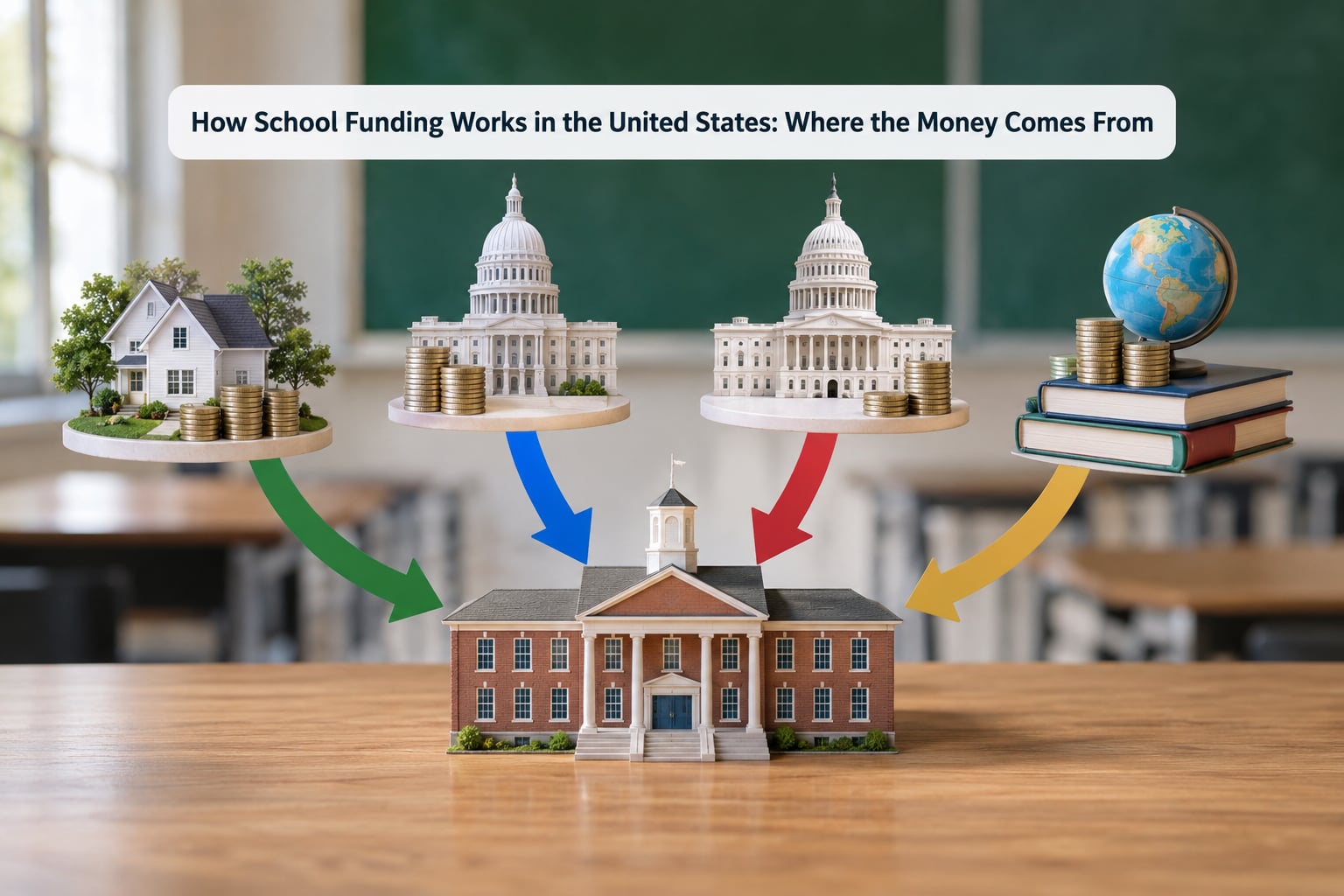
The system has three levels of government, and each one writes a different part of the check. States supply the largest share through income, sales and corporate taxes. Local districts, which are often called local education agencies in some states, supply most of the rest almost entirely through property taxes. The federal government supplies targeted money tied to specific programs and rules.
- State, about 46 percent, funded mainly by personal income taxes, sales taxes and corporate income taxes, distributed to districts through a funding formula.
- Local, about 42 percent, funded almost entirely by property taxes, collected by cities, counties and school districts on the land and buildings inside their borders.
- Federal, roughly 8 percent in a typical year and closer to 12 percent in recent years, funded by the U.S. Department of Education and spent only on programs like Title I, special education and school meals.
Those national percentages hide enormous variation. Some states lean heavily on local property wealth, others barely use property taxes at all. The Center on Budget and Policy Priorities publishes per-pupil spending by state every year, and the spread between the highest and lowest is measured in thousands of dollars per student.
The revenue picture at a glance
| Funding level | Share of revenue | Main tax instrument | Who decides the amount |
|---|---|---|---|
| State government | About 46 percent | Income, sales and corporate taxes | State legislature and governor |
| Local government | About 42 percent | Property taxes | School board and county assessors, subject to state limits |
| Federal government | About 8 percent, higher in recent years | Federal income taxes | Congress and the U.S. Department of Education |
| Other sources | Small share | Charter fees, donations, fees and grants | Individual donors and organizations |
That local share is why the property tax ended up carrying education in the first place. Property ownership was a stable, visible tax base in the nineteenth century, when states wrote school finance into law, and it was a poor proxy for ability to pay because it followed home values rather than household income. Every state that has since tried to repair that mismatch has had to override the original design.
There is also a legal reason the federal share stays small. In San Antonio Independent School District v. Rodriguez (1973), the Supreme Court ruled that the federal Constitution does not guarantee an equal right to public education, so there is no federal constitutional obligation to fund one. Anything Washington provides is a choice, not a requirement.
How Does the Federal Government Fund Schools?
The federal government does not send checks to operate your local high school. It funds programs, and a district has to follow the rules attached to that money to get it.
This is called the categorical model. Congress appropriates money for a defined purpose, the Department of Education writes rules describing who qualifies and how it may be spent, and the district or school draws the funds down as it delivers the program. Money that is not spent on the program is returned, which is exactly why program money rarely feels like operating money.
| Program | What it funds | How a school gets it |
|---|---|---|
| Title I, Part A | Extra reading, math and support for students from low-income families | Allocated to districts by the share of low-income students, then targeted to eligible schools |
| IDEA | Special education services and related staffing | Federal grants to states, passed through to districts based on identified disability counts |
| National School Lunch Program | Breakfasts and lunches for students who qualify for free or reduced-price meals | Reimbursement to districts per meal served, plus commodity purchases |
| Impact Aid | Extra funding for districts burdened by federal land or military installations | Calculated from acreage, student count and eligible federal property value |
| 21st Century Community Learning Centers | After-school and summer programs | Competitive state-level grants administered by state education agencies |
How School Funding Works in the United States, step by step
If you are trying to trace where federal money goes, this is the sequence:
- The district counts eligible students, low-income students or identified students with disabilities.
- The state education agency applies its share of the federal appropriation to those counts.
- The district receives an award and writes it into its budget as restricted revenue.
- The school applies the money to the program the rules allow, typically staff time, materials and services.
- The district reports spending and returns anything unused.
Title I eligibility turns on the share of students whose families qualify for free or reduced-price lunch, or who live in low-income single-parent households. That share is why a Title I school is usually a school serving a neighborhood with concentrated poverty, and why the money can be large in exactly the places where the local tax base is weakest.
On the question of federal cuts, note what the mechanics actually mean. Cutting a federal program does not shrink a teacher’s salary, because salaries are paid from state and local money. It removes a program layer. In many individual districts the federal share runs well under the national figure, sometimes 4 to 8 percent.
How Do State Funding Formulas Determine School Budgets?
A state funding formula is a rulebook for distributing state money. Most states use some blend of three ideas: a foundation level, weights for student characteristics, and equalization based on local wealth.
The foundation formula works in three steps. The state sets a foundation amount per student. It measures what the district can raise locally. It then sends state money to close the gap between the two, up to a cap.
Say the foundation level is 10,000 dollars per student. A district can levy 6,000 dollars per student from its own property tax, so the state sends 4,000. A richer district can levy 7,500, so the state sends 2,500. That is the whole idea: the state does not fully control spending, it smooths the gap so that a poor district is not left with a fraction of a rich one.
The second major model is the weighted student formula. Instead of one price per child, the state pays a base amount and adds extra weights for students with higher costs. A student identified as an English learner, a student in special education or a student counted as economically disadvantaged can each carry an additional weight, often expressed as a fraction of the base or as a percentage uplift.
| Element | Foundation formula | Weighted student formula |
|---|---|---|
| Starting point | A single foundation amount per student | A base amount per student |
| Student need | Usually ignored, or handled with separate categorical programs | Built in through weights on categories of students |
| Local effort | Levy required up to a cap, state fills the gap | Often a required share rather than an optional levy |
| Who it favors | Districts with a weak tax base | Districts serving concentrated student need |
| Real example | Maryland’s foundation amount per pupil, with special education funded well above base | Texas basic allotment for most students, plus weighted supplemental funding |
Real states sit somewhere between the two. Michigan, for example, channels a large share of its School Aid Fund through a foundation allowance, with separate lines for special education and at-risk students. Nevada uses a Pupil-Centered Funding Plan built on weights. Utah stands out for progressivity, directing high-poverty districts a substantial premium per student. Delaware still runs a formula written during the segregation era.
One detail worth knowing about: how a state treats low-income students in its formula decides whether funding is progressive. The Education Law Center counted 17 states in 2023 where high-poverty districts receive more per student, down from 28 a year earlier. That means in most states, serving more poor students does not automatically bring more money.
What happens when the state runs short matters too. Many states automatically prorate per-pupil payments across the whole system when revenue falls below the level the formula assumes. Michigan law is explicit about this. Proration is a blunt instrument: every district loses the same percentage and no district can plan a program around money that might vanish.
How Do Local Taxes and Property Values Affect Schools?
The local share of school money is mostly property tax, and the mechanic takes four steps from a house to a classroom.
- Assessment. A county assessor assigns your property an assessed value, which is often not the market value. States differ widely on the ratio.
- The millage rate. A school levy is expressed in mills, and one mill is one dollar per thousand dollars of assessed value.
- Collection. The county collector takes the money and distributes it among the district’s overlapping entities, including the city or township that shares your boundary.
- The local share cap. The state formula decides how much of the required levy the district may keep, and how much gets counted against the state aid it would otherwise receive.
Because so many of those steps happen outside your view, the tax rate on your bill tells you almost nothing on its own. A district with a lower rate and a richer tax base can out-raise a neighbor with a double rate, and the pattern is easy to confirm once you pull both districts’ numbers. The figure to compare is the assessed value per pupil, not the millage.
Your property tax bill is not all school money. It is split among the school district, the city, the county, sometimes a township and occasionally a fire or transit district, and each sets its own rate. Reading the line items on the bill is usually the fastest way to see your actual school share.
Two local mechanics drive most of the complaints I see. The first is levies and bonds: a district can ask voters for operating money through a maintenance levy or for buildings through a bond, and bond money is capital, not operating, so a successful bond campaign can raise a new stadium while classroom positions stay flat. The second is abatements, which remove or reduce the assessed value of new commercial or industrial development. Local advocates point to abatements whenever a district budget comes up short, and the arithmetic is not complicated: value that is exempted never appears in the tax base.
Not every state taxes property for schools. Hawaii, Alaska and a handful of others lean mainly on state income and sales taxes, which means a larger state share and a bigger state role in setting how much schools get.
How Does School Funding Reach Individual Schools and Students?
Money travels down three layers: district, school site, then the classroom program. The district holds most authority and signs the contracts. The school site decides how to spend within its allocation, usually after a principal and site council review. Individual teachers and programs rarely apply for anything directly.
Spending sorts into a few recognizable categories. Instruction covers teachers, aides and classroom materials. Support services cover administration, counselors, transportation, food service, maintenance and security. Capital outlay covers buildings, roofs, buses and equipment. Federal and state program money sits on top, restricted to its own purpose.
Two distinctions explain most of the confusion in public meetings. Current expenditure is the money spent running schools this year. Capital outlay is money spent building things, which can be large in a bond year while operating budgets stay exactly where they were.
And program money is not free money. Staff describe program formulas as a black box quite often, and the frustration is real: a restricted grant pays for a reading specialist, and it cannot pay the custodian. When a program ends, the specialist goes with it unless the general budget absorbs the position, which is why districts treat program money as a supplement rather than a base.
How Does Funding Affect Educational Equity?
Equity problems in school finance come from two things that are hard to see on a budget: how much a district can tax, and who is inside it.
A district can only tax the property within its own lines. District lines in many states were drawn or defended in ways that kept wealth on one side and concentrated poverty on the other, and redlining compounded the effect by depressing property values where Black and Brown families were allowed to settle. Raising property values helps a district, but only if the district is allowed to keep the return, which many formulas cap.
The scale of the gap is documented. EdBuild has found that schools primarily serving Black and Brown students receive about 23 billion dollars less than schools primarily serving white students. That figure is calculated from district revenue and enrollment, and it is an estimate rather than a settled accounting, but the direction has held up across data sets.
Equal formulas can still produce unequal schools. A district that funds every student at the same rate may look equal on paper and still spend less in practice, because a student identified as needing special education costs more to serve and a student in a high-poverty setting brings demands that a uniform rate does not cover. Staffing, class size, building condition and even how many counselors a campus can afford are all downstream of the funding formula.
There is a serious debate underneath this, and it deserves an honest answer rather than a slogan. The research consensus is that money matters most for students who start furthest behind, and that targeted, sustained spending on early literacy, tutoring and experienced teachers produces measurable gains. The skeptical view, associated with researchers such as Frederick Hess, is that money alone rarely changes what happens inside a classroom without reform in how schools are run. Both can be true. The gap between districts is a structural fact regardless of the answer.
What Can Parents, Educators, and Advocates Do?
Everything above becomes checkable once you know where your district files its numbers. This is the part most families never get told, so here it is in plain steps.
- Get the adopted budget. Search your district name plus adopted budget. Look for the general fund summary and the per-pupil expenditure figure.
- Compute per-pupil spending yourself. Divide general fund expenditures by actual enrollment. Compare it to a neighboring district rather than to a national list.
- Split operating from capital. A district with a large bond issue may look wealthy while classroom spending is average.
- Ask for the school-level spending report. Under the Every Student Succeeds Act, districts must report spending by school, including how much of the allocation is for instruction and how much is for administration.
- Find your state education agency data. State agencies publish per-pupil data and their own funding formula, and that is the source for anything you quote in public.
At a board meeting, the questions that get real answers are specific. Ask what the district’s yield per millage point was last year. Ask what the assessed value per pupil is. Ask how much unassigned balance the budget holds. Ask how many positions the district lost or gained and which category they sit in.
If you want to compare across districts, adjust for student need before concluding anything. Per-pupil spending tells you what a district spends, not whether that is enough for the population it serves, and comparing a low-poverty suburban district to a high-poverty urban one without adjusting will tell you almost nothing useful.
Frequently Asked Questions
What percent of school funding comes from the federal government?
The federal government supplies roughly 8 percent of K-12 revenue in a typical year, rising toward 12 percent in recent years while pandemic relief money was still being spent. That share is concentrated in specific programs such as Title I, IDEA and school meals, so districts that serve concentrated poverty receive more of it. In many individual districts the federal share is even smaller, often 4 to 8 percent.
Where does the majority of funding for local schools come from?
Local school funding comes almost entirely from property taxes, and that local share is about 42 percent of total K-12 revenue nationally. States add a larger share, near 46 percent, through income and sales taxes. So the two together pay for the overwhelming majority of what public schools spend, while the federal government covers roughly 8 percent for designated programs.
Why is school funding based on property taxes?
Property taxes became the main local school tax during the nineteenth-century expansion of public schooling, when land and buildings were a reliable measure of wealth that did not depend on shifting income or politics. The problem is that property value tracks home prices and land, not family income, so a low-wealth district can tax itself at a very high rate and still raise far less per student. That mismatch is the origin of nearly every equity dispute in American school finance.
How does a school receive Title I funding?
A school does not apply directly for Title I money. Congress appropriates it, the Department of Education awards it to states, and states give districts an allocation based on the number of students from low-income families in each district. The district then identifies eligible schools, most often by their share of students qualifying for free or reduced-price lunch, writes the money into its budget as restricted revenue, and spends it only on allowable program costs.
Are school taxes part of your property taxes?
Yes. A school district is usually one of several taxing entities listed on your property tax bill, alongside your city, county and sometimes a township, fire district or transit authority. Each sets its own rate and each line is itemized on the bill, so you can see the school portion directly. In states that do not tax property for schools, such as Hawaii and Alaska, that line is absent and the state funds schools mostly from income and sales taxes instead.
Why do some school districts get more funding than others?
Because a district can only tax the property inside its own boundaries. Two districts separated by a road can differ because of local property values, the number of students, how many carry high-cost weights such as special education or English learner status, and how generous their state formula is. District lines also matter enormously, since where those lines fall decides whose property is in the tax base at all.
Conclusion
Understanding how school funding works in the United States comes down to one sentence: states set the target, local property taxes fill part of it, and the state covers the rest. Everything else in this guide, from federal program rules to bond elections, is a detail on top of that arrangement.
Start by finding your district’s adopted budget and your state education agency’s per-pupil figures, then compare what your district spends per student against a neighboring district serving a similar population. That one comparison tells you more than any national ranking, and it is the one you can actually act on.