
School choice is a set of policies that lets public education funds follow a student to the school their family picks, instead of locking that money to the public school in the assigned attendance zone. In practice, a family finds the programs their state offers, checks eligibility, applies in an enrollment window, waits out any lottery, then covers whatever the public money doesn’t. Every one of those steps is a rule written by a state legislature or a district board, which is why the mechanics look different in every state.
That last part is the part most explainers skip. “How does school choice work” has a short answer, but the long answer is a stack of application deadlines, funding formulas, and capacity caps that vary enormously depending on where you live.
The useful way to cover this is to describe the mechanics plainly and then be candid about what the mechanics cost. A voucher that looks generous on paper can come up short of actual tuition. A lottery is a lottery. And a family with a nine-to-five job, two kids, and no broadband is carrying a burden that the program’s designers rarely budgeted for.
Table of Contents
- What Is School Choice and How Does It Work?
- How school choice differs from similar-sounding policies
- What Are the Main Types of School Choice?
- How Does School Choice Work in Practice?
- What the tuition gap looks like in real numbers
- How Are School Choice Programs Funded?
- How does school choice actually move money to a private school?
- What Can Students Gain From School Choice?
- What Are the Risks and Equity Concerns?
- How Does School Choice Differ by State?
- How to Choose the Right School Option for Your Family
- Frequently Asked Questions
- Does school choice mean the same thing as a school voucher?
- Can anyone apply to any public school under a school choice program?
- Is tuition charged for students in a public school choice program?
- Must school choice programs provide transportation or special-education services?
- How do students get into selective, oversubscribed school choice programs?
- What to Do First
What Is School Choice and How Does It Work?

School choice is any policy that lets a family choose a school, or a learning setting, other than the one assigned by default, and that attaches funding to the child’s choice rather than to the child’s address.
That is the whole definition. Everything else is variation. Some programs move no money at all, because a public school is already funded through the district’s operating formula and the family simply asks to attend a different building. Other programs hand a family a voucher or an account drawn from public funds and let them spend it somewhere else.
How school choice differs from similar-sounding policies
Three things get confused with school choice constantly, so it helps to separate them.
School choice is a menu, not a program. A voucher is one dish on that menu. So is a magnet school, and so is a cross-district transfer. When a legislator proposes “school choice,” they usually mean one of the mechanisms in the next section, not the whole thing.
Homeschooling is usually regulated, not funded. A homeschool family in most states files a notice or a plan with the local authority and gets no public money for instruction. Some states offer homeschool-specific tax credits or a curriculum reimbursement. That is a funding stream, not a choice program.
Residency and zoning are not the same thing. District maps decide which school is your default. A choice policy, where one exists, lets you apply somewhere else despite that map. If a state has no open enrollment statute, your only options are a charter school, a magnet program, or a move.
Programs also differ because the rules are set at two levels. The state writes the funding statute and the eligibility screen. The district runs the enrollment window, sets the admissions priorities, publishes the transportation rules, and decides what a lottery looks like. Two districts in the same state can run structurally different programs on the same state money.
What Are the Main Types of School Choice?
Think of the types as a spectrum, ordered by how much public money actually changes hands.
- Intra-district choice. Moving between schools inside your own district. Available nearly everywhere, and often no application at all beyond a change of address form. Capacity limits still apply, and popular schools can fill up.
- Open enrollment across district lines. The state lets families apply to any public school in the state, with no prior-public-school attendance requirement. A handful of states have this; most do not, which is why cross-district requests often need an inter-district agreement signed by both boards.
- Magnet schools. Free public schools with a themed focus such as arts, science, languages, or a vocational pathway. You apply, and many programs audition, test, or interview. A magnet is public and tuition-free, and it may oversubscribe heavily in a popular theme.
- Charter schools. Free public schools with more independence from state regulation and their own governing board. Many hold a lottery when oversubscribed. Some states let charters charge tuition and admit selectively, so charter rules are genuinely not uniform.
- Private school choice: vouchers and tax-credit scholarships. Public funds are directed toward tuition at an approved private school. Eligibility is usually income-tiered or tied to a specific public school the child attends.
- Education savings accounts. The state deposits money into an account the family controls, restricted to approved uses like tuition, tutoring, testing, and curriculum. The most common design is a universal per-student amount any family can use.
- Hybrid, microschool, and online learning. Some families use public funds for a combination of online coursework, small group instruction, and outside services without leaving the household entirely.
Here is the same set of options in a scannable form.
| Option | Who can apply | Cost to family | How you get in |
|---|---|---|---|
| Intra-district transfer | Any student in the district | Free | Form, sometimes a lottery if seats run out |
| Cross-district open enrollment | Any student in the state, in states that allow it | Free, minus transport | Application, inter-district agreement in many states |
| Magnet school | Usually any student, sometimes with a testing window | Free | Application plus audition, test, or interview |
| Charter school | Any student, though some states cap or prioritize intake | Free in most states | Application, then lottery when oversubscribed |
| Voucher | Income-eligible students, or students in a target school | Tuition minus the voucher, plus fees and transport | State application, then acceptance by a participating school |
| Education savings account | Any student in the state, in universal programs | Approved costs minus the account, plus transport | State application and annual renewal |
| Tax-credit scholarship | Students whose families qualify under the state credit | Tuition minus the scholarship, plus fees and transport | Scholarship administrator, then school acceptance |
| Online, hybrid, microschool | Varies by program | Varies widely | Enrollment packet, often with a waitlist |
One note on charter and magnet schools, because families ask this constantly: both are public schools, and neither charges tuition in the ordinary sense. A charter school’s difference is governance and regulatory flexibility, not price. A magnet school’s difference is its themed curriculum and a selective application. The real split is between admissions, not between public and private.
How Does School Choice Work in Practice?
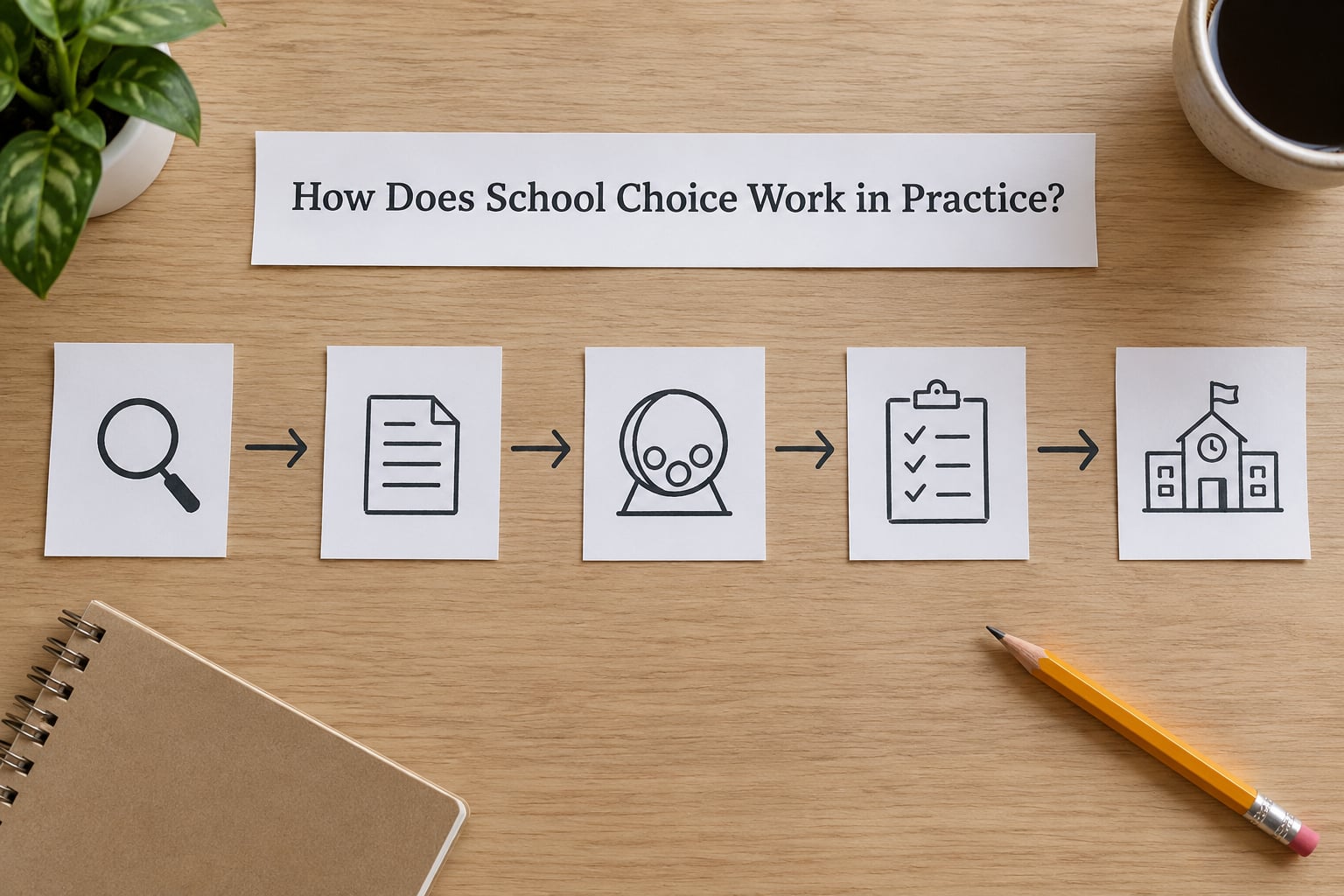
This is the part worth reading twice. Here is the actual sequence, with a hypothetical county that has a cross-district transfer program, a magnet with an audition, and a voucher program for low-income students.
- Start with the assigned school, then the rules. Read your district’s page before the program’s. Enrollment zones, priorities for siblings and for students in the same building, and the deadline for a change of address are all set locally, and they can disqualify a move before any state program gets involved.
- List the programs your state actually funds. The state education agency is the authoritative source. Advocacy organizations publish helpful lists, but the statute is what governs, and lists go stale between legislative sessions.
- Check eligibility before you fall in love with a school. The gates are residency, household income, whether the child attended a public school for a set number of days, and sometimes whether the child has an individualized education program. Indiana’s prior-public-school attendance rule is the most cited example, and it can strip an already-enrolled family’s benefit retroactively.
- Gather the documents. Proof of residence, the child’s birth certificate, immunization record, prior school records, income documentation if required, and the IEP if one exists. This is where the time goes, and it is the step families most often underestimate.
- Apply during the window, and to more than one place. Deadlines are hard. Most programs run a single enrollment window in the fall or winter, and a missed date means a year of waiting. Applying to two acceptable options costs a little paper and buys real flexibility.
- Wait out admissions or the lottery. If a school is oversubscribed, seats are allocated by published rules, which often combine a lottery with priorities for siblings, students already in the building, and sometimes an income tier. In oversubscribed programs the honest number is the waitlist, and it can run years.
- Handle the part nobody advertises. Tuition above the voucher, fees, uniforms, a private school’s required participation in a specific curriculum, and the daily drive. Families describe 40-minute commutes often enough that it deserves its own line in any plan.
- Re-check every year. Most programs require annual renewal, and rules change. The year your child qualifies is not a guarantee for next year.
What the tuition gap looks like in real numbers
A voucher amount is a ceiling, not a bill. In New America’s analysis of the Florida program, the maximum voucher was 5,900 dollars while the private school cited in the piece charged more than 6,300 dollars, before books and uniform. The arithmetic left a gap the family had to find. Individual accounts work the same way: the account covers approved costs up to the annual amount, and everything above that is yours.
There is a second, less discussed risk worth naming plainly. A private school participating in a voucher program is not required to accept every applicant, and it is not required to offer English learner services or special education. Some schools accept a student and later decline to continue when the cost of the services that student needs rises. That is a real pattern described in the research, and it is worth asking about before you sign, not after.
How Are School Choice Programs Funded?
Two separate flows of money matter here, and they are routinely confused.
Public school money reaches schools through a state operating formula. Each district’s total is built from a base amount per student, adjusted for counts of students with disabilities, English learners, poverty, and small rural schools. A student who leaves with a voucher or an account, or who simply enrolls in another district, takes their share with them. That arithmetic is the whole reason districts consolidate, and it is not a secret.
Private school money moves through four main mechanisms. The differences are about who holds the money, who pays the remainder, and who qualifies.
| Mechanism | Who receives the money | Who pays the remainder | Typical use |
|---|---|---|---|
| School voucher | The private school, on the family’s behalf | Family covers tuition above the voucher, plus fees | Tuition at an approved private school |
| Education savings account | The family, in a restricted account | Family covers costs above the annual amount | Tuition, tutoring, testing, curriculum, sometimes transportation |
| Tax-credit scholarship | The private school or scholarship administrator | Family covers the rest of tuition | Tuition, sometimes supplies and uniforms |
| Tax-credit ESA | The family, in an account funded by a credit | Family covers costs above the funded amount | Same account uses as an ESA |
How does school choice actually move money to a private school?
The voucher path is the simplest. The state issues the voucher to the family, the family signs it over to a participating school, and the state transfers that amount to the school. No voucher, no transfer.
The account path is different. The state deposits the annual amount into a restricted account in the family’s name, and the family pays providers and submits receipts for reimbursement under the program’s approved list. More control, more paperwork, and more ways to run into a rejected expense.
Tax-credit versions route money through the tax code. A provider donates, a donor claims a credit, and the scholarship or account is funded from that pool. The family sees a scholarship rather than a state payment, and the total pool depends on how many donors participate.
None of this is universal. Iowa’s universal account, running at 8,000 dollars per student in the 2026 school year, is the most generous design in the country right now and the reason school choice dominates local coverage in that state. Cost to the state ran past 300 million dollars a year there, which is the number to hold onto when the affordability claims start.
What Can Students Gain From School Choice?
The honest case is narrower than either side’s marketing, and the case for a different program is often stronger than the case against programs in general.
Program variety is the clearest gain. A family that wants a specific language immersion track, an arts conservatory, a career and technical pathway, or a small structured setting can often find one inside the public system through a magnet or career program at a fraction of the cost of private school.
Distance and safety are real for some households. A rural family may have no choice at all without an inter-district agreement, and a family in a neighborhood with a genuinely unsafe building has a legitimate reason to want out.
Competitive pressure cuts both ways, but it is not imaginary. When families can move, schools have a reason to respond to what families say they want.
The catch is that every one of these benefits is available to a family with time, transportation, and paperwork capacity. The same magnet program that serves a family with a flexible schedule is out of reach for a family working two jobs. Whether a program helps depends less on the policy label than on who can actually use it.
What Are the Risks and Equity Concerns?
Capacity and oversubscription. A program with more applicants than seats converts into a lottery and a waitlist. The public discussion then keeps talking about the program as if it were open to everyone.
Information asymmetry. Parents who can read a program’s rules, track a deadline, and drive to an audition are a different population from parents who cannot. The programs that are supposed to reach students hardest to serve are the hardest to apply to without help.
Transportation. Choice that adds 40 minutes of driving each way is choice only for families who have a car, a schedule, and often a second adult.
Selective enrollment and services. Private schools taking public money can decline students, and are not bound by the public obligations around special education and language services. A district that serves a higher share of students with disabilities is not doing the same job as a private school that serves none, and no account fixes that.
Segregation by default. When application rates, test preparation, and informational networks differ by income, participation sorts by income and race even when no one is explicitly excluding anyone.
Districts and closures. This is not theoretical. A district in Iowa facing up to six elementary closures is a live example of per-pupil money departing a system with rising costs. When a school closes, families lose the building, the bus route, the aftercare, and the volunteers, and the losses land hardest on families with the fewest alternatives.
Design determines most of these outcomes. Transparency requirements, default enrollment for applicants, transportation funding, and real accountability for participating private schools change what a program delivers. So does the eligibility rule. A universal account reaches a wider and more mixed group than a program limited to students already in a low-performing school, and each reaches a different set of families.
How Does School Choice Differ by State?
There is no national system to describe. School choice is a state-by-state patchwork with district-level variation on top, so any general rule will be wrong somewhere. Before acting on anything you read, run this list against the state education agency’s own pages.
- Which programs exist in your state right now, and which are proposals?
- What are the eligibility gates: residency, income, prior public school days, IEP status?
- Is the program universal, income-tested, or targeted at a specific school or group?
- When is the enrollment window, and when is the application due for each one?
- What transportation does the district or state provide, and to which grades?
- What services are participating private schools required to offer, and which are optional?
- What is the appeal process if you are denied, and how long is the waitlist?
- Do participating schools charge tuition, and what did a family actually pay there last year?
Federal proposals on school choice have recurred across several administrations and none has created an operative national program, so state statute is the only rulebook that pays out. Check it directly, and re-check it before you apply.
How to Choose the Right School Option for Your Family
Work through this in order. It takes an evening and a spreadsheet, and it will save you from a bad match that costs a year.
1. Write down what the child actually needs. A specific need is testable. “Better school” is not. “English support,” “a smaller setting,” “an arts program three days a week,” “daily transport support for a medical need” are all testable against a specific program.
2. Measure the real commute. Do the drive at the actual bell time on a Tuesday, not on a Sunday map. Then do it again in winter. If the drive exceeds 30 minutes each way, weight every other factor higher.
3. Get the true cost in writing. Ask the private school what a family actually paid last year for tuition, fees, uniforms, books, transport, and aftercare. Then subtract the public money. The remainder is your number, and it is rarely zero.
4. Ask the questions administrators would rather you didn’t. What is your average daily attendance, and what do you do about chronic absence? How many students have an IEP or a 504 plan, and do you serve them directly or refer out? Do you provide English learner services, and by whom? What happened last year when a family withdrew mid-year? How many families are on your waitlist, and what is the average wait? Who owns the account if the student leaves?
5. Run the comparison worksheet. One row per option, one column per factor: fit, commute, true annual cost, services offered, admissions odds, safety climate, stability, and whether the school’s founding documents and finances can absorb a bad year. Put the district school on the same sheet. It is free, and it is the baseline every other option has to beat.
On this site’s reading of it, the pattern in the research is worth stating without softening: these programs are taken up fastest by families who already had the most options, while the students they were designed for are the least likely to complete an application. That does not make the programs useless, and it does not mean a specific family should not use one. It means the design details, especially default enrollment, transportation funding, and services requirements, are the whole argument.
Frequently Asked Questions
Does school choice mean the same thing as a school voucher?
No. School choice is the umbrella term for any policy that lets a family choose a school or learning setting other than the assigned one. A voucher is one mechanism under that umbrella, alongside education savings accounts, tax-credit scholarships, magnet schools, charter schools, and cross-district open enrollment. Most choice programs move no money at all, because a public school is already publicly funded.
Can anyone apply to any public school under a school choice program?
Rarely. Only a small number of states allow statewide open enrollment to any public school without limits. In most states a family can apply to a magnet or charter school, and a cross-district transfer usually requires an agreement between two school boards. Popular programs oversubscribe, so applying is possible and being offered a seat is not.
Is tuition charged for students in a public school choice program?
Not for public programs. Magnet schools, charter schools, and district schools are tuition-free, and oversubscribed ones usually run a lottery rather than charge. Private school choice is where money matters: a voucher or account is usually an annual amount, and the family pays tuition above that amount, plus fees, uniforms, and transportation. Ask a participating school what families actually paid last year.
Must school choice programs provide transportation or special-education services?
It depends entirely on the program. Some states fund transportation for specific grades or distances, and many do not fund it at all, which is why long commutes are the most common complaint from participating families. Participating private schools are generally not required to offer the same special education and English learner services as public schools, so ask directly what a school provides and what it refers out.
How do students get into selective, oversubscribed school choice programs?
Through published admissions rules rather than first-come, first-served. A school with more applicants than seats typically runs a lottery, often combined with priorities for siblings, students already enrolled in the building, and sometimes income tiers. Magnet programs commonly audition, test, or interview. The realistic number to plan around is the waitlist, which in popular programs can run for years.
What to Do First
Start with the assigned school and your district’s rules, because that decision constrains everything else. Then list the programs your state actually funds, verify eligibility for each one, and compare true annual costs including the tuition remainder, fees, and the commute. Confirm the deadline and the waitlist odds with the responsible state or district office before you fill in a single form.
What is school choice and how does it work, in the end? It works by moving funding and responsibility in small, specific, state-designed ways, and it rewards the families who can absorb the paperwork, the commute, and the remainder bill. Understanding school choice honestly means holding both halves of that at once.