
To disagree without damaging a relationship, you separate the issue from the person: name the specific behavior, explain how it affects you, make one clear request, then listen long enough to understand their side before you settle on a next step together.
Most relationship damage comes from the delivery, not the disagreement itself. Saying no, pushing back on a plan, or naming a habit is fine. What erodes trust is blame, contempt, and the sense that raising the issue was punishment.
John Gottman’s research on couples turned up something useful here: how a couple handles conflict predicts whether the relationship lasts better than how often the conflict happens. Couples who argue are not the ones who break up. The pattern inside the argument is what matters, and it works the same way with friends, family, and coworkers.
Table of Contents
- What You Need Before You Open Your Mouth
- Step-by-Step: How to Disagree Without Damaging a Relationship
- Step 1: How to Disagree Without Damaging a Relationship Starts With Intent
- Step 2: Choose the Right Time and Setting
- Step 3: State Your Concern With Observation, Impact, and Request
- Step 4: Invite the Other Person’s Perspective
- Step 5: Stay With the Issue, Not the Character
- Step 6: Look for Options and Boundaries
- Step 7: Agree on a Next Step and Check In
- Say This Instead of That
- What To Do When They Will Not Engage
- When Some Disagreement Should Stop Being About the Issue
- Common Mistakes That Do The Most Damage
- Frequently Asked Questions
- How do I disagree without sounding aggressive?
- What if the other person gets defensive when I disagree?
- How can I pause a conversation without stonewalling?
- How do I disagree with someone I am very close to?
- How do I repair a disagreement after I said something hurtful?
- Start With One Clear, Respectful Sentence
What You Need Before You Open Your Mouth
Preparation is what keeps a hard conversation from turning into a fight. Five things are worth having ready.
- A clear point of view. One issue, stated in a sentence. If you have five, write them down and pick the one that actually matters this week.
- Relevant facts. What you observed, when, and how often. Observations travel; character judgments get argued about.
- Enough time. A 20-minute window minimum. Rushed conversations produce the sentences people regret.
- A specific outcome. Do you want information, a different decision, or just to be heard? Knowing this keeps you from asking for a confession.
- A plan for listening. Decide now that you will summarize what you hear before you respond to it.
If the conversation needs a third person — a mediator, a manager, a friend who holds both of you to the same standard — agree on that in advance too.
Step-by-Step: How to Disagree Without Damaging a Relationship
Step 1: How to Disagree Without Damaging a Relationship Starts With Intent
Before you speak, name to yourself what you are actually after. Sharing information, solving a problem, and asking someone to change their mind are three different conversations, and mixing them is how arguments grow.
Psychologists call the substitution of one for another a demand-withdraw pattern: one person presses, the other pulls back, and the gap between them widens every round. On Reddit’s r/relationship_advice and r/relationships communities, posters describe this loop constantly, and it is the reason so many people say the standard advice does not fit their situation.
Write one line: “I want us to decide X together” or “I need to understand how you see this.” If your line starts with “I want them to finally admit,” pause. That motive turns a disagreement into a verdict.
Step 2: Choose the Right Time and Setting
Not every moment is a conversation moment. Bring up a disagreement when the other person is rushed, exhausted, tipsy, or already dealing with something larger, and the content matters less than the moment does.
Good conditions: no audience, both people relatively calm, and enough time to finish. Bad conditions: the car, a text thread, the ten minutes before guests arrive, or anywhere children can overhear.
It also helps to open with the reason for talking. “I want to talk about the budget for the trip, and I have ten minutes” prevents the other person from bracing for a fight.
Step 3: State Your Concern With Observation, Impact, and Request
Structure beats emotion here. Observation first, then the effect on you, then a specific request.
Instead of “You never help with the dishes, and honestly it’s becoming a real problem for me,” try: “I’ve washed dishes alone five nights this week. I end up feeling like the kitchen is mine, and I would like to split it.” Same information, no accusation, and a request the other person can actually answer to.
Marshall Rosenberg’s Nonviolent Communication model makes the same move in four parts: observation, feeling, need, request. It is worth borrowing even loosely, because the part people skip is naming the need underneath the complaint.
You will know this step worked if the other person starts answering your question instead of defending their character.
Step 4: Invite the Other Person’s Perspective
Disagreement done well is a two-way exchange, not a presentation. Ask, then listen without planning your rebuttal.
Prompts that work: “Help me understand how you got there.” “What were you worried about when you decided that?” “Say more about the part I got wrong.” Then reflect it back: “So the concern is that the trip gets rushed, and you’d rather go somewhere closer. Have I got that right?”
The Harvard Negotiation Project puts it as listening to understand rather than to reply, and the Psychology Today version of this advice lands on the same point: you do not have to be persuaded to listen well, and you do not have to be liked to be heard.
Acknowledging their view costs you nothing and buys you the right to be heard with yours. A relationship loses far more from contempt than from disagreement.
Step 5: Stay With the Issue, Not the Character
The moment the conversation turns to who somebody is, it stops being solvable. “You are so selfish” ends the discussion and starts something longer.
Gottman named contempt — mockery, eye-rolling, name-calling, sarcasm — one of the Four Horsemen, and the only one he tied directly to a measurable decline in relationship satisfaction. Criticism targets behavior; contempt targets worth.
When a fight derails, name the derailment without blame: “We have moved off the vacation budget. Can we go back to that?” Then hold the line. The same goes for scorekeeping (“you did this in 2019”) and the grievance pile-on. One issue at a time is not politeness, it is triage.
Step 6: Look for Options and Boundaries
Once both sides are clear, move to solutions and generate more than one. A single proposed fix reads as a demand; three options read as a decision.
Sort them as you go. Preferences are negotiable — which restaurant, which weekend, whether to host. Boundaries are not. “I will not agree to spend money we do not have” is a limit, and a limit is not up for negotiation. Partners who know the difference stop arguing about things that were never going to move.
Compromise is a good tool when the issue is genuinely a trade-off. It is a bad tool when you are being asked to give up a limit.
Step 7: Agree on a Next Step and Check In
End with something concrete, because conversations that end on open loops tend to restart themselves. Summarize in two sentences: what you agreed on, what is still open, who does what, and by when.
Ending on a positive note is not fake cheerfulness. Saying “I like that you told me straight, and I’d rather hear it than guess” tells the other person that speaking up was rewarded, and that is the behavior you want repeated.
For anything complicated, book a check-in. Ten minutes on Thursday keeps a small disagreement from marinating until it explodes.
Say This Instead of That
Phrasing is the fastest lever most people have. These swaps cost nothing and change how the sentence lands.
| Instead of | Try |
|---|---|
| You always interrupt me. | I lose the thread when we talk over each other, and I need the rest of my thought. |
| You never listen. | When I talked about the deadline, I still feel unclear on what you heard. |
| That’s your job, not mine. | The rent is due Friday and the balance is not covered. I need us to decide who handles it. |
| You’re being dramatic. | This matters a lot to me, so I can see why it is loud for you too. |
| Fine. Do whatever you want. | I do not want to pick tonight. Can we look at both options tomorrow? |
| You are so selfish. | When the plan changes and I hear it late, I feel left out of the decision. |
| I already explained this three times. | My point is getting lost. Let me try again in one sentence. |
| You are just like your mother. | I am reacting to how this went last time, not to your family. |
| I do not care, pick whatever. | I care, and I am tired. I would rather answer after dinner. |
| Whatever, forget it. | I want to finish this, but not like this. Ten minutes and a break, then we start over? |
What To Do When They Will Not Engage
Some disagreement guides assume two people who both want to resolve something. Plenty of readers do not have that. The most common answer in the forums is a cycle where one person pursues and the other withdraws, and the pursuer ends up carrying all the emotional labor of the argument.
A few things help. Agree on a time-out signal in advance, when nobody is upset: a word, a hand on the table, a text that reads “reset, ten minutes.” Then promise a return time and keep it. The 20-minute version of this comes straight from restorative practice, where a break runs 15 to 30 minutes and never longer than 24 hours.
A time-out is not stonewalling. Stonewalling is turning away mid-conversation with no signal, no plan, and no return. A time-out is announced, time-limited, and followed by a re-entry: “I am back, and here is what I heard before I paused.”
Then name the pattern out loud, once, without blame. “We both stop, and nothing gets decided” is a problem you can work on together. “You never care” is a fight you will both lose.
When Some Disagreement Should Stop Being About the Issue
Gottman estimates that roughly 69 percent of a couple’s disagreements are perpetual. They recur because two people genuinely want different things, and no amount of technique resolves a difference in values.
Those are not failures. They get handled by agreement to disagree: name the difference, say out loud that you are not going to win it, and agree on what you will each do anyway. A recurring argument that ends with two people making different choices on purpose is fine. One that circles back every week without ever closing is not.
Warning signs look different. Persistent contempt, threats, shouting, shutting down for days at a time, or being punished for raising an issue are not a wording problem. If you are questioning whether a relationship is worth staying in, a qualified couples therapist can give you a much clearer read than any article, including this one.
Common Mistakes That Do The Most Damage
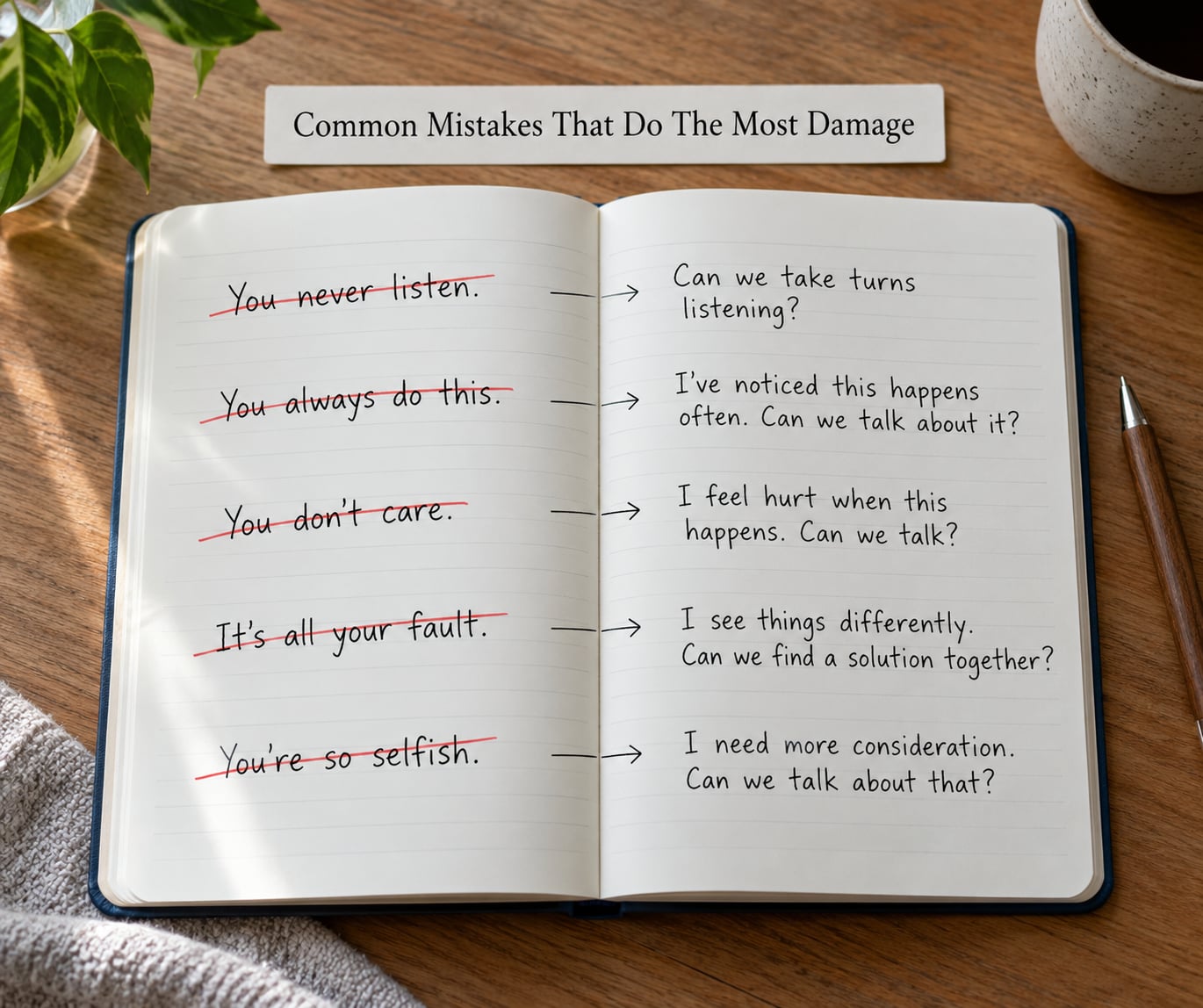
Almost every hard conversation goes wrong in one of a handful of recognizable ways. Each has a fix you can apply in the moment.
- Launching right after conflict. Fix: wait until both people are back under normal blood pressure. Ten minutes of doing dishes separately is usually enough.
- Hostile wording. “You always,” “you never,” and mind-reading land as character attacks. Fix: observation, impact, request.
- Unsolicited advice. Correcting before asking adds a second argument on top of the first. Fix: “Help me understand” first.
- Flooding the conversation. Bringing up every grievance at once guarantees that none get resolved. Fix: park the rest. “There is another thing, and I want it to have its own conversation.”
- Stonewalling. Fix: name it, set a return time, and come back on time. A pause without a return time reads as punishment.
- Apologizing without understanding the harm. “Sorry you’re mad” ends nothing. Fix: name the specific thing, ask what it did to them, and only then apologize.
- Trying to win. The moment the goal becomes being right rather than being closer, information stops mattering. Fix: aim to understand more than to be understood.
Three checks cover most of it. Ask yourself whether your motive is connection or victory. Take one real pause instead of pushing through. And repair small moments early, because a five-minute repair after a small rupture is far cheaper than a long one after a large one.
Frequently Asked Questions
How do I disagree without sounding aggressive?
Lower your volume and your pace before you lower your standard. Lead with what you observed, then how it lands for you, then one specific request. Skip loaded words like always, never, and obviously, which tell the other person you have already decided they are the problem. If your voice is rising, take a ten-minute break and come back with the same three-part structure.
What if the other person gets defensive when I disagree?
Defensiveness usually means the other person heard an attack, even if you did not intend one. Try naming the concern without the edge: I am not saying you did it on purpose, and I still need to talk about the impact. Then stop talking. Giving them room to explain usually gets you more than repeating your point does.
How can I pause a conversation without stonewalling?
A pause works when it is announced, time-limited, and followed by a return. Say I am too activated to do this justice, I need 20 minutes, and I will come back at 7:30. Stonewalling is going silent with no signal and no return. Agree on the signal with your partner while things are calm, so neither of you has to improvise it mid-argument.
How do I disagree with someone I am very close to?
Closeness usually means more history, not more honesty, so be more careful, not less. Pick one issue, choose a calm private moment, and lead with the fact that you value the relationship enough to raise it. With parents and older relatives you may need to accept that understanding is a realistic goal while agreement is not, and end the conversation on warmth rather than a verdict.
How do I repair a disagreement after I said something hurtful?
Go back within a day and use a repair attempt. Name the specific sentence, not your general regret. Say I said you do not care, and that was not true, and I am sorry. Then ask what it landed like for them and listen without defending yourself. A repair that includes a change going forward lands better than an apology that only clears you.
Start With One Clear, Respectful Sentence
Learning how to disagree without damaging a relationship is mostly about restraint. One issue at a time, one request, one genuine attempt to understand before you respond.
Start smaller than feels natural. Choose a calm moment, name the one thing you noticed, say how it affects you, make a single request, and ask what they make of it. That is the whole first move.
People who feel respected tend to cooperate. Treat the other person as someone with a real reason for where they stand, and you protect the relationship even when the issue stays unresolved.