
A parent-teacher conference is a short meeting, usually 15 to 20 minutes, and most parents walk in with ten questions and get through two. Knowing how to prepare for a parent teacher conference comes down to four moves: talk with your child first, gather three or four concrete examples instead of impressions, rank your questions so the important ones survive the clock, and walk out with a written plan.
That last part is where most conferences fall apart. Parents leave with a warm feeling and nothing written down, then three weeks later they cannot remember whether anyone agreed to check in on reading. A conference is the one scheduled moment you get direct access to the adult who watches your child all day. It is where a quiet concern gets named early instead of becoming a crisis at the end of the year.
Nerves are normal here. Parents in r/Parenting and r/AskParents threads describe the same thing repeatedly: a short slot, a real worry, and no idea how to open the conversation. Feeling underprepared is not a sign you are bad at parenting. It usually means nobody handed you a structure, so here is one, with sentence-level language you can actually say out loud.
Table of Contents
- What You Need — the Papers, Notes, and Questions to Gather
- Step-by-Step: How to Prepare for a Parent-Teacher Conference
- 1. Review Your Child’s Recent Experience
- 2. Gather Specific Examples and School Records
- 3. Write Your Questions Before the Parent-Teacher Conference
- 4. Prepare for Difficult or Emotional Topics
- 5. Practice Asking for a Clear Support Plan
- 6. Prepare for the Follow-Up
- Common Mistakes That Turn a Conference Into a Wasted 20 Minutes
- Frequently Asked Questions
- What should I bring to a parent-teacher conference?
- How do I ask a teacher for help without sounding confrontational?
- What if my child has trouble talking about school?
- How long does a parent-teacher conference usually last?
- Should I bring my child to the conference?
- What should I do if I disagree with the teacher?
- Your Next Step
What You Need — the Papers, Notes, and Questions to Gather
You need less than most people assume: a child’s recent schoolwork, a short list of your own questions, three specific examples, and one clear request. Everything else is optional.
Your child’s recent schoolwork. Pull three to five dated pieces rather than a binder of everything: a writing sample you liked, a worksheet that revealed a gap, a test you didn’t know was coming, a homework log. Dated samples matter because “he does fine in math” is an opinion and “he scored 62 on the October fractions quiz and got the same two question types wrong” is a starting point for a conversation.
Attendance and deadline information. Check the portal the night before. How many days was your child out, which assignments came in late, which ones never arrived. Absences explain a lot of grade drops, and teachers do not always have full visibility on home schedules, medical appointments, or a sibling who was ill all week.
Teacher messages and notes. Screenshots of emails or app messages dated near the concern are worth more than your memory. If you were told in September that reading was a worry and it never came up again, that gap is part of your question.
Your ranked question list. Five questions is realistic for a 15-minute meeting. Mark the top two as must-ask and put them at the top of the page, not buried in the middle of a paragraph.
One specific request, already worded. Whether it is a weekly progress note, a check-in with the school counselor, or an evaluation referral, vague requests get vague answers. “I’d like a short note every second Friday about reading” can be answered yes or no. “I’d like to talk about reading” tends to produce reassurance.
Your child’s perspective. Ask them before you write anything. A first-grader who says “she’s nice but loud” has handed you the exact opening for a social question.
A pen, paper, and your preferred contact method. Write down the teacher’s email or the app they actually read. Also note whether your family prefers email, a phone call, or the portal. Parents in r/Teachers threads describe the same friction from the other side: a handful of families answer every message and dozens do not.
Step-by-Step: How to Prepare for a Parent-Teacher Conference
1. Review Your Child’s Recent Experience
Start by asking your child three questions: What was easy this term, what was hard, and who do you sit with? Then add your own observations and compare the two.
The comparison is where the useful tension shows up. A child who says homework is fine while three assignments sit unsubmitted in a folder is telling you something real about executive functioning, not about honesty. Executive functioning is the skill cluster behind starting tasks, remembering materials, finishing work, and managing time, and it is the thing most often behind a grade drop that looks like effort.
Ask what changed. New seating chart, a substitute for six weeks, a new kid in the group, a death in the family, a move, a diagnosis. Most parents can name a change and assume it did not matter; teachers often noticed it the same week.
Write your child’s words down before they fade. Quoting a nine-year-old exactly (“she says reading out loud is the worst part”) gets a far more useful answer than a summary.
2. Gather Specific Examples and School Records
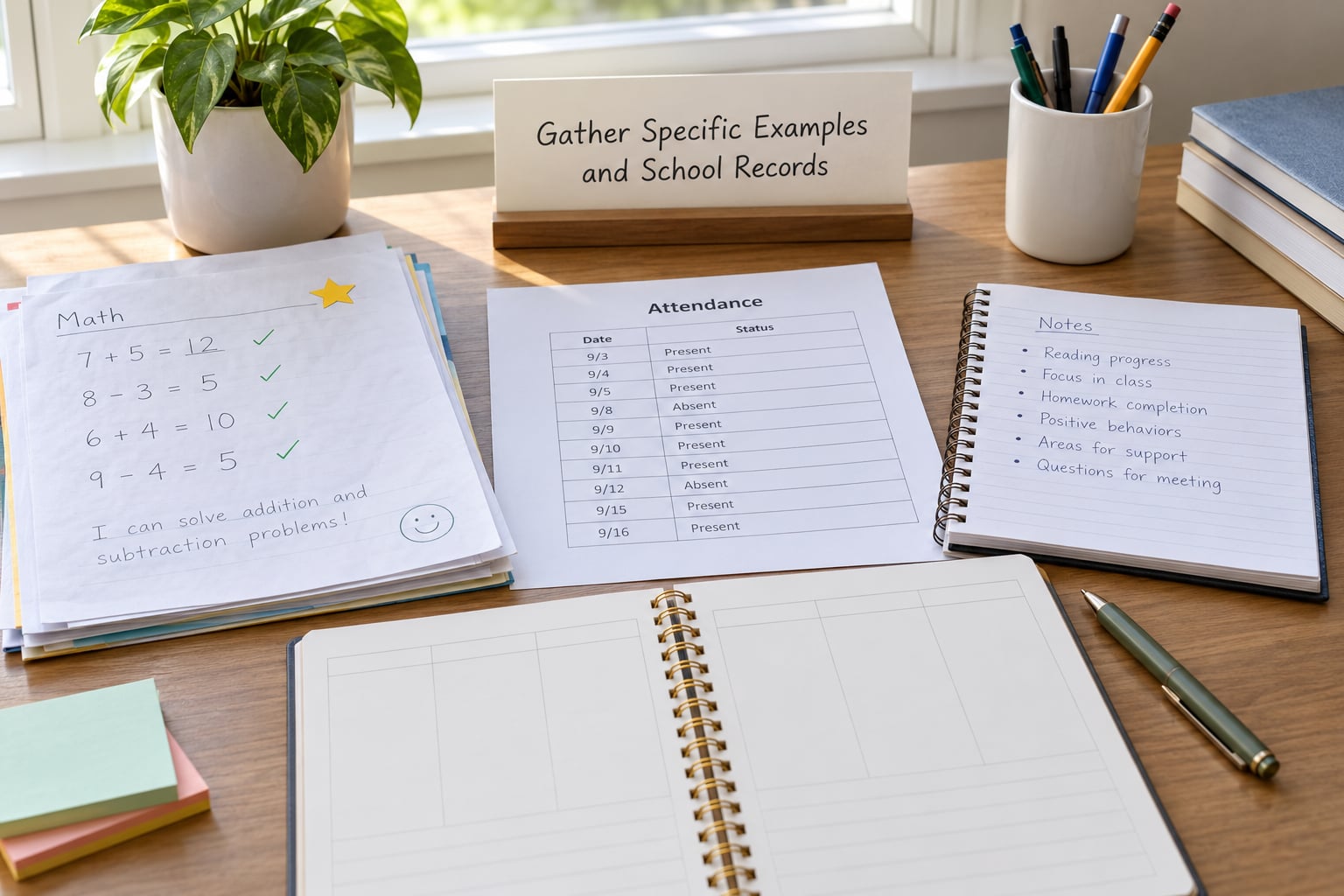
Specific examples are what turn a complaint into a workable conversation. Aim for three, each with a date attached.
An academic example. Name the assignment, the date, and what was missing. Missing work and misunderstanding look identical on a report card, and only the teacher can tell you which one it is.
A classroom example. “He talks constantly in advisory” is much harder to act on than “on three Tuesdays in October he was talking during independent reading time and had to be redirected.”
A social example. Ask about the friend group rather than demanding names. A child can lose access to a peer group without a single incident, and teachers see the reshuffling long before families do.
Pull whatever records you can access yourself: the attendance summary, missing-assignment list, benchmark scores, and any plan already in place such as an IEP or 504. If your child has one, bring the document, not your recollection of it.
Bring three to five work samples, not the whole folder. Teachers are marking papers between conferences and a 60-page binder signals you have not narrowed the problem down.
3. Write Your Questions Before the Parent-Teacher Conference
Write five questions, rank them, and expect to ask three. Bring them on one page in order.
Parents in r/AskParents threads ask most often about social life in class, which is exactly the question ranking pages tend to skip. It is also one of the easiest to word well. Ask: “Who does my child seem to enjoy working with, and does that group change?”
Group the questions so you can drop one and still have a complete picture:
- Progress: Where is my child doing better than last quarter, and where has it stalled?
- Understanding: Is the struggle with the material, the pace, or getting started and finished?
- Participation: How often is my child raising a hand, and does that look different from how you know they behave at home?
- Peer dynamics: Is my child part of a steady friend group right now, and have you noticed anyone getting left out?
- Support at home: What is the one thing you would change about how we practice at home?
- Next step: What would you want to see in six weeks, and how will we both know it happened?
Three of these do most of the work in a short meeting. Put the one you care about most at the top.
4. Prepare for Difficult or Emotional Topics
Difficult conferences go better when you decide in advance that you will describe, ask, and listen, rather than argue, defend, or explain away what you hear.
Prepare a sentence that opens the concern without blaming anyone. “We have noticed homework getting harder to start in the last three weeks. I would like to understand what that looks like for you in class.” It describes what you saw, says you are asking, and does not imply the teacher caused it.
If you expect bad news, decide your limit before you walk in. Know what grade or behavior would make you ask for a second meeting, a counselor, or an evaluation. That decision is much harder to make calmly in the moment, when you are tired and slightly defensive.
If the subject is bullying, self-harm, a safety worry, or a mental health concern, do not wait for your slot. Contact the school the same week, and use the meeting to ask what specific steps have been taken. You are allowed to ask which adult owns the follow-up and when you will hear from them.
When a concern at home never shows up on the report card, say it plainly instead of arguing. “Everything looks fine at school and I am seeing something different at home, so I would like to compare notes.” Teachers are not withholding information; they see a different eight hours than you do.
5. Practice Asking for a Clear Support Plan
A conference only counts if something is decided before you leave. Ask for four things: a strategy, an owner, a timeline, and a way to check.
“How can I help at home?” is a decent question, but it puts the work on you. Pair it with a school-side question: “What will you change in class, and when will you know if it is working?” Parents in r/Teachers threads describe being asked this far more often than the reverse, and it tends to get a real answer.
Make the plan specific enough to fail. A weekly email note on Friday about one subject, a ten-minute reading check twice a week, a check-in with the counselor in three weeks.
If your child may need more than a classroom accommodation, ask who the referral goes to and what the timeline looks like. An IEP is a written plan that sets out a student’s needs and the services, supports, and accommodations the school will provide, based on an evaluation. A 504 plan covers students who need accommodations for access to instruction but not the full services of an IEP. You do not need to diagnose anything at the conference. You need to ask who evaluates, what the process involves, and how long it takes.
Ask for help even when you cannot explain it cleanly. A school counselor, school psychologist, or special education coordinator exists for exactly the cases where a teacher’s classroom fix is not enough.
6. Prepare for the Follow-Up
Set a 48-hour follow-up habit while you are still sitting in the meeting. It is the cheapest step in this whole guide and the one most often skipped.
Before you leave, ask two closing questions: what is the plan, and when will we next talk about it? Write the date down in front of the teacher. It turns a vague intention into an appointment.
Within two days, send a short thank-you note. Three lines is plenty: what was discussed, what you understood the plan to be, and the date you will check in. If you misheard something, this is the cheapest possible place to correct it.
Then decide what you are watching for. One thing, and a date. If your child has an IEP or 504 plan, note which goals are tracked and when progress reports arrive, because a plan nobody reviews is just paperwork.
If a concern got cut for time, send it in writing anyway with a request for a short answer or a separate call. Half the parent questions that die in conferences die because nobody wrote them down.
Common Mistakes That Turn a Conference Into a Wasted 20 Minutes
Almost every disappointing conference traces back to one of a handful of avoidable mistakes. Each has a simple correction.
Arriving with observations instead of examples. “He is struggling in math” gives a teacher nothing to work with. Fix: bring three dated examples and say what you saw in each one.
Opening ten topics at once. You will get through two of them and leave the rest for nothing. Fix: mark two must-asks and put them at the top of the page.
Talking about your child instead of with them. Statements about your child as if they are not present eventually get repeated at home. Fix: use the child’s own words, and if your child is in the room, let them answer one question themselves.
Explaining away behavior instead of listening. When a teacher describes something difficult, the first instinct is often to defend. Fix: say “tell me more about that” before you offer context. You will usually learn the missing piece, and the teacher will feel heard rather than challenged.
Leaving without next steps. Warm handshake, no plan. Fix: ask the four questions in step five before you stand up.
Treating the teacher as the enemy. You will keep dealing with this person for the rest of the year, and so will your child. Fix: assume they want the same outcome you do and have run out of options for it.
Skipping the child’s version. Fix: the five-minute conversation in step one is the highest-return five minutes in this guide.
One last preparation habit worth building: email the teacher at least a couple of days ahead when you have a serious concern, and ask whether there is anything they would like you to bring. It gives them time to pull records and frame the conversation instead of reacting to it. If you need a new meeting scheduled, teachers often need three to four weeks of notice, so ask early rather than hoping for a cancellation.
Frequently Asked Questions
What should I bring to a parent-teacher conference?
Bring three to five dated work samples, your attendance and missing-assignment summary, one page of ranked questions, and a pen. Bring a copy of any IEP or 504 plan already in place, plus a note of what you have tried at home. If you have a concern that worries you, write the request you want in one sentence before you go.
How do I ask a teacher for help without sounding confrontational?
Describe what you observed, say that you are asking rather than accusing, and let the teacher respond before you add context. A sentence like ‘We have noticed homework getting harder to start in the last three weeks, and I would like to understand what that looks like in class’ usually gets a real answer. Teachers report that they would far rather hear a concern early than find out in March.
What if my child has trouble talking about school?
Ask small, concrete questions instead of ‘how was school.’ Try ‘who did you sit with at lunch’ or ‘what was the hardest part of math today,’ and give your child a few quiet minutes. Plenty of children say little at home and plenty more at school, so also ask the teacher directly what your child is like in class. Do not read the silence at home as a problem.
How long does a parent-teacher conference usually last?
Most conferences are scheduled in 15 to 20 minute slots, and the teacher often has a stack of families waiting after you. That is why ranking your questions matters more than writing more of them. Arrive a few minutes early with your list printed or handwritten on one page, and put your two must-ask items at the top so they survive the clock.
Should I bring my child to the conference?
It depends on age and purpose. For younger children, a short visit with the teacher can be lovely. For a conversation about grades, behavior, or a possible evaluation, most families meet without the child so they can speak freely, then tell them the important parts afterwards. Ask the school what it expects, because policies vary and some schools require the student to attend.
What should I do if I disagree with the teacher?
Say clearly which part you disagree with, ask for the reasoning behind it, and keep the disagreement about the child rather than about competence. If you still disagree after that, ask what evidence would change the picture and who else should weigh in, such as a counselor or administrator. A second meeting in two weeks with a specific question is far more productive than a longer argument in fifteen minutes.
Your Next Step
Before anything else, pick your child’s single biggest concern this term and write it in one sentence. Then find one dated example that supports it and one question that gets you a clear answer.
That is the whole assignment. Three lines on a piece of paper, and your next parent-teacher conference goes a long way toward being the meeting you needed it to be.