
An advance directive is a legal document that records the medical care you would want if a serious illness or injury left you unable to speak for yourself, and it usually names someone you trust to make those decisions for you. You need one because the alternative is guessing, and guessing is what turns a medical crisis into a family fight.
I have sat with people who thought about this for years and signed nothing, usually because the paperwork felt like an admission of something. It isn’t. It is a set of answers written down on a good day, when your thinking is clear and nobody is panicking.
If you landed here asking what is an advance directive and why you need one, here is the short answer first, then the detail: what it covers, how to make one that holds up, and where to put it so it actually gets found.
Table of Contents
- What Is an Advance Directive?
- Why You Need an Advance Directive
- What Does an Advance Directive Cover?
- What Is an Advance Directive and Why Do People Make One?
- What Is the Difference Between an Advance Directive, a Living Will, and a Power of Attorney?
- How Do You Create an Advance Directive?
- Where Should You Keep Your Advance Directive?
- What Documents or Tools May Help?
- When Should You Review or Update It?
- What Are the Common Mistakes to Avoid?
- How Do State Laws and Medical Orders Affect an Advance Directive?
- When Does an Advance Directive Take Effect?
- What If There Is No Family or No Clear Health Care Proxy?
- Frequently Asked Questions
- Do I need a lawyer to make an advance directive?
- Can I change or cancel an advance directive?
- Can my family override my advance directive?
- Does an advance directive apply to mental health care?
- How often should I share my advance directive with my doctor?
What Is an Advance Directive?
An advance directive is a signed document that tells health care professionals what treatments you do and do not want if you cannot communicate your wishes yourself. It also usually appoints a health care agent, a person you choose to speak on your behalf.
Any adult can make one, and the only requirement is that you can understand what you are signing at the moment you sign it. That bar matters more than people expect. A document signed during a fever or heavy medication may not hold up later.
Three things get confused with an advance directive constantly, so let us clear them up before going further.
- A will handles property, money and guardianship after death. An advance directive is about medical care while you are alive and unable to decide.
- A financial power of attorney authorizes someone to manage your money. A health care power of attorney authorizes someone to make medical decisions. They can be the same person or two different people.
- A POLST or MOLST form is a medical order signed by a clinician and meant to travel with emergency crews. It is narrower and more immediately actionable than a paper directive.
Why You Need an Advance Directive
Without one, doctors look to family. If nobody in the room knows what you would have wanted, treatment decisions get made by whoever shows up first and reacts fastest, which is rarely the person who knows you best.
Care teams also lean toward doing everything possible until someone with legal authority says otherwise. In a crisis that can mean weeks on a ventilator or feeding tube when your preference was comfort care only.
With a document in place, three things improve. Your wishes reach the people making decisions, your agent has authority to speak for you, and your family gets to grieve rather than negotiate. None of that is guaranteed. A directive is one strong signal, not a magic wand against a determined relative or a clinician who disagrees.
Why now, in 2026? Because the moment you most want it on file is the worst possible time to hunt for it, sign it, or argue about its contents.
What Does an Advance Directive Cover?
Most forms cover a short list of decisions, and you can go as specific or as general as you want. The usual items are:
- Life-sustaining treatment whether you want machines used to keep breathing and circulation going when recovery is not expected.
- Resuscitation whether CPR, defibrillation and chest compressions should be attempted if your heart stops.
- Feeding and hydration whether you accept tube feeding or intravenous fluids, temporarily or without a time limit.
- Organ and tissue donation a preference you can state on the same form or on a separate donor registry form.
- Comfort care a request for pain relief and symptom management even when comfort care means no curative treatment.
- Hospital and facility preferences a wish to stay home, to avoid intensive care, or to be admitted to a particular hospital when one is available.
Which choices are legally available to you varies by state, and some forms include prompts that read as a menu of legally recognized options rather than a blank page. If you are unsure whether a preference you want can be honored, ask a clinician or a local attorney rather than guessing.
What Is an Advance Directive and Why Do People Make One?
Think about a 34-year-old who has an advance directive on file and is three days out from a serious stroke. She cannot open her eyes, and her parents live eight states away. Her directive names a sister, states that she does not want a feeding tube without a time limit, and asks to be treated at the hospital near her home. Without that page, the night team is guessing.
Now think about an 81-year-old with dementia whose wishes changed six months before she lost the ability to say them out loud. A document written earlier, while she still could advocate for herself, is the only record that the change ever happened.
That is the whole reason people sign these. Not drama, not paperwork for its own sake. A written record of decisions made on a good day.
What Is the Difference Between an Advance Directive, a Living Will, and a Power of Attorney?
Terminology shifts state to state, which is why you will see health care directive, health care proxy and medical power of attorney used almost interchangeably. In general:
| Document | What it does | When it applies |
|---|---|---|
| Advance directive | Umbrella term for documents covering medical wishes | When you lack decision-making capacity |
| Living will | The treatment-wishes portion of an advance directive | When you cannot decide and cannot be fed by mouth, in many states |
| Durable power of attorney for health care | Names your health care agent and gives them legal authority to act | Any time your agent needs to make or enforce decisions |
| Financial power of attorney | Authorizes someone to manage money and property | Financial matters only, no medical authority |
| POLST or MOLST form | Clinician-signed medical orders for a specific patient | For frail or seriously ill people, travels with EMS |
| DNR or DNAR order | Orders that CPR not be attempted | Written and signed by a clinician for one patient |
Two of these are not advance directives at all. A POLST form and a DNR order are medical orders issued by a clinician, and they carry far more weight with an ambulance crew than a piece of paper in your wallet.
How Do You Create an Advance Directive?

You do not need a lawyer for a straightforward directive, and you do not need to pay anyone to print the form. The work is in the answering, not the paperwork.
- Get a valid form for your state. State health departments and many hospital systems publish free versions online. Avoid generic templates from sites with nothing but a download button.
- Read every prompt before writing. Forms often ask about tubes, ventilators, dialysis and resuscitation separately, and each has a space for your own notes.
- Write preferences in plain language. Anything beyond the form’s printed choices goes in a blank space or an attached sheet. “No feeding tube unless a doctor thinks it will bridge recovery” is workable; “no machines” is not.
- Name a health care agent and a backup. Choose someone who will speak up and can travel if needed. Leave them a copy and tell them you chose them.
- Sign and date it. Add witnesses or notarization if your state requires it. A form missing a signature or a witness line can be ignored.
- Make copies and put them where decisions happen. One for your agent, one for your medical record, one for home.
If your situation is complicated, a local attorney can review it, and many health systems offer short planning conversations with a social worker or chaplain at no charge to you.
Where Should You Keep Your Advance Directive?
Assume you will not have time to search. The original goes somewhere a family member or a proxy can find quickly, and copies go where care is delivered.
- Give a copy to your health care agent and to the person named as backup.
- Ask each doctor and hospital you use to put a copy in your chart, and confirm they actually received it.
- Keep one at home, in a drawer or folder that is easy to find rather than a safe nobody knows the code for.
- Carry a wallet card or bracelet identifying you as having a directive and naming your agent, with contact details.
- Save a scanned copy somewhere reachable in an emergency, and tell your agent where it lives. A cloud file nobody can open from a hospital laptop is not access.
Paramedics say the same thing repeatedly: they will not go hunting through your house for paperwork. They read a card, a bracelet, or a form in your chart.
What Documents or Tools May Help?
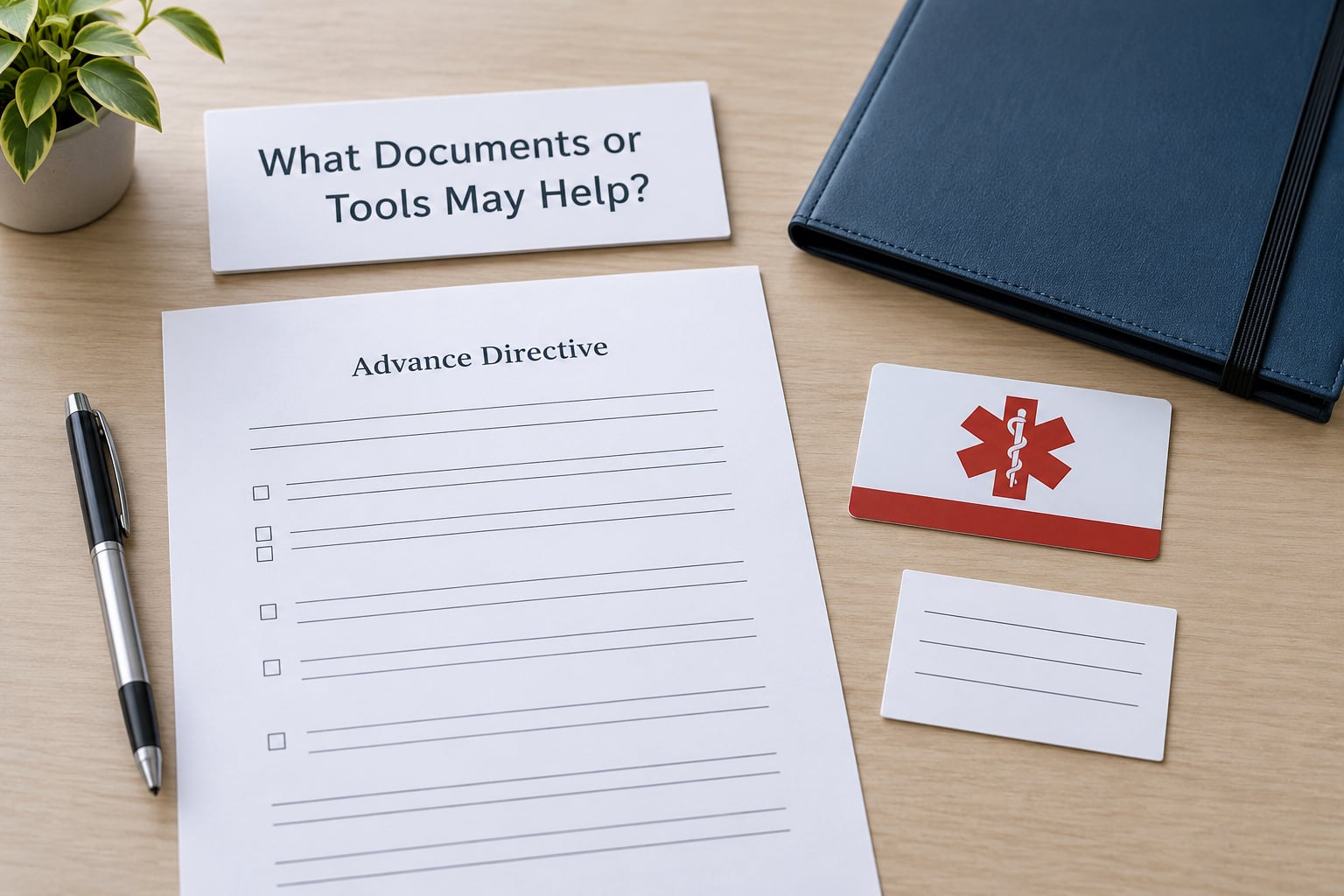
Start with your state health department, which will have a current form and often a registry. If your hospital system offers its own version, that is a reasonable second choice because staff there are used to reading it.
Patient and advocacy groups publish general guidance, and national projects on serious illness have produced plain-language materials that make the choices easier to talk about. The documents themselves need to meet your state’s requirements. Worksheets and conversation guides do not.
Do not assume a docuSign-style app or a binder makes the document valid. Signature rules differ by state, and some require witnesses to be present at the same moment you sign.
When Should You Review or Update It?
Set a reminder for once a year, then expect real changes earlier. Bring the document out for a conversation again when:
- you are diagnosed with a serious or chronic condition, or a new diagnosis changes what you would want done
- you have a hospital stay or major surgery
- your agent is no longer the right person, or one of your named backups has died, moved away or become unavailable
- you move to another state, since form names and witnessing rules change
- your goals shift, for instance after a period of recovery you did not expect
A directive written at 60 does not automatically describe the person you are at 78. Update it, sign the new version, and destroy the old copies so nobody finds two versions.
What Are the Common Mistakes to Avoid?
- Leaving it unsigned or unsigned in front of witnesses. This is the single most common reason a document does nothing.
- Vague or contradictory wording. Two sentences pointing in different directions get ignored in a hurry.
- Not naming anyone. A treatment wishes without an agent may still work, but only if the law in your state provides a fallback.
- Storing every copy in one place. A single fire, flood or move takes out the whole thing.
- Assuming filing equals availability. Health systems do not always surface an uploaded form when someone needs it in an emergency.
- Expecting it to outrank everyone. It guides decisions. It does not override a clinician acting in good faith, a court, or an emergency responder with no time to find it.
The most common problem of all is silence. A document nobody has read aloud is a piece of paper, and paper does not argue.
How Do State Laws and Medical Orders Affect an Advance Directive?
Requirements vary. Some states use their own statutory form and little else will be honored. Others accept a written statement from a person who has capacity, sometimes with witnesses, sometimes with notarization. Recognition across state lines is not uniform either, which is why re-signing after a move is the safe habit.
POLST and MOLST forms sit in a different category. They are completed with a clinician, signed, and carried with the patient so EMS can act on them directly. For someone with advanced illness, advanced frailty or a specific prognosis, that is the more useful document, and many clinicians will bring one up during a serious conversation.
Local law and local advice should settle legal questions. A state’s health department can tell you what its form requires, and a qualified attorney in your state can tell you whether yours will hold up in the situation you are worried about.
When Does an Advance Directive Take Effect?
It takes effect when a health care professional determines you lack decision-making capacity to make that particular decision. Capacity is decision-specific, so a person can be able to choose where to eat but not able to consent to surgery.
A diagnosis alone does not activate it. A terminal diagnosis, a stroke or a scan result do not transfer authority. Until capacity is gone and someone documents that finding, you remain the decision maker and your own spoken wishes control.
That is also why naming an agent matters. When capacity is intact your agent has an advisory role; when it is not, their authority becomes real and legally recognized.
What If There Is No Family or No Clear Health Care Proxy?
Ask about an alternate agent and a second backup, and consider someone outside your immediate circle who knows you well. A friend, a coworker of many years, or a neighbor you trust can serve.
In the hospital, a social worker can help locate a legally authorized surrogate, and an ethics committee can review a disputed case. States also have statutory procedures for appointing a representative for someone who cannot decide and has no agent, but those routes cost time and control, and a judge decides.
That is the practical argument for the backup line on the form. It costs you one sentence now, and it can save weeks later.
Frequently Asked Questions
Do I need a lawyer to make an advance directive?
Usually not. Most states publish a free statutory form that is valid when completed correctly, signed, and witnessed or notarized where required. A lawyer is worth consulting when your situation involves a guardian, a conflicted family, out-of-state treatment, or wishes that fall outside the choices printed on the form.
Can I change or cancel an advance directive?
Yes. Write a new one at any time as long as you still have decision-making capacity, and it replaces the old version from the date it is signed. Tell everyone who holds a copy, ask your doctor and hospital to update your chart, and destroy the earlier copies so nobody finds two conflicting documents.
Can my family override my advance directive?
They are not supposed to, and a valid directive generally controls over family preference. In practice a relative who refuses to accept it may push for a legal guardian, which takes time and can delay care. Naming a willing health care agent, keeping copies in the chart, and discussing your wishes in advance are the best defenses against that delay.
Does an advance directive apply to mental health care?
It can, but most standard forms focus on physical illness and life-sustaining treatment. Some states and some forms include mental health treatment preferences, such as whether you would consent to involuntary hospitalization during a crisis. If mental health decisions matter to you, ask for the specific form your state recognizes rather than assuming a general directive covers it.
How often should I share my advance directive with my doctor?
Once after you sign it, then again after any change, and at every new doctor, hospital or care team. Ask them to confirm the copy is in your chart, since a document submitted online may not surface when it is needed. Keep your agent current too, since they are the person carrying your wishes into the room.
Pick one thing to do first: download your state’s official advance directive form this week. Read it with the person you would choose as your health care agent, answer the prompts out loud, sign it with whatever witnesses your state requires, and then hand over copies before you forget. A conversation and a signature take less time than a single hospital week.