To write a persuasive opinion piece, you argue a position you can defend, prove each reason with evidence you can name, answer the strongest objection against you, and tell your reader what to do next. It takes most people two to three drafts. The hard part is rarely the writing; it is choosing a fight worth having and finding evidence that survives contact with people who disagree with you.
This guide works for a school newspaper, an op-ed, a letter to your council, a scholarship essay, or a piece for a community publication. The mechanics are the same in all of them.
Table of Contents
- What You Need to Write a Persuasive Opinion Piece
- Step-by-Step: How to Write a Persuasive Opinion Piece
- Choose a focused, debatable topic
- Prepare to write a persuasive opinion piece
- Find credible evidence and understand opposing views
- Build an outline that makes the argument easy to follow
- Draft clear topic sentences and evidence-led paragraphs
- Write an ethical and memorable conclusion
- Revise, fact-check, and format the final draft
- Common Mistakes
- Frequently Asked Questions
- How long should a persuasive opinion piece be?
- What is the difference between a persuasive opinion piece and an argumentative essay?
- How many sources should I use in a persuasive opinion piece?
- Can persuasive writing use personal experiences?
- What tone should I use when disagreeing with an opposing view?
- How do I conclude a persuasive opinion piece?
- Conclusion
What You Need to Write a Persuasive Opinion Piece
Five things have to be in place before you write a single body paragraph, and a piece that skips any one of them tends to read like opinion rather than argument.
- A focused topic. One debatable question you can settle in the space you have, not a sprawling issue.
- A clear position. A sentence stating what you think, phrased so a reasonable person could disagree with it.
- A named audience. The actual reader, and where they already stand.
- Credible evidence. Sources you can attribute out loud, gathered before drafting rather than during.
- A format requirement. Word count, length, deadline, style rules, citation format.
Get the word count in writing before you start. A 600-word op-ed and a 2,000-word essay need different amounts of evidence, and a piece written for one and trimmed to the other usually loses its counterargument section, because that is the first thing a strict cut takes.
Audience is the one most people skip, and it changes everything. A piece for a school audience can assume shared context and use first person freely. A piece for a council meeting cannot assume you will be read politely, and it needs to concede the objections a councillor will actually raise.
Step-by-Step: How to Write a Persuasive Opinion Piece
Seven steps, in the order that saves the most work. Two of them happen before drafting, which is where most drafts go wrong.
Choose a focused, debatable topic
A topic is good when a reasonable, informed person could disagree with you about it. That single test rules out most bad topics in both directions.
Too settled: people do not argue about whether the moon exists, so there is nothing to persuade anyone of. Too raw: a subject where your audience is already mobilised against you, where your job becomes damage control rather than argument. The workable middle is a live question with real disagreement on both sides and no obvious winner.
Run a candidate topic through three questions before you commit:
- Could someone smart disagree? If no, there is no argument here, only a description.
- Why does it matter, to you specifically? A reason you actually have beats a reason you assembled for the assignment.
- Can you find three sources on each side? If the opposing side has no writing at all, you have picked something settled.
Then narrow it. “School phones” is not a topic, it is a subject area. “Should phones be collected at the door during the school day, and what should replace them during class” is arguable, scoped, and answerable. Narrowing is usually the step that converts a vague interest into something you can actually write about.
One more check: what does your reader already believe? If they agree with you on every sub-point, your piece has nothing to do and readers will skip it. The ideal stance is “agree with me on this, but you do not yet accept this” — you are extending something they already hold rather than demanding they surrender it.
Prepare to write a persuasive opinion piece
Before drafting, write down three sentences: who the reader is, what you are claiming, and why you are claiming it. Keep them visible while you work.
Your thesis needs a claim and a reason, not just a claim. “School phones should be banned” is a claim with no argument attached. “School phones should be banned from classrooms because they measurably split attention, and the alternatives are already in staff hands” tells the reader what the rest of the piece will do.
A useful thesis can be disagreed with. If no sentence could be argued against, you have written a topic statement, not a thesis. Test it by finishing the sentence “a reasonable person might object that…” — if nothing comes, the topic is too settled.
Set the register at the same time. School publications usually tolerate more first person; op-eds and letters to officials need firmer, third-person-heavy diction. Writing an opinion column means you can be present in the piece, which is a different job from making a case in a letter.
Find credible evidence and understand opposing views
Evidence quality is a ranking problem, not a hunt. From strongest to weakest: primary data and named research you read directly, reporting from outlets with a corrections policy and named authors, expert commentary, published opinion from someone with standing on the issue, and social posts — useful for showing that a sentiment exists, worthless for proving a fact.
Two rules. Attribute inline, in the same sentence as the number, so the reader never has to guess where it came from. And never use a figure whose original context you have not read, because the number is almost never the problem — the problem is that it measured something slightly different from what you are claiming.
Forum writers ask constantly where good sources come from, and the honest answer is dull: search the topic, then read what the other side cites. Search results give you headlines, not understanding.
Then read the strongest version of the opposing argument before you write your own. This is the step that most improves a draft and the one most people skip.
Here are the three terms worth defining cleanly, because writers use them interchangeably and the sloppiness shows:
- Counterargument — the opposing position stated fairly, in words its holder would accept.
- Counterclaim — your one-sentence version of that position, which you then argue against.
- Rebuttal — your response showing why the counterclaim does not defeat your claim.
When you read the other side, note two things: the points where they already agree with you, which you can concede cheaply and which buys you credibility, and the point where the argument genuinely splits. That split is the real subject of your piece.
Aristotle’s Rhetoric gives you three places to look for persuasive force, and it is still the cleanest frame. Ethos is why you are worth listening to. Logos is whether the reasoning holds. Pathos is what the outcome means for the reader. Most weak pieces lean entirely on ethos or pathos; the piece that works carries all three, in roughly that order.
Build an outline that makes the argument easy to follow
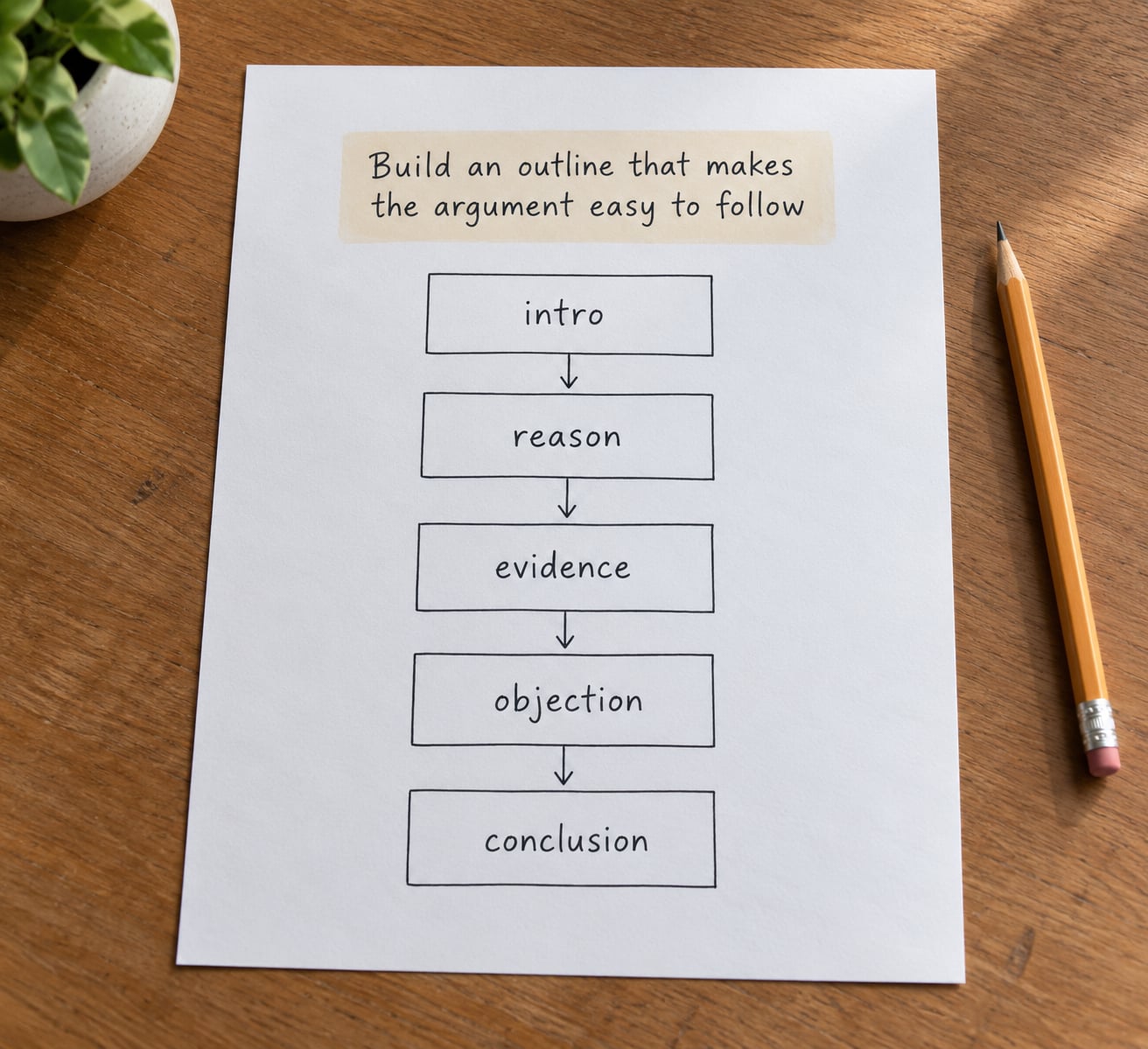
An outline is not a formality. It is how you find out that your third reason is really your first, or that you have two reasons and no argument.
Write one line per paragraph saying what that paragraph must accomplish. A useful outline looks like this:
- Introduction — earn attention, establish stakes, state the claim and the main reason.
- Reason one — the claim, then the evidence, then why the evidence supports it.
- Reason two — same shape, and it must not repeat reason one’s ground.
- Counterargument — the strongest objection, in the opponent’s own framing.
- Rebuttal — concede what is true, then show why it does not defeat the claim.
- Conclusion — the claim restated in new words, plus what the reader should do.
Three reasons is usually right for a piece under 1,500 words. Four is fine in a long essay. Two is usually an underdeveloped argument, and five is usually two arguments pretending to be one.
Any paragraph that tries to do two jobs — introduce and argue, or argue and rebut — will read as a block. Give each one job.
Draft clear topic sentences and evidence-led paragraphs
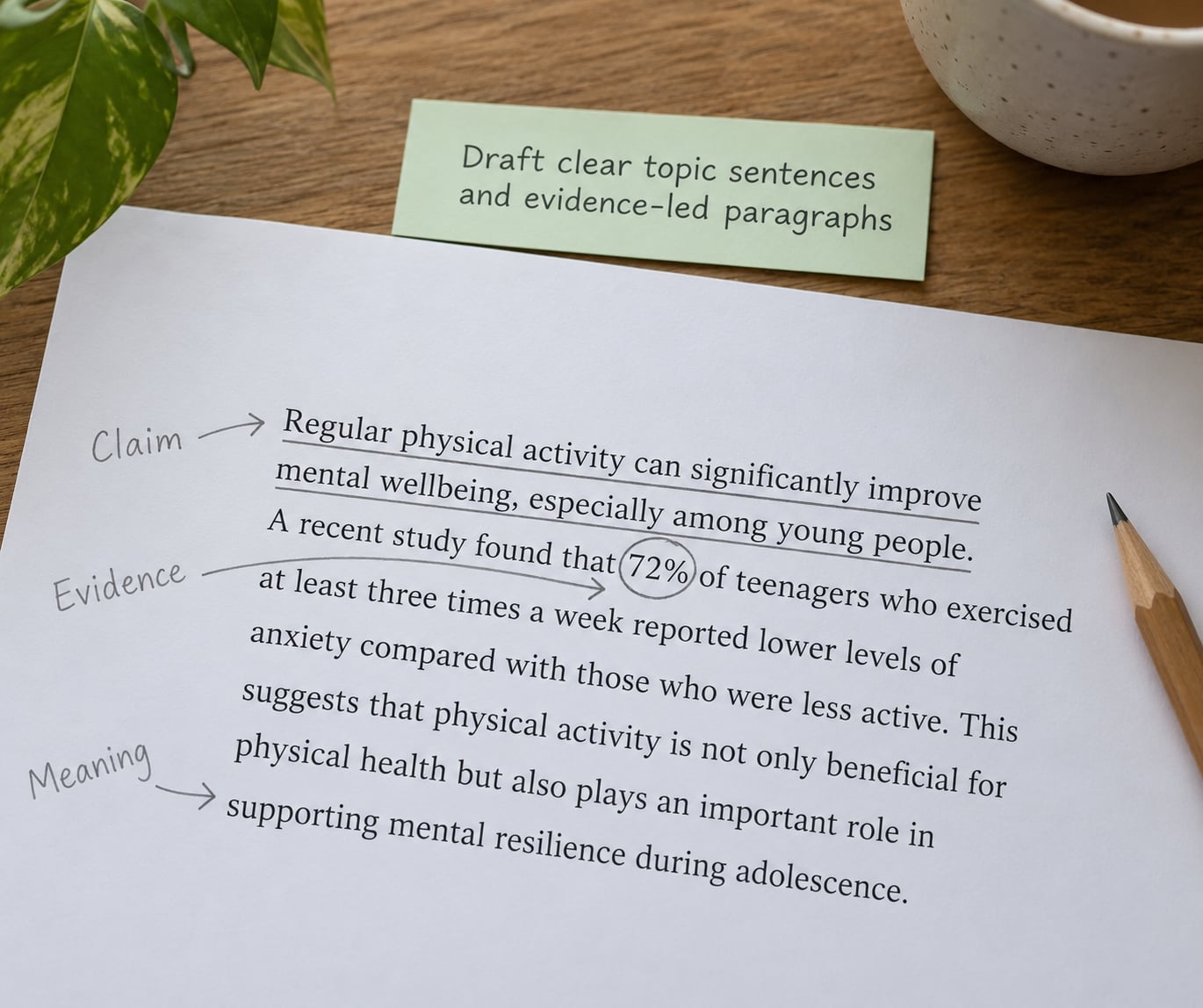
A body paragraph in persuasive writing does five things in order: state the reason, explain it, give the evidence, interpret the evidence, and connect it back to the thesis. Most drafts skip the fourth.
That skipped move is what “link and dump” looks like: a statistic appears, the paragraph moves on, and the reader is left to work out what it means. Interpretation is the sentence that says what the evidence shows, why it is relevant to your reason, and why it does not quietly prove something else.
Here is an illustrative paragraph with each move labelled, so you can see the shape:
[concrete scene] Last Saturday, the doors of the Carnegie branch library stayed shut until noon, and eleven people stood on the pavement waiting. [reason] Cutting weekend hours at a branch library punishes exactly the residents who have the least control over their schedules. [evidence] Circulation at the branch fell faster than anywhere else in the system after the change. [interpretation] A number like that is not a sign of declining interest; it is a sign that the service stopped being available to the people who used it most. [link back] Hours are the whole argument here, which is why restoring them costs the city less than any alternative on the table.
Nothing in that paragraph is impressive to look at. What makes it work is that every sentence has a job, and the reader never has to guess what any sentence was for.
Topic sentences should state the reason in language a reader could disagree with. “There are several problems with the policy” commits you to nothing. “The policy penalises shift workers by design, because the hours it protects are the hours shift workers do not work” is arguable.
Transitions should show the reasoning rather than announce it. “Furthermore” and “in addition” only tell the reader another sentence is coming. “That matters because it undercuts the argument on cost” tells the reader why.
On voice: the active voice is almost always the right default for persuasive writing, because active sentences put a named actor in front of a verb. On diction, precision beats intensity. One specific number, correctly attributed, persuades harder than three adjectives.
Write an ethical and memorable conclusion
Your conclusion has four moves: restate the claim in new words, synthesise the strongest reasoning, answer the counterargument one final time, and end on a recommendation.
Restating means restating. Copying your thesis word for word tells the reader you ran out of material. “The council should restore the Carnegie branch’s weekend hours” says something your introduction did not.
Do not introduce a new argument here. A fact that appears only in your conclusion is a fact the reader had no chance to weigh, and it reads as a trick even when it is honest.
End with what you want the reader to do. A council wants a specific motion. An editor wants a specific attitude changed. A teacher wants a specific rule questioned. “And that is why I disagree” is a shrug.
One thing to weigh before you publish: if you are arguing about a group you belong to, your credibility rests on knowing that group from the inside, and readers will assume you are advocating rather than describing. Concede something real about the difficulty, name who might reasonably disagree, and give the reader a reason to think you are not simply defending your own interests. On a community site, that concession is the difference between persuasion and marketing.
Revise, fact-check, and format the final draft
Read your draft once for the argument and once for the sentences, never both at the same time. Argument revision takes about ten minutes if you have a clear list of what to check.
- Read only the first sentence of each paragraph. They should form an outline of the argument. If they do not, the paragraph order is wrong.
- Check every citation resolves. Open each source, confirm the number is there, confirm it means what you claim.
- Find your counterargument. If a reader cannot name the opposing view from your piece alone, you have not stated it fairly.
- Find the paragraphs doing two jobs and split them.
- Check the ending against the opening. If they are near-identical sentences, rewrite the ending.
- Read the hook aloud. If it needs context to make sense, it is not a hook.
- Cut hedges that carry no information — “it is important to note”, “in many ways”, “arguably”.
- Confirm format: word count, citation style, headline length, submission deadline.
Then check the word count last and cut from the middle rather than the argument. What usually goes is the second illustration in an otherwise strong paragraph, and almost never the counterargument section.
Common Mistakes
These are the failures I see most often, each with the fix that actually changes the draft.
- Announcing the essay. “In this piece I will argue that…” buys you nothing. State the claim and start earning it.
- A too-thick opening. An introduction that runs four sentences before the reader knows what you think is usually an introduction doing two jobs. Move background into the section that needs it.
- A vague thesis. If no one could disagree with it, sharpen or abandon it.
- Evidence with no interpretation. After every statistic, write the sentence saying what it means. This is the single highest-value edit in the whole process.
- One giant block paragraph. Long paragraphs hide the structure from a skimming reader. Cut them into topic + support.
- No counterargument. Omitting the objection makes the piece read naive, because every informed reader supplied it for you.
- A rebuttal that misses. If your rebuttal argues against a weaker version of the objection than the one you actually read, the reader notices.
- Loaded or emotive substitutions. Words like “obviously” and “just common sense” invite the reader to check your reasoning instead of following it.
- An ending that copies the opening. Restate it in new words, then add the call to action.
Five short habits that help more than most tricks: draft the counterargument paragraph before your final body paragraph, so you know what you are building toward; write the thesis last, after the argument has settled; keep a running list of every number you cite and where it came from; read the draft out loud once; and cut the first paragraph you wrote in full.
Frequently Asked Questions
How long should a persuasive opinion piece be?
A persuasive opinion piece runs 600 to 1,000 words for a letter or op-ed, 1,000 to 1,500 for a class publication or column, and 1,500 to 2,500 for a formal essay. The length is set by the venue and the requirement, not by how much you have to say. If you must cut, cut the second illustration in a paragraph, never the counterargument section.
What is the difference between a persuasive opinion piece and an argumentative essay?
There is almost none in the writing itself, and the difference is in where it runs. An argumentative essay is assessed, often assigned, and judged against a rubric. A persuasive opinion piece is published to a real audience who did not request it and can ignore it. The same structure serves both; the stakes for the reader are what differ.
How many sources should I use in a persuasive opinion piece?
Enough to prove each of your reasons, and no more. In practice that is four to eight sources for a piece under 1,500 words, with at least two coming from the opposing side so your counterargument is grounded rather than invented. Quality beats quantity: three sources you read directly and can attribute out loud beat twelve headlines you skimmed.
Can persuasive writing use personal experiences?
Yes, as evidence about your own experience rather than as proof about everyone else’s. A story establishes why the issue matters to you and gives the reader a concrete reason to care. It does not establish that a policy is wrong for a whole population. Pair it with data before you treat it as a general claim.
What tone should I use when disagreeing with an opposing view?
Use the register your venue expects and keep the target the argument rather than the person making it. Write the counterargument in language its holder would accept, concede what is genuinely true in it, and argue against the reasoning. Loaded words and sarcasm invite a reader to defend the tone instead of engaging with the claim.
How do I conclude a persuasive opinion piece?
Restate the claim in new words rather than copying your thesis, synthesise the strongest reason in one sentence, answer the counterargument a last time, and end with what you want the reader to do. A specific recommendation beats a summary. Do not introduce a new argument in the conclusion, because the reader has no earlier evidence to weigh it against.
Conclusion
Start by writing your thesis as one sentence, then gather the single strongest piece of evidence that supports it. Read the best version of the argument against you before you write the third paragraph. Revise for interpretation after every statistic, check each citation, and cut once you hit your length.
If you follow that order, most of the hard part of learning how to write a persuasive opinion piece happens before drafting, which is where it belongs. What the finished piece is trying to change is the reader’s next action, and every choice above is measured against that.