
To spot logical fallacies in a debate, do four things in order: pull out the speaker’s central claim, test whether the evidence actually bears on it, check the step from premise to conclusion, and name the pattern only if the gap is one you recognize. Most fallacies are identifiable in about a second once you hold roughly a dozen names, and you can practice on any argument you disagree with today.
A logical fallacy is a flaw in reasoning that has no bearing on whether a claim is true but makes the claim sound more convincing than it deserves. The reasoning breaks; the conclusion is not automatically false. That distinction is the single most useful thing this topic offers, because plenty of readers hear “fallacious” and assume “guilty.”
One honest warning before the steps. Naming a fallacy does not prove the other side is wrong, and it does not end the exchange. On r/badphilosophy, writers push back hard on fallacy-spotting used as a weapon to re-orient an argument instead of clarify it, and that criticism is fair. The goal is a better conversation, not a win.
Table of Contents
- What You Need
- Step-by-Step: How to Spot Logical Fallacies in a Debate
- Step 1. Isolate the claim before you judge the argument
- Step 2. Test whether the evidence actually supports the claim
- Step 3. Examine the step from premise to conclusion
- Step 4. Name the pattern from the seven most common logical fallacies
- Step 5. Check whether the flaw carries the whole argument
- Step 6. Respond with a request, not a verdict
- Step 7. Avoid the common mistakes that turn analysis into a fight
- Frequently Asked Questions
- Is it rude to point out a logical fallacy in someone’s argument?
- Does using a logical fallacy mean the conclusion is wrong?
- What if I can’t find a fallacy in an argument I disagree with?
- What are the 7 common logical fallacies?
- Can ChatGPT identify logical fallacies?
What You Need
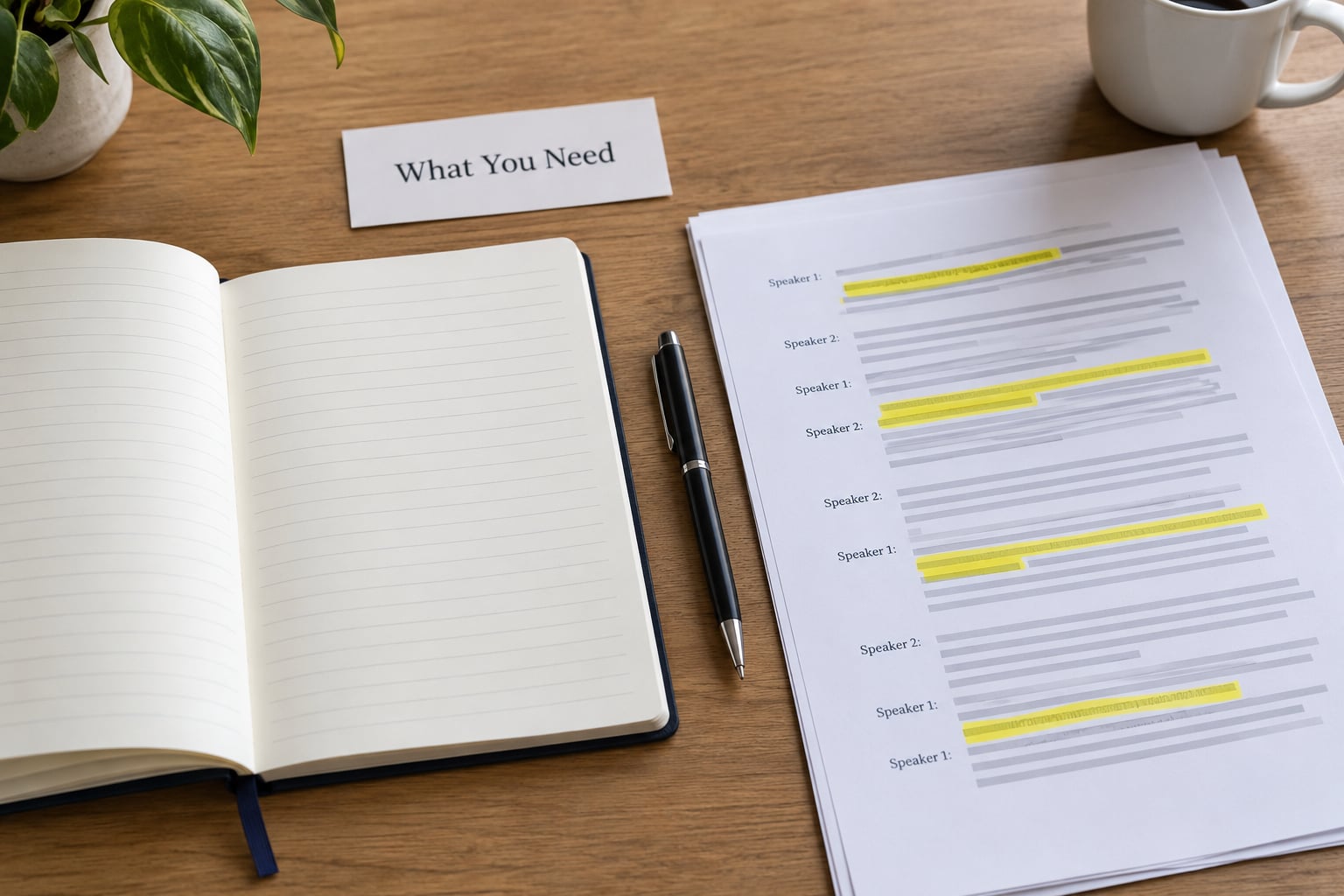
You need four things before the debate starts, and none of them cost money or require software. Without them, you will react to whatever sentence came last rather than to the argument.
The central claim. What is the speaker actually asking you to accept? Write it as a single sentence with a verb: “This policy will reduce crime,” not “Crime is a serious problem.” A claim you cannot state in one sentence has not been made yet.
The speaker’s reasoning. The path from premises to conclusion, including everything skipped over it. You need this in writing or as a note, because you cannot reconstruct it accurately from memory after it is gone.
The relevant context. Definitions, time frames, and what is actually up for debate. Most heated disagreements turn out to be two people answering different questions.
A recording method. Three columns are enough: claim, evidence, and flaw. A phone note or the margin of a printed transcript both work. One warning: if you are also trying to follow a live exchange on stage, write fewer words than you think you need.
Seven names worth memorizing cold. Ad hominem, straw man, false dilemma, slippery slope, appeal to authority, appeal to emotion, and hasty generalization. Those seven cover the large majority of what you will hear in classrooms, comment sections, town halls, and family conversations. The full list below adds five more.
Step-by-Step: How to Spot Logical Fallacies in a Debate
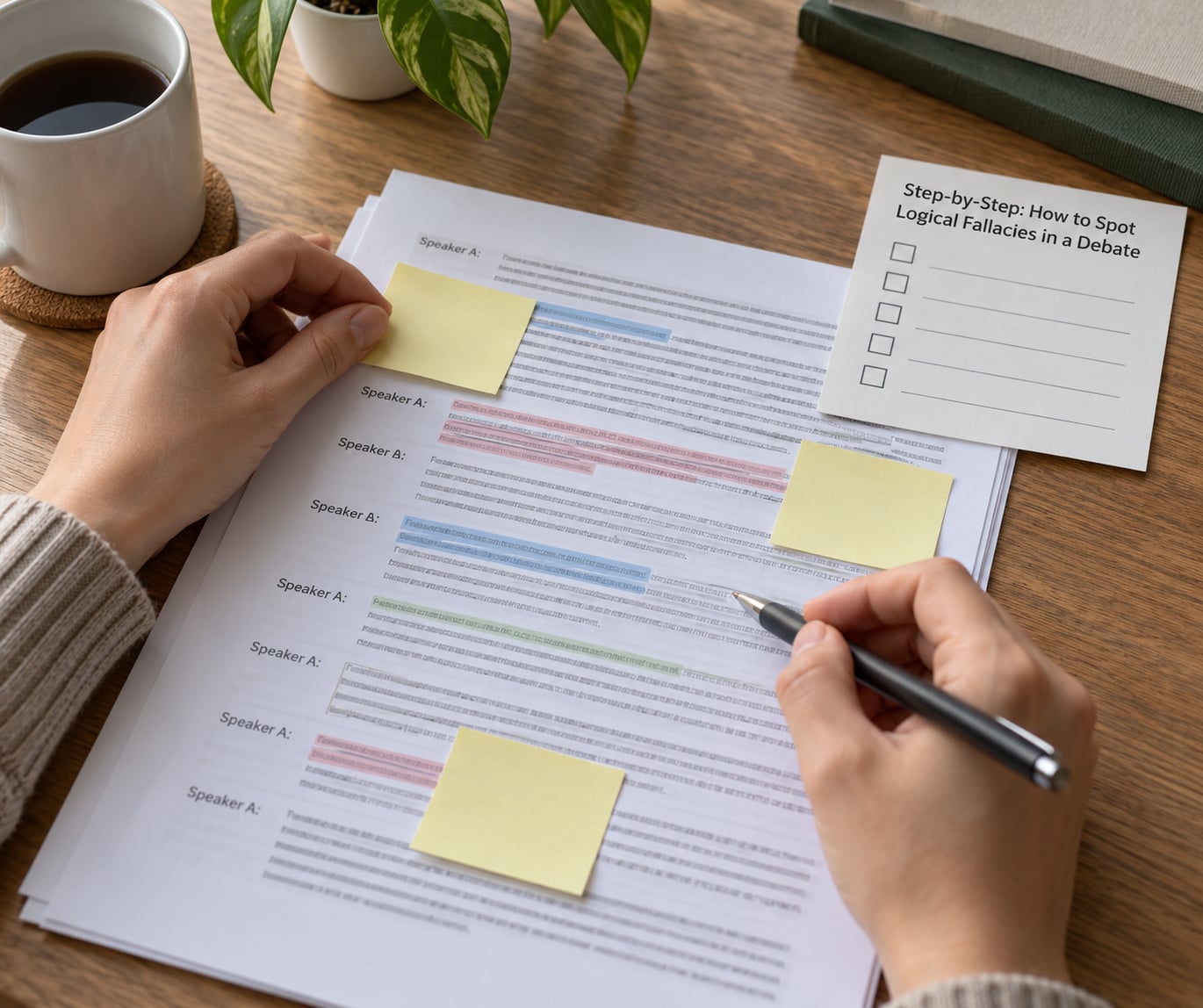
Seven steps, in order. The first three are diagnostic and slow. The last four are the fast moves you use once you already suspect something.
Step 1. Isolate the claim before you judge the argument
Start by writing the speaker’s central claim in your own words, one sentence, without their adjectives. Everything else they said is either support, illustration, or atmosphere. This is the step most people skip, and skipping it is why half the arguments you get heated about were never in dispute.
Separate four things carefully: the claim, the evidence offered for it, personal remarks about the speaker, and pure commentary. A debater can commit an ad hominem and still have made a good point thirty seconds earlier. Bundling them means you end up rejecting the whole argument when only one strand failed.
How to tell it worked: you can state the claim without using the word “should” or “obviously.” If your version needs those words to hold together, you have probably captured their confidence rather than their position.
Step 2. Test whether the evidence actually supports the claim
Ask three questions about every piece of evidence: is it relevant, is it credible, and does it say what the speaker says it says? Relevance first. Evidence that is true, well sourced, and about a different subject supports nothing, which is how a red herring works when it works well.
Credibility means checking whether the source could actually know. An expert on soil chemistry has no special standing on election security. Watch for reverse substitution too: nobody in a debate cites a blog post as evidence of a fact when the blog was written to argue the fact.
How to tell it worked: you can restate the evidence in your own sentence and the connection to the claim still holds. If you cannot restate it, the speaker has not given you evidence, they have given you a tone of voice.
Resist one bad habit here: a false conclusion is not a fallacy. Plenty of people reach a wrong conclusion through perfectly sound reasoning from flawed premises. That is an error in the premises, not a flaw in the reasoning, and confusing the two leads you to the wrong diagnosis.
Step 3. Examine the step from premise to conclusion
Put the premises on one line and the conclusion on the next, then look at the bridge. If the conclusion would still follow if the premises were true, the reasoning is fine even when the premises are shaky. If it would not follow, the problem is in the bridge, and that is where fallacies live.
Unsupported jumps are the ordinary kind: someone moves from “some teachers grade unfairly” to “grading is broken across the board.” Reversed causality shows up as “people who succeed do not need help, so help does not work.” Hidden assumptions go unnamed and then get treated as settled, usually something like assuming a single cause for a complicated outcome.
Overgeneralization is the same jump with better odds of escaping notice. Two counterexamples do not disprove a pattern, and three supportive anecdotes do not establish one. Look also at equivocation: when the same word means one thing in the premise and a different thing in the conclusion, the argument only appears to work.
How to tell it worked: you can say exactly which bridge is broken, in one sentence, without needing a Latin name. If all you can say is “that feels off,” you have stopped at step one or two.
Step 4. Name the pattern from the seven most common logical fallacies
Once you know the bridge is broken, match it to a name. Seven cover most real debates, and each has a phrase that gives it away.
1. Ad hominem — attacking the person instead of the claim. Listen for: “you can’t take this seriously from someone who…” The person’s history may matter for credibility, but only after their argument is on the table, and only on the specific claim.
2. Straw man — replacing the opposing position with a weaker version. Listen for: “so you’re saying we should just…”. You did not say that, and nobody holds the view you just described. If you catch yourself nodding along to a summary you would not accept if it came from a friend, that is the tell.
3. False dilemma — presenting two options when more exist. Listen for: “either… or…”. Real policy questions usually have a middle option nobody wants to fund. “Reject the policy entirely” against “keep it exactly as it is” is a choice nobody sensible is actually making.
4. Slippery slope — stacking unlikely consequences until the conclusion sounds absurd. Listen for: “next thing you know…” and “and then”. One step is fine. Four undocumented steps, each one hypothetical, is not a forecast.
5. Appeal to authority — treating someone’s status as proof. Listen for: “an expert says”. Sometimes the expert is exactly right. Check whether the person cited is an expert in this field, and whether they actually said that.
6. Appeal to emotion — using feeling in place of evidence. Listen for stories that end just before the policy question. Concern about a child harmed by a decision is legitimate and morally serious; it is not a measurement of how often that harm occurs.
7. Hasty generalization — building a rule from too little. Listen for: “everyone I know”, “my friend said”. A pattern drawn from one hallway is not a pattern, and telling it back to the speaker as a finding tends to end the conversation badly.
| Fallacy | What it sounds like | Worked example | How to respond |
|---|---|---|---|
| Ad hominem | “You can’t take that seriously from him” | A student cites a textbook; the other debater replies with the student’s record | “Set the record aside. What does the textbook say, and does it hold up?” |
| Straw man | “So you want zero oversight” | “More oversight” restated as “no limits on inspection” | “I said more oversight. What number did you have in mind?” |
| False dilemma | “Either fund it fully or admit it failed” | A transit program is offered as all-or-nothing funding | “Which third option are we leaving out?” |
| Slippery slope | “Next thing you know, nobody can…” | A zoning change leads, by three hypotheticals, to total collapse | “Let’s check the first step. Is that step documented?” |
| Appeal to authority | “A leading expert says so” | A physiotherapist is cited on budget policy | “Is that their field, and did they say that in writing?” |
| Appeal to emotion | “Imagine a child in that situation” | A moving anecdote stands in for crime statistics | “That case matters. How common is it? Let’s get the count.” |
| Hasty generalization | “Everyone in that office is like that” | Two confrontations become a claim about a whole department | “How many people is that based on? What’s the base rate?” |
| Appeal to ignorance | “No one has proven otherwise” | A claim is defended because it has not been refuted | “What evidence would settle it? Has anyone looked?” |
| Red herring / whataboutism | “What about what they did years ago?” | A question about budgets turns into a question about the other side’s record | “Let me finish the budget question first.” |
| Circular reasoning | “He is credible because people trust him” | A source is verified by the reputation of those who cite it | “What independent record would confirm that?” |
| Equivocation | The same word, two meanings | “The policy failed” means no benefit, not that every target missed | “Which sense of ‘failed’ are we using here?” |
| Bandwagon | “Thousands of people agree with me” | Support is offered as proof of correctness | “How many, and what is their basis?” |
Two structural distinctions help here. A formal fallacy is invalid on its face: the conclusion cannot follow from the premises, whoever is talking. An informal fallacy depends on content, credibility, or context, which is why the ones above need a conversation to confirm. In a live debate you will hear informal fallacies constantly and formal ones rarely, because a visibly invalid argument loses quickly on stage.
Step 5. Check whether the flaw carries the whole argument
This is the step that keeps you honest. Identifying a fallacy tells you the reasoning failed, not that the conclusion is wrong. A conclusion can be true and argued badly, and a sound argument can land on a false claim because a premise was false. On r/JordanPeterson, the thread that circulates most on this point is blunt about it: pointing to a fallacy “just does not make it false.”
So before you press the advantage, ask whether the speaker offered anything else. Sometimes a fallback, an analogy, or a direct example survives the broken bridge. Sometimes it does not, and then the argument really is in trouble. If a known liar’s argument is self-refuting, using that is fair play, as noted in r/DebateReligion, where writers point out that judging the source is legitimate in exactly that case.
Two more fallacies live at this level rather than in the bridge. The fallacy fallacy is reasoning that a claim is false because the argument for it was fallacious. The dialectical fallacy treats any disagreement as a contest to be won rather than something to be understood, which is usually what makes a conversation turn into a fight.
How to tell it worked: your reply targets the specific bridge and asks for a better one. If your next sentence is “so you are just wrong,” you have stopped analyzing.
Step 6. Respond with a request, not a verdict
The wording matters more than the diagnosis. A neutral response names the problem in the reasoning, not the person, and asks for what is missing. It usually takes less than a sentence, and it works on stage, in a comment section, and across a dinner table.
Ask for evidence: “Which data are you basing that on?” Ask for the missing premise: “What has to be true for that to follow?” Restate fairly before you object: “If I understand you, you’re saying we should drop the program entirely, and here’s why I don’t think that holds.”
Name the pattern only when the phrasing will not work without it, and pair it with a question: “This looks like a false dilemma to me. Which option am I missing?” If it is not worth a real question, it is not worth the interruption. On r/allthequestions, people describe spotting fallacies as good clean fun, then immediately ask whether it is rude; the answer in practice is that a question is nearly always welcome and a correction delivered as a verdict rarely is.
Step 7. Avoid the common mistakes that turn analysis into a fight
Naming every disagreement a fallacy. Most disagreements are just disagreements. If you cannot say which bridge broke, say you think the evidence is weak and leave it there.
Treating confidence as evidence. Loud delivery, technical vocabulary, and interrupting are performance, not reasoning. A speaker who talks fastest is not thereby more right.
Ignoring missing context. Two people arguing about “safe,” “fair,” or “working” are often conducting a jingle-jangle dispute, where a shared definition would end the fight. Fixing the definition first takes ten seconds and settles more debates than any rebuttal.
Debating the character instead of the argument. You have crossed into the fallacy yourself, which is the fastest way to lose a room.
Using the list as a weapon. A catalogue of fallacy names lets you end discussions by intimidation rather than by reasoning. If you cannot restate your opponent’s position to their satisfaction, you have not refuted it, and they know it.
Two honest options remain when you find no flaw. Say the argument is weak rather than fallacious, which is often exactly right and much harder to argue with. Or steelman it, state the strongest version you can build, and then answer that version. Building the strongest form of the other side’s position is the single most persuasive thing a debater can do, and it takes about thirty seconds.
Frequently Asked Questions
Is it rude to point out a logical fallacy in someone’s argument?
Usually not, if you point at the reasoning and ask a question. What reads as rude is delivering the name as a verdict with no interest in an answer, especially when the person is mid-sentence or on stage. Pair the name with a genuine request, restate their position fairly first, and pick your moment. In a classroom or a moderated space, naming fallacies is normal and expected.
Does using a logical fallacy mean the conclusion is wrong?
No. A fallacy is a flaw in reasoning, not a verdict on truth. A true claim can be defended badly, and a false one can be defended well by coincidence. What identifying a fallacy reliably tells you is that the reasoning will not hold up under scrutiny, so the argument needs rebuilding rather than the speaker needing to be silenced.
What if I can’t find a fallacy in an argument I disagree with?
Most likely the argument is weak but not fallacious, which is more common than people expect. Weak means the evidence is thin, the reasoning is loose, or a premise is false, and none of those break down under their own weight. Say what is missing instead of reaching for a name. Not every disagreement is a fallacy, and readers on r/NoStupidQuestions and r/askphilosophy reach that conclusion more often than the internet suggests.
What are the 7 common logical fallacies?
Ad hominem, straw man, false dilemma, slippery slope, appeal to authority, appeal to emotion, and hasty generalization. Between them they cover most fallacious arguments you will meet in debates, classrooms, meetings, and comment sections. The giveaway for each is a characteristic phrase or move: attacking the person, restating a weaker version, offering only two options, stacking hypothetical consequences, citing status, leading with a story, or generalizing from two examples.
Can ChatGPT identify logical fallacies?
It can label candidates quickly and it will often be right about the obvious ones such as ad hominem, straw man, and false dilemma. The failures are consistent: it names fallacies for arguments that are merely weak, it confuses a false conclusion with flawed reasoning, and it will go further than the text supports when asked to be confident. Use it to draft a list of candidates, then check each one against the claim yourself.
Start with step one. Write the claim, check the bridge, and only reach for a name when you can point at the specific place the reasoning fails. Everything after that is practice, and you get practice for free on the next argument you read.