
Propaganda is communication built to move you rather than inform you, and you can recognize a propaganda technique by naming what the message does: which emotion it triggers, which device it borrows, and what it leaves out. Seven steps do it, and the whole process takes a few minutes once you have them.
Most people already sense when something is manipulative. Fewer can say which tactic is running. That gap matters, because a named technique tells you exactly where to apply scrutiny instead of leaving you to argue about whether you liked the tone of a post.
This guide covers the seven devices most media-literacy courses teach, the broader playbook beyond them, and the part most guides skip — how to stop short of calling everything propaganda. A political advertisement is persuasion. Propaganda is persuasion with the exits removed.
Table of Contents
- What You Need Before You Analyze Anything
- Step-by-Step: A Seven-Step Method to Recognize a Propaganda Technique
- 1. Identify the exact claim in the message
- 2. Classify the emotional appeal
- 3. Check the source and who benefits
- 4. Trace the evidence behind the claim
- 5. Recognize a propaganda technique by name
- 6. Consider what the message leaves out
- 7. Reach a measured conclusion
- Common Mistakes in Recognizing Propaganda
- Quick Tips for Stronger Judgment
- Frequently Asked Questions
- What is the fastest way to recognize a propaganda technique?
- Can a truthful message still use propaganda techniques?
- How can I tell the difference between propaganda and biased opinion?
- Why do propaganda messages so often use fear or anger?
- Should I share a message if I suspect it is propaganda?
- What if the evidence supports the claim but the source is hostile?
- Conclusion
What You Need Before You Analyze Anything
Four things, and three of them cost nothing.
- The original message. Not a screenshot of a screenshot, not someone’s cropped quote. Find the full post, article, video or flyer so you can read what came before and after the sentence that stopped you.
- The source and the date. Who published it, who paid for it, and when. A technique borrowed from a 1954 campaign manual is worth different attention than a post from six hours ago, because the evidence available to check it is different.
- A quiet interval. A few minutes away from the feed. Urgency is itself a pressure tactic, and you cannot think carefully while your pulse is doing the reading for you.
- Two or three verification tools. Reverse image search, a search of the claim’s exact wording in quotation marks, and a reputable fact-checking outlet you actually trust. These are browser features and free sites.
That is the whole setup. If you have those four things, you can work through any message.
Step-by-Step: A Seven-Step Method to Recognize a Propaganda Technique
Work these in order. The sequence matters because later steps are wasted if you have not yet isolated what is actually being claimed.
1. Identify the exact claim in the message
You cannot evaluate a claim you have not written down. Most propaganda works because the central factual claim is buried inside opinions, predictions and vivid imagery.
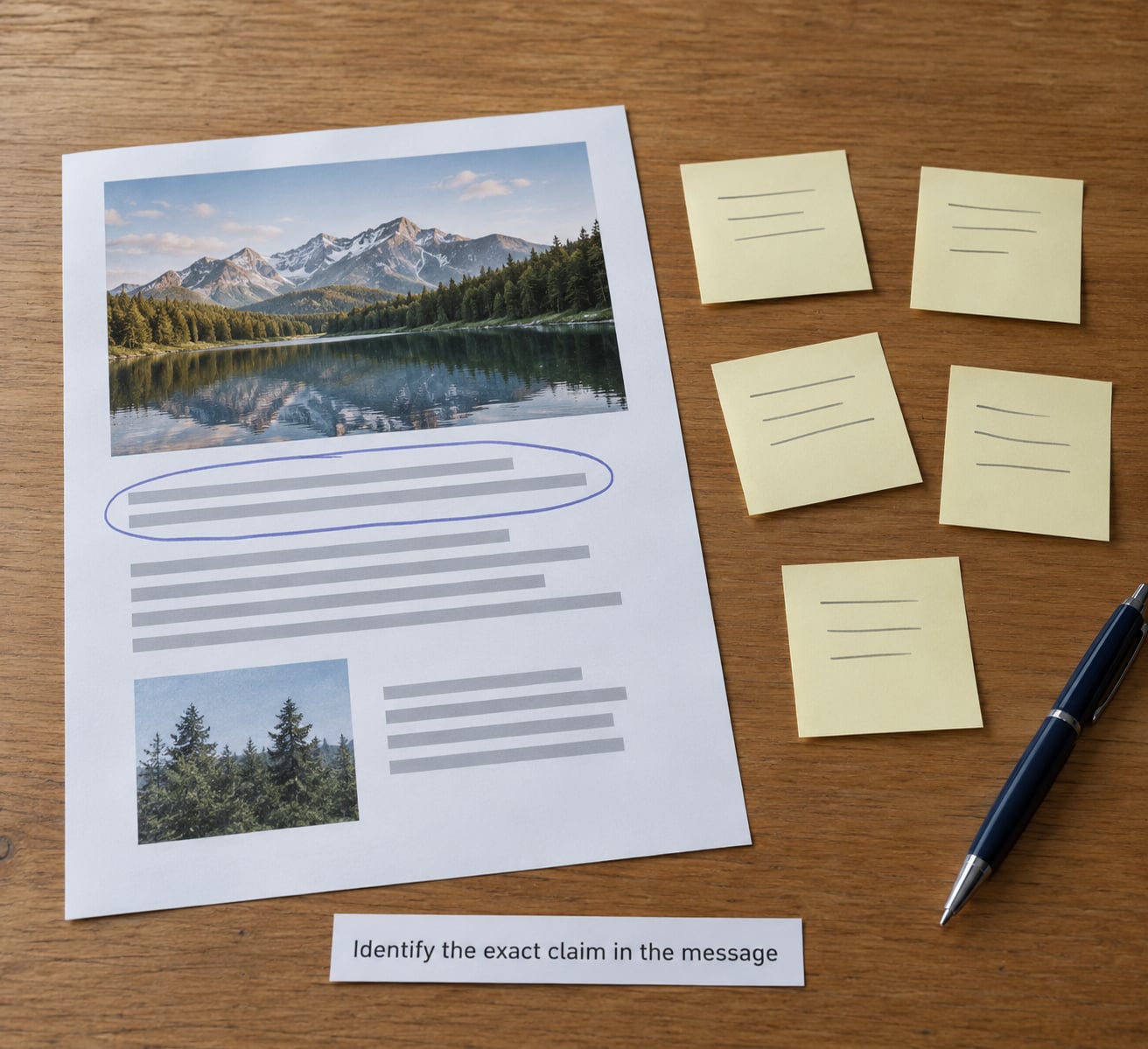
Take the message and split it into four buckets: what is asserted as fact, what is predicted, what is described, and what is felt. Only the first bucket can be checked against evidence.
Worked example. A post says: “City council gutted the safety budget, and now residents are paying the price.” The checkable claim is that the safety budget was cut by the council. The rest is prediction and consequence framing.
Rewrite the claim in your own neutral words. “The council reduced the safety budget by 18% in the fiscal year ending June.” If you cannot rewrite it neutrally, the message has probably not made a testable claim at all — which is its own finding.
2. Classify the emotional appeal
Emotion is the delivery system. Propaganda techniques borrow a feeling and then attach a conclusion to it, so the conclusion feels earned before you have looked at anything.
The appeals to watch for are fear, anger, hope, disgust, pride and urgency. Fear points at an enemy or a catastrophe. Anger points at a person or group held responsible. Hope points at a promised future. Disgust points at something framed as beneath contempt.
The diagnostic question is not whether the emotion is strong. Strong feelings about real injustice are honest. The question is whether the feeling arrived before the evidence, and whether removing the emotional language would leave the argument standing. If the case disappears when you strip out the fear, the fear was carrying it.
3. Check the source and who benefits
Three questions do most of the work here: who is the author, who is the audience, and what is the potential impact if people act on it. This author-audience-impact triad comes straight from the US Holocaust Memorial Museum’s teaching materials, and it is the fastest way to separate news from recruitment.
Trace the funding. Look for a byline, an organization name, a disclosure or a sponsor. Follow the author to their previous work and notice who pays them. A message with no identifiable author, no corrections policy and no contact route is asking for trust it has not earned.
Then ask who gains if you accept the claim. An organization hiring a specialist to warn about a chemical their product does not contain is not a neutral source on that chemical. Neither is a candidate’s spokesperson describing their opponent, a company’s post about its own safety record, or an advocacy group’s page about the funding it exists to oppose.
Stated as plainly as possible: the speaker, the audience and the payoff together tell you more than the tone of the writing ever will.
4. Trace the evidence behind the claim
Most propaganda never invents data. It repurposes data, which is harder to catch because the numbers themselves are real.
Follow the chain to the original: the study, the filing, the transcript, the recording, the court document. Ask three things. Where did this number first appear? Does the original say what the message says it says? Is the comparison valid, or has a percentage been swapped for a base rate?
A screenshot of a table is not evidence until you have found the table. A quotation is not evidence until you have heard the full sentence. A chart with no source line usually means the chart’s author did not want you to check it.
Search the exact wording in quotation marks. If a sentence you have never seen appears word for word across a dozen sites, you are looking at a syndicated or seeded claim rather than independent confirmation.
5. Recognize a propaganda technique by name
This is the step that turns a feeling into a diagnosis. Naming the device makes you checkable and makes the conversation productive, because the other person can argue with the label instead of shrugging.
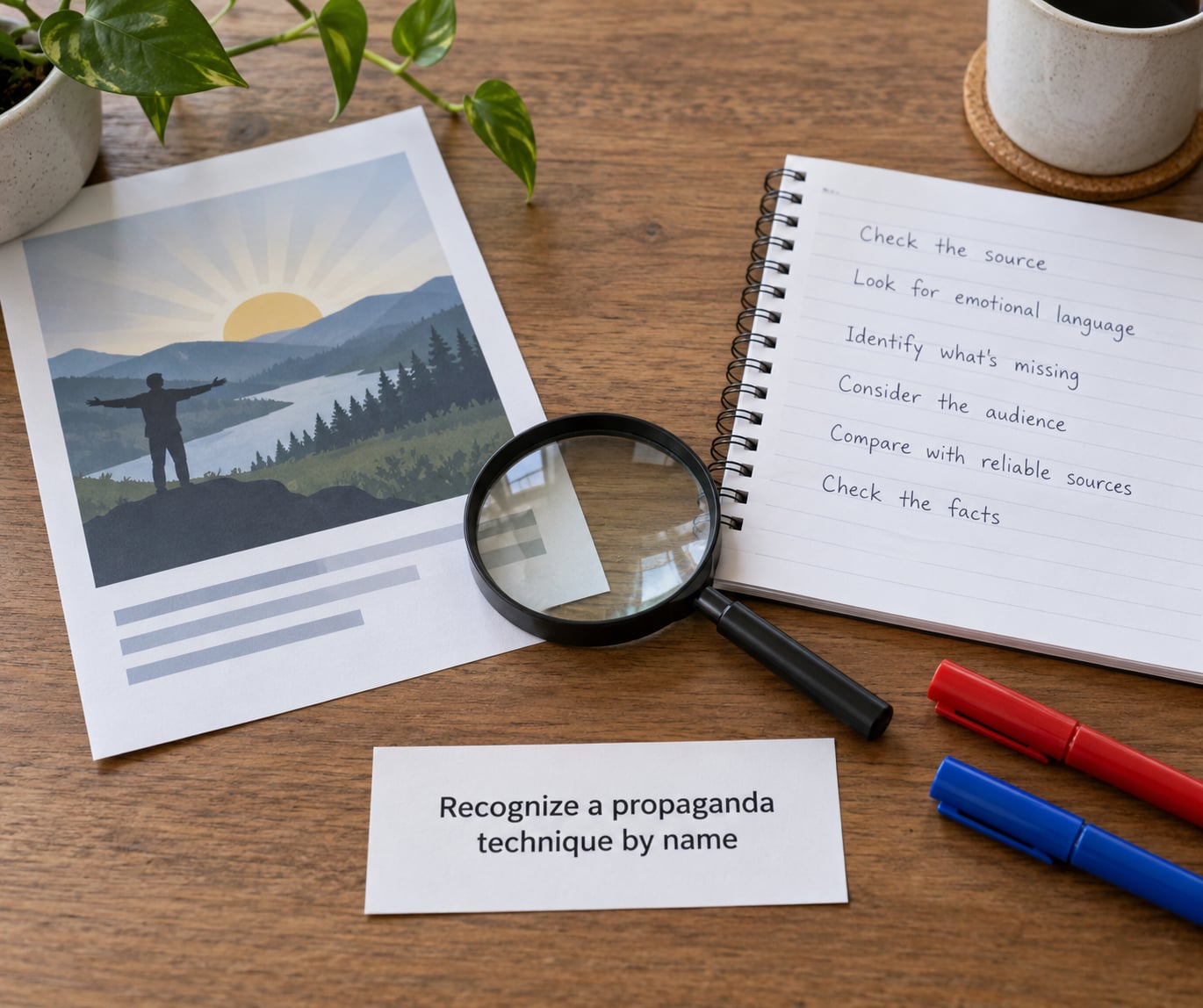
The seven devices below come from the Institute for Propaganda Analysis, which published its list in 1937 and analyzed advertising and wartime posters to train readers to spot technique rather than take it personally.
| Technique | What it does | Red-flag language | Everyday example |
|---|---|---|---|
| Bandwagon | Urges you to join the majority | “Everyone knows,” “millions have already,” “join the thousands” | A product ad that leads with a counter of existing customers |
| Name-calling | Attacks the opponent instead of the argument | “They are the problem,” “corrupt,” “enemies of” | A campaign ad that spends its whole minute on the other party’s character |
| Glittering generalities | Substitutes a vague virtue for evidence | “Freedom,” “family values,” “our proud heritage” | A speech praising a nation’s greatness with no specific claim attached |
| Plain folks | Borrowed credibility from an ordinary persona | “As a mother,” “I’m just like you,” “folks down the street” | A CEO filmed in a diner talking about work ethic |
| Testimonial | Uses a name to borrow trust | “Dr. Smith recommends,” “real results,” “as seen on” | A supplement advertised with an unnamed physician and a stock photo of results |
| Transfer | Moves prestige or emotion from one thing onto another | Flags, uniforms, logos, references to national greatness | A bank shown beside monuments and family photographs |
| Card stacking | Gathers favourable facts and omits the rest | A long list of positives with no comparison and no downside | An employer’s recruitment page listing every benefit and no workplace data |
Beyond the seven, a wider playbook is worth knowing. Each of these works the same way — borrow a familiar reaction and skip the evidence.
- Appeal to fear warns of catastrophe unless you act now.
- Appeal to prejudice leans on an existing dislike of a group.
- Guilt by association links a claim to someone already condemned.
- Whataboutism redirects scrutiny to the opponent’s record.
- Scapegoating names one culprit for a complicated problem.
- A big lie repeats a falsehood until it feels familiar.
- A half truth tells something true inside a frame that inverts its meaning.
- Gish gallop floods you with so many claims, some of them true, that checking them all seems pointless.
Two more modern patterns matter for anyone who scrolls. Agenda setting works by deciding which questions you ask: a feed that runs twenty stories about one threat has decided what is on your mind that week. Firehose of falsehood repeats a claim across many outlets at once, so that the volume reads as consensus and no single source needs to hold up on its own.
You will see the label “propaganda” used for three different things, and the difference is worth keeping straight.
- Misinformation is false and shared in the belief that it is true.
- Disinformation is false and shared on purpose.
- Propaganda does not require falsity at all. A truthful statistic placed where it does the most work is still propaganda.
6. Consider what the message leaves out
Selective framing is the technique that survives fact-checking, because everything on screen is accurate. The failure is in the cropping.
Ask what a fair account would also include. A five-year achievement presented alone omits four earlier ones. A risk rate presented without the population it applies to overstates it. A complaint quoted without the reply that followed it reverses its meaning. A chart that starts at a convenient axis makes a small change look like a collapse.
The question that catches the most: what would this message have to concede to be fair? A message with nothing to concede is usually not making an argument, it is running a frame.
7. Reach a measured conclusion
Rate the claim in one of four buckets, and write the bucket down.
- Supported — the original evidence exists and says what the message claims.
- Misleading — every fact is accurate, but the framing, the crop or the omission changes the reasonable conclusion.
- Unsupported — no evidence either way; you cannot confirm it.
- False — the original evidence contradicts it.
Then decide what to do with it. Silence is usually the strongest response to a message built on repetition and reaction. Correcting privately works when one person is confused rather than mobilized. Public correction is worth it only when the claim is spreading widely, and even then lead with the evidence rather than the accusation. Naming the technique in your reply, calmly and specifically, tends to drain some of its force.
Common Mistakes in Recognizing Propaganda
The most common error is not being fooled. It is over-calling, which trains people to dismiss your analysis entirely.
Judging propaganda only by whether you agree with it. This is the big one. If hostile messages are propaganda and friendly ones are not, the word means “disagree with me.” A genuine union flyer praising a pay rise and a corporation’s flyer praising the same pay rise are both persuasive; whether either crosses into propaganda depends on technique and intent, not direction.
Treating emotional content as automatically false. Emotion is evidence of intent, not of error. A video of a grieving family can be entirely accurate and still manipulative. Equally, an angry person’s account of an injustice can be completely true.
Trusting polish. Professional design, confident narration and a clean logo are signs of budget. Historically the best propaganda has been made by skilled designers with unlimited resources, which is exactly why visual quality tells you nothing about accuracy.
Dismissing inconvenient evidence. If a source you dislike cites a real document, the document stays real. The correct move is to check the document, not to discount the person. That habit costs credibility every time it fails in public.
Confusing disagreement with deception. Two credible outlets can disagree sharply and both be telling the truth. Disagreement signals that the evidence is thin or contested. Deception means someone knows better and is not telling you.
Quick Tips for Stronger Judgment
Run the reverse image search before reading anything else on an image. Scam images and recycled photos get caught here in seconds, while the caption’s tone reads as trustworthy.
Check the publication date on the original, not the reshare date. A genuine article recirculating is common; a fresh account with a five-year-old photo is not the same thing.
Read one paragraph above and one below the claim. Most cropped quotes reverse their meaning in the surrounding context, which is why quoting the middle is so effective.
Consult two sources that do not cite each other. If every site repeating a claim links back to the same press release, you have found one source wearing thirty hats.
Apply a cooling-off rule: nothing outrage-inducing gets shared by you within an hour of arriving. Most regrettable posts are regretted for exactly that interval.
Ask which technique you personally find hardest to spot. Most people are fluent in name-calling and hopeless at half truth, which is where selective framing does its quietest work.
Frequently Asked Questions
What is the fastest way to recognize a propaganda technique?
Isolate the central factual claim, then ask what emotion is carrying it. Fear pointing at an enemy, anger pointing at a scapegoat and hope pointing at a promised rescue are the three fastest signals. A fourth check takes seconds: search the claim’s exact wording in quotation marks and see whether the same sentence appears across many unrelated sites. Repeated identical wording usually means one source, not many.
Can a truthful message still use propaganda techniques?
Yes, and this is the part most people get wrong. Propaganda is defined by purpose and technique, not by falsity. A real statistic shown without its base rate, a genuine celebrity endorsement with no disclosure of the payment, or a fair-sounding appeal to shared values can all steer you accurately and without your consent. That is why the named technique matters more than whether the facts survive a check.
How can I tell the difference between propaganda and biased opinion?
Bias is a lean in the selection and framing of accurate material, and it exists on a spectrum. Propaganda is communication built with the aim of producing a particular response rather than informing. Two tests separate them. Ask whether the author names an opponent or an enemy, and ask whether the message offers any update path, any correction route or any concession. Bias leaves gaps. Propaganda closes them.
Why do propaganda messages so often use fear or anger?
Fear and anger produce urgency, and urgency suppresses the checking behaviour you would normally use. Both also narrow attention: fear fixes it on a single threat, anger fixes it on a single target. Neither requires deep understanding of the issue, which is convenient, because the sender rarely wants you reading the underlying evidence. The emotional state is doing the persuading so that the content does not have to.
Should I share a message if I suspect it is propaganda?
Usually not, and the reason is practical rather than moral. Repetition is the engine of most propagation, so a share adds reach to a claim you have not verified. If the message matters to you, correct it privately with the original evidence attached. Reserve a public response for claims spreading widely, and lead with the evidence rather than accusing the person who posted it.
What if the evidence supports the claim but the source is hostile?
Then the claim is probably true, and you should say so plainly. Hostile sourcing is a reason to check harder, not a reason to dismiss. Check that the original document says what the source says it says, then weight the claim by its evidence rather than by the source’s intentions. Over time, a pattern of one-sided sourcing is worth naming separately from any single claim you declined to repeat.
Conclusion
To recognize a propaganda technique, do four things in order: write down the exact factual claim in neutral words, name the emotion carrying it, trace the evidence to its original source, and ask what the message leaves out. Then name the device — bandwagon, name-calling, glittering generalities, plain folks, testimonial, transfer or card stacking — so your objection is specific rather than a feeling you cannot defend.
The discipline that keeps this useful is restraint. Labeling every disagreement as propaganda makes the analysis worthless to the people you most want to reach. Persuasion is everywhere and mostly harmless. Propaganda is what you look for when the argument has been built so that checking it feels pointless.