How to prepare for wildfire smoke indoors comes down to four things: keep outdoor air out, force every bit of indoor air through a high-efficiency filter, pick one room to make much cleaner than the rest of the house, and know in advance what you will do about heat, pets, and medications. Most of the work takes one afternoon, and doing it before smoke arrives is far easier than doing it while the sky is orange.
This guide is written for households in the United States and Canada. Smoke can travel hundreds or thousands of miles, so a hazy sky often means a fire you cannot see. As of 2026, the guidance below still matches what the U.S. Environmental Protection Agency, AirNow, and the CDC recommend, and nothing here replaces advice from your own doctor or pharmacist.
Table of Contents
- What You Need
- Step-by-Step: How to Prepare for Wildfire Smoke Indoors
- 1. Check Local Air Quality and Smoke Forecasts
- 2. Identify and Prepare a Cleaner Indoor Room
- 3. Make Your HVAC and Air-Cleaning Plan: How to Prepare for Wildfire Smoke Indoors Through Filtration
- 4. Set Up Particle-Reducing Protection
- 5. Prepare Masks, Medications, and Daily Supplies
- 6. Plan for Children, Older Adults, and Health Risks
- 7. Know When to Leave, Seek Shelter, or Get Help
- Knowing When It Is Safe to Open Up Again
- Common Mistakes
- Opening windows and doors to let the smell out
- Running a fan that blows outdoor air indoors
- Assuming a mask alone is the plan
- Buying an ionizer or ozone generator
- Placing the air cleaner too far away
- Staying home during an evacuation order
- Frequently Asked Questions
- Is it okay to run AC during wildfire smoke?
- Do air purifiers get rid of wildfire smoke indoors?
- What two things should you do before a wildfire approaches your house?
- How long does wildfire smoke stay in your lungs?
- Can breathing in wildfire smoke make you sick?
- What if I rent, or my home has no central HVAC?
- Conclusion
What You Need
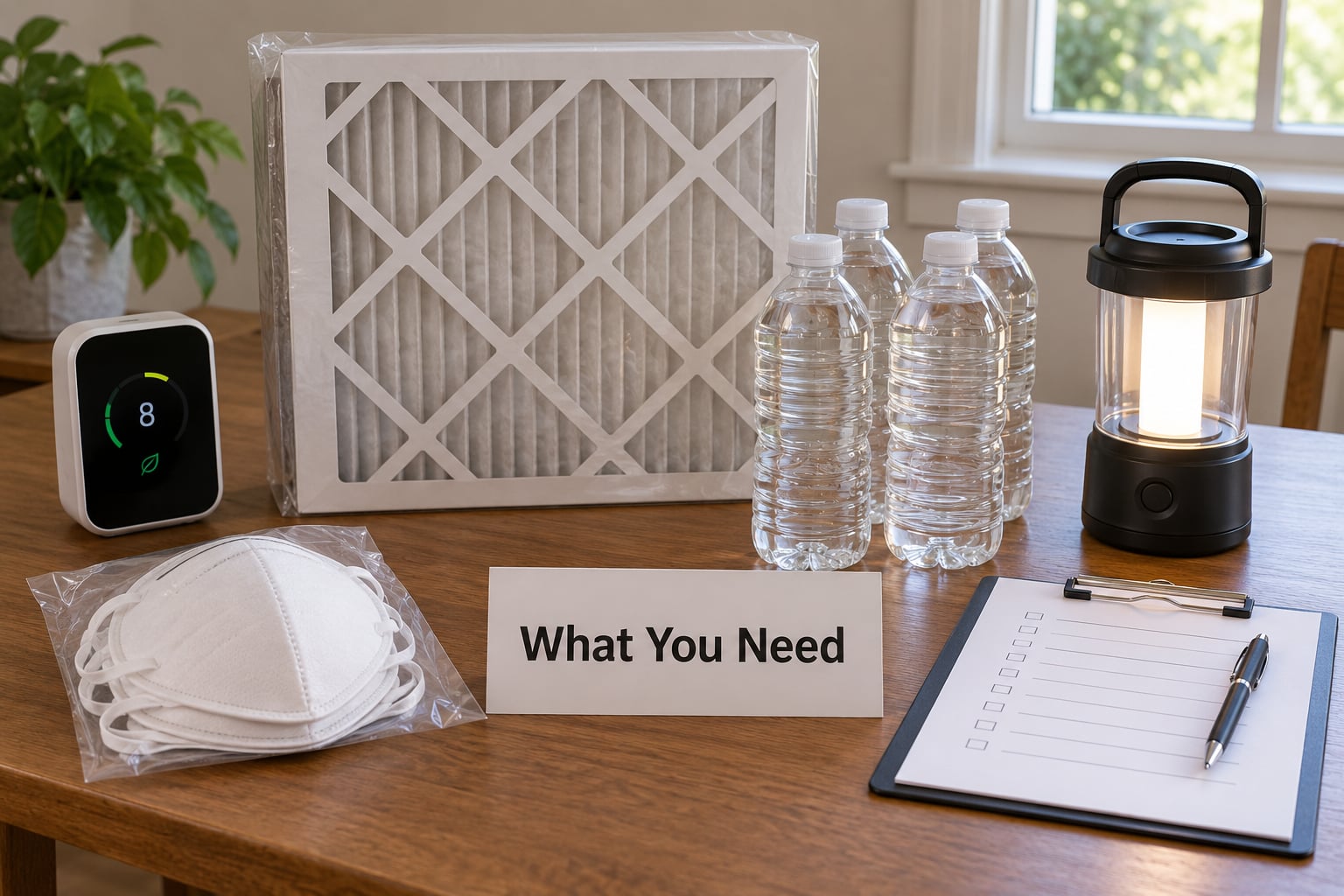
Gather these before the season starts, not during it. When smoke arrives, hardware stores and delivery times are the least reliable things in your week.
- A way to watch air quality. The AirNow Fire and Smoke Map on airnow.gov, the AirNow mobile app, and your state or local health department’s alerts. Bookmark all three on your phone.
- An indoor PM2.5 monitor if you can get one. A sensor that reads a few micrograms before smoke and a few hundred during smoke tells you what your eyes and nose cannot.
- Your HVAC filter size and rating. The printed model number is usually on the side of the filter or the label inside the filter cabinet. Note whether your system is compatible with a MERV 13 filter.
- Spare high-efficiency filters. Filters load up in a couple of weeks during heavy smoke, not the usual three months. Keep enough for repeated changes.
- A portable HEPA air cleaner, or a box fan and furnace filters if you want to build your own cleaner. Size it to the room, not the house.
- NIOSH-approved N95 respirators, one per person who goes outdoors. Adults and teens usually fit an adult size. Small children often do not, and a respirator that does not seal does not protect.
- Sealing supplies: removable weatherstripping, door sweeps, painter’s tape, and foam sealant for gaps you find.
- Thirty days of prescriptions that matter, plus a written list of health conditions, doctors, pharmacy number, and emergency contacts in one place.
- No-cook food, bottled water, flashlights, and battery banks. Stay low on cooking, because frying, broiling, candles, incense, and fireplaces all add indoor pollution.
Step-by-Step: How to Prepare for Wildfire Smoke Indoors
1. Check Local Air Quality and Smoke Forecasts
Start with information, because every later decision hangs off it. On airnow.gov, look at the Fire and Smoke Map for your county, then check the local forecast and public health alerts for smoke and evacuation notices.
Know your baseline before it matters. When the local AQI is good, note the number, and compare your indoor sensor reading against it. During smoke days, act on the guidance for your group: AQI around 100 means unhealthy for sensitive groups, and 150 or higher means unhealthy for everyone.
You know you are ready when you can answer three questions without logging in to check again: what the AQI is right now, what it will likely be tonight, and whether officials have issued an evacuation order. Evacuation instructions outrank every air-quality number on this page.
2. Identify and Prepare a Cleaner Indoor Room
One good room beats a half-done attempt at the whole house. Choose the smallest bedroom or den with an attached bathroom, fewest windows, and one doorway you can close. Concentrate your people, pets, supplies, and filtration in that single room rather than chasing perfection across a whole home.
Close the door, seal gaps around it with painter’s tape or weatherstripping, and put the supplies you gathered inside. You know it is done when, standing outside the room with the door shut, your indoor sensor in the hallway reads meaningfully higher than the sensor inside.
Sleep there, work there, and keep pets there if you can. Keep household members in that room rather than moving through the rest of the house, since the smoke that gets tracked from room to room on clothing and bedding is the slow leak most people miss.
3. Make Your HVAC and Air-Cleaning Plan: How to Prepare for Wildfire Smoke Indoors Through Filtration
If you have a central forced-air system, its filter is the single most useful thing you own during smoke. MERV 13 or higher catches most fine particles before they circulate. Check your equipment manual or label first, because a filter rated too high for your system can restrict airflow and stress the blower.
Set the system to recirculate, which means indoor air goes through the filter instead of through the fresh-air intake. On most thermostats that is the AC or fan setting rather than heat or a vented setting. If your system has a fresh-air or economizer damper, close it.
Expect to change filters more often than the schedule says. A filter that would normally last a season can load up in two or three weeks of heavy smoke, and a loaded filter cuts airflow exactly when you need the system running. Keep checking the pressure drop or just rotate filters on a shortened interval.
You know the plan is working when the return grille ducting is noticeably cleaner after a day than it would be in a normal week.
4. Set Up Particle-Reducing Protection
Portable cleaners handle the room the HVAC system cannot reach, which in most homes means a bedroom, a closed-off office, or a nursery. Choose a true HEPA unit rated for the square footage of your cleaner room, and run it on high for the first hour after smoke arrives. That initial hour in a closed room clears the air faster than almost anything else you can do that day.
Place the unit where it pulls dirty air toward it, not tucked in a corner where it pulls from only a few feet. Keep doors to the cleaner room mostly shut so the machine works on a smaller volume of air instead of chasing smoke through the whole house.
Building a Corsi-Rosenthal style cleaner is a legitimate option: a box fan blowing into a large filter, sized so air flows through the filter rather than around its edges. Do it carefully, never run one unattended overnight, and keep the fan and filter fully in contact with the housing. Skip it entirely if you cannot tell whether air is flowing through the filter face.
Stay away from ionizers and ozone generators. They do not remove particles, and several produce ozone as a byproduct, which is exactly the pollutant you cannot afford during a smoke event.
5. Prepare Masks, Medications, and Daily Supplies
Put NIOSH-approved N95 respirators in the cleaner room and in every bag that leaves the house. A cloth covering, a surgical mask, or a dust mask does not filter fine particles, which is the fraction that reaches the deepest part of the lungs.
Keep a 30-day supply of prescriptions, and keep the written health summary with them. If a pharmacy runs short or closes, the summary is what lets a clinician or an urgent care provider help fast. Ask your doctor before smoke season if you want a written plan for managing a flare.
Plan for a day indoors without cooking, driving, or power. Keep ready-to-eat food, water, charged phones, battery banks, and a flashlight where people can reach them without going outside or through a smoky hallway.
6. Plan for Children, Older Adults, and Health Risks
Watch smoke exposure more closely for children, adults over 65, pregnant people, and anyone with asthma, COPD, heart disease, or diabetes. For a school-age child, cut outdoor practice, recess, and sports during smoke days and move them indoors rather than pushing through it.
Reduce exertion indoors too. Cooking, cleaning, playing with a lively dog, and carrying laundry all raise the volume of air a person breathes in, which matters more than usual when that air is polluted.
Know the warning signs. Shortness of breath, chest tightness, wheezing, coughing that will not settle, or symptoms that return after a smoke event cleared are reasons to contact a healthcare professional promptly. Severe breathing trouble, confusion, or blue lips or fingertips are emergencies.
Pets are exposed alongside you. Keep them in the cleaner room rather than outside, bring bowls and litter indoors, and talk to your veterinarian about a plan if your animal has asthma, heart conditions, or a flat-faced breed that struggles with breathing.
7. Know When to Leave, Seek Shelter, or Get Help
An air cleaner and a mask cannot make a dangerous home safe. If your local officials issue an evacuation order or a shelter-in-place order, follow it, and take your written health summary and medications.
If a cleaner air room is not something you can manage, look for cleaner air nearby: a public library, a community center, a school with a filtration system, a shopping mall, or a designated shelter. Local public health departments publish the locations near you.
Watch for an indoor reading that stays high despite filtration, symptoms that build through the day, or a house that is also dangerously hot. Each of those is a reason to call a clinician, a local emergency number, or 911, depending on severity.
Knowing When It Is Safe to Open Up Again
Do not judge the end of a smoke event by smell alone, because your nose adapts within hours. Wait until the local AQI and your own monitor both return to their pre-smoke baseline, usually below 12 micrograms for sensitive groups, and stay there for a sustained period.
Then open up gradually. Air the cleaner room first, then the rest of the house, and run a portable cleaner while you do it, since opening windows pushes a fresh wave of fine particles indoors.
Clean damp, not dry. Run a HEPA vacuum if you have one, and wipe surfaces with a damp cloth. Dry dusting and standard vacuums throw fine particles back into the air, which is why people cleaning up after smoke often feel worse indoors before they feel better.
Common Mistakes
Opening windows and doors to let the smell out
Smoke smells strong but does not settle out quickly, so an open window is an open door for fine particles. Windows and doors stay shut while the AQI is elevated. If the house becomes dangerously hot, follow local public health guidance on cooling instead of defaulting to open windows.
Running a fan that blows outdoor air indoors
A window fan or a whole-house fan on vent mode pulls smoke straight into the living space. Use exhaust fans only for the shortest time needed, and stop kitchen and bathroom range hoods that vent outdoors, because in a leaky house they pull smoky air in rather than clearing it.
Assuming a mask alone is the plan
A respirator protects you while you are outdoors. It does nothing for the hours you spend breathing indoors, which is most of a smoke day. Filtration and sealing do that work.
Buying an ionizer or ozone generator
These units leave fine particles in the room and can add ozone. A true HEPA or MERV 13 device with a published efficiency rating is the one that works.
Placing the air cleaner too far away
A small unit pushed into a corner of a large room moves air in a tiny circle. Size the unit to the room, place it in the open, and leave it running rather than switching it on for an hour a day.
Staying home during an evacuation order
No filter matters if the building is at risk. Evacuation notices come from local officials, not from air quality apps, and they override anything on this page.
Frequently Asked Questions
Is it okay to run AC during wildfire smoke?
Yes, running air conditioning is helpful, as long as the system recirculates indoor air instead of pulling in outdoor air. Set the thermostat to AC or fan rather than a fresh-air or vented setting, and close the fresh-air intake damper. On a window unit, set the vent lever to closed. The system then filters and cools the same air instead of bringing smoke indoors.
Do air purifiers get rid of wildfire smoke indoors?
Only units with true HEPA filtration or a MERV 13-or-higher rating capture the fine particles that matter, which are the PM2.5. Ionizer and ozone-generating models do not remove particles and can add ozone to the room. Run a properly sized unit continuously in a closed room during smoke, and keep the door mostly shut so it is not filtering the whole house at once.
What two things should you do before a wildfire approaches your house?
Upgrade your HVAC filter to MERV 13 or higher, with spares on hand, and set up a portable HEPA air cleaner in one small room you can seal. Those two moves do most of the work: filtration cuts the particles you breathe, and the closed room limits how much smoke enters in the first place. Also confirm your AQI source and evacuation contacts while nothing is urgent.
How long does wildfire smoke stay in your lungs?
Fine particles inhaled during a smoke event leave the lungs within days to a few weeks, but the effects do not end that quickly. Inflammation, irritated airways, and increased cardiovascular risk can continue for weeks afterward, and some people notice reduced exercise tolerance for a while. Anyone with existing heart or lung disease should ask their clinician about a written smoke-season plan.
Can breathing in wildfire smoke make you sick?
Yes. Fine particulate matter irritates the airways, triggers asthma attacks, and worsens heart and lung disease, and the CDC has documented a roughly 17 percent rise in asthma-related emergency department visits on smoke days nationwide. Children, adults over 65, pregnant people, and people with chronic conditions face the most risk. Seek medical care for persistent coughing, wheezing, or shortness of breath.
What if I rent, or my home has no central HVAC?
Your plan shifts to portable equipment. Put a true HEPA air cleaner in the smallest bedroom with a closed door, run it on high during smoke, and seal the gaps around that door with removable weatherstripping or painter’s tape. If you rely on a window AC or a ductless mini-split, close its fresh-air intake so it recirculates. Portable N95 respirators and a no-cook food supply finish the setup.
Conclusion
Start with information: bookmark AirNow’s Fire and Smoke Map, note your normal indoor PM2.5 reading, and set phone alerts for local smoke and evacuation notices. Then pick the smallest room with a bathroom, seal its door, move a properly sized HEPA cleaner into it, and upgrade your HVAC filter to MERV 13 if your system allows it.
Finish by staging the rest: NIOSH-approved N95s for anyone who goes outside, a 30-day supply of prescriptions with a written health summary beside them, and no-cook food and water. That work is quiet, it takes an afternoon, and it is the difference between managing a smoke day indoors and reacting to one. Learning how to prepare for wildfire smoke indoors ahead of time is the part most households skip.