A lease is a legally binding contract, and almost every line in it can be enforced against you: the rent and the late fee, the deposit deductions, the automatic renewal, the rent hike, the early break penalty. Most of what to check before signing a lease comes down to three things, and they are the same three that cause most disputes later: the full monthly cost, the deposit and fee rules, and the termination terms. Give yourself an unhurried hour with a pen, the whole document, and a phone camera before you sign.
This is general information about residential leases, not legal advice. Deposit limits, notice periods, and the clauses a landlord may never include all vary by state and city, so check your own local law before you rely on anything here.
Table of Contents
- What You Need
- Step-by-Step
- 1. Read the Lease From Start to Finish
- 2. Verify the Rent, Deposit, and Every Fee
- 3. Check the Dates, Term, and Renewal Rules
- 4. Inspect the Apartment and Document Its Condition
- 5. Clarify Utilities, Services, and Access
- 6. Understand Repairs, Pets, and Changes
- 7. Compare the Final Terms Before Signing
- Common Mistakes
- 1. Signing Without Reading Every Addendum
- 2. Treating a Security Deposit as the Last Month’s Rent
- 3. Assuming a Verbal Promise Changes the Lease
- 4. Failing to Test the Apartment Before Moving In
- 5. Missing Deadlines and Renewal Triggers
- 6. Not Keeping a Complete Copy
- Frequently Asked Questions
- Should I sign a lease before seeing the apartment?
- When signing a lease, who signs first?
- Can I get a copy of the lease to read before I sign?
- What makes a lease unenforceable?
- What are the red flags to watch for before signing a lease?
- How much can a landlord require as a security deposit?
- Conclusion
What You Need
Gather these before the review starts. Scrambling to find a document mid-signing is how people sign things they did not mean to.
- The complete lease. Every page, every addendum, every rider, and any rules document attached to it. Ask for a copy to take home before the signing appointment. You are entitled to read a lease before you sign it, and a landlord who refuses is telling you something useful.
- The listing details. The advertisement, the floor plan, and the amenities page, so you can compare what was promised against what is written.
- Your application file. Photo ID, proof of income, rental history and references, and whatever the screening criteria are.
- A ruler or tape measure, a phone camera, and a flashlight. For the inspection, not the desk review.
- Contact details for the landlord or property manager and, if you have one, a local tenant rights organization or legal aid number.
- A calendar. Every date in the lease goes in it immediately: start date, renewal deadline, notice deadline, rent increase date.
Step-by-Step
Work through these in order. Each step depends on the one before it, because the later steps only make sense once the numbers are settled.
1. Read the Lease From Start to Finish
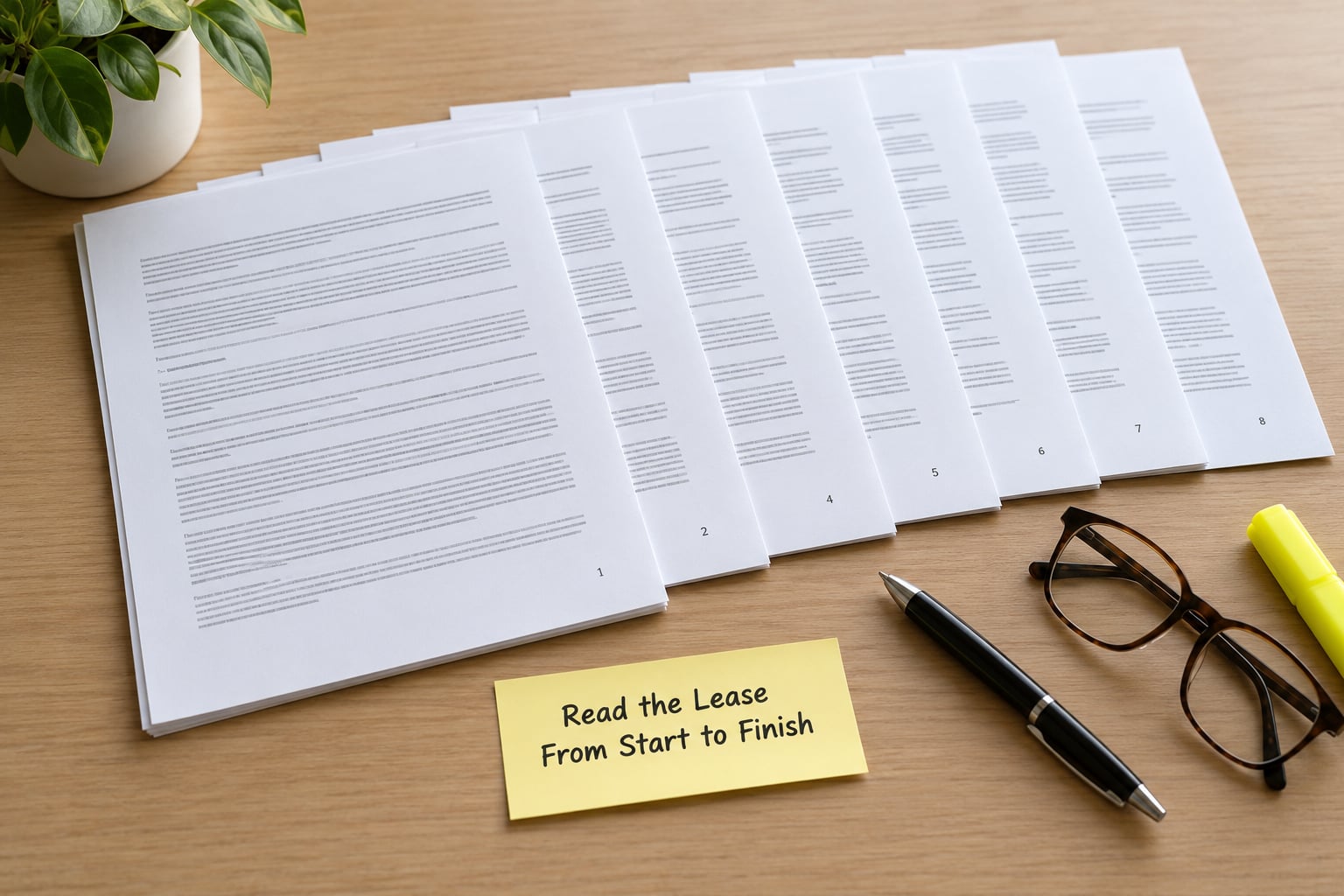
Read it once without stopping to judge anything, then read it again with a pen. Section by section, you are looking for the term and dates, the rent figure, the deposit, every fee, utilities, maintenance duties, the right of entry, renewal and termination language, and how disputes are handled.
Three terms come up constantly and are worth defining once. The lessor is the landlord; the lessee is you. A fixed-term lease runs for a set period and ends on a date certain. A month-to-month lease rolls forward until either side gives notice, usually 30 days in writing. An addendum or rider is a separate attachment that amends the main lease, and riders are where the parking, pet, and storage rules hide.
Do not rely on a verbal promise, and do not accept a partial document. If a leasing office hands you the lease at the appointment with a deadline attached, ask politely for the same file as a PDF so you can read it at home. Most will send it; the ones that refuse are the ones to walk away from.
2. Verify the Rent, Deposit, and Every Fee
Compare the advertised rent against the number in the lease, character by character. Then list every cost that is not base rent, because the headline number is rarely what leaves your account each month.
- Application and screening fees, and whether they are refundable if you are declined for a reason the landlord caused.
- Security deposit and any separate pet deposit, which is often smaller and often not fully refundable.
- First month’s rent, plus prorated rent if your move-in date lands mid-month.
- Parking, storage, and amenity fees, including whether they are per month, per space, or billed separately.
- Trash and recycling charges, which usually land on your utility bill rather than the lease.
- Mandatory renters insurance, and whether the landlord offers a plan at a cost to you.
- Late fees and payment method charges. Wire transfer and money transfer fees have quietly changed the real cost for plenty of renters, which is why autopay or a check is worth asking for.
A common budgeting guideline is that housing costs, including rent, utilities, and fees, should sit near 30 percent of gross household income. That is a planning rule, not a law, and it is the number that tells you whether this lease is affordable once the fees are counted.
Ask for an itemized payment schedule in writing, and get the refundable amounts and the deadline for their return stated in the lease. A landlord who cannot produce one has not thought about the money side, and you will not enjoy the conversation later.
3. Check the Dates, Term, and Renewal Rules
Dates are where quiet traps live. Write down the lease start date, the end date, the rent due date, and any grace period, then find the renewal deadline and put it in your calendar with a two-week warning.
Ask what happens if you do nothing. Many fixed-term leases convert to a month-to-month tenancy, or renew for another term, unless a tenant gives notice by a date stated somewhere on page fourteen. If you miss that window, you can find yourself committed to another full term at a higher rent.
Also check whether the landlord may raise rent during the term, and by what procedure and cap. Some clauses allow increases at renewal only. Others allow them at any point, and some permit the landlord to change house rules unilaterally mid-term. If the language allows changes without your agreement, ask for a cap in writing before you sign.
4. Inspect the Apartment and Document Its Condition
Paper review is only half the job. Walk the unit yourself, and if you are signing remotely ask for a live video walkthrough before you commit, with your phone on the other end asking questions. Renters on renter forums describe being pushed to sign before unit selection during college housing cycles and remote relocations, and the advice there is consistent: do not sign for a unit you have not seen.
Run the room rather than scanning it. Every door and window should open, close, and lock. Check that the deadbolt and the chain work, that the peephole is there, that the blinds raise and lower. Run the taps and look for water under the sink. Flush the toilets. Turn on every outlet and light. Start the heating and the cooling and give each a few minutes. Look at the ceilings in corners and around windows for water stains, and open the cabinets under sinks for damp or pests. Confirm that smoke and carbon monoxide detectors are present and working. Smell the apartment, because a musty note in a bedroom often means something behind the drywall.
Photograph everything while you are there and let your phone keep the dates. Then write a move-in condition report with one line per item and an area marked on a simple sketch. Send that list and the photos to the landlord in writing on the day you move in, and keep the sent message. When the deposit comes back, that documentation is the only leverage you have over pre-existing damage, and commenters who have been through a move-out dispute almost all say the same thing: photos taken on day one are worth more than any argument after.
Check that the unit in the lease matches the reality, down to the unit number, the address, and the number of bedrooms and bathrooms. A mismatch is not a small thing. If the lease describes a different unit than the one you were shown, you have a genuine problem to resolve before any money changes hands.
5. Clarify Utilities, Services, and Access
Utilities are the most common source of surprise on the first bill. Read the list and mark each item as tenant-paid or landlord-paid. Electricity, gas, water, sewer, trash, and internet are all commonly tenant-paid even when the lease does not spell it out clearly, while heating and hot water are included in some regions and not others.
Ask how each one is metered, who opens the account, and what happens to the bill if nobody opens it. An account that is never transferred in your name leaves the previous tenant or the landlord liable, and that surfaces as a shutoff or a collections letter later.
Also find the right of entry clause: how much notice the landlord must give before entering, and whether that notice can be waived. State law usually sets a floor, commonly 24 hours for non-emergency entry and no notice at all for a true emergency like a gas leak or a burst pipe. Then ask how repairs get requested, through which channel, and what the expected response time is. A building where the only path to a repair is an unanswered voicemail is a building you will be chasing.
6. Understand Repairs, Pets, and Changes
The maintenance section decides who pays when something breaks. Look for what the landlord is responsible for keeping in working order, what counts as an emergency repair you must handle immediately, and what happens if the landlord does not respond within a stated period. Habitability rules set a minimum standard that a lease cannot talk its way below.
Check the permission list for anything you plan to do: painting, hanging pictures, installing shelves, changing locks, washing the windows, keeping a satellite dish. Nail holes and paint are the usual sources of deposit deductions, and most leases treat them as damage rather than normal wear and tear. Getting permission in writing before you hang a frame costs one email.
Read the rules on pets, guests, smoking, and vehicles with the same care. Note the pet deposit, the monthly pet fee, any weight or breed restriction, and whether there is a number limit. Note how many guests you may have and for how long, whether anyone may sleep there overnight, and where parking is assigned. Roommates should also confirm which furniture and appliances belong to the landlord, since damage to a washer that was not yours is still charged to you.
7. Compare the Final Terms Before Signing
Read the version you are about to sign against the version you reviewed. Look for changed pages, initials in the margin, blanks left unfilled, and addenda that appeared late. Never sign a page with blank spaces in it, and never initial a page you did not read.
Before signing, send the questions you could not resolve as a short written list and get the answers back in writing, attached to the lease as an addendum. That single habit prevents most of the disputes renters describe in the last month of a tenancy. Then sign, pay through a method with a record, request the fully signed copy including every addendum, and save it somewhere you will actually find it in eleven months.
Common Mistakes
These are the errors that cost renters the most, and each one has a straightforward fix.
1. Signing Without Reading Every Addendum
Parking, pet, storage, appliance, amenity, and electronic-use rules often live in attachments rather than the lease body, and they are signed as part of the same contract. The mistake is assuming they are house rules you can ignore later. Ask for every attachment as one file, and when you sign, record which version you signed and keep it with your copy.
2. Treating a Security Deposit as the Last Month’s Rent
A deposit is not prepaid rent. They are separate, and in many places the deposit may only be used for unpaid rent and damage beyond normal wear, which means you still owe the final month at move-out. Get the amount, the permitted uses, the inspection process, and the deadline for itemized deductions and return written into the lease before you hand over the money.
3. Assuming a Verbal Promise Changes the Lease
A concession about rent, an included utility, a repair, or pet approval that was said in a tour does not bind anybody if it is not in the document. What to check before signing a lease always comes down to paper: concessions belong in the lease or in a signed addendum, and the version that arrives in your inbox afterward is the one that counts.
4. Failing to Test the Apartment Before Moving In
Twenty minutes of testing beats a month of arguing about whether the dishwasher worked when you arrived. Walk the unit, run the appliances, check the locks, photograph everything, and submit a dated condition report the same day. Without it, pre-existing damage tends to become your deduction.
5. Missing Deadlines and Renewal Triggers
Miss the notice window and a month-to-month tenancy can roll into another full term at a higher rent, which is how a one-year decision quietly becomes a two-year one. Enter the renewal deadline, the rent increase date, and any move-out notice period into your calendar the day you sign, with reminders set two weeks ahead, and reread the relevant clause before each one.
6. Not Keeping a Complete Copy
The signed lease, all addenda, payment receipts, the condition report with photos, and every email with the landlord belong in one folder, kept both in your email account and on your phone. When a question comes up in month nine, the person with the document is the person who gets an answer.
Frequently Asked Questions
Should I sign a lease before seeing the apartment?
Ask for a live video walkthrough before you sign, and get the unit number, bedroom and bathroom count in writing. Signing for a unit you have never seen is the scenario renters most often regret, because the condition report you file after move-in is the only evidence you get. If the landlord refuses a walkthrough and the lease describes a different unit than the one shown, that is a reasonable reason to walk away. Local law varies on disclosure duties, so check what your state requires.
When signing a lease, who signs first?
In most residential signings the tenant signs first, because the landlord does not want to lose the unit while waiting on paperwork. Read and sign your own copy before anyone else does, and make sure you receive a fully executed copy with every addendum afterward. Everyone who will live in the unit should be on the lease, not listed as an occupant only, or they have no rights and you carry full liability for their damage and unpaid rent.
Can I get a copy of the lease to read before I sign?
Yes, and you should. Ask for the lease as a file you can take home, ideally before you pay an application fee or a deposit, and give yourself at least a day. A reasonable landlord expects the review. If a leasing office insists the document is only available at the appointment, on a deadline, that pressure is itself information about how the rest of the relationship will go.
What makes a lease unenforceable?
Common reasons include terms so one-sided that a court treats them as unconscionable, provisions a state statute forbids outright, missing required disclosures, and oral agreements lasting longer than a year, which generally must be in writing to be enforced. Clauses that shift a legal duty onto the tenant, waive a right the tenant cannot waive, or allow unlimited unilateral rent increases are the ones worth challenging. Whether a specific clause fails depends on your state, so get local advice before you sign.
What are the red flags to watch for before signing a lease?
Watch for these: money requested before a lease exists, especially by wire or money transfer; refusal to give you a copy before signing; blank spaces or pages that appear at the last minute; unilateral rent increases during the term; an as-is clause that weakens your deposit claim; liability for a roommate with no way off the lease; and no written maintenance or entry terms at all. Two more that get missed: late fees and wire charges that quietly raise your real monthly cost, and renewal language that commits you to another term if you miss a notice deadline.
How much can a landlord require as a security deposit?
It depends entirely on your state, and the caps vary widely, with some states setting a ceiling and others setting none at all. What to check before signing a lease is that the amount is stated, that the permitted uses are defined, and that the return deadline with an itemized statement of deductions appears in the document. Ask your state attorney general’s office or a legal aid society for the current rule rather than relying on a general web page.
Conclusion
Three actions cover most of what to check before signing a lease. Get the complete lease with every addendum and read it away from the leasing office. Write down your true monthly cost, the deposit terms, and the renewal and termination dates so you can see the whole commitment in one place. Then inspect the unit and send a dated condition report with photos on move-in day.
When a clause is unclear, the answer is the same every time: ask for it in writing before you sign, and ask for an itemized schedule rather than a reassurance. And if the terms still do not make sense to you, a local tenant rights organization, legal aid society, or your state attorney general’s housing unit can review the document for free, usually faster than you expect. Rules changed and vary by place, so this general guide is a starting point rather than the last word, and it should be read alongside local law.