
The honest answer is that you teach kids about money by handing them small amounts of real money, letting them make real choices with it, and talking through the trade-offs afterward. Start around age five with coins and a jar. Add allowance and a simple split between saving and spending by age eight. Budgeting, borrowing and investing can wait until the stakes are big enough to feel like something.
Most parents want this guide because they were never taught it themselves. Nobody sat them down with a plan. So here is one that takes about ten minutes a week, needs no app, and does not require you to know anything complicated about banking.
One thing to decide before you start: your child will make mistakes with money, and that is the point. The goal is not a child who never overspends. It is a child who notices, adjusts and tries again without a parent standing over them.
Table of Contents
- What You Need
- Step-by-Step: How to Teach Kids About Money
- How to teach kids about money with wants, needs, and choices
- Use real money in everyday situations
- Help kids set savings goals they can actually finish
- Practice budgeting with flexible limits
- Discuss money without shame or pressure
- Common mistakes
- Frequently Asked Questions
- At what age should I start teaching my kids about money?
- How much allowance should I give my child?
- What do I do when my kid blows all their savings?
- Should I tell my kids how much I make?
- How do I get a teenager to talk about money?
- How do I explain compound interest to a kid?
- Conclusion
What You Need
Nothing here requires special equipment. Most of it is already in a kitchen drawer.
- Real coins and small bills. Actual money teaches counting and value in a way play money cannot. Keep a small supply separate from the household till.
- Three jars or three envelopes. Label one save, one spend, one share. Clear containers matter more than fancy ones, because the child has to see the money sitting there.
- A notebook or a printed savings tracker. One page per goal, with the target amount written at the top and dates down the side.
- Receipts and a weekly shop circular. The circular is where price comparison happens without anyone feeling assessed.
- A chart for earning. Paper on the fridge is enough. It holds the chores, the amounts, and the dates they were paid.
- Ten minutes. Genuinely. Longer sessions turn into a lecture, and a lecture teaches nothing.
Leave out anything that requires an adult account, a minimum balance or a decision you would need to research. A child under ten learns more from ten dollars in a jar than from a bank product you had to open for them.
Step-by-Step: How to Teach Kids About Money
How to teach kids about money with wants, needs, and choices
Sit at the table with a notebook and write down everything the family bought that week. Then draw two columns and sort it together. Food, a winter coat and a working car go in one. A video game, a second pair of trainers and the snack you did not need go in the other.
Keep the tone flat while you do it. The moment you imply that a want is a character flaw, you lose the conversation and probably the next one too.
Then go one layer deeper, because needs and wants is only the entry point. Ask what else could buy that same job for less. A jacket from a secondhand shop does the same job. A cheaper snack does the same job. Now ask what they gave up by choosing the other option, which is the real lesson: every choice costs something, and the something is not always money.
Children pick this up faster than you expect when it stays attached to their own day. Ask what they would keep and what they would drop if the family budget suddenly had to shrink by ten percent. Let them answer before you do.
You know it is working when the sentence changes. Instead of “get it,” you hear “we could wait and get the other one.” That pause is the whole exercise.
Use real money in everyday situations
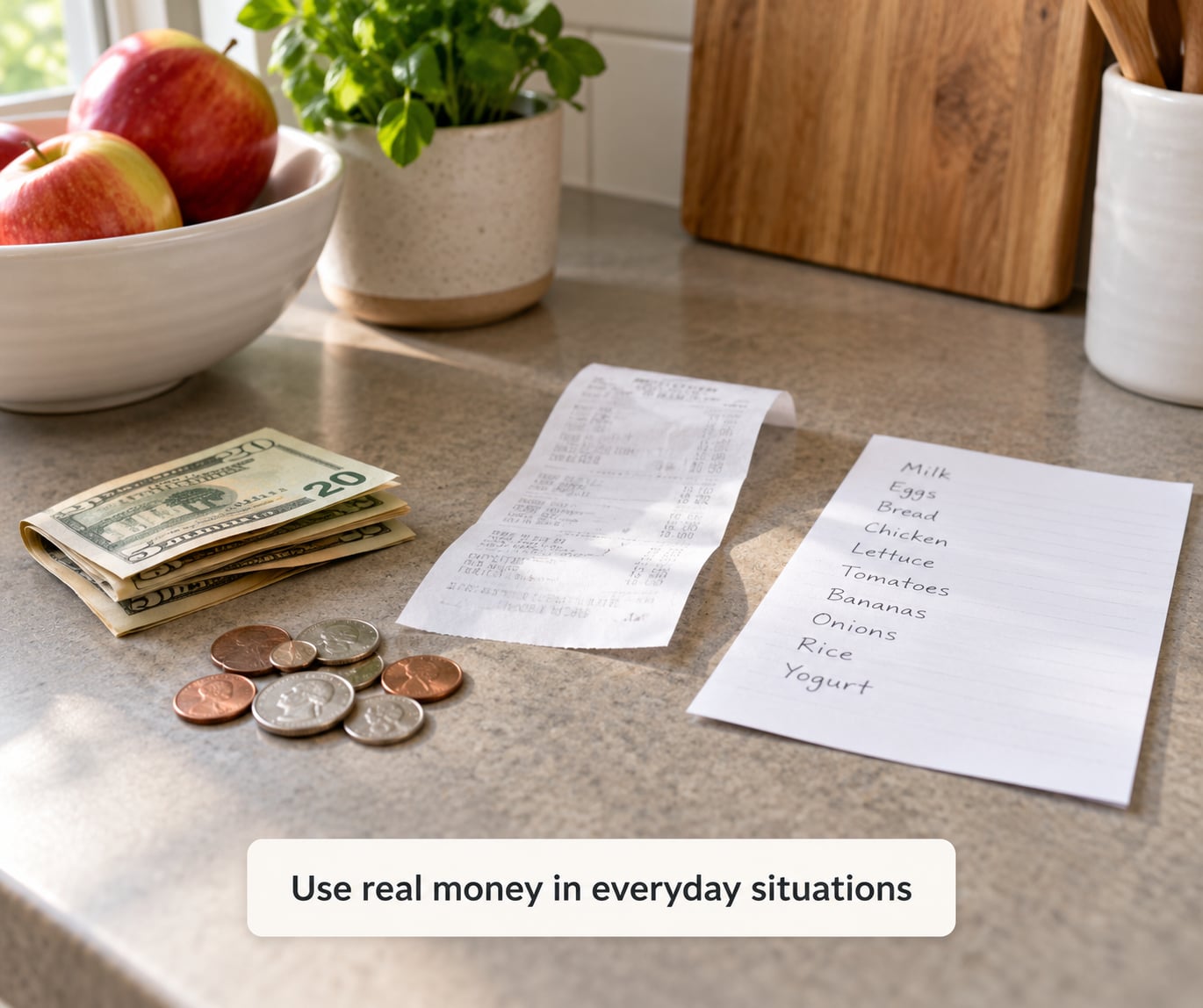
The shop is the best classroom you will ever get, and it costs nothing extra. Hand a child one or two items to pay for and give them a bill larger than the total. Let them take it to the till, count out the coins, and receive the change themselves.
The waiting is the valuable part. Twenty seconds at a till feels like an age to an eight-year-old. Use it: ask what they could buy with the change if they saved it for a week, or what it would cost to split with their sister.
Do the same at home. When you unpack the shopping, hand a child a fixed portion of the money and let them put it away. The next time they ask for something at the shop, they already know that the money came from somewhere.
Coins get their own lesson. Keep a jar at home and let a young child count it on Sundays, adding the new coins each week. Coin counting is slow, unglamorous and genuinely useful, because it is the first place arithmetic becomes personal.
Allowance works best in cash at first, paid on the same day every week. A consistent day matters more to a child than the amount. When they collect it themselves, the money has a person attached to it, and that changes how carefully they spend it.
Help kids set savings goals they can actually finish
A goal only works if the child chose it. Pick something they want badly, find the price together, and write it at the top of the page. Then ask them how much they get each week and how many weeks that takes. Do not correct their arithmetic if it is optimistic. Let the first week prove them wrong.
Break a distant goal into smaller ones. Forty dollars for a game console becomes four ten-dollar steps, and each completed step gets a tick. Framed that way, waiting is not denial. It is a series of finished problems.
Many parents run a family bank, which is simply an informal savings account kept by the adults. Deposits earn a flat rate and the child can withdraw later. Rates parents describe on forums like dadssupportingdads.org and r/UKPersonalFinance sit far above anything a real bank pays, and they are only useful because the number is visible in the ledger. Make clear that this is a family rate, not what money earns in the market, and that nothing is guaranteed beyond what you personally agree to pay.
Keep a simple statement on the fridge. The balance going up, in ink, once a week, does more than any conversation about the future.
Reward the waiting rather than the purchase. If your child saved for four weeks for a twenty dollar item, celebrate the four weeks. Buy the item too. You are marking the habit, not building resentment.
Practice budgeting with flexible limits
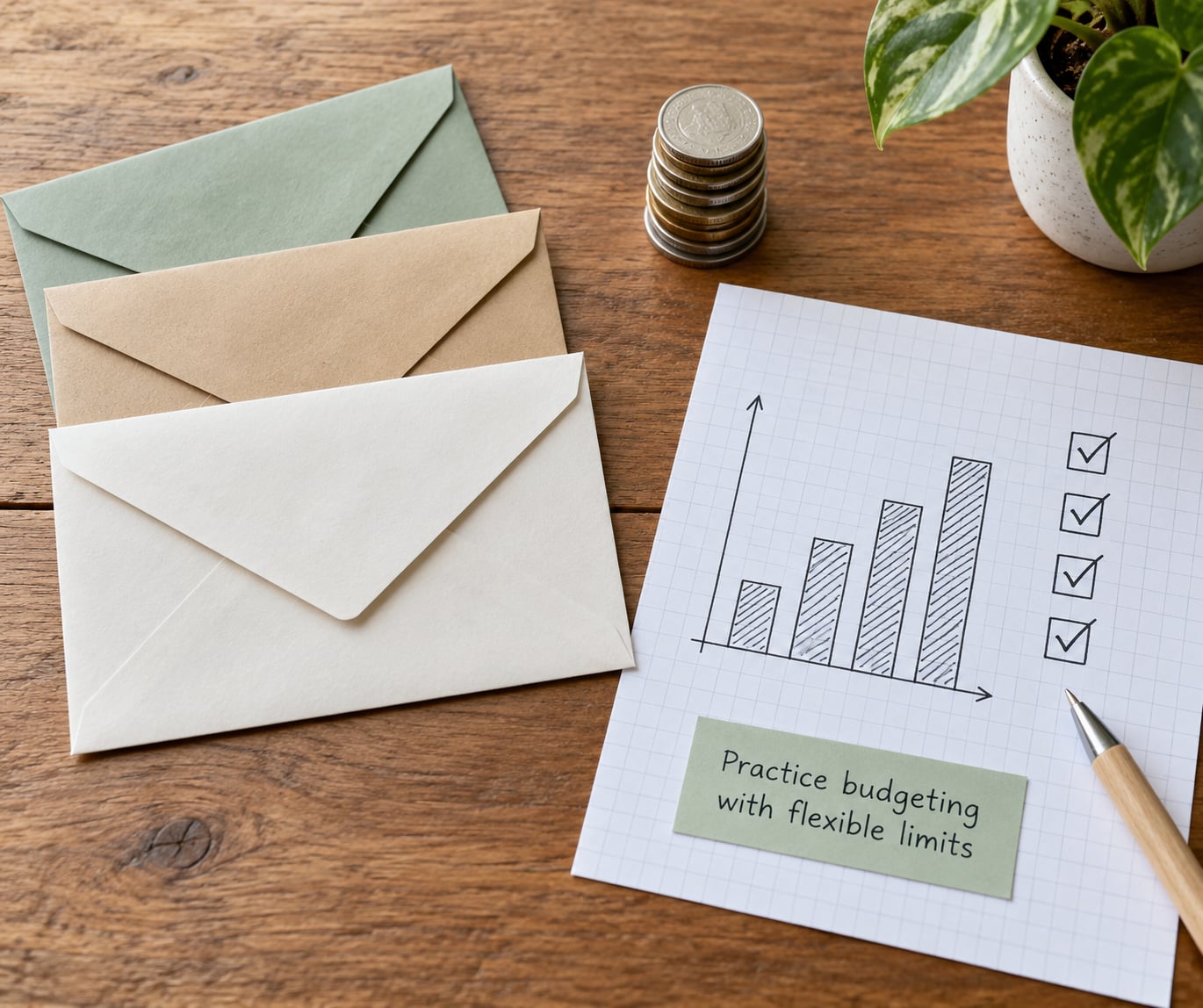
Give your child a small amount and let them divide it themselves. Twenty dollars from an allowance, allowance plus a birthday cheque, or the leftover from a garage sale all work. The point is that they decide the split, and you stay quiet while they do it.
Three parts works better than percentages with a nine-year-old. Save some, spend some, share some. Ask what they chose, then ask what they would change if the spend part ran out on day four. That question teaches adjustment faster than any worksheet.
Envelopes beat apps at this age. When the spend envelope is empty, the decision is finished. There is nothing to check, no balance to refresh, no app telling a child what is possible. That emptiness is the feedback.
Practice buying without real consequences. Give them a catalog page and twenty pretend dollars and let them build a wish list. Then add shipping, or the cost of batteries, or the matching item that only exists as a set. Prices stop looking like stickers once the extras arrive.
Borrowing is the last piece and the most useful. When they want something they cannot afford, ask which they would rather do: wait, borrow from you and repay it, or borrow from a stranger and pay interest. Most children pick waiting once they hear the interest option out loud.
Discuss money without shame or pressure
Have the real conversations in the car. It is one of the few places a child cannot walk away, and the side of the road slows everybody down.
Tell them about your own mistakes first. Overdraft fees you forgot about, a subscription you cancelled too late, an impulse purchase you could not afford. Admitting a mistake makes the next question safe for them to ask.
Answer direct questions with ranges rather than line items. Most children can handle hearing that some bills are the same every month, some change, and that some months are tighter than others. Exact numbers rarely help and often create pressure to perform well rather than to think.
Never compare siblings, and never compare your child to a friend. Both teach that money is a score, which is the opposite of the lesson.
Tell other adults the rules before the visit. Grandparents who arrive with a present the night after you said no will quietly undo months of work, and the child is not the one who caused the problem. Agree in advance on an amount, or ask that gifts come as experiences instead.
Keep affection separate from spending. A kid who learns that being liked depends on what they buy will spend to be liked, and no budget fixes that.
Common mistakes
Most parents who give up on this did one of the following things first.
Using money as punishment. Taking back allowance to enforce good behaviour teaches that money follows obedience, and that is a lesson with consequences far past childhood. Handle discipline separately, every time.
Teaching percentages to a seven-year-old. Saving ten percent of twenty dollars means two dollars, and a child can hold two dollars. Once the fraction stops being a physical thing, it stops making sense.
Expecting adult decisions from a young child. An eight-year-old should not be choosing between two health plans. Match the stakes to the age and let the big calls stay with you until they can hold the whole picture.
Spending every lesson on saving. Saving is half of it. A child who only ever hears about saving learns to hoard and to feel guilty. They also need practice choosing between two things they want with money they actually have.
Rescuing every mistake. A broken toy, a wasted jar, a subscription forgotten for four months. Let it stand, then review it a week later when nobody is upset. Rescue only what actually repeats.
Skipping allowance because it is awkward to say no. Parents often avoid starting because they fear the arguing. The arguing happens twice, then it becomes routine. A smaller amount you can sustain beats a generous one you withdraw.
Lecturing instead of demonstrating. Parents ask children to behave financially while the household budget stays a private mystery. Say out loud what you chose not to buy this month and why. That single sentence teaches more than any conversation about needs and wants.
Frequently Asked Questions
At what age should I start teaching my kids about money?
Most parents get good results starting around age five, when a child can count to twenty and understands that different things cost different amounts. Earlier than that, keep it to coins in a jar and naming prices out loud in the shop. Starting later is not a failure, but every quiet year is another year your child spends without thinking.
How much allowance should I give my child?
Enough that they can make a mistake and still buy something small, and no more than your family can sustain. A five-year-old usually needs far less than parents give. A teenager who funds their own spending learns quickly. Raise the amount when responsibilities rise rather than on birthdays alone, and keep the payment day consistent.
What do I do when my kid blows all their savings?
Let it happen, then review it when nobody is upset. Ask what they expected, what they actually wanted, and what they would change next time. Rescue only what repeats. If the shortfall means missing something essential like school supplies, cover that quietly and leave the savings lesson intact instead of quietly refilling the jar.
Should I tell my kids how much I make?
In ranges rather than exact figures. Most children can handle knowing that some bills are fixed, some vary, and that some months are tighter than others. Precise numbers rarely teach anything and often add pressure to perform. Tell them what you earn only if you would be comfortable hearing them repeat it at fifteen.
How do I get a teenager to talk about money?
Stop teaching and start consulting. Ask for their read on a decision you actually have to make, like where to eat, whether to repair or replace something, or what to do with a bonus. Teenagers engage with money when it touches something they care about. Talking through their own plans lands better than another lecture about yours.
How do I explain compound interest to a kid?
Start with two jars and a rule. Put two coins in one jar and one in the other, and agree that whatever the first jar holds, the second doubles. A month of that is visible proof. Then say plainly that banks pay a small rate on savings and much less on borrowing, which is why keeping money in the first jar usually wins over time.
Conclusion
Do one thing this week: write down everything your family spent last week and sort it into two columns with your child. Ten dollars in their hand and ten minutes at the table will carry further than any year of advice from you about the future.